Serious question: with how much instability there is with this company, why would anyone want to work there? Are they the best in their business and just have hit a rough spot? Why is Flexport so commonly discussed here?
Because they're a YC start-up https://www.ycombinator.com/companies/flexport
and their founder CEO is well-connected like other tech start-up CEOs https://www.latimes.com/business/technology/story/2021-10-28...
[0] https://web.archive.org/web/20220807165943/https://www.twill...
Because they can’t get offers elsewhere?
Regardless of reason why someone wants to work at an org, it's likely they can find gainful employment elsewhere.
I'm positive this is what happened and you can't make me believe anything else.
https://www.flexport.com/blog/flexport-co-ceos-note-to-emplo...
Layoffs suck, they drain the moral when things are already hard and negative feeling. This is why it's critical to celebrate wins as often as being transparent about disappointing news.
The leasing or contracts on the air freight must be a bit of a problem if shopify has trimmed their business to flexport. Probably needs to free up cashflow to cover the expenses.
Wonder how the % of business shopify was for flexport.
There’s no standardized data format that can be handed off at each step without human involvement. It would be optimal to have an algorithm handle the ocean freight, import clearance, and booking the warehouse and trucker to handle it from there.
Maersk took a shot at a standardized data system and called it quits due to limited support. But Maersk does have a platform offering realtime rates on container bookings on their own vessels, import clearance, and trucking through their platform. I believe other carriers like MSC and ONE-Line are following this approach to get their customers on board.
What’s promising is that if one major carrier does succeed with a standardized data process, they can more easily integrate it within the ocean carrier alliance that they are part of. The 3 major ocean carrier alliances control 83% of global capacity. This seems like a more straightforward way to take a stab at setting a standard for millions of containers moving worldwide. Large companies would plug in and to manage their supply chains using their logistics suite, and smaller companies would simply use the ocean carriers dashboards.
For now it appears that it’s still cheaper to hire from the worldwide supply of low paid logistics workers than it is to get everyone on a unified system.
There are systems that link all those parties together, available as SaaS of the shelf, and used by giants like DHL.
What people don't see, tech only gets you that far in logistics until information disparity and people-business problems hit you.
And yet the employees get a barebones 9 week severance.
Lame.
If the money is all borrowed and meant to keep the company running, why would employees get more than is a reasonable severance package? And by the way, 9 weeks of severance on pretty good tech job salaries is far more than many are lucky enough to get, lest you live in too much of a bubble to realize.
It's drastically shorter than their cohort of tech companies, which is the comparison they sell themselves as.
Between that and the rescinded offers, if they do ever make it out of this trough, they'll have a hard reputation to shake and have to pay up with signing bonuses.
Just because that isn’t common practice doesn’t mean I don’t think something like 9 weeks isn’t unacceptably short.
It’s nearly impossible to get another job and receive your first paycheck within 9 weeks.
I think it’s just that little bit extra pathetic when it’s a large and successful company with revenue in the billions that can’t even find the money to round up severance to an even number of weeks.
And I am struggling to think of how applying the WARN Act to all layoff situations wouldn’t be a net benefit to most employees.
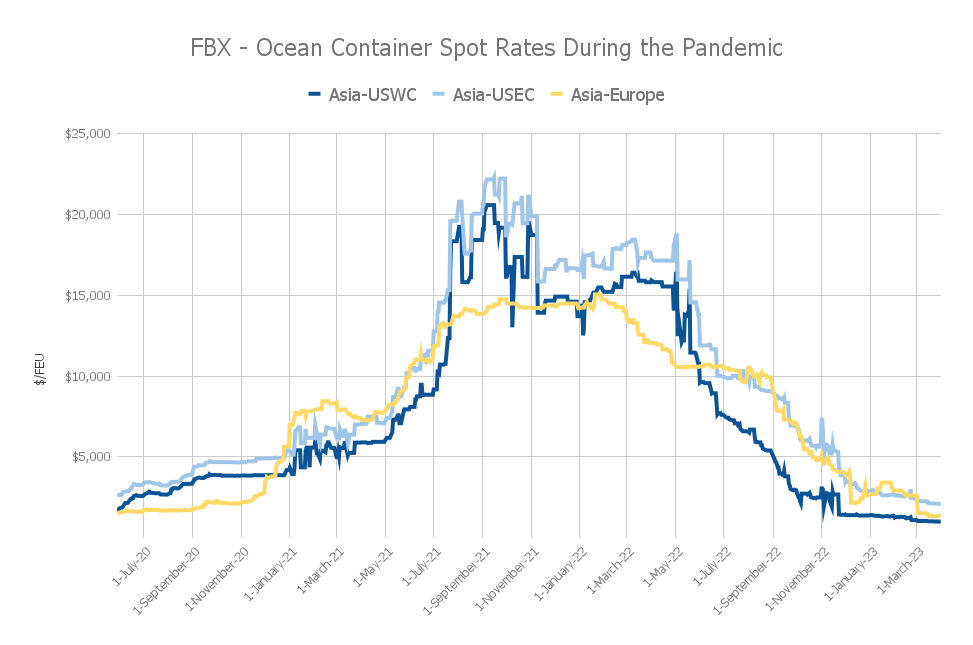
Internet rando analysis: Flexport most likely surfed the COVID wave of shipping, but the new macro makes the go forward much more challenging with aggregate demand declining (you can see this in both marine and over the road shipping volume declining). Boom time->war time transition as an org, hit by both rapidly rising interest rates (cost of capital, equity valuations) at the same time as volume declines precipitously.
https://www.flexport.com/research/post-covid/
https://www.flexport.com/research/after-the-boom-evolving-e-...
https://www.flexport.com/blog/how-long-will-covid-impact-las...
https://www.freightos.com/wp-content/uploads/2023/05/FBX-Oce...
https://www.cnbc.com/2023/04/24/economy-is-in-a-freight-rece...
https://www.ccjdigital.com/economic-trends/article/15543395/...
https://talkbusiness.net/2023/02/u-s-freight-volumes-fall-to...
https://hn.algolia.com/?dateRange=all&page=0&prefix=false&qu...
It seems a lot of these actions followed that failure.
Friday the 13th.
And somehow that ended up with the nice round number of 20%.