For me one of the most compelling data points wasn't even a parenting reference. It was https://www.amazon.com/Millionaire-Next-Door-Surprising-Amer.... First published in the mid-1990s, the chapters on the children of millionaires found that the more support millionaires gave to their children, the worse that those children turned out. Armed with that theory, I've always doubted the wisdom of extreme helicopter parenting that has become popular since.
Poor black and brown women are disproportionately targeted by child welfare authorities starting literally from birth. https://www.ncbi.nlm.nih.gov/pmc/articles/PMC7372952/ This makes it particularly important that we actually change the laws around what constitutes neglect or endangerment, not just create a culture shift.
However, I have a lot of friends with children and some of their takes are completely irrational to me.
“Let the kids WALK three blocks to school? Not anymore, things aren’t like what we grew up with. It’s scary out there!”
Exactly. Violent crime, etc has been on a general and significant downward trend since we were kids (80s and 90s). It’s not what we grew up with - it’s significantly safer. The media drives a tremendous amount of anxiety and it’s extremely detrimental to parents, kids, and society overall.
It used to be “sex sells” (still does) but more and more it’s “fear sells”.
I wonder if what is defined as "support" is actually, meddling, undermining, and pressurzing children into fulfilling the parents needs.
Support was defined by the wealthy parent providing financial support, whether through a stipend, gifts, or whatever. It turned out that, despite the best of intentions, such support almost inevitably wound up with destructive emotional dynamics.
In other words, even taking kids to school in a car instead them walking (or at least on the bike, but their own feet still involved, therefore they are themselves 100% in control in going to school) is the support that is not the in the list of "support" but will be in the long run. I should mention, I do recognize the time constraints of current society.
You can get the book for $2.74:
https://www.amazon.com/Millionaire-Next-Door-Surprising-Amer...
Unless there is some other reason you don't want to buy it?
hope someone finds the happy medium of allowing growth without unnecessary stress
https://d2eehagpk5cl65.cloudfront.net/img/q60/uploads/assets...
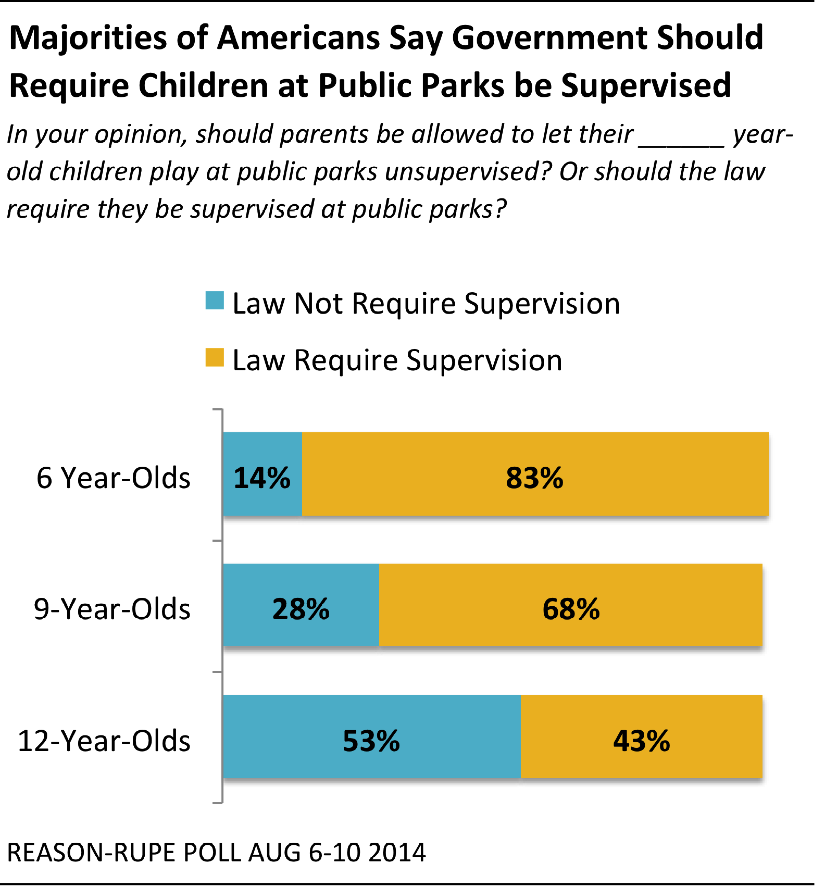
According to this poll from 2014, 43% Americans think that the government should require 12-year-olds to play at public parks under supervision.
You could create the most walkable neighbourhood in the world and not achieve much in this regard.
If the child’s playground is right next to a block of houses and shops with people walking around all day, it is much less likely that the child is taken away. Whether it’s actually safer, I’m not entirely sure, but it definitely feels safer to have your kid playing near a busy pedestrian area, compared to an abandoned playground down a quiet road at 4pm. And the feeling is what matters regardless.
And that is a big part, but also just the feeling of trusting your neighbors increases when you live in a walkable place and see your neighbors all the time. [0] That source isn’t maybe the most thorough, but it echoes my experience of moving to a quiet but walkable neighborhood in the Netherlands from the US. People really do trust their neighbors much more here, and I’ve changed in that regard too. Everyone is always offering to help each other out.
As always, giving into hysteria only leads to more hysteria.
The massive expansion of the rights of angry Karens to summon State guns on command that occurred somewhere in the 1980s is why the current homebuying generation doesn't care about "walkability" in the first place: the generations that grew up under those conditions have simply adapted with mansion-sized homes because if you don't have a private version of what used to be a third space free from Karen's prying eyes, you don't get a space at all.
It shouldn't be lost on anyone that the people who most want walkable neighborhoods "for the children" are also the people who are going to destroy those benefits once they see the results of the other things they vote for on the street outside "for the children's safety". So no, I see no reason to build things the way they want and agree that tendency towards isolation is mainly because by and large we remain rich enough to avoid addressing the elephant in the room.
The way parents interpreted the poll is not "Given a hypothetical park somewhere in the world, should..."
But rather "Given the current state of parks in America, should..."
The parents are most likely right, it currently probably is unsafe for kids to be alone in public parks.
But that is not because american parents hold dogmatic beliefs about kid independence, they're just making a judgement call based on how unsafe parks currently are.
eg. car oriented neighbourhoods mean kids don't get to play as much, and that's a factor which is independent of economic/social status.
But also other socio-economic factors can lead to similar outcomes (eg. underfunded schools, longer work hours for parents, and the like).
I spent hours and hours playing on my driveway and in my yard with minimal supervision.
I think the idea here is that children need to have the opportunity to explore the wider world independently, not just a 50 metre circle around their home.
As a 8 or 9-year-old, could you go to a friends house, to the store, or to school without parental supervision?
Did you have safe bike lanes to do this? Was there safe public transportation? Sidewalks on busier streets? Safe crosswalks where the cars are supposed to stop by law - and are those laws enforced heavily to keep you safe? Could you play independently outside of your yard?
Now in my home town there are zero kids on the street. Culture has shifted drastically.
Most places I've seen, yes in the US, have bike paths, and houses are typically in a separate area from main thoroughfares. Why wouldn't a kid bike to a friend's house, or a local park?
We played in the forest, created tree homes, tunnels and much more. It was an incredible time which I'm certain helped me a lot in my development.
Granted, I was growing up on a farm in Germany. There wasn't much traffic or other "dangers".
When I was a kid, we were told to go outside and play until the street lights came on.
Where have I heard that before..
https://www.scientificamerican.com/article/harsh-nazi-parent...
> In "The German Mother and Her First Child", Haarer wrote, “It is best if the child is in his own room, where he can be left alone.” If the child starts to cry, it is best to ignore him: “Whatever you do, do not pick the child up from his bed, carry him around, cradle him, stroke him, hold him on your lap, or even nurse him.”
[0] https://jonathanhaidt.substack.com/p/the-play-deficit [1] https://news.ycombinator.com/item?id=36910256
I miss that heirarchy more than I'd care to admit. The endless cycles of milking the good while it's good, is an offensive and time wasting replacement for what used to be a well-timed culture.
It is deeply humorous to see fear of traffic and crime listed as a valid reason to keep kids inside. When you list fear of data leaks as a valid reason for privacy from surveillance, people discount you. So much emotional picking and choosing lately.
Parentalism is destroying the West, make no mistake, "security" is a massively overrated parasite, sucking the life out of it's inhabitants. Get off my back.
Structured play has predefined rules; for example, playing Monopoly, role-playing, or cooking with an adult's help.
Although you had to follow rules in a school setting, it wouldn't necessarily make your play structured, since you always have to follow those rules anyway; it's not like playing Monopoly, where the playing itself is governed by additional rules, and everyone takes turns, and follows a set structure.
This should barely pass as a "kids these days" like-and-share from your grandpa on Facebook that has a bunch of comments from Cheryl about how true it is. Which is tragic, because it's something anyone who spends time with children can figure out... that independence makes for a happy child. But to be published in a journal I thought the point was to find rigorous evidence for such things, not muddy the waters further with vague specious claims.
I feel that if you've never heard of a meta-study then you must not be very deep into science at all - like, even undergraduates know what a meta-study is.
Just read a bunch of papers, summarize them, and write a new paper. Scientific research had devolved to the point, that no one knew how to do new research.