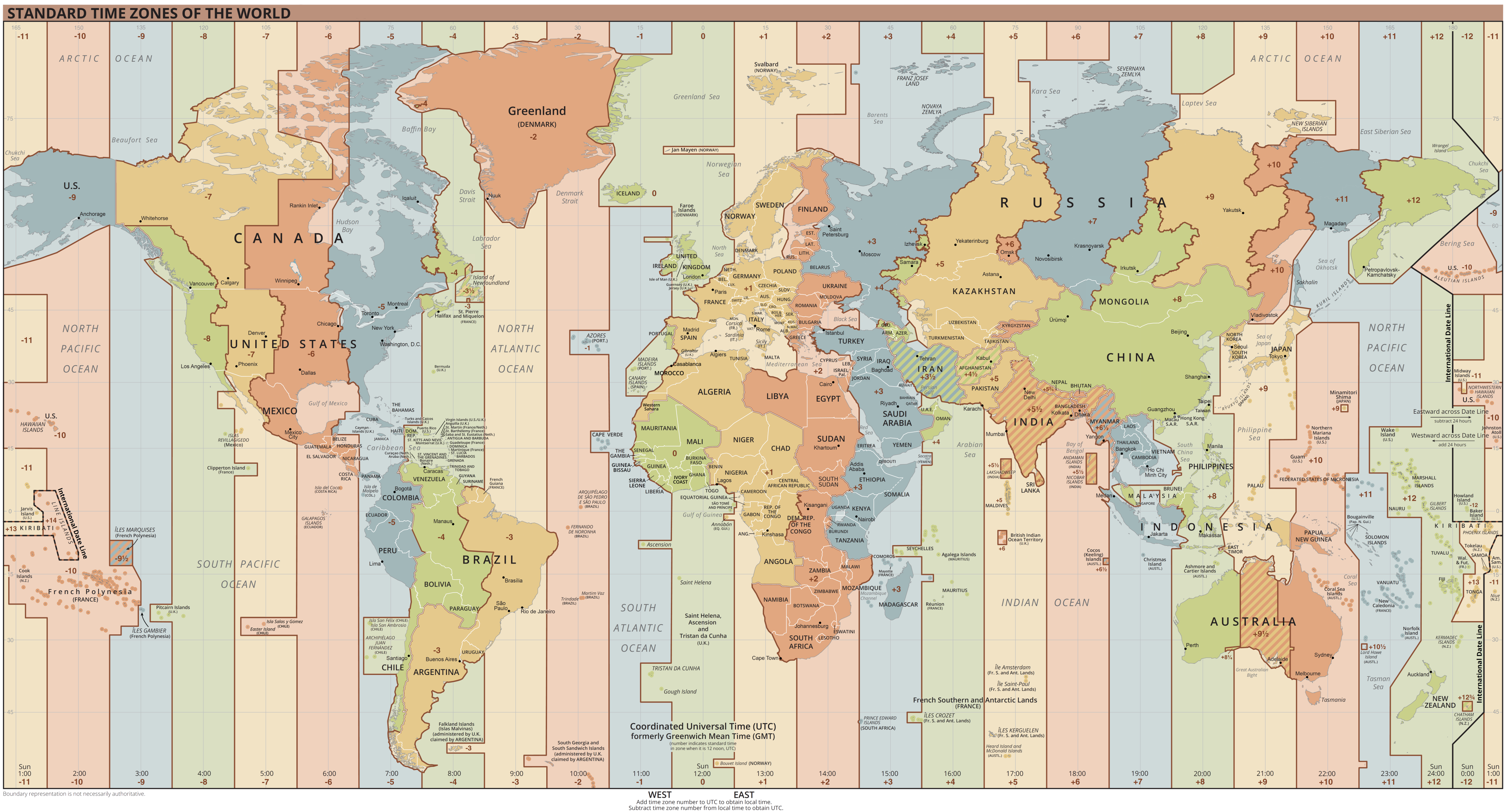
Splitting & re-groupings are almost arbitrary and have no consideration for politics, business and culture.
Ireland & N. Ireland in different TZ? France & Corsica in different TZ? Pushing Ireland & Portugal into their own TZ and calling it Azores time? Bringing UK into alignment with Spain/France/Belgium/Netherlands, but pushing Germany/Italy/Switzerland into alignment with Eastern Europe countries but out of alignment with Western Europe?
A 2 step process by which some countries change TZ twice? Would love to write the code for that mess.
I don’t think we’ll be clambering to add friction to business with Northern Ireland and Britain so we can hang out with Portugal and Iceland.
Trust me. You can deal with 3 hour time difference without even noticing.
(Actually don't, this is what china does and it's not a very good time (hah.))
Sec becomes really, really easy. No one can access it at all!
Reasons
- criminality is lower when there's longer light
- earlier darkness leads to more accidents. It's better to have longer darkness after the masses are RESTED (in the morning), opposed to when they're TIRED (in the evening)
- longer day-time for office workers, is more productive
- shorter time of year that has long after noon darkness. As humans are using artificial light to stay up longer, it's better to align the time of day with that
I know that we could just change our culture and habits and move everything we use to do one hour back, but that has an inertia that will make it impossible.
> Reasons
> ...
Why not just have time as close to solar as possible and move working hours as needed? I have always found arguments for permanent summer time very confusing. Just move working hours as needed, why do you need to deviate the entire clock from the solar time for that?
[1] Because the equation of time might not be exactly zero at noon, the Earth isn't a perfect ovoid and you could be up to 7.5 degrees of longitude from the centre of an hour-wide timezone, even if you drew them perfectly straight down the globe with no regards to national borders.
So, let's take the assumption that the average awake time is 7:00 - 22:00. Gives us 15 hours of awake time.
Solar noon should be at 7:00 + half of the awake time: 7 + 15/2 = 14.5 = 14:30
To calculate sunrise on the longest day and shortest day we use: 14.5 - half of light time
To calculate sunset on the longest day and shortest day we use: 14.5 + half of light time
This means sunrise and sunset in Amsterdam:
summer, longest day, 16:48, 16,8 hours:
- sunrise: 14.5 - 16.8/2 = 6.1 = 6:06
- sunset: 14.5 + 16.8/2 = 22.9 = 22:54
winter, shortest day, 7:41, 7.683 hours:
- sunrise: 14.5 - 7.683/2 = 10.6585 = 10:40
- sunset: 14.5 + 7.683/2 = 18.3415 = 18:20
Given this reasoning, instead of being GMT+1, Amsterdam should be GMT+3 all year round
Speak for yourself! I am definitely sleepier in the morning, and definitely feel less safe driving in the morning.
I prefer summer time, because I almost never wake up before dawn, but for most people, I think DST is actually the best. You generally want people to wake up at around sunrise. It means we could adjust office hours to sunrise, say, work starts 1h30 after sunrise and ends 10h after sunrise. Nice, but it would be a mess. Instead we are using clocks, but the problem becomes that during winter, you will wake up and even sometimes start to work at night, something that most people dislike, and during the summer, morning daylight is lost to sleep. So, how to fix the problem? DST of course. It is an approximation, but it means that as a whole, our lives more closely match the sun cycles.
So that's my opinion, keep the DST. It is added complexity compared to no DST, but we have been doing that for decades, we know how to deal with it. And while many people want to abolish DST, about half want winter time, the other half want summer time, there is no consensus, so we might as well keep DST.
I just don't understand how anyone can think changing the clock creates more light. If that were true wouldn't everyone change their clocks, and by more than an hour?
All your arguments are just about people starting and finishing work earlier. It's so annoying that it has to be "change the clocks" instead of just "why don't we just start at 8 and finish at 4?"
I think the easiest way to permanently switch to UTC+1:00 will be to first try UTC+2:00 for a year; few people are going to accept only seeing the first rays of the sun at around 9:50 in winter.
> ...opposed to when they're TIRED (in the evening)
Morning darkness is way more dangerous. You don't want to have dark mornings when people are in a rush, commuting to work.
It would mean a sunrise at 9h30 (given today's sunset/sunrise times)
(2) the proposed time zones are really impractical, not necessarily in principle, but in their specific implementation. Germany-Netherlands in different time zones is strange, Dublin and Belfast in different time zones is stupid, Athens and Crete in different time zones is absurd.
National borders is quite possibly one of the worst ways to do time zones. At least in the US time zone borders were specifically chosen to run through areas of low population, so you would minimize the number of people doing, say, living in France but working in Geneva one hour ahead.
Also it's kind of odd that Ireland and Portugal are in their own little time zone, when it probably makes more sense to just sync up with all their other neighbors.
Map of Timezones: https://upload.wikimedia.org/wikipedia/commons/8/88/World_Ti...
But otherwise I am warm to the proposal. Some tweaks would make it more practical/politically acceptable (keep Portugal and Ireland on the Western Time Zone, don't split up Greece from the islands).
They could be completely clueless of what dynamite they are playing with.
I'd suggest that ain't going to happen, especially as the UK is no longer a member of the EU, and so this will be ignored.
As I recall part of the issue with the previous time this was proposed was that the UK intended to continuing observing Summer Time in the summer, and hence it would cause issues for Ireland if it had to stop switching.
I guess we can only wait and see...
If someone prefers brighter mornings and darker afternoons, and someone else the opposite, the solution is easy. Adapt your life to follow that. Don't expect the time to suit you, it is keeping track over the sun's trajectory over the sky, not your life.
Those pesky employers are such traditionalists, though.
When you travel (or call) somewhere new, instead of consulting a timezone map to set your watch or know if it's safe to call someone, you'll consult a guide to local "time equivalents" and set your expectations based on that. "Let's see, it's 08:00UTC now and my time guide says locals at that location usually each lunch around 17:00UTC, so if I call Bob there now, it's the middle of the night for him"
The use of "tomorrow" and "yesterday" will be confusing in parts of the world where at 24/00 o'clock it isn't night. Convincing people will be difficult.
But for just the the EU it would work nicely.
It really seems the simplest way to go. But I guess because of history it's hard for people to conceptualize how it would work. (Outside of HNers that is)
> The Time Use Initiative (TUI) is the main non-profit organisation promoting the right to time all over the world. Its main objective is to encourage public discussion on how we collectively organise our time, seen as a way to improve citizen’s well-being through innovative time policies.
So this is not a proposal from an EU department, but it's a proposal to the EU. For sure they "encourage public discussion" as the comments here on HN demonstrate.
Some -- not all -- of the other cosigning entities are ridiculous. One of them (Normalzeit Leben) is literally the title of one person's blog where they talk about their struggles with DST.
[1] https://en.wikipedia.org/wiki/European_Economic_and_Social_C...
That's terrible.
Well done.
It doesn't even do that for most people in Ireland, according to its own map! As it appears to be based on land mass without regard to population density, the majority of the population would most naturally be in the Western European Time Zone, but they'd be pushed into the Azores Time Zone. A government in Dublin is not going to agree to a time zone change that wouldn't make sense for Dublin, and that's even ignoring the extreme political problems and potential violence and unrest involved with Ireland and Northern Ireland being in different time zones.
For that matter, Greece is understandably not going to agree to any change in time zones that results in a map where its islands that Turkey disputes are changed to be the same colour as Turkey, rather than Greece. Neither is Cyprus. It would be a bit like asking either the government of Taiwan to start using simplified characters, or the PRC to start using traditional characters, and simply saying that it would make language support on computers simpler.
I would support a reasonable proposal to end DST and have more natural time zones. But it has to at least consider factors other than just land masses and solar time, or it will never be a viable proposal. Their "full document" and "justification" doesn't include any discussion of the political ramifications or of population densities. They don't appear to give any justification of their specific country-level recommendations at all.
Probably, there is also some analysis paralysis: it is just hard to chose between keeping the winter or the summer time. Just look at this thread: morning birds cannot agree with night owls, someone leaving a bit to the west disagrees with those leaving in the east of the same country...
I wish we'd just settle on any choice. At this point I care much less about "winter vs summer time", more about abolishing DST itself. Twice a year I have a small jet lag for nothing.
I really like the extra hour of sunshine in the Summer time, I would miss it.
And to think this proposal would even take away an extra hour on top of that... Yikes.
Centers of population of each country: https://cs.baylor.edu/~hamerly/software/europe_population_we...
Country populations: https://en.wikipedia.org/wiki/Member_state_of_the_European_U...
If I've done the math correctly (and this was very quick and dirty) you get something like +0:40 / 10 degrees E, roughly the longitude of Hamburg or Milan. Ultimately there's gridded population data that could be used to get a better answer but I suspect it's in this neighborhood.
In Germany, there are 16 states. Many of them have different laws, e.g. regarding store hours and so on. Neighboring countrys like Austria or Poland have even more conservative laws.
The difference between sunrise and sunset in Palermo and Oslo is almost 90 minutes twice a year.
There are tons of cultural differences between Europeans. In southern countries, people tend to stay up later in the evening and sleep longer in the morning than in northern countries (at least that is my impression from traveling).
In the continental United States, there are four time zones, none of which even pay much attention to state borders.
Still, everyone manages to live their lives, talk to people on the phone, commute from one place to the other.
So why are Europeans so afraid that the people they talk to might be an hour or two off?
You do it only twice per year. But how often do you stay late up because of an event or whatever. And how often do you travel to another time zone, sometimes even >6 hours.
I think the latter effects outweigh the health impact of clock alignment significantly.
Your body has six months to get used to an hour difference, so it sets in nicely, for maximum impact 6 months later.
> But how often do you stay late up because of an event or whatever
Personally, not often at all, but I get the point. The time you're supposed to wake up doesn't change though, and that's what makes the difference.
> And how often do you travel to another time zone, sometimes even >6 hours
I can count how many times I've done that in my life on one hand, and I'm sure I'm not alone in Europe.
> I think the latter effects outweigh the health impact of clock alignment significantly.
Have to disagree. Like I said it's to do with having a set hour you're _supposed_ to wake up. Meal times are another big factor.
- Waking up before sunrise has a negative impact on health for some people
- Going to sleep before (or just after) sunset has a negative impact on health for some people
We do not all have the same sleep cycles. Early birds and night owls are a real thing, and any solution will be an improvement for some, and a degradation for others. Health-wise, I think the best solution would be to abolish office hours. Don't look at the clock, look at the sun, and let people work at different times. Of course, economically, it would be a mess.
So yeah, no good solution, only compromises. The most we can ask for is fairness. I don't know what is the most fair, but I think the current situation (with DST) is close, as it is what people have settled with.
But also during the year, you gain an hour of sleep. Studies show that heart attacks fall that day. People always discount this one.
Also, Azores Time Zone is the existing name of the time zone.
Unfortunately I've moved from the Netherlands to Germany and my family, a few longitudinal kilometers away, would have to do timezone gymnastics when we talk about any sort of plans, so needless to say, from my personal point of view I fully agree with you that NL and DE being in different timezones, instead of the sea being the timezone separator as it is today, is bonkers
It's an automatic watch. You do not have to worry about it. Communicate UTC timestamps with timezones between computers, but don't make people use those "because it's easier to program."
So if after the switch you are supposed to start an hour earlier, you just start one hour later, thus starting at the same time according to the sun.
This might sound crazy but the craziness of making people switch clocks is evil and cruel
Meanwhile, I bet most even don't understand the effect of DST (minimizing how much the clock-time of sunrise varies, at the cost of increasing how much the clock-time of sunset varies, https://coolinfographics.com/blog/2012/11/6/daylight-savings...)
https://news.ycombinator.com/item?id=38478402
If people would become aware of that the proposal might have more chances.
Hitler actually did us a favour on that front.
I'm in The Netherlands and after this Germany will be in a different time zone than me. That's not cool.
Timezones are a lot less of a problem now that we are using calendar apps to book events. Better integration of tools to negotiate availability would make that even easier.
The problem that people largely govern their activities by the rotation of the earth and we are in different places on that globe doesn't go away.
If things really were more complicated and you always needed to ask the question of "when can I call today", would it really be that difficult to incorporate schedules into contact records so your phone can tell you "available after 23 today".
With timezones: google "what time is it in melbourne"
Without timezones: google "when morning starts in melbourne"
Didn't convince me a little
And it contains "debatable" statements, such as "For most people, it is not a problem to sleep beyond sunrise." That's not my experience, and they don't offer evidence. It's followed by a worse one: "Having to get up an hour earlier due to DST the next morning, unable to finish your sleep, is what causes sleep deprivation." Yeah, that's one day, perhaps two. Very early sunrise is 2 months.
But if you shout loud enough, you get influence.
You mean aside from the list of citations?
What's the harm in that? It still gets light in the morning at a reasonable hour.
On the other hand, I'm glad to have Central European TZ.
Why don't we reduce working hours to 7 also
Currently, partly due to a historical legacy of railroads, time-zones are longitudinal. That is, they help standardize time (and daylight hours) across east-west distances.
However, given that the number of daylight hours is even more starkly affected by north-south latitudinal differences, we should also implement time-zones in that direction. After all, what does "12:15am" really mean if its dark in London and sunny in Reykjavik?
So, in order to standardize daylight hours, we could implement north-south time-zones as well, producing time-offsets for each lat/long cell on the globe. We could standardize the number of daylight hours in a given 24-hour period (using the equator as reference) and standardize each cell to have the same number of daylight hours.
In order to do so, we would simply have to redefine what a "second" is (or really, all time measurements.) So, the further north you go during the summer, the shorter a "second" becomes (so as to preserve the same number of "seconds" per time-cell) whereas in the winter you would have the opposite effect. Therefore this also has the interesting consequence of changing the duration of all time measurements seasonally, with a greater delta the further away from the equator you are (a "second" would always have the same duration at the equator.) So the further away you are from the equator, the quicker the duration of time changes with respect to equatorial time as time passes seasonally. Still with me?
Good, because we can do even better! Why even have time cells? Time-zones were implemented as lines on a map because that was the technology that was available at the time. But now that we have the internet, we can instead standardize an algorithm that could be implemented into all RTC chips and run on reference servers a la atomic clocks. So instead of "crossing over" into the next time cell, all of your time measurements would be sped-up or slowed-down proportionally to your GPS-measured latitude (standardized to some number of significant digits.)
So all analog clocks would immediately be rendered useless -- unless you are exactly on the equator -- and we would live in a world where you could speed up time by running north, but only in the summer.
If you've made it this far without throwing your laptop/phone out of the nearest window in rage, thank you for your patience (and welcome to the time grid!)
"During the Second World War, Western European states were forced to adopt Central European Time by Hitler and Franco. After the war, this was not revoked, leaving the Western European states at a disadvantage to the Central European states due to the detrimental effects of misaligned clocks."
https://timeuse.barcelona/wp-content/uploads/2023/02/proposa...
just getting rid of dst seems most reasonable to me but iirc it has been prposed before without any success.
if the world is still ok with adjusting with time like taking 6 hour flights twice every year, then so be it.
Step 1: All EU countries abolish the clock change to DST in spring and remain on the clock time they use in winter. For those countries whose recommended time zone is their current standard time, no further steps need to be taken.
Step 2: Those countries whose recommended time zone is not yet their current standard time, additionally turn back their clocks one last time by one hour in autumn, in order to adopt their recommended time zone as their new standard time."
I really wish we could do this in the US.
Basically time stuff is arguably one of the big Chesterton's Fences that comes up on HN a lot. We didn't end up where we are for no reason or because people in the past were stupid.
People in the past had a very different time environment. I used to have 1 watch. Now I have a dozen different clocks in my apartment.
We also did not interact with other time zones nearly as much.
It was mess on the day there should a change, many people arrived on their appointments one hour before or later. Many automatic systems changed their time, different clocks at home reported different hours.
This chaos lasted one morning. After some time, nobody now complains about not having it. Many people don't remember about the change anymore. The only people that complains about daylight change are the ones that work with people from countries that have that.
Abolishing daytime change is not the same as adopting an "universal" (country-like?) timezone, but shows that it is _possible_ to do on a "big country spanning a lot of latitude as well as longitude and tens of millions on wildly different work and sleep schedules".
Maybe the main issue is that many people fear change? (Which is quite "funny", as winter/summer time is a change in time...)
We should all pretend to be robots and use UTC for everything. Problem solved!
I'd rather have the sunset start at 8PM and go over the horizon at 9PM (without DST) in the summer, than the current ends at 10PM in the summer. https://www.timeanddate.com/sun/usa/seattle
Now somewhere like Miami, FL https://www.timeanddate.com/sun/usa/miami with DST has a longest day of about 6AM to 8:40PM (civil twilight start / end), which without DST goes to 5AM and 7:40PM.
After that I suspect most people will figure out how to adjust their business / working hours to get the sun when they want.
There's a societal pull in the direction of earlier time, even aside from anything about sunlight. Nobody wants to be "late" compared to their economic neighbors so they gravitate towards earlier time zones. This is correcting for that.
I have no opinion on the idea, just relaying what they are proposing.
The US is about 4000 miles wider. That makes it hard.
If you’re going to abolish it, this is the way. None of this permanent summertime nonsense.
Eliminating daylight savings means the sun goes down at 8pm in August, instead of 9pm.
But both Portugal and Spain are living in the wrong time zone, which is at least one hour off compared to natural solar time. So it most probably don't make a difference health wise if you move from Portugal to Spain.
Because they made a bad choice on where to live and now they don't care about the unintended consequence on others?
Help me understand why "your" problem on the other side of the earth deserves to override what is best for me locally.
DST is not natural. Animals do not set their watches back and forth. It's a human construct. We only do it "because we've done it" for years and the general population is too herdmind to even consider changing it.