Previously I’d see them during holidays only, and now I see them once a month and actually am able to spend quality time with them.
And while I respect the idea and value of non-remote, I don’t think any amount of “in-person whiteboarding sessions and relationship building” would be worth sacrificing for the flexibility of spending quality time with my family and seeing them more often.
This means that I couldn't read anything. Shaking of the bus also gives me time to time a mild headache. Now if the ride was smoother (like a train or a tram) and I still could sit and read then indeed I would agree with you.
Fortunately I don't have to commute very often so I can tolerate this to a degree but if I had to commute every day then it would add considerable extra strain into my life.
Normally the day should be divided into 3 equal parts: 1 sleep time, 2 work time, 3 personal time.
Commute time effectively steals from either personal time or from sleep time and this comes on top of getting ready for work that is also a major waste of time in the mornings.
But I also self-selected roles closer to the end station in London so the commute at the other end was short-ish.
Whenever I had to do any other commute: by car, bus, multiple changes, etc it was always a grind and shortlived.
However, I was able to stop even the not-so-bad commute long before COVID as I wanted to be at home when the kids came back from school as they are only young once and briefly so. Though I miss the "me-time".
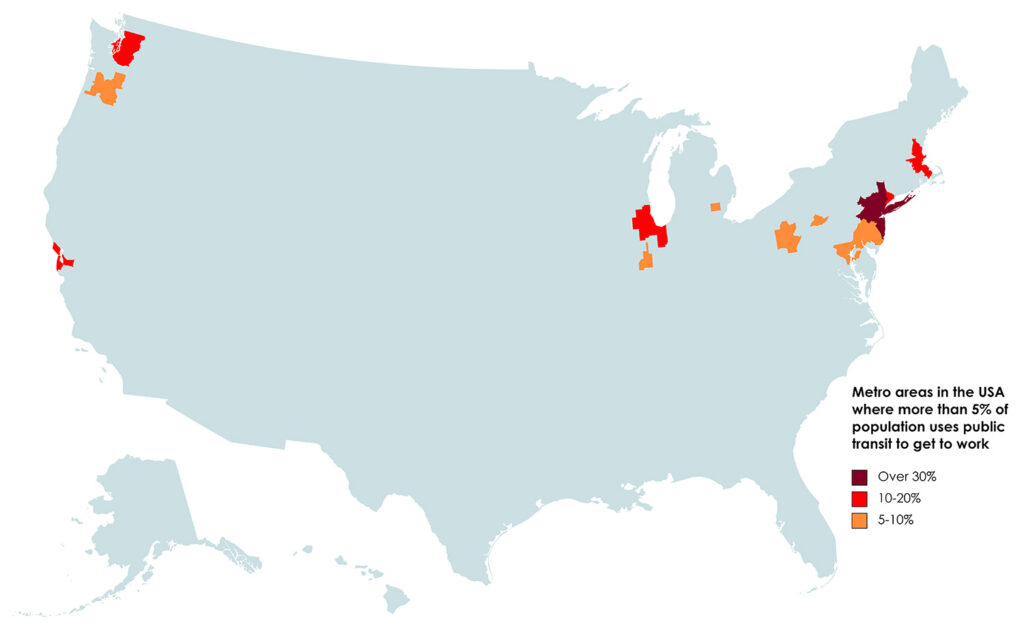
Public transit use:
https://vividmaps.com/public-transportation-in-the-united-st...
https://vividmaps.com/wp-content/uploads/2023/09/public-tran...
Population density:
https://www.axios.com/2023/10/28/americans-moving-map-2022-f...
https://www.axios.com/2023/01/31/cities-pandemic-moving-tren...
Just as an example, right now I am in an Indian city where there is some minimal public transport but a majority of people need their own vehicle to commute for most of their journeys. And it is not an unusual scenario for India, which contains more population than Europe and North America combined.
That depends on the public transport. When I lived in London (inside what is known as the zones 1-6), I had a walk, a wait for space on a train, then stand for 40 minutes on that completely packed train, then a change at a crowded station, then another wait for space on an underground train, then stand on a completely packed underground train. All of this while dealing with angry and rude other people trying to push on each step before you. I would get to work completely stressed and in a bad mood already. That is on a good day. On a bad day the trains would just be cancelled, or the underground halted, or something and it would take hours to just get to the office.
The only way I would consider going back to something like that is for a huge, huge amount of money.
This is very subjective, as well as personal and irrational, but I find it to be true. I benefit from having a reason to go out into the world in the morning. WFH and the freedom to go to the coffeeshop or take a walk didn't match up.