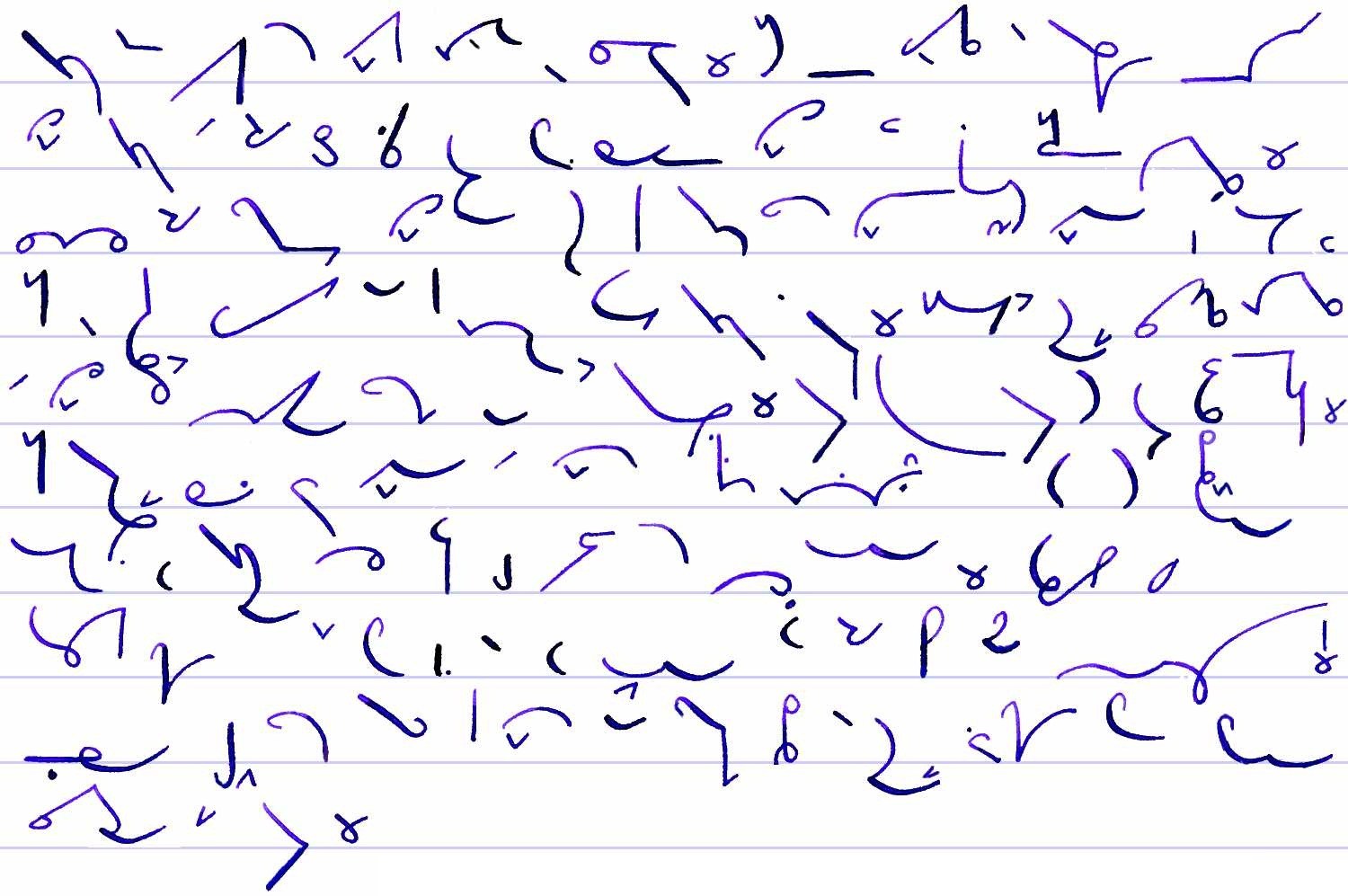
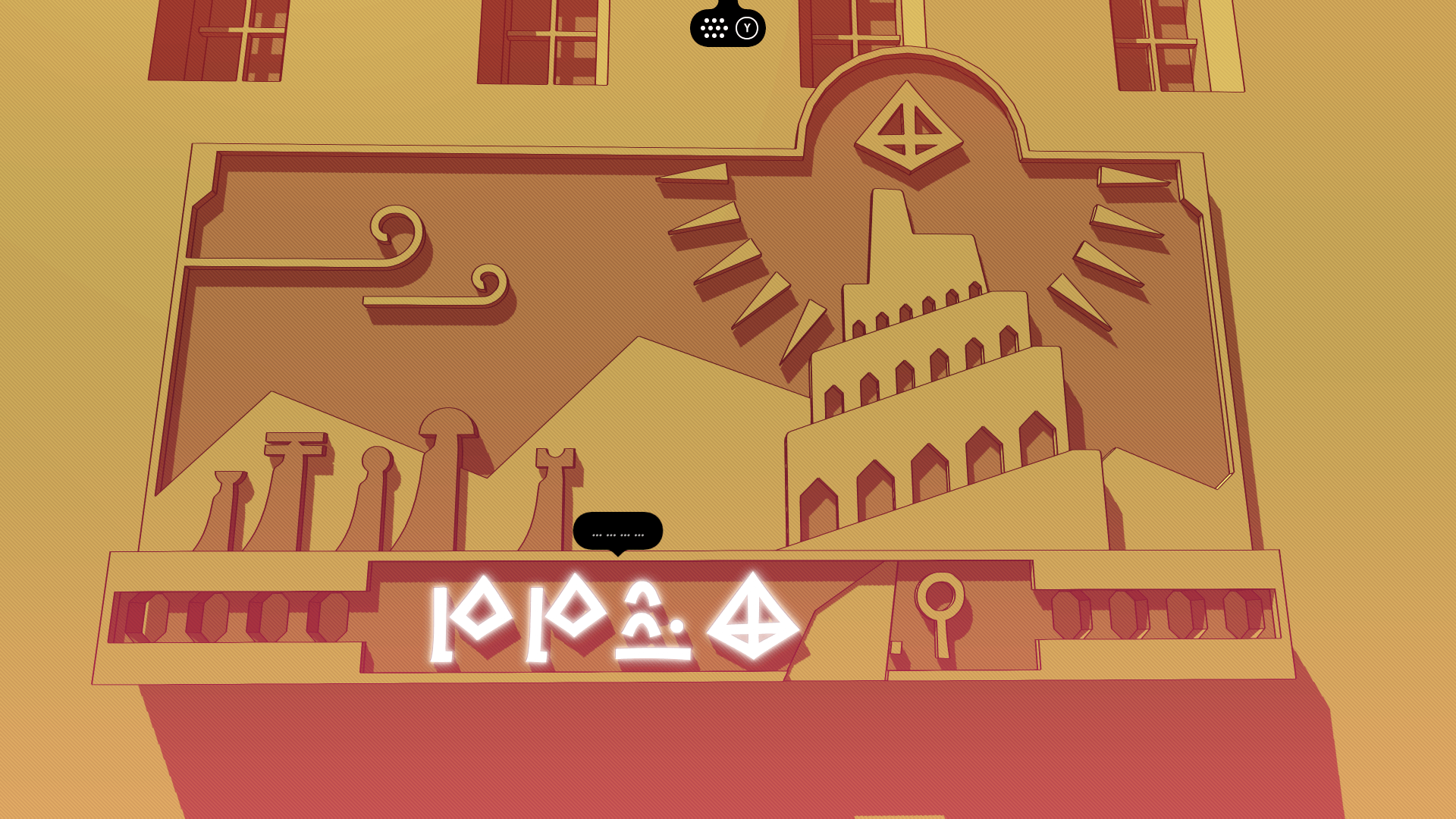
The game’s dialogue and story are all written in a series of ever more complex writing systems, unseen and novel to the game. There’s a mechanic where you get to prove to the game you understand what is being written or said (characters have subtitles also in the writing systems) and it’s really good fun!
Pittman shorthand: https://4.bp.blogspot.com/-6Wr53ouD4Ok/WhxIZR6AOZI/AAAAAAABI...
Sennaarian writing: https://cdn.focus-home.com/fhi-fastforward-admin/resources/g...
Both of these make the writing faster, but reading slower. I once spoke the world's champion shorthand writer - I've forgotten her name. She said the even she cannot read shorthand as fast as regular text.
Which made sense before computers, when a stenographer needs to write very quickly, and English is written long.
Bt, nowadays we need the opposite - a "shorthand" which, once you have learned, can be consumed quickly. I know from experience that it takes much less time to read Hebrew than to read the same text in English (even though my mother tongue is English), since the vowels are assumed and abbreviations are extremely common - the actual text is shorter and quicker to read.
I can scan a long article quickly, but I wish there was a way to convert that to a writing system that was quicker to intake.
A shorthand system is free to represent words phonemically instead of orthographically, and most languages have fewer phonemes per word than letters (or strokes/radicals/jamo if you're looking at Asian characters), so it would make sense to just always do that. So maybe Vietnamese would be the most compact if you used a phonemic system, but I actually think it's more complicated than that.
There are a limited number of different types of strokes you can include in a shorthand system before they become too similar to each other, so you are capped in how much information per second can be written regardless of the language. Different languages have different numbers of phonemes (Rotokas has just 11, while Taa has over 100). If you have very few phonemes, you can group clusters together into single strokes, whereas if you have many phonemes then you may need multiple strokes for a single phoneme.
So what you'd really want is the language with the greatest information per phoneme divided by the total number of phonemes, or another way of putting it, how well it fits into a .zip file :)
[1] Search for "text expansion translation" to get the general idea. I've mainly referred to the guideline from https://eriksen.com/language/text-expansion/ but many other guidelines agree. See https://www.w3.org/International/articles/article-text-size.... about the general phenomenon.
Do you have a citation for that? I know some Swedish and often need to read documents in it and I don't get the impression that it's any more compact than English.
Quick intro: https://imgur.com/a/zYyON
Stenography is where it was at! My mom's second husband was working at the local parliament and had to take notes, in real time, about what politicians were saying and he'd use stenography. He'd then hand his "stenographed" notes to a secretary that'd convert them back to english, which he'd then proofread.
It was french btw, which is even longer than english (about 20% longer).
Shavian alphabet https://www.shavian.info/alphabet/
Which has similar goals
I used to be a journalist and tried to adapt it for my language (Estonian) years ago, but eventually gave up. Possibly tried it with Gregg also, which is the coolest one visually IMO. Orthic is entirely new to me, thanks a lot for this link!
Does anyone have any experience with this that suggests that maybe it can be clearer than cursive?
One can always hope…
There are multiple levels of shorthand, the faster ones drop more and more information from each word if it can be inferred from the context (for someone familiar with the topic, i.e. yourself mainly).
Shorthand never really stuck for me. Learning to write and read it wasn't that difficult actually, but I couldn't quickly scan shorthand notes like I could with regular writing. I suppose that's a matter of practice and I wasn't ready to sink hundreds of hours into just that. One thing I learned from the experience was how frustrating of an experience it is if you're not good at reading. I have always been an above average reader and I couldn't understand how people struggled so much with it. Reading shorthand was effortful and slow, especially at the very beginning for me and that gave me some perspective of how some of my classmates must have felt.
I have most success with nibs which are very smooth but stubby. TWSBI Diamond 580 with 1.1 mm stub nib worked best for me, but it takes bottled ink.
The emphasis on curve and proportion in Gregg has made my cursive hand much more regular, flowing and pleasing to the eye. I’m sure similar benefits would accrue to learning and practising Orthic where specific curves, angles and joins have meaning.
But she never seemed to actually use it later in her life (she still touch typed tho!).
I wonder how useful shorthand is in these days when cheap recording devices are available in everyone's pocket.
Maybe people who keep hand written diaries still use it?
It's a fantastic skill but so rare to see these days, it was mainly used by secretaries dictating notes to then type up I think. Now we are our own typists, it's largely relegated to history.
Classic shorthand has never worked for me as it records the sound rather than the semantics. This is reasonable as a way to time delay dictation (when you read the shorthand you hear the sound in your head, so you type as if you were hearing the person speaking in realtime). But when I read I don't hear any sounds, so this would be like listening to the person speak, which defeats all the advantages of reading.
Trying to write as fast as an average person speaks makes it very hard to do anything else, like be an attentive conversation partner, but scribbling some notes down in shorthand so you can return to them later is really useful.
It also does not take long to learn because many of the consonants are simplified versions of ordinary letters (such as 'C', 'G', 'b', 'n', 'm' and so on), whereas the vowels are just lines.
And so I don't think your recommended strategy would pay off.
Orthic has some of that, but not to the extent of Gregg.
So I wonder the writing medium Arabic was for. Roman Alphabet does lend itself reasonably well to stone work I feel.
Or is that one of those linguistic myths that doesn't play out like that.
[0] https://en.wikipedia.org/wiki/Qalam
[1] https://www.youtube.com/watch?v=mppajQ7TLGs
[2] https://greekasia.blogspot.com/2020/01/the-bactrian-language...
It's definitely faster, but it's a steep learning curve.
For a slightly easier learning curve, I suggest ASETNIOP - https://asetniop.com/. The are/were keyboards built with a single row (maybe + thumb keys) that speak ASETNIOP, but I can't seem to find any at the moment.