If you didn't know anything about laptops and wanted to buy your first one, it would be a nightmare to figure out what all those seemingly random numbers mean on most non-Apple laptops.
Apple continues to simplify the laptop naming scheme, we're at a point where it's simply:
Air OR Pro
Small screen OR big screen
All other details can be configured in the buying flow but there's not much to think about if you just want a simple laptop.
It's not even close to a competition. Macbooks are just so far ahead of everyone else that you can't even compare them.
Most Windows laptops have abysmal batteries, to the point that you can barely call them laptops. The trackpads are downright unusable. The keyboards are a hit or a miss. And for some reason, so many companies are still shipping laptops with 1080p screens in 2024.
Anything even remotely within Macbook vicinity costs the same as a Macbook anyway.
Increasingly feels like most manufacturers have given up on the laptop as an innovation center and are happy to just scrape up the consumers who can't or won't buy Apple.
The weird part of that argument to me: to arrive to that point you've already made a ton of choices that need to be educated.
You decided on the form factor: you don't want a convertible (neither a Surface like tablet + keyboard, nor something like a Yoga).
You decided to forgo touch.
You decided you don't really want to game. You also evaluated you don't need anything Windows or x86 only.
Then sure there's about 10 models. But at that point is it much complicated than say, choose from the DELL XPS line ?
And the crazy thing is, despite Dell having 170+ laptop SKUs they don't use that fact to actually have a wide range of products.
You'd think with 170 different SKUs they could produce an ultrabook with ports, wouldn't you? A modernised version of the E7270? Apparently not, though.
The problem with this tactic is that there's a lot of SKUs that give people a terrible experience and they jump to another brand.
Apple's solution to this is to instead have 50 SKUs, organize them by a few very easily understandable categories, and then price every SKU exactly within $50-$75 of one another so that there's always a meaningful upgrade for slightly more money. This is also why Apple is very stingy with storage and RAM. They use the cost of upgrades to pull you to higher priced SKUs, which then need their own upgrades, and OH LOOK there's an even nicer base model for just a little more!
[0] The amount of money you save when the thing you want to buy turns out to be cheaper than what you were willing to pay.
With such bloated webapps now a days, those 8G of RAM are going to cook too fast...
Newegg's feature selector is pretty good at sorting through this. Just uncheck all the bad screen resolutions and CPU models and see what's left. Bonus: Require at least 32GB of memory in an exact power of two, excluding all the junk that solders 8GB to the system board.
Dell has XPS 13, XPS 15, and XPS 17 and now the plus designation. It's pretty easy.
If you remember back in the day, Nokia also had a crazy number of SKUs for their phones. Nokia is no longer the power it used to be. Could it mean many SKUS means a lack of focus ? Thinking you can out market / out segment your competition rather than try to concentrate more on the product ?
I find AMD also has less SKUs than Intel. Here, as a challenger you can't really afford to segment the market as much as the leader. You need to concentrate your offerings in a few potent products.
Having suffered through many Dell laptops (flagships) I'd rather flush the money down the pan than buy one machine from them.
What Dell is selling in comparison to Apple is legacy technology with shoddy workmanship.
I don't get it. What's so great about Apple's lack of choice?
All those numbers try to hide that they basically sell all the same.
They are marginally more expensive, but they also very easy to sell second-hand. I'm speculating that the monthly cost is on par with a PC.
(And with more and more Electron apps, might struggle even with that once you hop onto a video call.)
When the original iMac came out, it was by far the #1 computer SKU. It was way better than competing products at the price range because of those economies of scale.
> All other details can be configured in the buying flow but there's not much to think about if you just want a simple laptop.
You would think so, but unfortunately not. Apple is quite good at upselling and their price gating for screens, ram etc. is very opaque. In other words: whether you want the air with non-sabotaged specs or the pro or the pro pro or the pro max is not simple.
I had to return a decently spec-ced M3 Macbook PRO 14" because it only supported 1 display (base M3) and pay more for M3 pro even though I don't need the extra horsepower.
And now the base M3 Air's support 2 displays? This is wild
It’s incredibly stingy. For a while you could make the argument that a lot of Air purchasers wouldn’t need it, but I don’t think that’s the case any more. My wife has an M1 Air with 8GB and between Office, Chrome, Teams, and Slack she quite regularly gets beachballs and weird performance hitches.
The vast majority of their market would not fit into the developer, content creator, or just plain power-user category. There's people who just log on to do internet banking and email when they're not on Reddit or Facebook.
For some anecdata, 16/512+ would be a waste on my parents, in-laws and my whole extended family for that matter. They would benefit from it, but they're not screaming at spinning wheels, and are probably a bit more patient and accustomed to 'slowness', which is pretty subjective.
Think of an alternate universe where Apple does the opposite: every new model they push the envelope and double the baseline RAM compared to the previous year. In that world you’d have all the software growing in memory use without bound. Consumers would be forced into a treadmill of computer upgrades like we haven’t seen since the 90’s when CPUs were skyrocketing in performance every year.
For anyone who forgets what the 90’s was like, here’s an example with Mac models:
1990 saw the launch of the Mac LC which had a 16 MHz Motorola 68020
1999 brought the Power Mac G4 at up to 500 MHz
That’s a 31-fold increase in clock rate (and several times that in overall performance) in the same timespan we’re discussing. Software that was written for the G4 had no chance of running on the LC (ignoring CPU architecture differences).
MacBook Airs are the mainline consumer machine these days. Apple does not want users to feel like they need to upgrade them every year (despite what people say).
I looked at the price for m3 and if it would have 16gig it would literally be perfect for just 1k but nope 8 more gigs cost you an arm and a leg
Have a crate with about 40+ of those machines at work, essentially useless from the era where the person in charge of buying laptops just bought the bottom end for every employee and considered it a job done.
Even worse, if one plots the (price, unified memory amount, chip type), and looks at it from right-to-left, then the dollars per system capability is disgusting when you order a lesser system. You get the most value for your money when you buy the maximum unified memory configuration (on those three points).
Better yet, with a maxed out unified memory configuration, one can further save on SSD writes by using (and loading/storing) RAM disks for their projects!
Most people buying a MacBook for work are likely getting a higher unified memory, so their workstations live longer. Meanwhile consumers will have to keep consuming as they fry their internal SSD's on their airs...
I was also wondering if a 1TB apple fabric device is simply an 8TB fabric device with 8x the write life...
I have a great M2 pro machine, but officially it can only support 2 external monitors. I should be able to close my screen and power 3. I can do this with a dock so it's not a resources problem.
I am curious what is different between the Air and the Pro that the Air can power 2 external monitors (it does say when the lid is closed) and the Pro can only power 1 regardless. Or is this a software update and the Pro page just has not been updated.
I keep hoping that this is a problem that is only temporary and eventually it will be removed or as time goes on each series can run 1 more monitor or something.
I've been running three for a while. 2 Thunderbolt 3 + 1 Thunderbolt 2 daisy chained. They work. There are a couple glitches, but they work.
I'm on my work machine now but I believe it also works with the laptop open.
https://9to5mac.com/2024/03/04/14-inch-m3-macbook-pro-multi-...
But nevertheless, Apple's hardware strategy sucks ...
[1] https://www.bestbuy.com/site/samsung-odyssey-49-1000r-curved...
[2] https://old.reddit.com/r/ultrawidemasterrace/comments/mb9vnv...
I use Asahi Linux on M2 now, and the USBC display support isn’t done yet, but I am hoping it would be better than MacOS.
More-than-one-display is pretty much the standard on regular (non-apple) computers: you can drive as much as your system can sustain.
If it can identify something people will pay more for, while not quite putting off most people, it'll do it, no matter how mad.
So if most people think 8GB is fine for a laptop, they'll buy it, and everyone else pays through the nose for more.
Most people only want one extra screen? That's what you get on the base machine and you must pay (alot) for more. If one day most people need two, then you'll get two.
Apple seem to spend a lot of design time on how to extract the most money out of those willing to pay, no matter how annoying it is.
I don't want to waste time migrating to a new system, only to find out I need to return/resell it, or later down the road find out another arbitrary/artificial limitation Apple has set that I either have to find a work around for or suck up until I can switch machines again if none exist.
This is unfortunate since there are some features that have made it very tempting to switch.
But just in general, Intel has always prioritized lots of I/O flexibility on its chips. If you look at the datasheets there have always been dozens and dozens of units on every SKU that are never plumbed out to ports on the device. Three or four display outputs, six or eight USB controllers, stuff like that. Apple is the opposite: they won't include something if they aren't absolutely sure they need it. So after the shift from x86 to Apple silicon, laptop users are feeling a squeeze on I/O that used to seem "free".
Apart from the initial M1 MacBook Pro release, it feels like most products Apple has released in the last few years has always been missing one or two features, and the next release happens to have that feature. E.g. the first M1 Air did not have MagSafe even though the Pros did, and then Apple included MagSafe in M2 Air, but it didn't support multiple displays; now Apple is including multiple displays in M3 Air.
It feels awfully convenient that each generation conveniently has a nontrivial feature upgrade.... Apple has less incentive to make each generation "complete" -- by delaying features (more) consumers will feel obligated to upgrade per generation.
Edit: Better wording, I suppose, that the non-PRO supports two external monitors with the lid closed, the PRO supports 1. Still an odd overall offering/branding.
The M3 Pro has more space and is more ... pro?
I had a 2019 cheesegrater Mac Pro. With Catalina, I was able to drive two 4K screens at 144Hz in HDR10, because Catalina apparently supported DSC 1.4.
Then they introduced the ProDisplay XDR with Big Sur which had people agog at "how were they able to drive this 6K display given the bandwidth limitations?"
Well, the answer is because they absolutely nerfed/bastardized DSC 1.4 from Big Sur (and it's maybe only been updated in Monterey? Unsure, I no longer have the screens - ironically I bought an XDR) to make it happen with some proprietary magic: those same screens could now only be driven at 60Hz in HDR10 or 95Hz in SDR.
Proof in the pudding was that my monitors (LG27GN950-B) actually allowed you to change the advertised/supported DSC version, and when I "downgraded" the monitors to DSC 1.2, performance actually improved, and allowed 120Hz SDR and 95Hz HDR.
This happened with many many users, across many screen types.
Apple studiously ignored it, and may still be. They simply don't care if you're not using an Apple display.
$999 for an 13-inch M2 Air is just bonkers. You can easily pay $1500, even $2000 for Windows laptops that are hotter, heavier, AND slower.
The main problem with the non-Apple laptop market is that there is a mind-boggling number of confusing models, SKUs, processor/gpu variants, etc., and wildly variable physical quality control that confuse consumers and leave them unhappy. This is the flip side of choice in prioritizing, say, gaming performance over battery life while optimizing price or vice-versa.
Also my personal opinion is that 90% of consumer frustration comes from the extremely subpar implementation of Hybrid Sleep between Windows, Intel/AMD, and OEMs. Consumers expect to be able to close their laptop and for it to preserve battery instead of becoming hot or dying the bag. That really needs a solution.
People love to say this without linking to a model. That's because the models in this price range are obviously not in the same weight class as a MacBook.
Edit: Weight class and weight-of-laptop are not the same thing. I don't know how to explain the idiom "weight class" so that the more... literal-minded Hacker News commenters will understand what I mean, but let's start there.
Please link to a model, just one in the 500-600 range that is comparable to a 1K Apple model.
I have owned half a dozen Windows laptops in the past, in all kinds of price ranges, cheaper and far more expensive than a Macbook Air.
None were even remotely comparable to the build quality and practicality of a Macbook Air. This was true even in the Intel CPU era. In the M processor era, the gap only increased.
You cannot even do research on a good Windows laptop because the makers constantly change the model numbers to confuse the customer and hide the flaws of these systems.
You buy a Windows laptop then either the screen, the battery life, the touchpad or the keyboard will suck ... maybe all four.
The sole reason to buy a Windows laptop and put up with all these flaws is playing games. If you need that you will put up with all that crap.
I would kill for a version of ThinkPad X1 Nano or X1 Carbon for example that had the battery life, silence, and unplugged performance of a Macbook Air for example, but no such machine exists even if I were to spend twice as much as the cost of a MacBook Air.
This is 100% it, Lenovo has been killing it lately with their Yoga/Slim series, but for every laptop they have that competes with a MacBook, they also have a myriad of other options that are just e-waste. At the end of the day, the average consumer is not going to do the same kind of research that a tech enthusiast might do, and Apple has a somewhat simple catalog (although incredibly overpriced once you step out of the entry configs).
The display... is not comparable. Sure, it's 144hz compared to the Mac's 60hz... but it's only 74% NTSC at 250 nits with 1080p, so the color accuracy and dim picture is distractingly bad.
And as for sleep, it's just useless. You close it with 70% at night and it's dead by morning. Supposedly the battery is the same size, but even when it's awake, the battery never makes it last more than ~2 hours. Also, that's two hours... when I'm not gaming, as I painfully learned when trying to download a Windows ISO. When I'm gaming, well, then it's shorter.
I might as well mention the thick, heavy, completely plastic construction. Feels like it will shatter from one drop. On the upside I managed to upgrade it from 8GB to 16GB... but then I'm wondering why this laptop even shipped with 8GB in the first place.
Ultimately though, it runs Windows with a basic GPU. Desktop Parametric CAD isn't coming to Mac anytime soon.
Things that matter to me and that all Windows laptops in the same price range or lower as the MBA have shittier speakers, camera, monitor (both brightness and color accuracy). The trackpad feels entirely wrong on those plastic devices and often you have loud fans turning on at random times. Furthermore they're usually heavier despite being made out of plastic rather than metal.
I would pay more for an acceptable alternative - no fan, Windows 11, good battery life, top quality screen, no gimmick features (touchscreen! detachable screen! whatever).
No such thing exists, as far as I can tell.
Another way to look at that is "MacOS vs non-MacOS" laptop market.
There is only one manufacturer of MacOS laptops. That helps keeping the number of models down. Same thing for the iOS vs non-iOS phone and tablets market. If you want MacOS or iOS you must buy Apple. Hackintoshes do exist but are a rounding error compared to the number of machines Apple sells. And if you want Apple, you must get MacOS and iOS. You can run something else on that hardware, but again we are writing about rounding errors.
There are non-MacOS laptop manufacturers with even less models than Apple have. Maybe it's very niche but the Framework laptop has been popular on HN lately and it has only two models.
On the other side if you want to buy non-MacOS, then HP, Lenovo or Dell have a zillion of laptops each, ranging from the very low end to the very high end. Some people pick features and look at which models are left with those features (that's me.) Some people pick a price tag instead. Probably the laptop is a commodity to the price tag people, much like gas. Who really cares about the gas company? If you need to fill the tank everything will do.
And about
> the extremely subpar implementation of Hybrid Sleep
this is something that Microsoft throw at us and we can't dodge it much. My laptop runs Linux and it's from the pre Hybrid Sleep era. I didn't investigate if Linux sleep works well with new laptops.
It really doesn't make me want to reward them with more money, only to find out what exciting new issues will be present and trivially reproducible for the entire next revision of the hardware.
I don't think this true, unless you have extremely low standards for "acceptable". I've tried a number of $400 laptops and in every single case got fed up with the shittiness within minutes.
Mind boggling that so many smart people at Microsoft/AMD/Intel/HP/Dell have not been able to figure this out yet.
Can you show me just one of those, please?
I would buy it today.
Anecdotally, my Framework 13 AMD ran me 1500 and I ended up with 64 GB of ram, 2 TB of storage, and an AMD 7840U. I bought my RAM and storage separately to get that end cost, to be fair.
I wouldn't be surprised if the M3 actually outperforms my processor by a bit, but having way more RAM matters a lot to me. All that on top of being able to repair my own machine is a no brainer to me.
I know most laptop users wouldn't care about this stuff, but I really hope Framework does well and helps bring repairability back to laptops.
HN used to say that System76 were the best laptops ever, so I bought two of them. They’re an incredible pile of shit, in addition to the battery life or the clunky build, the fans turn on and off like my gamer boyfriend’s PC back in 2001.
System76 said they won’t take them back, after I tried to give it to every intern.
I’m absolutely flaggerblasted at what Linux or Windows users tolerate, it seems fine for them, since all of their laptops is like this! The problem is having low standards, and compared to this, they think their laptop is great.
* Framework is philosophically best, and they make solid machiness. * Macbook Air has just insane battery life and is so small.
I would love if I could run macOS on a Framework.
Just out of curiosity, why? I have ~200 tabs open in chrome, and have ~10 different apps open. Mac could handle it perfectly well due to reliance on swap and compressed memory. My swap used is 20 gb but really can't say that even when switching apps fast.
Just recently there was a Thinkpad P14S on sale for $999 that blows the Macbooks out of the water in terms of ram and storage, while having a high quality OLED display and a Ryzen CPU that can easily trade blows with Apple silicon. It is hotter and heavier and has very bad battery life, though.
In $999 13" M2 Air you get 8GB Unified RAM and 256GB memory. Intel ARC seems to be better than M2 graphics. Weight is exactly the same. Usual downsides remain - fan and smaller battery life, although still pretty good.
No one matches Apple's build and screen quality. But their base models are pretty underpowered, and it's not until you're spending closer to $2k that you get specs that feel appropriate for 2024. On the Windows side, there are lots of cheaper options, many of which have beefier specs, but the build quality pales in comparison.
The right tradeoff depends on your budget and what you really need out of a device.
For $1700 you can get a sub-1kg Asus ExpertBook B9 with 32GB RAM and a 2TB disk and a decent 12th 12 core Gen Intel CPU.
https://www.amazon.com/ASUS-ExpertBook-i7-1255U-Military-B94...
Not saying it is better in all respects, but definitely in some, meaning there are definitely alternatives.
And the screen is 1080p from 15 years ago.
No thanks.
That will be a great little machine to use until it starts throttling. You'll need an MBP to keep consistent peformance.
But yeah, there's still a real lack of Windows laptop competition these days, especially if you want a GPU. 'Gaming laptops' tend to come with severe heat/noise/weight/battery problems.
(And why are competitors touchpads still shit-tier compared to Apple? Even on those bulkier gaming laptops where space isn't at a premium and the price is on the premium side)
It boggles my mind people still buy 1080p laptops.
Abandoning the (clearly lacking) Mac Store is not these same as abandoning the macOS platform.
Its Unix-like under the hood, with mostly same syntax for the terminal, but linux and MacOS are very fundamentally different.
With the size difference between the MBA and MBP almost eliminated, the M2 MBA was a superfluous SKU at launch, much less now.
It's nuts that the entire rest of the industry basically has own-goaled Apple into a dominant position. Apple's playbook:
1. Model-year build stability over faster go-to-market on new components. 2. Better build quality. 3. Better battery life. 4. Better display, especially in value models.
I'm leaving OS and UI out of the discussion.
e.g. $1,899.00 for 15'' 16GB ram + 1TB SSD
i just bot a similar aluminum HP with Oled , Ryzen 7, 16GB , 1TB SSD for $700
the build quality is good, just a tick below apple. the fan is mild, not as good as apple.
but $1200 premium for apple ? I had to say no
My 5 year old Lenovo Carbon X1 14" is 2560x1440 while I can't buy a current X1 with anything above 1920x1200 for any price. WTF?
When I was looking at Thinkpads there was never any better options than 1920x1200 but if I switched to the US site I could order with the HiDPI OLED screen.
With that said, the specs on a Mac air are extremely modest when you really look at them. Apple is simply optimizing to do more with less.
If it wasn't intentional they should incorporate it into their marketing -- "exactly the same weight as air!"
I don't know why you bought a new one. You can have two ways to look at this, one way is your ultra pessimistic view, my view is I don't need to upgrade my laptop ever 2 years anymore.
Before the M1 Max I was upgrading so often because intel macbooks sucked so much. Now I can comfortably say I'm keeping my M1 Max for a decade.
As for being "exploited" by ads, just don't be, stop mindless consumption...
I’m doing most of my daily driving on whatever computer work gives me anyway, this is just the personal dev/audio machine. I do the same with a gaming computer too though, my gaming laptop from like 7 years ago is still going strong. I turn down shiny graphics settings to get good FPS anyway, I care way more about gameplay than visuals.
That's a nice thought but the computer will probably lose security updates in the next 10 years.
And that really annoys me. The press release says that the new computer is "built to last" and I'm sure that's true, physically. I have a 2015 Macbook Pro which works fine (obv. slower than a modern computer but fine for everything I need to do), it does still get security updates (it's two OSs behind the current macOS at the moment), but I think the time until it doesn't is probably measured in months.
As I say, it works perfectly, was indeed "built to last", but I guess I'm going to have to throw it away (bad for the environment) and buy a new one soon?
That also makes me less enthusiastic about dropping huge amounts of money when I do finally buy a new laptop.
If Apple releases on-device AI, this will be an effective way of getting people to upgrade like they used to, but haven't had to recently. For example, I bought Pro-level computers in my younger years, but now would only consider an MBA, mini, or iMac. But they could get me to go for a Pro if it were the only way to get more RAM for better AI performance. It will also likely shorten upgrade cycles since newer computers would have the latest and greatest performance. When I bought my M2 MBA years ago I suspected it would last me a long time. Now I'm not so sure since I don't have a ton of RAM.
These "pro" machines have always been known for work and productivity, and 8GB just sounds like a piss poor product decision
However, you quickly hit throttling if you push for more than a couple minutes at a time (like when you export in Handbrake, it will slow down and only run marginally faster than the M1, in my experience).
I suspect mine would be green almost all the time, even on this almost three year old M1 Max.
Eg: The M3 Max is a substantial improvement over the M2 Max in both CPU and GPU. But the M3 Pro is a moderate improvement at best compared to the M2 Pro.
It's also why you should understand your personal use case and do research. I think this is on you, not Apple. Corpos gonna corpo -- you have to do the research to figure out whether the gains from new chips will actually impact your workflow.
If you bought a M3 Max just to fuck around on Facebook and Hacker News then of course you won't notice a difference. If you are running workloads that actually require that level of performance then you will notice a significant difference. M3 Max is twice as fast at rendering 3D scenes in Cinebench.
For most real-world users, the M3 really is about 30% faster in single-core and 100% faster in multicore. That is really significant for a lot of us, especially software engineers. But the really big speedups mentioned in Apple's marketing are more niche and it takes some savvy to recognize that.
(I'm plenty content with my M1 Max for now and I expect I'll continue to happily use it for a few more years)
I wouldn't exactly just avoid them, though most are useless, so it's not a bad idea. You just want to understand what they are... even honest ones will only present information that is a reason to buy.
E.g., when I saw the iPhone 15 ads and the best thing they could say about was that it had some titanium, I knew it was a product I could ignore. (Not that I have an iPhone 14 either, but I already knew that one wasn't worth an upgrade to me).
In the Windows world, I rarely if ever come across a laptop where the speakers weren't clearly last in precedence for engineering and BOM consideration. Just astoundingly bad sound quality accepted as normal in the Windows laptop world, even in supposedly premium machines.
In comparison, even the least impressive MacBook Air speakers are good.
But if you were coming from another MacBook Pro when evaluating the Air I can see why you would have come away wanting better. The Pro machines are indeed a clear step up, and the larger 16" models are even better given the extra space they have to work with.
Sometimes I hear her watching some movie or show a few rooms away, and I can never know if she's watching it on the TV or on the Pro just by the audio alone. Those speakers do fill the room, and them some.
I have never really watched more than short content on that form factor. I like a bigger screen and a remote, watching anything like a movie on a laptop feels klunky.
A 4K monitor I use works perfectly fine on Linux, but with Macbook Pro, even though resolution perfectly matches, it still has blurred font (the filter they apply completely changes the look of the font, even though I use the same one), everything just remains blurry and again, watching video disables it.
Edit: nvm, looks like the Air supports two external displays but the Pro only supports one.
yeah, the fact that such basics are still broken is the biggest scandal to me in these premium machines with so much tech progress otherwise
Apple has a serious anti consumer practices and we should not be supporting this company. The EU fine is just a start and hopefully there is a serious crack down to force them to open their hardware and software. Cheers to EU and its wonderful policies, let's hope the rest of the world follows through!
In any case, encouraging their behavior by constantly purchasing their services and computers should be discouraged.
Their hardware maybe good but we should cease to support this company until their attitude changes.
> Support for up to two external displays: MacBook Air with M3 now supports up to two external displays when the laptop lid is closed …
Perhaps more to the point, you're right -- Apple doesn't deserve to be lauded for removing something that was a dumb restriction in the first place. But it is interesting considering this is the most popular laptop in the world.
Comparing the port count/capabilities of the two isn't a fully fair comparison though. The Apple Silicon Macbook Air models are likely 1) much faster than that corporate-issued laptop (even if it's workstation class), and 2) much smaller and quieter (no fan noise even under load).
Though I'm not sure why all the griping about how many monitors an Air can support; users can buy a Macbook Pro if they want more monitors? I don't understand the logic behind buying a tiny, thin laptop only to dock it as a workstation.
The restriction I am most annoyed with these days is the lack of external GPU passthrough. I’m not even sure the asahi Linux folks have gotten that working yet.
So folks are probably just happy they’re not having to deal with as many compromises and tradeoffs (they get to have their PC that works almost just like a smartphone but does more things their intel machine could now). That’s totally understandable.
The M3 MacBook Air relaxes this restriction by allowing two external displays.
It's easy to deduce that it's a big deal for macbook air users because it wasn't possible before.
It's easy to deduce both from the article and from other comments here, which presumably you read if you're going through the trouble of responding to someone else's comment.
I typically despise this type of question, where you're obviously trying to make a point but playing dumb and playing it off as if you have no clue what you're talking about.
This type of question is used all over the place and super obnoxious.
I'm not American, genuine question, why is it a big deal that you're getting free healthcare? I've had free healthcare my whole life, shrug.
As a European, genuine question. Why is it a big deal that Biden wants to forgive student loan? I've gotten free education my whole life, shrug.
As an apple user, why is it a big deal that Dell is extending it's warranty to 2 years? My apple device gets updates 4 years later, shrug.
https://9to5mac.com/2024/03/04/14-inch-m3-macbook-pro-multi-...
vs £2,299 (from Costco) for 14" MBP M3 Pro (11/14/16), 36GB RAM, 512GB
I'm unsure if £600 extra is worth it for average dev use? The main points I know are: better screen, speakers, fans, 12GB extra ram. But not sure about valuing those at £600. Hm
(I'm making this specific comparison because I've just ordered the MBP, but could return it, and get the MBA :D)
My personal machine is a 16GB M1 Air. I never wish I had more horsepower. It's simply never an issue.
My work machine is a 16GB M1 Pro. Ditto. Really, I'd probably be fine on an M1 Air for that, too.
[EDIT] Yes I run local docker containers, though not with huge production datasets or for load testing or whatever—all that works fine. And, hell, they run faster than the shitty oversubscribed VMs our K8S cluster hands out anyway—I see way worse performance in prod.
[EDIT EDIT] Oh and I used to compile a fairly big C++ program on my Air pretty regularly, and use it to test/develop a big 3D application. Worked fine. Took a damn beefy server to compile that project much faster than my Air did.
Something between "editing an .html file" and "recompiling huge C++ projects every hour"
A few docker containers, IntelliJ, etc
Half the reason I'm getting is a Mac is because they're so nice to look at, so I think I really want the better screen. And the extra RAM is always nice. And I know I'll appreciate the decent speakers.
Plus it'll arrive way quicker. I think I'm happy with the MBP...
The MBP arrived. What a machine!
I'm biased that my current laptop is a 2015 MBP (never owned an Air). But I'm still tempted to return it and get a 15" M3 MBA and save £600.
I think I underestimate battery life and over-emphasised performance. I've been running some npm & maven tasks every 1 minute, run a docker container, playing music on the speakers, set battery to power saver, set brightness to 50%. And after 4.5 hours I'm down to 72%, so I think I'm happy with that.
> M3 takes MacBook Air performance even further:
> Game titles like No Man’s Sky run up to 60 percent faster than the 13-inch MacBook Air with the M1 chip.
> Enhancing an image with AI using Photomator’s Super Resolution feature is up to 40 percent faster than the 13-inch model with the M1 chip, and up to 15x faster for customers who haven’t upgraded to a Mac with Apple silicon.
> Working in Excel spreadsheets is up to 35 percent faster than the 13-inch model with the M1 chip, and up to 3x faster for customers who haven’t upgraded to a Mac with Apple silicon.
> Video editing in Final Cut Pro is up to 60 percent faster than the 13-inch model with the M1 chip, and up to 13x faster for customers who haven’t upgraded to a Mac with Apple silicon.
> Compared to a PC laptop with an Intel Core i7 processor, MacBook Air delivers up to 2x faster performance, up to 50 percent faster web browsing, and up to 40 percent longer battery life.
Combining the two datapoints 15x faster than Mac with non-Apple-silicon and 2x faster than PC with i7 makes it seem like Intel parts have improved a lot since Apple stopped using them.
Regarding your last point, it’s because of the video accelerators on the M series chips which is why they mention Final Cut. The latter comparison to Intel laptops also has to take into account that it’s been ~4 years since Apple shipped that.
I am kind of interested in the M3 Air. I generally prefer MacBook Air over MacBook Pro, since it's lighter and more compact than the Pro, but I am currently still using a MacBook Pro with M1 Pro due to the limitations of the earlier Airs. It seems that these limitations are getting lifted slowly, with the M2 supporting up to 24GB RAM and the M3 supporting two external displays in clamshell. If the MacBook Air M3 supported 32GB RAM, it would pretty much be a no-brainer to go from the M1 Pro to Air M3.
Gosh having started program on 286s in the 1980s, my M1 air feels blazingly opulently fast. What sort of local development are people doing that requires heavier compute than an M1 air, but doesn't require a full on cluster?
Apple's "Pro" branding has become increasingly meaningless but in the MacBook category, which I believe is where it originated, it's meant to suggest "media professional", a demographic which has reason to care about all of these things.
There are even shades of this in the iPhone and iPads Pro, which have a few features which are mainly of interest to professional media types. For AirPods it just means "the expensive ones", and for Vision Pro it means "this is expensive". That's the main signal for phones and tablets as well, realistically.
Surely you mean “more noise”.
The Air is also way overkill. I had a 12" MacBook before that. It ran the software that I wrote. I write markdown in Sublime Text and run python scripts.
There just isn't a reason to get something beefier.
Also, make the modifier keys symmetrical. Add a control key to the right side of the keyboard! Yeah, the keyboard is a big deal for blind people like me. I do know a few blind people that use Macs sometimes, but I don't know if they just hook up an external keyboard as much as possible like I do, or just use the built in one without a nampad and such.
I was legally blind for 15 years. Apple has been there for me with their screen zoom since Powerbook G4 12" on OSX 10.3. I've since had surgery on my eyes, and I still find myself relying heavily on the screen zoom. It's probably my all time favourite feature of OSX/MacOS.
Thankfully I haven't had a need for VoiceOver or NVDA, so I wouldn't know how to compare those. But I think it's great that Apple actually puts in internal effort on accessibility unlike Microsoft/Linux.
If so, knowing those configurations would be useful. I have a friend I recently told to wait for the M3 models (and for reviews of same and for the initial bugs, etc. shakeout to subside).
I'm also wondering about the reported/speculated internal bus width and bandwidth differences between the M2 and M3. Supposedly, the M3 is/would be a bit narrower, hopefully making up the resulting impact upon performance through other improvements.
I'm not quite sure why the comparisons on the marketing page are against the M1 Air.
For a desktop (which does the Docker things) I use a maxed out Mac Mini M2 Pro. Still, it's painful to see an upgraded Air which I do not own, but also a little bit warming that they don't seem to pushing a comparison with the M2 equivalent. Crazy times.
12" MacBook despiste its CPU flaws was the perfect size.
Not talking about screen sizes obviously, but I really don't have an intuition for what 'less than half an inch' thickness is and I'm sure there are a _lot_ of people who use English as their interface language outside of the US.
Go to other local websites and the specs will be in the local units (most likely metric), but even in Europe, display sizes or car wheels are almost always denominated in inches.
This is totally fine for companies targeting US domestic markets I guess but I suspect Apple sees itself as an international company and they should have the budget for proper internationalization.
Maybe they just don't care for people to know how thin the Air is, but the number of search results for 'thin' on the page let's me think otherwise.
It's the total spending dollars that's important. By using US customary units, you get 25% of the world GDP in one easy-to-do-business-with entity.
so just a word of advice to fellow devs - go for the MBP. if you're on here you need it.
Everything just loads instantly. Like literally instantly, and I can easily work a whole workday on it with some battery to spare.
In any case, if these ARM-based macbook pros can run linux native with minimal fuss, I'd buy one -- but AFAIK, they're not there yet.
Its pretty easy to do a compatibility check on forums before purchasing. My IdeaPad Gaming works flawlessly with Manjaro, even supports the charging settings and performance modes.
I still prefer the ~2017 ThinkPad X1 Carbon, despite the much slower CPU, half the memory, worse screen, and the coating peeling off. Not sure why I prefer it, perhaps some combination of it being lighter, quieter, and the screen opening 180°
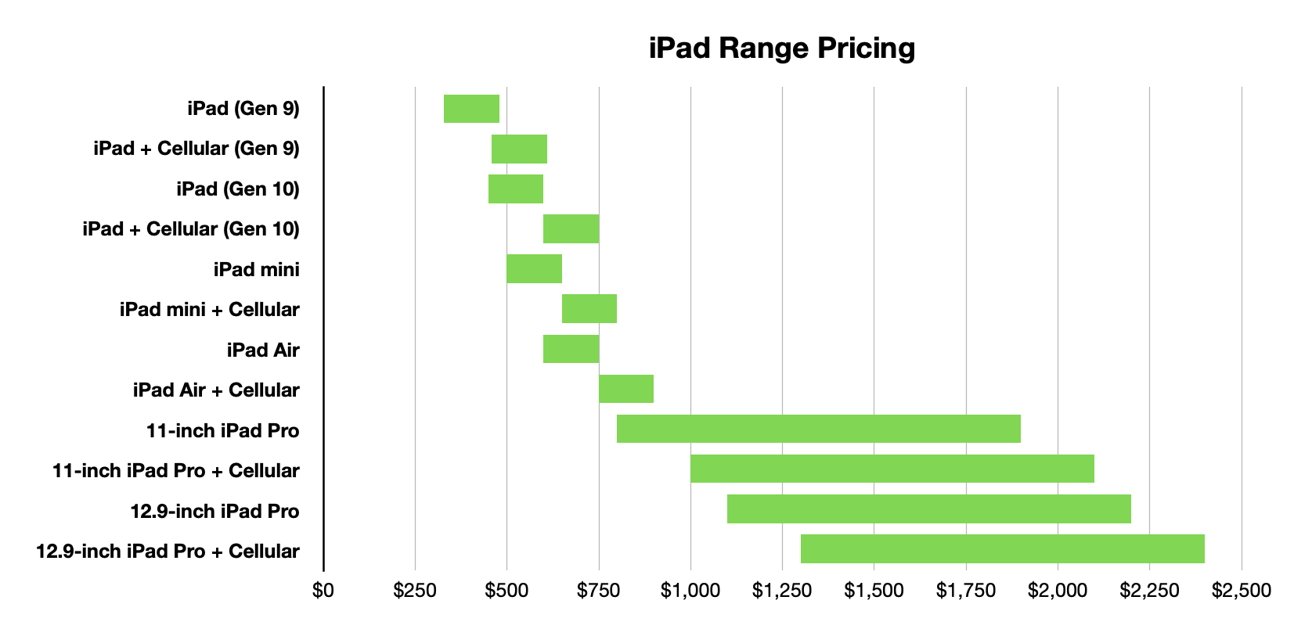
Apple has some of the most amazing Price Laddering I've ever seen.
Folks complain about only 1 external monitor support, etc.
This is all part of Apple's price laddering strategy.
MKBHD does a good job describing it.
https://www.youtube.com/watch?v=XeDPwpIFs-I
Here it's visualized (for iPad)
https://photos5.appleinsider.com/gallery/50966-100692-nov-20...
It looks like they have had the laptops for 3.5 years now, and I've never heard a single complaint about performance or compatibility. One reports the battery life has dropped tremendously. But frankly, these things are basically reliable appliances. I was expecting both to be completely broken by now and have been very pleased.
I wonder if that explains the battery difference.
USB-C Alt-Mode and Thunderbolt always trump DisplayLink. So it's best to figure out first what displays you want to connect and then buy the Mac that supports that configuration. But if you already have a Mac that doesn't support the number of displays that you want to hook up, DisplayLink is a solution.
Luckily, these new MacBook Air models support two external 5K@60Hz displays with the lid closed.
I was cautious about this issue before buying the device, but the fears turned out to be unfounded. Sure it won't be good enough for competitive gaming or something like that, but watching youtube is pretty good, and text rendering is indistinguishable from regular display. The only issue is that refresh rate seems to be about 30fps but for many tasks it is acceptable.
> USB-C Alt-Mode and Thunderbolt always trump DisplayLink.
Yes, but does it allow you to connect 3 displays to your notebook? I actually wanted just 2 external displays, but the DisplayLink device had 2 ports, and I have many HDMI displays laying around, so I connected 3 because I can.
I've used both and while Displaylink works, native support is definitely snappier. Not by much, but just enough to be able to notice.
It's awful design... It would had been forgivable if it was just a small circular camera cutout, but I'm guessing they didn't do that purely because they wanted to be different. Plus to go with a circular camera cutout on their Macbooks would suggest that it's not a great design choice on the iPhone either.
It's the only thing I genuinely hate about my M3 Macbook. Almost everything else is great.
This time, it supports for up to two external displays with the lid closed.
The Macbook Air with M1 is already discontinued. [0].
Can't wait for the Mac mini with M3 Max or Mac Studio with M3 Ultra.
[0] https://www.macrumors.com/2024/03/04/apple-discontinues-m1-m...
I like M1 Pro so far with models up to 30-70b parameters, but the memory bandwidth is my current limit.
With a large jump in unified memory and bandwidth we could see 120b parameter models running on a laptop.
As a side note, why does Apple continue to reference the Intel MacBook Air... It's over 6 years old now, no shit this new CPU is 16x faster...
These kind of comparisons are still valid for me. There are plenty of others less technical than me that want these too. The youngest intel Airs only just aged out of applecare coverage last year, and for most casual users getting 4 years out of an Apple computer is totally expected.
I wouldn't be surprised if they could double performance.
I know Apple is pushing MLX, and MLC-LLM is fast too, but in practice most Mac users (I think) are using llama.cpp based stacks.
I can even develop and run Apple MLX code while I'm streaming. (I lose a few frames when generating images with Stable Diffusion or load big LLMs like Gemma 7B.)
My MacBook Pro M1 wasn't there for streaming and recording at the same time. But even an M1 Max could do the job as well.
The quality of the 16" MacBook Pro (Liquid Retina XDR?) is way ahead of the MacBook Air... which is a shame, because my dream form factor is the 15" MacBook Air. The 16" is so bulky and heavy.
(On the other hand, most of the time I hook my 16 up to Apple's Studio Display, which is definitely not ProMotion or anything exceptional!)
Is this really a benchmark someone would diffrenatiate buying options?
I avoid the MS Office suite wherever I can. Recently went through some lengths to deactive Microsofts intrusive updating background service (nearly as bad in slowing down my system as Adobes).
I would be interested to find out how many individuals and families pay for Microsoft’s software, when apple and google provide free alternatives. (Maybe constrained to families that use mac / iphone, Microsoft might be more popular for Windows families?)
ie: For most people, if you’re not getting free access through work or school, is it actually worth paying for?
All data was lost because the storage is not removable.
Replaced it with a Framework which will more repairable and has removable storage.
Basics matter.
I have removable disks in my workstation but that has never saved me from data loss. The most common cause of data loss is an errant "rm -rf" or "git checkout" or whatever. The second most common cause is the storage media failing (bad sectors, flash wear, etc.). On portable devices, I imagine one of the most common causes of data loss is losing the device itself.
The only way to prevent these classes of data loss is with backups. "One is none."
Is it only this one with HDMI from Apple? https://www.apple.com/shop/product/MUF82AM/A/usb-c-digital-a...
are there others with USB-A with Displayport or USB-C Display connection?
Frankly, Apple is an amazing organization and I am extremely thankful that they've empowered product designers to bring us these amazing creations.
Apple is one reason that I love existing in this era. Sure, there are others. But having Apple... enables me to bring a laptop + a backup battery (anker 737) practically anywhere and work all day without needing a direct electricity connection.
Laptop + Phone + external battery packs = work all day
The light weight, stay-cool-ness ... makes it so easy to work from.
I love you Apple. So glad to not have to use Windows. Sure, Linux desktops distros are decent (despite bugs), but Apple "just works".
how about we make them thicker, so there's enough room to keep the screen from eventually touching the keys when closed and permanently marring it after a few years. I guess, its only been happening since 2007, probably not enough time to come up with a solution.
/rant
At which point you might as well spring for the Pro.
I can't fault the business logic but as someone who'd only use a Mac for occasional iOS development, this nudging upward dissuades me from pursuing that idea altogether.
The Air with 16GB is not too bad, especially if you get the discounts that are everywhere.
Wow. Until they support CUDA or more ML/AI implementations on their chips, this is just marketing speak.
But "supports cloud-based solutions" is a pretty lame way to sell it.
I purchased an M1 Mac Mini and I regret it, I should have gotten a laptop because I often find myself wanting to use my computer outside of my office. I am not doing anything crazy with this thing, just photo editing and light coding.
Is there any reason why I should choose a Pro over an Air at this point?
But I also rarely do much on it aside from web browse and write small Flutter and Golang apps.
I'm disappointed with the low ram and storage specs, but you also get a laptop that'll last until the unreplaceable battery dies.
I opted for a M2 Air in October seeing small differences in M2 pro vs M3 pro, so I guess I was right - the difference must be so small that Apple can't stomach the difference.
I'd rant about how they try to market new models with more and more stupid marketing when they don't have anything to show, but I guess this only means I don't need to upgrade for a while since they are all out of proper innovation...
Imagine being a fanboy for Apple this days. Nothing to look for. They are so blatant in extracting value and not bringing anything new to the table, probably best compared to Nokia in it's heyday.