Lost me at the first sentence. Let me fix it:
“Planners follow the flavour of the day while committing the same sins over and over, their failures recognizable only in retrospect once replaced with a new (also faulty) paradigm based on centralized planning. Despite their repeated failures, as an industry or field of study they show no contrition and continue to act as if they and only they know what’s best.”
As a whole planning departments seem unable to defend decisions with relevant data and instead rely on indefensibly old manuals and standards. Some of which themselves use indefensible statistics- particularly traffic manuals (lets plan our roads based on a survey of a similar road in Atlanta in 1994!). Or worse municipalities follow each other in circles and trends.
This would all be fine if the downstream effects weren’t affecting investment with a floor of tens of millions dollars.
I don’t know what the answer is but Parking Reform, Strong Towns and Not Just Bikes are my north stars on this stuff. Do you have any others?
What’s worse, is to watch governments now rush to “fix” the mistakes that they are solely responsible for by punishing people - retroactively changing the rules - and costing average folk their savings. I refer to Canada specifically which made it so challenging to build housing for 40 years that we have a massive scarcity and housing crisis that is being “fixed” by taxing / fining people for having a second home.
Over the last century, economics has build some of the necessary concensus to move closer to a science and architecture has moved closer to art + compliance, leaving the rest to civil engineers.
But global urban planning communities remain at each other's throats, and if anything, have diverged even further.
Traffic engineering is a joke because Uber and Google Maps run better traffic simulations than any planning committee in the country. The science has been available to those who want to find it. It's avoidance by planning groups (not blaming the engineers so much as the overall organization) evokes the incompetence/malice comparison from Hanlons razor.
The Urban planning outcomes of the anglophone vs the rest of the 1st world might as well be spitting in each other's faces. Given similar policy goals, cultural values and weather....one of them is wrong.
And I know I have placed my bets.
I think you might like this planning talk given in the 90s. One of my favourite videos on youtube and quite hilarious at times:
The Suburbs Are Bleeding America Dry | Climate Town (feat. Not Just Bikes) : https://www.youtube.com/watch?v=SfsCniN7Nsc
I’ve seen them be quite proactive with plans near the Metro extension. But then VDOT does dumb shit like failing to build out multi-modal transit to meet the vision of the local planners.
https://islandpress.org/books/arbitrary-lines#desc
By getting planners out of some of the unnecessary minutiae of their jobs, they can, well, actually plan for things. Ensure that we have good street grids, land set aside for parks and schools that are harder to retrofit into a pure 'anything goes' system, and also try to do some planning to keep genuinely noxious uses away from where people live, rather than "keeping apartments away from the 'nice' neighborhoods".
I find it wild how much the west abhors eastern communist central planning and then adopts it for the very fabric of its communities.
The city zoning board denied me, saying that that 5-acre plot had been zoned for ONE house and an ADU of no larger than 300 sqft.
That was when I realized why housing is so expensive.
But then there is a corresponding increase in property tax revenues to pay for it, so this should require no approval and just be something that happens. The city pays for the new infrastructure from the taxes paid by the new people using it.
I've lived a ridiculous number of major USA cities and I'll never forget what Houston, which is the only one I can think of that had no zoning, looked like.
https://www.chron.com/news/houston-texas/houston/article/Wei...
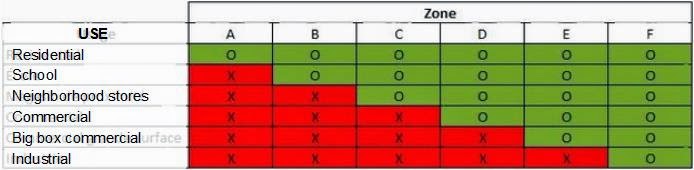
You'll notice that the model is additive instead of exclusionary. Basically if a block is zoned light commercial, you can put stores, apartments, or single family homes on it. Here is a nice chart https://1.bp.blogspot.com/-Lweabho82d0/U0HCJsQ3tbI/AAAAAAAAA...
Tokyo does zoning right, and the simplest first step to solve housing problems that plague major American cities is to just adopt a model of zoning that is proven to work.
A national zoning law is very interesting.
My biggest complaint about every city in TX I lived in (Houston, Austin, SATX, Dallas) was the lack of MDUs (among other things) causing them all to be painfully sparse. I lived in the densest neighborhoods I could find, usually Uptown or with Austin right off Guad by UT and 5th/Comal and my life now living in Denver which has a HUGE amount of MDUs/Duplexes/etc everywhere is so drastically different even though Denver has nowhere near the population of those. I haven't driven my car in months and nearly everyone I know lives in a 1-10 block radius.
What was my previous mountain view from my 4 story townhouse is now an 11 story office building directly behind me that glares down at my patio, though, so there's that. I think it's coming with 400-1000 car parking spots (underground garage).
We've been trying to get this (currently) low-traffic, low-mph throughfare street to completely ban car traffic and be turned into pedestrian/restaurant walking only, which it was during COVID and was wonderful, so that's probably dead in the water now.
By the way, this is very common in many Latin American countries such as Colombia. When you walk through these neighborhoods it's at first a bit odd because you're not used to seeing single family homes next to towers (coming from the US at least). But then you realize it's totally fine and the neighborhoods are in many cases really really nice.
I feel like one partial solution for NIMBY brain is travelling to cities in other countries and seeing things are different and realizing that it's actually totally fine.