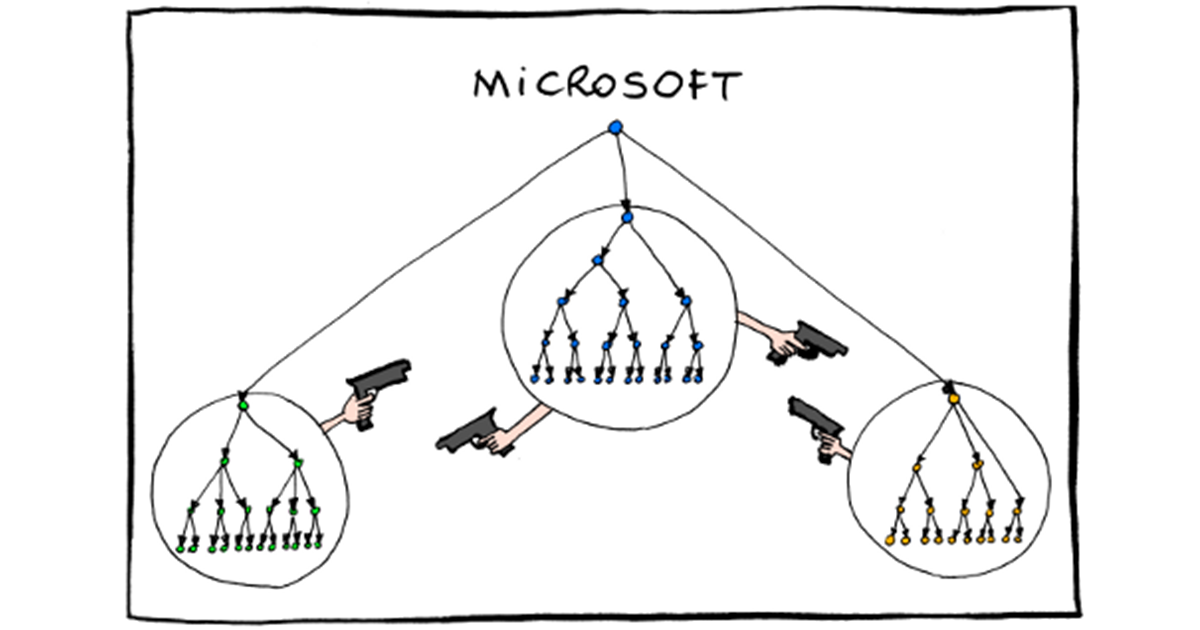
It's the benefit of how Apple does product ownership. In contrast to Google and Microsoft.
I hadn't considered it, but AI convergence is going to lay bare organizational deficiencies in a way previous revolutions didn't.
Nobody wants a GenAI feature that works in Gmail, a different one that works in Messages, etc. -- they want a platform capability that works anywhere they use text.
I'm not sure either Google or Microsoft are organizationally-capable of delivering that, at this point.
Your quote really hit me. I trust Apple to respect my privacy when doing AI, but the thought of Microsoft or Google slurping up all my data to do remote-server AI is abhorrent. I can't see how Microsoft or Google can undo the last 10 years to fix this.
I'm actually a little gobsmacked anyone on this forum can type those words without physically convulsing.
The even more terrible part is I'm sure it's common. And so via network externalities the rest of us who do NOT trust any of these companies on the basis that all of them, time and again, have shown themselves to be totally untrustworthy in all possible ways, will get locked into this lunacy. I now can't deal with the government without a smartphone controlled by either google or apple. No other choice. Because this utter insanity isn't being loudly called out, spat upon, and generally treated with the withering contempt that these companies have so richly and roundly earned this decision is being made for all society by the most naive among us.
Rather, I think they meant "trust" as in "Apple is observably predictable and rational in how they work toward their own self-interest, rarely doing things for stupid reasons. And they have chosen to center their business on a long-term revenue strategy involving selling high-margin short-lifetime hardware — a strategy that only continues to work because of an extremely high level of brand-image they've built up; and which would be ruined instantly if they broke any of the fundamental brand promises they make. These two factors together mean that Apple have every reason to be incentivized to only say things if they're going to mean them and follow through on them."
There's also the much simpler kind of "trust" in the sense of "I trust them because they don't put me in situations where I need to trust them. They actively recuse themselves from opportunities to steal my data, designing architectures to not have places where that can happen." (Of course, the ideal version of this kind of trust would be a fully-open-source-hardware-and-software, work-in-the-open, signed-public-supply-chain-ledger kind of company. You don't get that from Apple, nor from any other bigcorp. Apple's software is proprietary... but at least it's in your hand where you can reverse-engineer it! Google's software is off in a cloud somewhere where nobody can audit changes to it.)
Apple tells a pretty compelling lie here. Rather than execute logic on a server whose behavior can change moment to moment, it executes on a device you "own" with a "knowable" version of its software. And you can absolutely determine no network traffic occurs during the execution of the features from things announced this week and going back a decade.
The part that Apple also uploads your personal information to their servers on separate intervals both powering their internal analytics and providing training data is also known, and for the most part, completely lost on people.
I do not have either Google or Apple accounts and I do not intend to ever open such accounts (despite owning some Android smartphones and having owned Apple laptops).
Because of this, I am frequently harassed by various companies or agencies, which change their interaction metods into smartphone apps and then deprecate the alternatives.
Moreover, I actually would be willing to install such apps, but only if there would be some means to download them, but most of them insist on providing the app only in the official store, from which I cannot install it, because I have no Google account.
I have been forced to close my accounts in one of the banks that I use, because after using their online banking system in the browser for more than a decade, including from my smartphone, they have decided to have a custom app.
In the beginning that did not matter, but then they have terminated their Web server for online banking and they have refused to provide directly their app, leaving the Google store as the only source of it.
I have been too busy to try to fight this legally, but I cannot believe that their methods do not break any law. I am not an US citizen, I live in the European Union, and when an European bank (a Societe Generale subsidiary) refuses to provide its services to anyone who does not enter in a contractual relationship with a foreign US company, such discrimination cannot be legal.
I trust Apple more than I trust Google to not share my data with a large group of corporate entities who want to sell me things I do not wish to buy.
I believe both - and if required, organizations like Mozilla, Ubuntu, Redhat/Oracle, whoever - to comply with law enforcement requests made of them to hand over any data relating to me that they might hold. I'm OK with that. I think Apple has less of that data than Google, and works actively to have less of it. Google works actively to increase the amount of data they have about me.
I think even if you had a functional device using entirely open software, that any organisation you share that data with or use to communicate with using that device - including cloud service providers, network providers, and so on - would also comply with law enforcement.
"Ah!", you say, "But I get to choose which crypto to use! I know it won't have backdoors!". To which I will reply you are unlikely to have read and truly understood the source code to the crypto software you're using, and that such software is regularly shown to have security issues. It's just not true that open source means that all bugs become shallow, and the "many eyes" you're hoping for to surface these issues are likely employed at, err, Apple, Google, Redhat, Ubuntu, Mozilla...
I look at the landscape and I conclude that true open source environments have a ton of issues, Google/Android have far more (for my taste), and that I am more confident in Apple than I am in either myself (even as an experienced tech expert), or Google, or Microsoft, to keep my data private to me to the greatest extent legally permissible.
Do I think "legally permissible" should be extended? Sure. Do I wish a multi-billionaire would throw 50% of the net worth at making open source compete on the same level? Yeah, cool. Do I think any of that is realistic in the next 5 years? No. So, I make my bets accordingly, eyes wide open, balancing the risks...
Sorry, but this seems like a very vague claim to me. Can you specifically point out a time where Apple proved itself untrustworthy in a way that impacts personal privacy?
When Apple says they treat my data in a specific way, then yes I do trust them. This promise is pretty central to my usage of them as a company. I'd change my mind if there was evidence to suggest they're lying, or have betrayed that trust, but I haven't seen any, and your post doesn't provide any either.
End to end encryption? Sure, but we’re sending your location and metadata in unencrypted packets.
Don’t want governments to surveil your images? Sure, they can’t see the images - but they’ll send us hashes of illegal images, and we’ll turn your images into hashes, check them against each other, and report you to them if we find enough.
Apple essentially sells unbreakable locked doors while being very careful to keep a few windows open. They are a key PRISM member and have obligations under U.S. law that they will fulfil. Encryption backdoors aren’t needed when the systems that they work within can be designed to provide backdoors.
I fully expect that Apple Intelligence will have similar system defects that won’t be covered properly, and will go forgotten until some dissident gets killed and we wonder why.
For a look at their PR finesse in tricking media, see this, over the CSAM fiasco that has been resolved, in Apple’s favour.
https://sneak.berlin/20230115/macos-scans-your-local-files-n...
Nothing wrong there per se, its just good to realize it.
Ah yes, blame the simple-minded plebes who foolishly cast their noses up at Windows Phone. If only Ballmer were still in charge, surely he'd have saved us from this horrible future of personal, privacy-respecting AI at the edge...
Apple is very intrusive. Macos phones home all the time. ios gives you zero control (all apps have internet access by default, and you cannot stop it)
Apple uses your data. you should be able to say no.
And as for your data, they do other things too, a different way. Everything goes to icloud by default. I've gotten new devices and boom, it's uploading everything to icloud.
I've seem privacy minded parents say no, but then they get their kid an iphone and all of their stuff goes to icloud.
I think apple should allow a personal you-have-all-your-data icloud.
Depends on where you are. Apple will bend over backwards when profits are affected, as you can see in China.
Ironically, the only time a large company took a stand at the cost of profits was in 2010 when Google pulled out of China over hacking and subsequently refused to censor. Google has changed since then, but that was the high watermark for corporates putting principles over profits. Apple, no.
My impression is that they had little chance to survive in a Chinese market, competing with a severely limited product against state-sponsored search products while also being a victim of state-sponsored cyberattacks.
It was the morally correct decision, but I don't know if they were leaving any money on the table doing so. I suspect the Google of today would also decide not to shovel cash into an incinerator.
Google wants to track even my physical security key across sites to track me.
How can I trust their AI systems with my data?
So they were effectively asking for the make and model.
There are non-certified authenticators which may have unfortunate behaviors here, such as having attestations containing a hardware serial number. Some browsers maintain a list and will simply block attestations from these authenticators. Some will prompt no matter what.
There is also a bit of an 'Open Web' philosophy at play here - websites often do not have a reason to make security decisions around the make and models of keys. Having an additional prompt in a user conversion path discourages asking for information they don't need, particularly information which could be used to give some users a worse experience and some vendors a strong 'first-mover' market advantage.
In fact, the motivator for asking for this attestation is often for self-service account management. If I have two entries for registered credentials, it is nice if I have some way to differentiate them, such as knowing one of them is a Yubico 5Ci while the other is an iPhone.
Many parties (including Google) seem to have moved to using an AAGUID lookup table to populate this screen in order to avoid the attestation prompt. It also winds up being more reliable, as software authenticators typically do not provide attestations today.
It’s unlikely latency would permit them to proxy every request to fully mask end-user IPs (it’s unclear what “obscured” means), and they would probably include device identifiers and let Microsoft maintain your shadow profile if that could improve ChatGPT output (it may not require literally storing your every request, so denying that is weasel phrasing).
I first bought some devices for myself, then those devices got handed off to family when I upgraded, and now we're at a point where we still use all of the devices we bought to date - but the arbitrary obsolescence hammer came down fairly hard today with the intel cut-off and the iPhone 15+ requirement for the AI features. This isn't new for Apple, they've been aging perfectly usable devices out of support for years. We'll be fine for now, but patch support is only partial for devices on less-than-latest major releases so I likely need to replace a lot of stuff in the next couple of years and it would be way too expensive to do this whole thing again. I'll also really begrudge doing it, as the devices we have suit us just fine.
Some of it I can live without (most of the AI features they showed today), but for the parts that are sending off to the cloud anyway it just feels really hard to pretend it's anything other than trying to force upgrades people would be happy without. OCLP has done a good job for a couple of homework Macs, I might see about Windows licenses for those when they finally stop getting patches.
I'd feel worse for anyone that bought the Intel Mac Pro last year before it got taken off sale (although I'm not sure how many did). That's got to really feel like a kick in the teeth given the price of those things.
Could also be a memory problem. The A17 Pro in the iPhone 15 Pro comes with 8 GB of memory while everything before that has 6 GB or less. All machines with the M1 or newer come with at least 8 GB of memory.
PS: The people who bought the Intel Mac Pro after the M1 was released knew very well what they were getting into.
The iPhone 15 Pros were the first iPhones with 8GB. All M1+ Macs/iPads have at least 8GB of ram.
LLMs are very memory hungry, so frankly I'm a little surprised they support such low memory requirements (especially knowing that the system is running other tasks, not just ML). Microsoft's Copilot+ program has a 16GB minimum.
The new AI features will be available on the iPad Air I just ordered, and on my M1 MacBook Air, and I'll be able to play with them there until I'm ready to upgrade my phone. I think these new features sound great, but I'm not in any hurry to adopt them wholesale.
And if you don’t like them you don’t have to use them. I don’t use Siri and it doesn’t bother me that Apple includes it on all their machines.
What is it about this release that has lost your support? Specifically gating the Apple Intelligence stuff to the most modern hardware?
My MBP hasn't hasn't been _fully_ supported for many years. The M1-specific features started rolling out in 2021 - ability to run iPad apps being the most obvious one, the ability to get the globe view in maps being the most questionable. IIRC, my MBP did not yet have a M1 Pro/Max version available for sale when they announced the M1-specific features.
The point being, having AI features unavailable doesn't make the Mac unusable any more than it makes an iPhone 15 unusable. Those parts should continue to operate the way they do today (e.g. with today's Siri).
Hardware matters again now in a way it hasn’t for a couple of decades.
The old Macs can still install Linux/Windows/ChromeOS Flex. iPads/iPhones not so much.
Apple has a clear intent that allows the subsequent groups to work towards and contribute to it. Google and Microsoft don’t. They have a vague idea, but not something tangible enough for subordinate leaders to meaningfully contribute to.
There was also likely no team on calculator at all (are there bugs that justify a maintenance team?), so it needed a big idea like 'Math Text' to be green-lit or it would simply never come. This is despite missing calculator being an obvious deficiency, and solving it via a port to be a relatively tiny lift.
Totally agree on the AI points. Google may have incredible research, but Apple clearly is playing to their strengths here.
Like what's going on inside Google, it's getting stupidly political and infighty. If someone tries to build a comprehensive LLM that touches on gmail, youtube, docs, sheets etc, it's going to be an uphill battle.
None of them would work on-device, all would leak your data into the training set.
It showed you contextual cards based on your upcoming trips/appointments/traveling patterns. E.g. Any tube delays on your way home from work. How early you should leave to catch your flight.
This alongside Google Inbox was among the best and most "futuristic" products.
I was glad to see today Apple implementing something similar to both of these.
There'd be constant sabotage.
Lots of middle management power groups that would prevent a cohesive top down vision from easily being adopted.
Anyway, while I see all of your points, none of the things I've read in the news make me excited. Recapping meetings or long emails or suggesting how to write are just...not major concerns to me at least.
Microsoft seems to have lost all internal cohesion and the ability to focus the entire company in one direction. It's just a collection of dozens of small fiefdoms only caring about hitting their own narrow KPIs with no overall strategic vision. Just look at the mess of competing interest that Windows 11 and Edge have turned into.
Quick, what’s “copilot”?
https://crmtipoftheday.com/wp-content/uploads/2017/07/ms-org...
they are irrelevant on the mobile ecosystem, a place where almost all this features are most relevant and useful
As a(n amateur) fiction writer who pays too much for ProWritingAid each year, I'd love to see if this feature is any good for fiction. I take very, very few of PWA's AI-suggested rewrites, but they often help me see my own new version of a bit of prose.
This Apple AI presupposes their strong ecosystem, which no one has anything similar to. Google was in a good position years ago, but they are criminally unfocused nowadays.
But for some reason, they decided to just stick to feature tidbits here and there and chose not to roll out quality-of-life UI features to make Gemini use easier on normal apps and not just select Google apps. And then it's also limited by various factors. They were obviously testing the waters and were just as cautious, but imho it was a damn shame. Even summarization and key points would've been nice if I could invoke it on any text field.
But yeah, this is truly the ecosystem benefit in full force here for Apple, and they're making good use of it.
RCS isn't fair, Google wanted the carriers to work on that, but in a disparate ecosystem they also couldn't come to a decision
Also, apple bought up more ML startups than google or microsoft.
Neither is great, but at least the megacorp has a financial incentive to maintain some of my privacy.
Sounds like some crazy level of meta where your brilliance is applicable to any pair of mega corps...which I don't buy.
I'd _love_ to be able to pull down my email from Fastmail, Calendars from iCal, notes from Google Notes etc to a single LLM for me to ask questions from, but it would require all of the different sources to have a proper API to fetch the data from.
Apple already has all it on device and targeted by ML models since multiple iPhone versions ago. Now they just slapped a natural language model on top of it.