* https://en.wikipedia.org/wiki/LGM-25C_Titan_II#Mishaps
* https://en.wikipedia.org/wiki/1965_Searcy_missile_silo_fire
* https://en.wikipedia.org/wiki/1980_Damascus_Titan_missile_ex...
I do see military vehicles traveling to and from the one that I am close to semi regularly, perhaps a month or so on average.
As far as fire response, they likely have their equipment for that at the control centers as well.
Sounds like a serious weak point
Digging into one of the cables is going to get you a prompt and unpleasant visit from base security.
https://en.m.wikipedia.org/wiki/LGM-30_Minuteman#/media/File...
There are alternate ways to launch the missiles (e.g. radio from a plane) in the event of an attack.
Actual change in procedure? Or just extra cheek-clinching?
Around 2000 land owners are affected, and anecdoctally it seems to add a few days to a 811 response (~a week instead of 2-3 days).
This sounds like it couldn't possibly work (surely all the little errors compound?) but apparently it's how Apollo navigated
https://wehackthemoon.com/tech/inertial-measurement-unit-mec...
GPS can be jammed (see Russia-UKraine war), so inertial systems are still very important for rockets, for example some HIMARS rockets start with GPS and then rely only on inertial while getting close to target.
Sidewinders are another example. Both developed at China Lake.
I remember taping two together back to back and integrating acceleration across them. That's when I learned Kalman filters. It was accurate enough so I could throw it across my desk and measure the desk length :)
https://en.wikipedia.org/wiki/Kalman_filter#History
https://github.com/chrislgarry/Apollo-11/blob/master/Luminar...
I think if I kept messing with it, it'd get a lot better, but I sorta lost interest. This was more of a fun weekend toy.
I think all phones have them, and they might be reachable through chrome/safari. And it is kinda fun to play with, but you'll probably hit sampling rate errors pretty quick. you gotta guess the shape of the curve between datapoints.
Besides inertial navigation, they had a transponder that would echo back a continuous pseudorandom bit stream, and the delay gave a precise measurement of distance.
Or you can add an external correcting factor, such the Trident's astronav system that takes star-shots to recalibrate the INS.
But it's based on the same idea, only getting position as a derivative of velocity. (And some borderline-magic statistics applied.)
And that's before taking into account the absurdity of how low power the broadcast signal is.
Maybe this has changed or is ineffective now that smartphone/quadcopter IMUs have caught up.
They did not caught up. There are two kind of IMUs: one where you have to account for the rotation of the Earth during signal processing and one where there is no point because it will be lost in the noise anyway. The smartphone/quadcoptee IMUs are the second kind. The first kind is still export controlled.
Random errors (i.e. noise) cancel out in the long run thanks to integration. You're then only left with systematic offset errors which can presumably be calibrated out to a large extent.
But honestly only about half as crazy as GPS would sound if you tried to put it in similar terms. And that's before considering the signal itself is way below the noise floor.
As much as I love these technical writeups, I wish more people who understand the slightly expanded bigger picture/ implications of the missile technologies would write what they know before the generation goes extinct.
There's so many dots that are easily connected from articles like these... but I suspect some level of classification prevents those in the know from being able to publish.
The bulletin of atomic scientists is the only non-fringe source that ever comes close. (Their article on the new generation of warhead fuses is a great resource for those wanting to go down the rabbit hole. Even it now seems to have been scrubbed from their site. [0])
[0] https://web.archive.org/web/20170307194641/https://thebullet...
Eta working bulletin link: [1]https://thebulletin.org/2017/03/how-us-nuclear-force-moderni...
"To target a Minuteman I missile, the missile had to be physically rotated in the silo to be aligned with the target, an angle called the launch azimuth. This angle had to be extremely precise, since even a tiny angle error will be greatly magnified over the missile's journey. " ... "The guidance platform was completely redesigned for Minuteman II and III, eliminating the time-consuming alignment that Minuteman I required. The new platform had an alignment block with rotating mirrors. Instead of rotating the missile, the autocollimator remained fixed in the East position and the mirror (and thus the stable platform) was rotated to the desired launch azimuth. "
Most of the tech for the Minuteman I was developed in the mid-1950s.
With that level of processing, would you rather solve a 2d problem by precisely orienting the missile before launch? Or a 3d one by requiring it to orient during flight?
Keep in mind: any equipment to self-orient in-flight also needs to be carried on the missile itself, while being tolerant of launch, acceleration, and reentry forces.
Any precision machinery at the launch site has no such requirements.
It's also mentioned that the computer uses one of the first integrated circuits for miniaturization. Do you know if this can be definitely traced to advances in industrial/consumer products? It's a common trope that military research trickles down - so it's a "good" thing. It's not clear if this actually happens or if progress would have been made eventually without the need for these machines.
I've been doing a lot of research on the impact of Minuteman and Apollo on the IC industry (which led to the current post). The Air Force likes to take credit for the IC industry, as does NASA, but the actual influence is debatable. My take is that both projects had a large impact on the IC industry, more from Minuteman. However, even in the absence of both projects, there was a lot of interest and demand for ICs. If I had to take a quantitative guess, I'd say that those projects advanced ICs by maybe a year, but the basic trajectory would have remained the same.
Chromates are effective corrosion inhibitors for aluminum alloys and some other metals. Here's a brief article about how they work with aluminum:
"Inhibition of Aluminum Alloy Corrosion by Chromates"
https://www.electrochem.org/dl/interface/wtr/wtr01/IF12-01-P...
When the Wikipedia entry's "Safety" section says that sodium chromate is corrosive, in context it means "destructive to human tissue by contact." That is, like sodium hydroxide (lye) and many other chemicals, in concentrated form it can destroy skin and eyes.
Or maybe early RADAR systems of 1942 and later?
(been reading about WW2 Pacific naval/air wars, and I am curious about these new-at-the-time technologies)
The machinery is ironically beautiful to look at!
How did this compare to its approximate contemporary in the USSR ?
Note that you need to start with the lowest bit with a serial computer, which explains why x86 is little-endian. It goes back to the Datapoint 2200, a desktop computer made from TTL chips and running serially. The Intel 8008 processor was a copy of the Datapoint 2200 (as was the Texas Instruments TMX 1795). Although the 8008 was parallel, it copied the little-endian architecture of the Datapoint 2200.
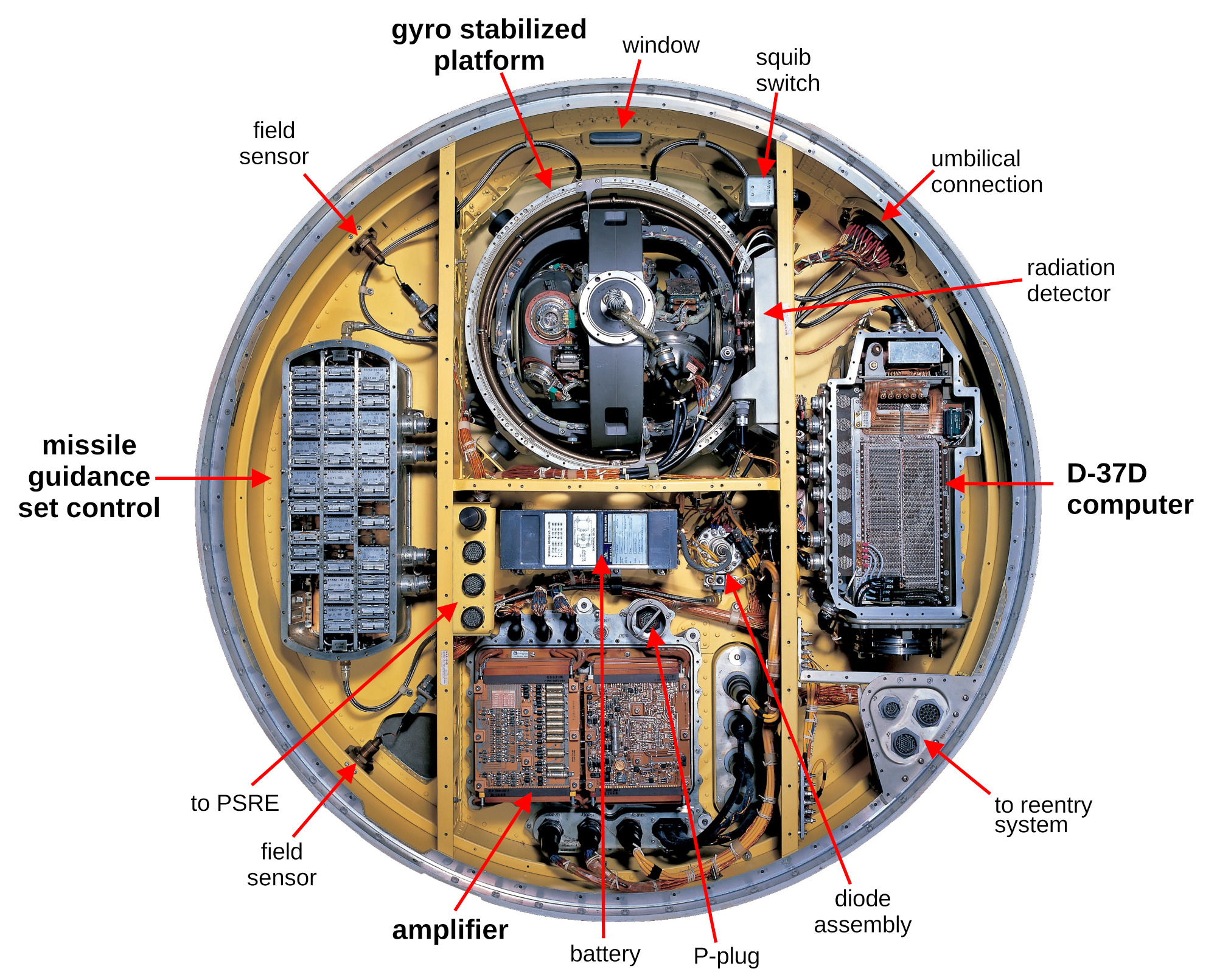
(As labeled in https://static.righto.com/images/minuteman-mmiii/guidance-la...)
> Also note the window in the side of the missile to allow the light beam from the autocollimator to reflect off the guidance platform for alignment.
Had never heard of gyrocompasses before. I worked on a small robot in the past and remember having to calibrate the magnetic compass, which was not very accurate (similar to smartphone compasses). I never thought about how they’d get super precise headings for ICBMs.
The Encyclopedia Britannica article on gyrocompasses is really good. Here it explains why you can’t use a gyrocompass on a vehicle on fast aircraft (and I guess small robots that are jostled around a lot):
> A major contribution by Schuler was the discovery that, when the period of oscillation is 2π√(Earth radius/gravity), the heading precession of the gyroscope spin-axis due to acceleration is exactly the rate of change of the angle between the apparent and true meridians seen on a moving vehicle. The gyrocompass will then read true north at all times if its indicating reference is offset by the angle between these two meridians. The angle, at ship speeds, is a direct function of the north-south speed and is easily set into the system. The need for accurate speed measurement for this offset is the main reason why a gyrocompass is not practical for use in aircraft.
https://www.britannica.com/technology/gyrocompass
Love this article!
I really wonder what the failure rate would be if they were all actually launched today. And I mean failure, from not lifting off, to failure in flight, to misguided warheads etc.
https://www.spaceforce.mil/News/Article-Display/Article/3796...
> I really wonder what the failure rate would be if they were all actually launched today
I hope we will never find out. But certainly there would be many duds. But this is calculated into the effectiveness of the system by simply having more missiles. That is how it achieves its goal of dettering a would be attacker. (Not even talking about how there are two other totaly separate legs of the nuclear triad with dissimilar personel and technical solutions.)
Jeff! Did you remember to take out the warheads? Jeff?!
https://www.youtube.com/watch?v=zUg7x1zo7D0
They can test the missiles and reentry vehicles, everything except the nuclear warhead. The closest those come to a test is a supercomputer simulation, since those tests are forbidden by treaty.
Minuteman III has an excellent but not perfect [0] failure rate. Some other older systems, like the UK's submarine launched Trident missiles... not so much.
[0] https://www.airandspaceforces.com/icbm-test-failure-nuclear-...
https://en.wikipedia.org/wiki/UGM-133_Trident_II
However, the warheads on the UK missiles are designed and manufactured by the UK.
Obviously you can't factor in unknown problems but that's what drills and test flights are for.
„Aligning the missile was a tedious process that used the North Star*t* to determine North.„
Opinion: I don't think the US would if Russia or China didn't first. China likely won't for the same reason the US doesn't need to: they have super-computers and the sims line up with the data from prior tests. Russia might however if only to saber rattle, although they likely don't need to either. Russia however is likely not in any hurry to have a test failure right now. So while testing could resume, I wouldn't put money on it.
Note too, that mil spec silicon is different in that it is resistant to CMOS latch-up, redundant CRC protected self-correcting consensus register ops, and large gate sizes less sensitive to Gamma radiation.
It was an interesting time, and a few people still think living under the Sword of Damocles builds character. =3
Each stage needs to function in the presence of nearby nuclear detonations, resulting from both adversary and friendly weapons.
These detonations are expected to cause severe shock, thermal, radiation, and electromagnetic transients.
In the case of the most important targets, it is guaranteed that numerous detonations near the target, from ABM systems and friendly impacts, will occur, and these systems have been engineered and are expected to perform reliably under such conditions.
Minuteman D-17b: The Desktop Computer Was Born in an ICBM
https://www.youtube.com/watch?v=MJPnZzZtswc (Alexander the ok)
Check him out and give him slack for his vocal fry. It's mildly annoying but the content is just so good.
Obtaining position & veocity: I think it even more interesting when one compares the difficulties of getting these fundamental navigation data in an aerial, ground and undersea platforms.
https://aviation.stackexchange.com/questions/49961/why-are-a...
Minuteman III used a smarter targeting algorithm that only needed 70 words of data per target, so the missile could support something like 8 targets at once, selected by a knob on the launch console. (The launch officers didn't know what the targets were; they were just told to use target #3 for example.) The targeting data was read off punched tape for Minuteman II and a magnetic tape cartridge for Minuteman III.
Simplified launch orders via the football, etc.
One group scenario might have been silo coordinates for an offensive first-strike. One group city coordinates for launch on warning strategic counter-strike, etc.
Each missile got a target from each scenario list programmed into a 'memory slot' with some overlap.
The organization/ optimization is mind-boggling.
But few understand that this is WHY the wargames and strikes had to be pre-planned ahead of time. It wasn't political hubris, but a technical requirement due to memory allocation.
The future so bright, I gotta wear shades.
The scary thing is that, when left alone for a long time, and these rockets have been, "the plates" keeping the chemicals from meeting each other ahead of schedule, corrodes, just a tiny bit at a time. each time raising the possibility of premature ejaculation just a tiny little fraction.
Which to his point would be even more scary, but just isn't the actual real world risk with the way the things were designed.
Plus hypergolics are usually toxic on their own, even without mixing and/or booming, in a quieter, more-deadly-to-technicians way.
Spills and defueling and meeting well-intentioned but bad safety guidelines that require abundant fiddling were the real source of danger. More fiddling == bad.
Iirc, the fuels/oxidizers/reagents/ whatever-liquids mainly behaved like aluminum oxidizing, such that reaction with the tanks components actually created an increased buffer layer of oxidation/ protection.
Tank corrosion wasn't high on the list of risks after it was figured out on a per-chemical basis.
I think it's one of the aspects covered fairly well in (the great, often posted) Ignition! [0]
> O SON OF SPIRIT! The best beloved of all things in My sight is Justice; turn not away therefrom if thou desirest Me, and neglect it not that I may confide in thee. By its aid thou shalt see with thine own eyes and not through the eyes of others, and shalt know of thine own knowledge and not through the knowledge of thy neighbor. Ponder this in thy heart; how it behooveth thee to be. Verily justice is My gift to thee and the sign of My loving-kindness. Set it then before thine eyes. > > ~ Baha'i Teaching
> Be united, O kings of the earth, for thereby will the tempest of discord be stilled amongst you, and your peoples find rest, if ye be of them that comprehend. Should any one among you take up arms against another, rise ye all against him, for this is naught but manifest justice.
> (“Gleanings from the Writings of Bahá’u’lláh”, pp. 253-254)
Examples of that would include ego, greed, petty revenge, etc...
But I guess the way I said it did come across that way, so yeah, my bad
I'm just saying that if we could evolve past such petty ego-based sentiments in the world, then wouldn't such pressure to develop weaponry in such massive amounts, and hence we could focus on actually making a functioning society