So basically the "rush hour" program has likely been costing me more money than if I just ignored them to begin with up to this point. I do realize these programs are primarily about limiting peak gross load and not saving individuals money but maybe I won't go out of my way to abide by them now...
En masse though, it seems not ideal from a cost perspective the way things have been scheduled up until now. I'll give them the benefit of the doubt that it might be adjusted better in the future.
Harder to turn off than anything else in recent memory. If anyone has a pro tip on an easy way to cancel let me know.
Presumably they similarly have some sort of cloud permission into your thermostat, which can be disabled by changing the password, resetting the device, or worst case scenario, get a new thermostat.
Either you are not reading it right, or there is a problem with your thermostat's demand response schedule, because the only way demand response makes money (hence rewards for users) is by reducing demand during net load peaks, because that completes with the high marginal cost of fossil spinning reserves.
Sizing transmission for the absolute yearly peak is not cost effective, so various schemes are used to reduce that peak, including efficiency improvements and demand response.
This is entirely separate from questions of renewable cost and carbon and pollution and makes economic sense even on 100% fossil grids.
I briefly tried out the thermostat program and it was honestly trash. It was near impossible to unsubscribe too.
What's odd in Texas is that they are resisting the notion of connecting to the rest of the US grid. This would allow them to import power cheaply when they need to and export power when they have too much of it. My guess is that they actually curtail a lot of energy at this point because there's simply too much of it most of the time.
A quick glance at the main page of gridstatus.io shows that right now California and Texas are burning a lot of gas while there is negative pricing due to wind delivering over capacity in the states in between. They are literally paying people to consume more power there while they are paying for huge amounts of gas to be burnt in California and Texas. It's night time there of course so, solar is out.
What's preventing states from doing the obvious thing here? The mid west could be exporting power at a profit right now and instead it has negative power. And California could not be burning many tons of gas right now because there's a surplus of power right next to it.
Your regular run of the mill Texan may not care one way or the other, most times. But if they get into a crunch where their electric bills are much higher, I assure you that they will care.
Negative pricing and "burning a lot of gas" are maybe not as bad as you think. As more wind/solar get added to the generation mix, there will be more peak times where prices may become negative. The lens I have is this means there is incentive for more storage to come on the grid to soak up those events and then offload at peak demand times.
It's my understanding that basically the entire point of gas power plants is that they are very cheap to stop and start (as opposed to e.g. coal or nuclear), at least, that's the case in the UK - are these plants different in the US?
I don't necessarily buy the argument but I am fairly certain that a big chunk of it.
We live in a time where functional electric service is a necessity for life. We also live in a time where extreme weather patterns are getting more frequent and more intense.
The very least Texas could do is implement the equipment and procedures necessary to enable importing power from the national grid in an emergency. The cost to implement interconnects at key locations is infinitesimal compared to the costs incurred when there are systemic outages.
The "we can do it better ourselves" argument only works when you don't repeatedly catastrophically fail at "doing it better."
And they never asked for conservation?
Is it normal to go that close to the edge without trying to cut load?
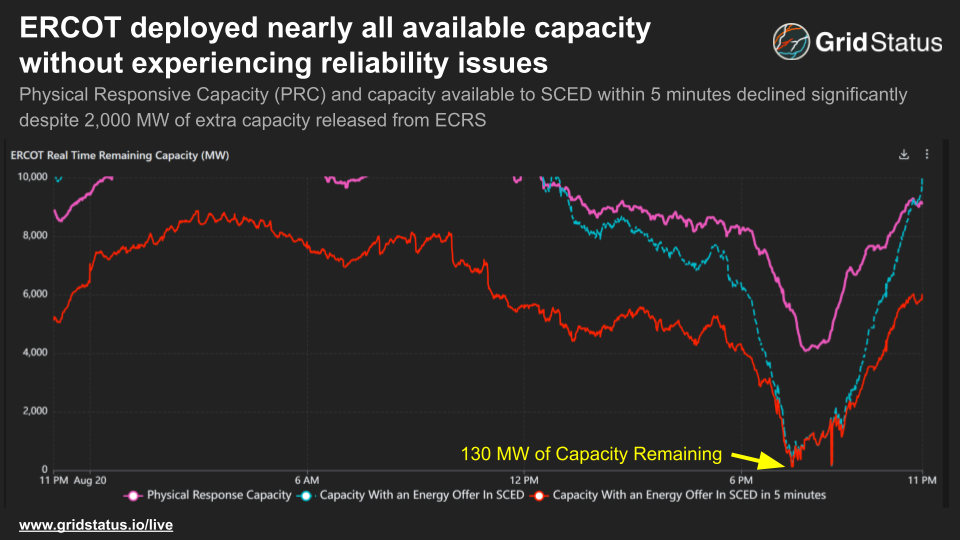
The grid actually had ~4 GW spare capacity (according to the graph) if it was needed, but it wasn't part of SCED.
The graph showed it increasing fast just before. Is it so unthinkable it could jump again?
Or is that they could get more (non-SCED) in time, it would just cost a ton so it's avoided if at all possible?
I imagine the other ERCOT demand response programs were also dispatched.
Not sure how well it works, but they send out another email letting us know how we did compared to similarly sized houses in my area.
If demand goes over the edge, they will start doing rolling black outs.
I haven't paid much attention to them. Perhaps they should put a threat level code in the subject line.
Green = Go about your day
Yellow = Don't use your big appliances or hot water as much
Orange = Yellow, plus turn the thermostat to 80 and keep the doors closed
Red = Bitcoin mines offline. All buildings shut down ancillary consumption. A/C in common spaces set to 85. Prepare to roll blackouts.
Of course, there's zero chance of any sort of state governmental policy to help incentivize it in deep red state land.
But if recent history has shown anything, I would consider it a primary feature of any home in Texas to be relatively grid independent with its own generating capacity and storage.
https://www.gosolartexas.org/available-incentives
A lot of the incentives are from local power companies like Oncor, but one notable state-wide incentive is that solar installations are exempt from property tax by state law.
I dunno why people act like Texas is staunchly anti-renewable. TX state politicians have said some goofy stuff about "windmills freezing over", but overall Texans are extremely pro-wind and pro-solar. It's a huge economic driver for a large part of the state, and it's seen as an overall part of Texas's strong energy industry, complimentary to oil rather than as a competitor to it. George Bush and Rick Perry were both Republican governors but both were _very_ pro-renewable and oversaw massive booms in wind energy especially. In 2005 Texas (including Perry at the time) passed a law to invest billions of state dollars into building transmission lines specifically to make it feasible for renewable energy generation in west Texas to bring power to the populated areas in the east, which is attributed to the massive wind boom. Abbot, on the other hand, has sadly not been very pro-renewable, but much of the state still is.
Uncompensated demand curtailment is such a scam. Just pay people to curtail demand.
The net effect is more power generation available, not less.
Buyers of first and last resort.
Though the data centers are pivoting to AI. https://www.cnbc.com/2024/07/18/bye-bye-bitcoin-hello-ai-tex...
Though it's still significant. https://www.texastribune.org/2024/07/10/texas-bitcoin-mine-n...
The Real-World Costs of the Digital Race for Bitcoin - https://www.nytimes.com/2023/04/09/business/bitcoin-mining-e... ( Published April 9, 2023; Updated Jan. 3, 2024 ). It's a well done presentation.
And they are shocked that this is driving up electrical prices. https://x.com/LtGovTX/status/1800968003636408657 (June 12th, 2024)
> ERCOT CEO Pablo Vegas and others gave shocking testimony today in the Senate Committee on Business & Commerce that within only six years (that’s only three legislative sessions), our power grid needs will grow from about 85,000 to 150,000 megawatts. That is much higher than the 110,000 megawatts they previously projected. The 110,000 megawatts was already a big increase, which is why the Senate pushed our incentive plan to build more dispatchable power last session. 150,000 megawatts is almost double the megawatts we now have on the grid.
> Later testimony said the growth is due to the increases in population, normal business growth, and Artificial Intelligence (AI). However, crypto miners and data centers will be responsible for over 50% of the added growth. We need to take a close look at those two industries. They produce very few jobs compared to the incredible demands they place on our grid. Crypto mining may actually make more money selling electricity back to the grid than from their crypto mining operations.
> Texans will ultimately pay the price. I’m more interested in building the grid to service customers in their homes, apartments, and normal businesses and keeping costs as low as possible for them instead of for very niche industries that have massive power demands and produce few jobs. We want data centers, but it can’t be the Wild Wild West of data centers and crypto miners crashing our grid and turning the lights off.
> The Senators asked why this had not been disclosed before today. #txlege
---
The theory is/was that Texas grid works "best" (the market runs most efficiently) when its running at the most capacity (everyone with something that can generate power is making money - this is better than conserving and asking polluting or less efficent sources to spin down when the demand isn't there ... in theory) with the ability to have things that can't pay for the increased price (in theory, that was supposed to be crypto) scale back their use when other demand goes up.
And the fact that in some time periods it seems the miners made more money from downscaling energy demand during peak loads than they did from mining activities.
Plus residents in some areas are up in arms that these companies got a variety of tax exemptions and sweetheart deals, jobs never materialised (because how many people do you need?), and what they seem to get in return is more expensive power bills.
After background thought for an hour, they should ask. Their load projections and needs should be fed out to the network somehow, and it should be opt in for the customer to help support the projected load shaping IF they desire and can. It should never be forced upon the customers.
The incentives and potential for abuse of the billing provider to provide data that negatively shapes the customer's use into more expensive use is an issue that should be avoided.
No batteries I know of will make economical sense though. Batteries are expensive, wear down and/or require maintenance. After x years / cycles your batteries will be dead and will need to be replaced.
Storing your "free" energy in a battery will end up costing more than just buying the energy when you need it.
Expensive energy storage is a big part of the reason why "green" energy countries like Germany have some of the highest energy prices in the world. And also some of the highest CO2 emissions per kWh in the EU (they need coal and gas powered plants as backups for when there's no wind and solar, because batteries don't make economical sense).
But the part about battery degradation is not true. Tesla Powerwall has a 10 year warranty[1] with 70% capacity retention. This means that Tesla has data showing that the battery will have higher capacity than 70% after those years. That's a lot of cycles and a lot of renewable energy that the battery will provide in its lifetime.
[1] https://energylibrary.tesla.com/docs/Public/EnergyStorage/Po...
Fully integrated consumer battery prices haven't (yet) followed the decline in cell price, probably because there's lot of demand for this kind of product.
Not sure why you consider them to be "green" given the facts you brought up. Germany has never been particularly green energy wise. It's a big population and lots of heavy industry with relatively little energy resources like hydro.
The are building solar and wind quickly now. Maybe that's why you got the impression that they are "green".
Note how ridiculously fast the battery rollout in Texas and California has been recently.
If you've not got some local regulation that stops early adoptors from being left high and dry when the market changes, then you're in head to head competition for that cheap nighttime energy with big corporations building out grid scale batteries.
Don't get me wrong. The BESS helps with frequency, synchronization and voltage issues. They just do very little to flatten the wind spikes without turning off 10-20% of the wind fleet.
[1] https://blog.gridstatus.io/content/images/2024/08/ERCOT-Reca...
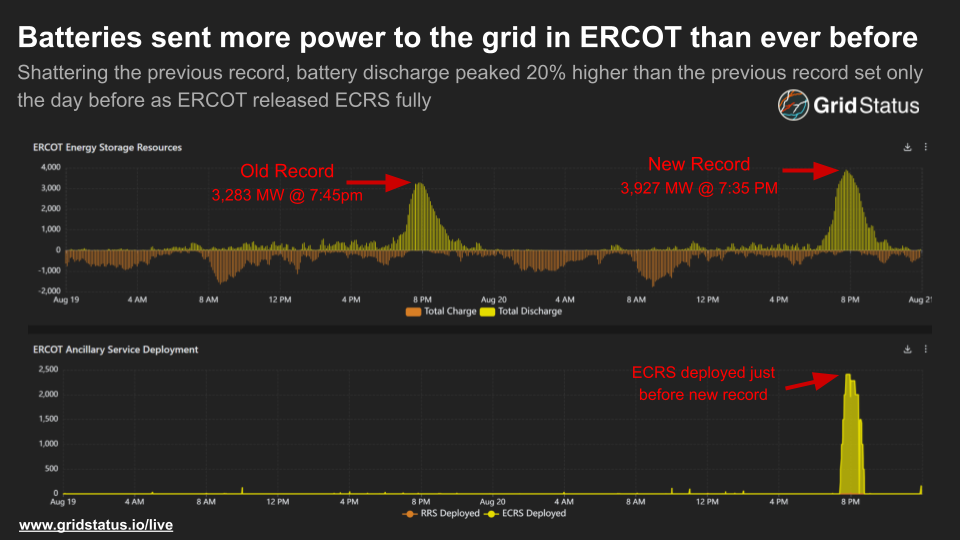
Instead of calling for something that needed more than 5 minutes, ERCOT relied on all the batteries on the grid. I don't know what this quote means:
> 2,000 MW of extra capacity released from ECRS.
But I do know what this means:
> battery discharge peaked 20% higher than the previous record, which was set only the day before.
It's referencing this graph: [2]
[2] https://blog.gridstatus.io/content/images/2024/08/ERCOT-Reca...
The graph has units of Megawatts. In other words, the thing that was record setting about the batteries was not the Megawatt-hours, or total storage in battery systems.
What set the record was the instantaneous power usage, and apparently the batteries in Texas were at their hottest ever. (No idea if anything caught on fire though!)
Here are some more assumptions I am reading into this:
* The 130 MW that didn't come online may have been rotated around. Maybe all the generation jumped in at different times, guided by supply and demand, but ERCOT regulations likely played a role in keeping the existing systems from exceeding the demand or blowing up transmission lines, etc.
* The article says "Solar and Demand Were High Throughout the Day" but I assume that simply means that over time, more and more solar will be installed and more businesses and cities are becoming aware of https://www.ercot.com/services/programs/load (Demand Response). It means they can get cheaper electricity at night for instance, so they run their power-hungry machines when the prices are low.
* Never underestimate the power of Nature. Probably the daytime temps in Texas right now drove the high solar production and high demand. High temps usually mean clear, sunny days and everyone huddling near an air con.
Probably?
> High temps usually mean clear, sunny days and everyone huddling near an air con.
Or all of those mandatory RTO forcing large open spaced cubicle farms to run AC in a building made of glass. Not sure of the image you have in your head being the reverse of homeless huddled around a barrel fire.
>> 2,000 MW of extra capacity released from ECRS.
ECRS = ERCOT Contingency Reserve Service.
Contingency reserve services are used to maintain system reliability during unforeseen events. Think of power plants that can quickly ramp up generation, or other assets that can quickly reduce their demand.
In this case, ERCOT tapped 2,000 MW of capacity from ECRS.
ECRS is a program run by ERCOT, they trigger the battery discharge directly, or in some situations the resources might respond to an under-frequency relay.