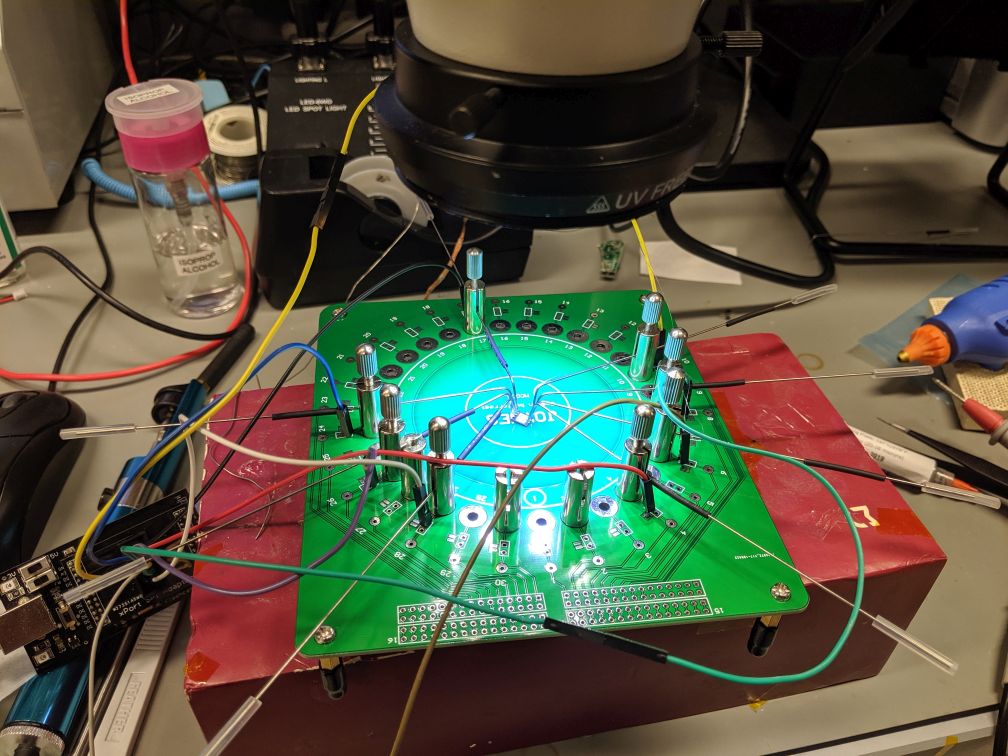
Both pads would have protection diodes to VCC/GND providing phantom power when tied to the appropriate rail. Plenty of chips work fine with phantom power.
I probably would have tried slowly and carefully whittling away the plastic near where the bond wires used to be to try to expose some metal first before using this salt water bath idea, but if it works it works.
Reminds me of PCBite
Very impressive! I wonder at what speed it impacted. I tried reading the chart at the bottom but I'm not sure what "axial" velocity is—probably not vertical speed given it drops over time rather than rises as the rocket dropped.
I suppose you could take the derivative of the height at impact point but I'm too lazy.
What I find interesting is the 4-second delay before igniting the second stage. This is very inefficient compared to immediately igniting it when the first stage burns out. Max-Q (airspeed pressure) issues? 30,000 ft permit ceiling?
Edit: * At 25 sec. it's still going up, so the velocity is decreasing due mainly to gravity, but the rocket is ballistic so the accelerometer is slightly negative due to air friction adding to the gravity deceleration. At about 40 sec. it has reached max altitude and velocity is zero. Accelerometer is still close to zero. Velocity picks up, as shown by barometric altitude curve. Eyeballing it, at about 65 sec. its reached terminal velocity, as shown by barometer curve being pretty flat. Decrease after that is due to decreasing t.v.