Very cool that their hardware keept chugging along for years without hiccup, too.
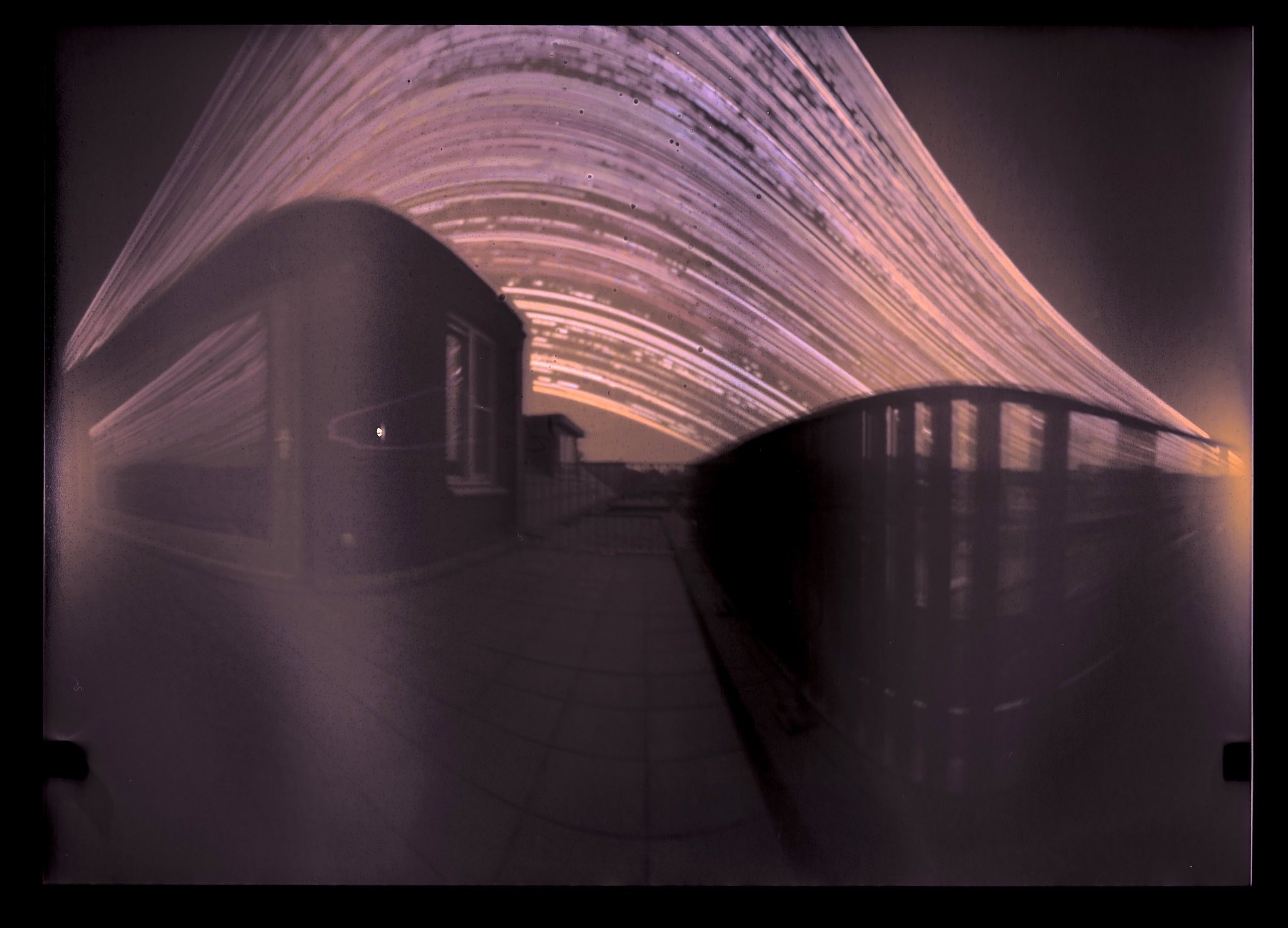
If you want to do something kinda similar but far less involved: a very lo-fi, no computer involved thing to do is an ultralong photographic exposure (months, a year, longer) with a pinhole camera.
The results are quite artistic IMO [1], the camera is fire-and-forget and you don't need any chemicals to develop the image. Just photograph/scan the photographic paper and invert the colors.
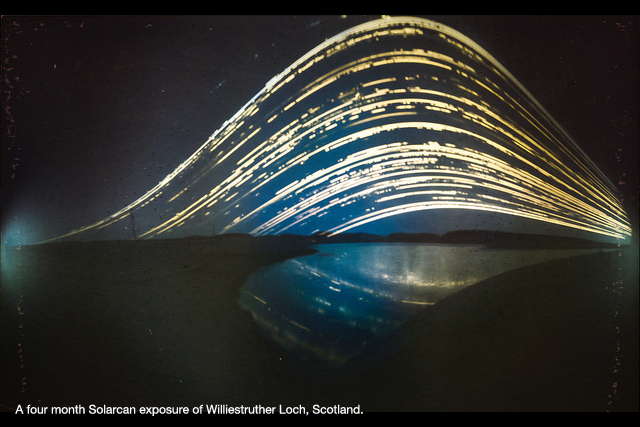
I'm not affiliated with them, but Solarcan sells ready made single-use pinhole cameras. An almost zero-regret purchase I'd say.
[1] You see the sun move through one year of skies, as seen from my balcony: https://files.rombouts.email/IMG_6500.jpeg
People have made wonderful, mildly spooky pictures with these: https://solarcan.co.uk/wp-content/uploads/2018/05/solarcan-p...
Thanks for sharing
To avoid HN hug of death on this 1832 users Mastodon instance.
Very cool arrangement of those pictures, i was wondering what he has done about the daytime pictures when i read the title.
On the other hand, it's driving me absolutely crazy that he centers the image at 4:00 rather than midnight. Or maybe that's to show the shimmer of sunlight a little after noon on the right hand side?
I can't figure out why it's "bluest" closest to dawn and dusk. I'm guessing the exposure makes a huge difference, and obviously the night part is way more exposed than the daylight part, or else it would be much darker. Wondering if the camera used automatic exposure, and how much of the brightness of colors in the image are artifacts because of that? Also if he locked the white point hopefully?
It seems like if you wanted to do this accurately, you'd need to lock exposure to handle a bright blue sky without blowing out -- both aperture and shutter speed. And lock white balance. The question is whether that would allow for sufficient sensitivity at night. But if you're just averaging color values across a section of sky and mainly looking for moon and moonlit clouds, I think it would, since pixel noise will get averaged out and the moon is bright.
I asked o1 to estimate colors by hour and its reasoning and estimates seem fairly convincing[1], and also show more saturated blues dawn and dusk, though it did not model clouds.
1. https://chatgpt.com/share/67795fe3-9ac8-8009-9922-153f40c509...
I think because the night sky offers interesting variation that looks nice stitched together. the sunny day, not so much. I will also point out, OCD notwithstanding, that 0hour/12am is an arbitrary time to start the day, and you should really look at the days/nights all strung together in a long continuous strip
[1] https://shademap.app/@52.39941,4.88468,11.49849z,17360064872...
This means you can ray-march the location of the sun throughout the year over the entire country to calculate exactly where and when a surface is occluded by shadows from nearby (or even faraway, sometimes) objects.
The LIDAR data can be as detailed as a shadow cast by antennas, a chimney or a tree... Which is more important than you'd think, because a little bit of shadow on a single panel means that all panels daisy-chained to that panel will see an efficiency drop! (So you either don't chain them but give each panel its own inverter, or you wreck your neighbors chimney)
https://shademap.app/@-50.35203,-70.98027,4.13034z,173600823...
Well, nothing to do except for storytelling, music, dancing, parties, games, plays, sports, eating, drinking, visiting, festivals, gossip...
People have been pretty good at keeping themselves entertained for a very long time.
Meanwhile, I can see the moon and like ten stars on a typical night, because I live in a city and there is massive ambient light at night.
It's neat that you can look at different things, like cloud cover, the moon, stars and anomalies (such as the aurora). But these are convoluted in the raw data. Deconvoluting these to obtain a keogram of just the sun, just the moon, just the anomalies would probably make for some interesting visualizations.
Here is a link to the keogram section (I didn't know the term), but watch the whole video, I did a bunch of other art:
Sunset on these days after the shortest day is of course even later than sunset of the shortest day.
On the beautiful image of the OP, you can see that after dawn of December 21, dawn continues to get later over the next few days.
In my area, sunrise on 12/21/2024 was 6:54am, and it will continue to get later until 1/8/2025, when it is at 6:59am.
Length of day on 12/21/2024 is 9 hours, 54 minutes, and length of day on 1/8/2025 is 10 hours, 2 minutes.
Searching the web, I haven't found an explanation for this that "clicks" for me as both intuitive and rigorous. Any thoughts or pointers on this?
Here is an approximation that captures the main effect (the 23.5 degree tilt of the earth's rotation axis) and overlooks secondary effects.
Consider the equator. Imagine a circle on the X-Y plane centered at the origin. Angle the circle up 23.5 degrees, rotated around the x axis. The projection of this circle back onto the plane is an ellipse on the X-Y plane, with the vertical axis about 92% of the length of the horizontal axis. Now, consider a series of vectors in the X-Y plane starting on the X axis, with angles in steps of 0.986 degrees. (This is approximately the angle the earth progresses around the sun each day.)
Where each vector hits the unit circle, move the point up or down so that it hits the ellipse. The angle will change a bit for most of the rays. In some cases the angle will be a bit smaller, and in some cases a bit larger. These discrepancies are the variations in time of day of sunrise and sunset over the course of a year on the equator.
Study this Wiki article, especially the components part: https://en.wikipedia.org/wiki/Equation_of_time
See ‘equation of time’ and ‘analemma’ for underlying astronomical explanations, as hinted at by sibling posts.
It's probably because the composition algorithm takes a central line through each image (a line through the zenith), so it captures relatively few horizon-adjacent pixels that would highlight the reds of sunrise/sunset.
Nevertheless, it's the first time I've seen this and liked the project a lot. I've seen this from normal images, but not from such a fisheye lens.
Really cool project.
Edit:
Looking at https://victoriaweather.ca/keogram.php?photo=20120810.jpg how can this contain the entire landscape if only the center line is used, which is supposedly always the same line? I mean, the camera isn't rotating. Is this just another kind of view generated from the dataset?
The year long keogram presents even less data, as it's just the centerline of the keogram for each day. So, essentially just the center pixel of each image. Still gives a good overview of what the sky conditions were like throughout the year.
The fixed column (and upward view) approach used in the main link is better for showing the movement of the sun/moon/stars.
I wish there were a corresponding article with a technical write-up covering both the capturing rig and image assembly process.
Is there an FFmpeg or imagemagick command, or perhaps a Photoshop script to feed the images into?
For the software processing you can use anything; I would write a python script to create a large canvas, and then downscale the images and place them at the appropriate location. You could also load the whole dataset into a large tensor and do anything you want with it.
I noticed the extreme hour glass shape in his image, but it's even more impressive when compared to yours!
I think an early technique of tracking their migration before gps/chip/batteries were small enough was a primitive light sensor + data logger that would log day/night hours on the bird as it flew from island to island and the light data was enough to roughly estimate lattitute (and often enough to infer a location/date.
The data looked great in this form. It wasn't hourglass but with jagged edges and shifts. You could easily see which months the bird stayed in a single place for several days etc. clever stuff.
That's the moon, and it looks like it's increasing cloud cover + dawn causing camera to decrease overall exposure.
It's kind of a fun synchronicity though as just after seeing that video, I watched episode 2 of 3 Body Problem where the same sort of thing happens!