society has always been this way, from the hunter gatherer days, to middle ages - that's why people want to become part of the elite.
It's only recently that the average people have had the chance to become elites, rather than be born into it. But the desire to be elites, molded by evolutionary/darwinian pressure, is not gone, nor different, than in the past. Another word for it is "the human condition".
It still mostly depends on being born into it. In the US your odds of going from impoverished to wealthy are extremely slim and socioeconomic mobility is among the worst compared to other developed countries. The US falls behind South Korea, Lithuania, Estonia, Singapore, Malta, and Slovenia, while the Nordic countries top the list.
Depending on the study, socioeconomic mobility in the US has either stagnated since the 1970s or actually declined. Average people have little hope of substantially improving the situation they were born into while the percentage of people born into wealth (but not the 1%) who slide downward in socioeconomic status grows. Wealth inequality continues to accelerate at an insane pace. (https://en.wikipedia.org/wiki/File:1962-_Net_personal_wealth...)
Just about everyone would like to be one of the "elites" but most people would be happy with a fair chance to meaningfully improve their lifestyle.
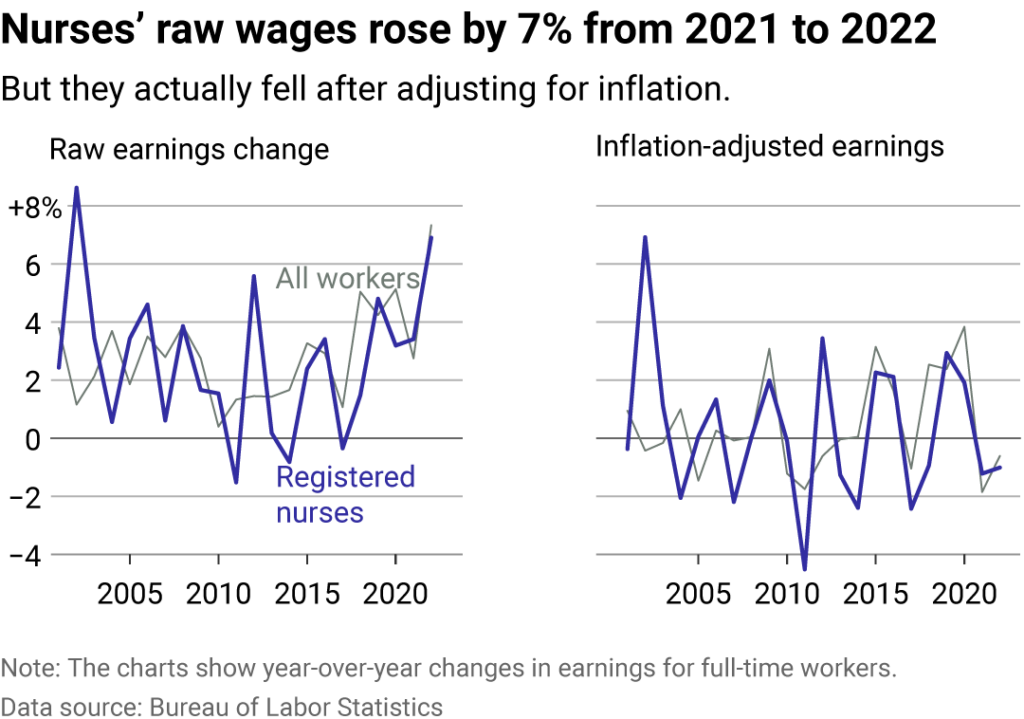
There's a lot of need for nurses which has made the job attractive, but it's worth noting that wages have been going down (https://www.incrediblehealth.com/wp-content/uploads/2024/01/...), they aren't especially higher than the money other workers make, and the actual working conditions for nurses have gotten worse. Telehealth also threatens to reduce both their wages and the number of (US) nurses we'll need in the future.
If people just want work, elder care seems like it'd be a safe bet for a while, but those wages and working conditions can be even worse.
Social mobility is a measure of relative rank change. In countries with compressed wage ranges, such as those you mention, “social mobility” is an artifact of the mathematics, it doesn’t mean you are meaningfully wealthier than the average person. You can double your household income in the US to above average and still not be “socially mobile”. Social mobility is not a meaningful measure for continent-sized economically diverse countries.
A person can go from the trailer park to being upper middle class in a place like Mississippi and it doesn’t count as socially mobile because you are being ranked against the household income of someone in Seattle, 3,000 km away. As far as the person in Mississippi is concerned, they are living the dream.
The opportunity to improve your standard of living in e.g. Europe pales in comparison to the opportunity to do so in the US. It won’t be classified as “socially mobile” in the US as an artifact of how the math works, but no one in the US cares.
In countries like the US, you can achieve enormous gains in income and still not be socially mobile by definition. Specifically, it has nothing to do with how easy it is to become wealthy, which is what most people incorrectly intuit it means.
High “social mobility” is worthless if it doesn’t come with a high standard of living.