From when we started in 2009 to today, we both had to increase two shoe sizes.
She just finished her first 50 mile ultramarathon using Xero thin soled shoes. It was half on the AT, and she had no issues with that.
I'm a less serious runner, just enough to be able to knock out a few miles on demand and the annual Broad Street 10 mile run.
We both hiked 1000 miles of the AT on a thru in 2022. We've also clocked around 3O00 miles of other small day hikes and overnight trips. All with Zeros or Altras, and with a 30lb pack.
Over the years, she's had some minor issues with plantar fascitis that went away when she added in regular stretching. She's had a few bouts of hip bursitis when ramping up mileage for the ultra.
I've had some issues with knee pain that started on the thru hike related to scoliosis. My one hip drops lower than the other, twisting the knee and causing issues on both. Regular single leg exercises and heavy lifting keeps that in check (hard to do on the trail unfortunately).
Neither of us have had any issues with ankles, calves, or typical runner knee issues. I'm not sure I can credit the shoes for all of it, but I'm very glad we started with them and neither of us have any reason to change. Regular thick foam trainers now feel very uncomfortable, it's hard to describe. They squish my toes (which are very wide). They change my gait which feels awkward.
It's funny, now I feel like I see lots of runners in my area using these thin soled shoes, like the Merrel Vaporglove, Xeros, or alternative. Maybe it's cohort bias? Either way I am glad I found them when I did!
I read someone who said that walking barefoot was a religious experience for them, in which every step was a prayer. Someone responded that they weren't as religious, and for them every step was fondling the earth. Both work for me, and both work better with thinner soles.
Barefoot hiking is also very niche from what I've seen, but I do think there is something undeniably nice about walking around camp or a yard in bare feet.
https://www.reddit.com/r/BarefootRunning/comments/1ec5i5n/di...
It's kinda like how some nicer brands offer a variety of size modifiers in addition to "small, medium, large" on their ready-to-wear shirts, like "slim", or Brooks Brothers' named fit-variants ("Regent", "Madison", et c)
I didn't start regularly wearing shoes until after college. Since I started wearing shoes there has been a significant change in my foot structure. My big toes have moved outward by at least 10 degrees. Before then they were directly in-line with the bones and ligaments running down the foot.
When you walk and run barefoot your foot soles get much thicker. You learn how to respond to your feet. I tend to not get splinters or glass slivers because I can feel them before I put my full weight down. Even when something does pierce the skin, it doesn't penetrate the sole, and I can just pick up my foot and grab it out with my fingers.
One of the most interesting benefits seems to be resistance to fungal infections. If I ever start to feel itching in my feet, then I go for a long walk barefoot on concrete. It just ends.
What do your feet look like today ? Honest question.
Paradoxically, I am very paranoid about injuring my toes - so walking around doesn't concern me (at worst, I'll step on something pointy and will need a bandaid), but losing another toenail because someone kicks me with a hard shoe is something I dread.
Also: I would absolutely never, ever go barefoot in a big city, which is defined by being big enough to have a train. Stepping on a sharp rock or thorn is one thing; stepping on someone's broken beer bottle and then hiking through all the wonderful fluids that cities accumulate sounds like a nightmare and a free trip to the hospital to get pumped full of every antibiotic known to humanity.
This makes sense at a slow gait, but how do you manage this when running?
The only time I put them on is when I go into the supermart or airport.
Your soles thicken up so much that you forget how puny they are normally. So I'll accidentally lead friends through some stretch of area and they can't follow because of the hot sand or sharp sea shells, and the discomfort is very mild for me.
It's kinda sad going from that back to the city where your feet never touch the ground.
I only own minimalist footwear (zero heel to toe drop, wide toe box, no toe spring). Dress shoes, sneakers, sandals; all of it.
They helped me get off of orthotics, which I've worn for over 20 years, while reducing stress on my knees (I have osteoarthritis in my right knee) and making what little arches I have in my feet stronger.
It's a shame that pop culture seems to have _ran_ in the other direction (maximalist ultra-cushioned clown shoes). I honestly have no idea how people walk in those things. I purchased a pair of BOHEMPIA minimalist hemp chucks the other day. It came with a ~2-4mm insert for comfort. It felt like the cushion from the inserts made my legs work so much harder. All felt right once I took them off.
That said, I never ran barefoot except for a very short segment one time. Actual barefoot running is a whole other experience. Huaraches, which I've also run with, don't compare. I'm scared to do it more often due to glass shards and other fun things on the road, but if I ran more often and on smooth, unobstructed pavement, I'd absolutely do it barefoot.
I have bunions which make wide toe box especially necessary for me with toe spacers, and I found these $40 running shoes to be more comfortable than my $120 Altras: https://www.amazon.com/dp/B0DD36GZG5 (zero drop + wide toe box)
It's pretty sweet when a cheap option is also your favorite option whether that's shoes or pants or bikes—you get to buy extras and it's no big deal if it gets scuffed/damaged. Meanwhile you'll probably baby your $120 shoes.
I do not recommend WHITIN or, by association, any "Amazon-only" brand. They copy styles from more expensive sneakers at much lower quality to hit cost.
I purchased a pair three years ago as a replacement for Merrell Vapor Gloves that were difficult to find. (Merrell stopped making their Vapor/Trail Gloves for a while, though they appear to be back.) They were heavier than the Merrell's while using cheaper fabric and less comfortable soles.
While affordability of minimalist sneakers is a real issue, I'd recommend spending a little more and getting XERO's.
I purchased a pair three years ago as a replacement for Merrell Vapor Gloves that were difficult to find. (Merrell stopped making their Vapor/Trail Gloves for a while, though they appear to be back.) They were heavier than the Merrell's while using cheaper fabric and less comfortable soles.
While affordability of minimalist sneakers is a real issue, I'd recommend spending a little more and getting XERO's.
Vivobarefoot is the best if you want stylish minimalist footwear. They are also my preferred brand, as of my sneakers and boots are supplied by them. I'm a huge fan of their casual and winter boots. You can wear their winter boots barefoot in the winter and still keep your feet warm as long as it isn't extremely cold. US$100-$300.
Xero makes good, affordable minimalist footwear. I'm not a fan of their designs, but they are increasing in popularity enough for it to possibly become an acquired taste for me. I wonder how their collab with the NBA helped sales. They also make great huaraches and minimalist sandals (which is how they got their start, actually), including a DIY kit which you can use to make sandals that match the shape of your foot. US$20-$150.
BOHEMPIA makes hemp minimalist sneakers in the Chuck Taylor All-Star design. Because they are hemp, you can wear them without socks and not worry about your shoes smelling. They look almost EXACTLY like Chucks. Highly recommend. (US$150)
There are lots of options for minimalist sandals:
- Xero, as stated above. (US$20-100)
- Luna makes really good ones, especially for trail running (so I've heard). They also have a traditional, upstyled huarache (Vibram rubber sole instead of car tire), though I found the leather laces to be extremely uncomfortable on my cramped toes. (US$50-150)
- Shamma Sandals is good also. I really like their leather Numa Warriors; these are part of my daily rotation. I hacked them so that I could use Earth Runners straps instead of the adjustable lacing system they come with. Super solid, though I have to adjust my heel strap every few hours because of how my feet pronate while I walk (having flat feet's the best! /s). (~US$100)
- Earth Runners are similar to Shammas, though I haven't bought from them because I've been happy with my Shammas. Lots of people seem to really like them, though.
- More that I haven't mentioned.
For dress shoes, many (Vivobarefoot, Lems, etc) make "dress" shoes that are really sneakers with an Oxford design. They'd look terrible with a suit.
For _real_ dress shoes, there are only two real players in town (that I know of): Carets and The Last Shoemaker.
Carets look fine, and I tried to order from them two years ago, but they were having major logistical issues that caused them to push my order indefinitely _without telling me_. They seem to have sorted this out, as they now have plenty of options in stock now. (US$250-$500)
I ended up going with The Last Shoemaker. It's run by two Brits working out of Vietnam. They are handmade with high-quality leather. I LOVE their shoes. Reminds me of the Allen Edmonds I used to have. Aside from the widened toe box, you can't tell their minimalist at all. I've also gotten custom dress boots and loafers from them that look spot on. They take a while to get, but I can't recommend them enough. (US$350-$500+)
Lems is my go-to now. I have a few pairs since 2022, and none of them have spoilt on me yet.
Anyways, I'll add my experience with barefoot running:
- Forefoot/midfoot strike is the most important takeaway. Heel strikes are for walking (slow, low-impact), not running (faster, higher-impact).
- I used to get shin splints from sports like soccer and basketball. But as long as I do some barefoot jogging (1-2x/week) I'm pain free. I think it strengthens the supportive muscles around the knee and ankle. All the leg muscles, really.
- Speaking of soccer, anyone have recommendations for wide cleats?
- I only got one tiny thorn/splinter in the past few years of going barefoot.
- I'd rather jog on concrete than grass because grass can hide things like sharp objects or doggy dookie. In general, I run barefoot in places I trust, and I always scan the ground ahead of me as I run.
Note that I'm an amateur runner, not doing more than 5Ks. But cardio conditioning is my limiting factor, not feet or legs.
The switch to forefoot striking helped me a lot with pain in my knees, with my tendons getting inflamed. The trade-off was inflamed Achilles tendons, and occasionally the plantar fascia. It was a great trade-off.
Running in VFF's is awesome - so light, free, etc. Better on grass than pavement for sure. Because of my stride, I'm prone to blisters on my pads behind my pinky toes, so I would really burn through the VFF's in ways I don't with minimalist shoes, hence the switch. VFF's are also stinky, even when you've got lots of toe socks to help with moisture. (Those socks would develop holes even faster than the shoes)
All in all, I thought the toe shoes were awesome. If I was still super into running, I'd probably only wear them on race days.
These are what I have, love these and have been going strong for a few years:
https://www.amazon.com/dp/B07DVQVQHF?ref_=ppx_hzsearch_conn_...
And then these for indoor:
https://www.amazon.com/dp/B096NBWPWF?ref_=ppx_hzsearch_conn_...
The Monarcida line is less expensive and has 4E sizing (the SW or Super-Wide models) but I’ve never really liked them because of the synthetic material they’re made from and the studs on the shoes.
The other option, which I’ve gone with, is the Monarca line. They’re usually made from Kangaroo leather (which can be stretched) and have a relatively wide sole plate. There are different Monarcas, looks for the “classic” ones not the alphas which have a synthetic upper and are said to run more narrow. Of the Monarca line, the MIJ (Made In Japan) shoes are supposed to be the widest and highest quality.
After so many years of wearing minimalist shoes I’ve found that cleats aren’t too comfortable to run in so I’ve gone to just wearing turf shoes. Mizuno’s previous models had a very bendy sole that lets my foot move pretty freely.
Do you have any insight on treadmill or track, vs. running outside?
How far do you barefoot jog each week that seems to be enough for you?
I usually run 1-2 miles when I go out, not too much. Just enough to feel all the secondary leg muscles get fired up. Of course if you're new to barefoot running, people recommend starting with short distances.
On shin splints: one trigger was my poor running form. I would lunge my feet forward focusing on getting the longest stride, landing on the heel because my foot was in front of me. It didn't hurt my heel because traditional shoes are so padded there, but the physics/angles/forces of that form are bad. Instead, barefoot runners talk about "falling forward", which is exaggerated imo but gives you the cue that your feet should land under or behind your torso, not in front. This reduces the impact on the feet and legs. Barefoot running teaches this foot placement very quickly. Not sure if that's something you already do or not, but hope it helps.
EDIT - just saw your other comment. Go for a little barefoot run, maybe a few different times, and I think you'll quickly find out where your feet want to go. The "torso first, not feet first" mindset really helped me. (I'm flat footed too, and insoles didn't help me personally; not to yuck your yum, though. Maybe they'll be more comfortable for you)
I am typing this while icing my knees because I've developed a bad case of Runner's Knee. Causation? Possibly, but I'm more apt to blame being fifteen years older than I was.
In that era I saw two major misconceptions around minimalism in running footwear. The first is the idea that heel-to-toe "drop" is the the main important metric -- of course, a shoe company thing. Actually what matters a lot more is proprioception -- the feeling of knowing where your foot is in space relative to the ground, and also the feedback your foot is getting from the ground.
The second misconception is that it's important to switch over 100%. Related to this is a misconception that somewhat more minimalist is better. As a competitive runner, I saw benefits from mixing in barefoot strides and a couple miles per week barefoot on soccer fields while keeping my training shoes the same. I'd recommend others do the same, and very gradually increase mileage.
The challenge for research in my understanding is that it's very hard to track long-term injury prevention and performance improvement in a statistically significant way. You can measure what happens when habitually shod people do a barefoot run, and you can go to Kenya and study how habitually barefoot people land when they put on shoes, but that's different from the long term impact on your gait of changing your footwear for a long period of time. (I'm not a researcher myself but I've talked to them.)
After a few years of regular barefoot running my running gait had changed enough that I didn't feel the need to keep doing it and have been doing runs in race shoes almost exclusively for the past decade.
I do think all shoes, except those original Vibram Five Fingers, are not a great substitute for barefoot running itself. Running barefoot on a nice grass field feels so much nicer and more fun, too! But the minimal shoes do help force you to feel the ground and not just slam into it, so I think they can help.
Whatever you do, I'd only make changes slowly: try 10 minutes of barefoot running or with different shoes, a couple times a week at the end of a normal run, and go from there.
I didn't start out of any book hype but bought a pair out of curiosity and then lost my regular running shoes before a race. It was a monthly 5k and my time dramatically improved that month (I had also switched to a standing desk, making root cause fuzzier, which I also still use). Most of my running is on rough, rocky trails except when they are wet or for the 5k.
"The data showed significant differences in the oxygen uptake (a way to measure the energy cost of running) in the Vaporfly shoe resulting in a 2.8 percent improved running economy, or the amount of energy it takes a runner to go a certain distance, over the Adidas shoe on average"
https://lifesciences.byu.edu/can-your-shoes-really-make-you-...
[edit] a quick search found this article about supershoes and the range of response - see https://run.outsideonline.com/gear/super-shoe-hyper-responde...
Never use the shoes anymore but that book has made me a healthier human for sure.
I get all kinds of comments and snide remarks, but to walk and stand pain free I really don't care.
Seems to me another enticing narrative with little to no sound evidence a la Guns, Germs, and Steel, Sapiens, and the like. The stuff this site loves to gobble up with comment after comment of supporting anecdata.
This article from 2024 [1] that discusses newly published research seems to refute your claim.
[1]: https://www.smithsonianmag.com/smart-news/long-distance-runn...
You know literally anyone can write literally anything in a book right? There's no vetting, no magical reality check. You can write a book that's nothing but good sounding falsehoods and nobody can stop you. You can even fill it with 10 pages of garbage, low quality citations!
The modern equivalent of a book is a 3 hour Youtube video essay, and most of them have more research behind them!
But nobody would obsess over them like people here obsess over lifestyle books.
If you are thinking about doing it when you never did before, DON'T. You should be doing a progressive transition. It changes your knees, ankles and calves. It should take at least 6 months to a year.
If you don't do that, you will injury yourself. People running Marathons barefoot suddenly are risking a lot.
My general approach is to run less far but more often since you usually don't notice tendon injuries while you're exercising, but a day or two later.
My problem? I walk on my left heel normally... Duh. Resulting in very assymetric walk. I am trying to "fix" this. It will probably take another 6 months or year..
By the way, running on toes feels wonderful compared to walking on your toes, in my opinion.
On the other hand, I have never cared for the big puffy shoes. My preferred shoe was the ASICS Excalibur GT. They haven't made them in about 40 years, and who knows whether I'd still like them with my older feet.
I was amused by the book's argument that elaborate shoes brought on a rash of injuries. No, the running craze that set in during the late 1970s brought on that rash. It's hard to get running-related injuries when you aren't running, and before about 1975 few adults ran much.
i did real no shoe barefoot running and pushed most people to try that. it did have an effect; no more twisted ankles. i got them quite often and never after 3 months of no shoes. there was a kid who eventually played d1 ball who joined because he had 'bad ankles' and still credits me for solving that.
you can get all the benefits of barefoot running by running or jogging once a week on a beach or soft grass soccer field. i think it's building up muscles in the leg to better balance you. no changes occur in the actual foot.
For casual shoes I mostly wear leather boots which also have no cushion and stiff thick rubber soles. I kinda like the variety for different surfaces
But I tried it and it was a bust. A one mile run would lock my calf up, and that would set me back for weeks. I still have the Lunas and wear them on the boat.
Futsal will destroy them.
0: https://www.skinnersfootwear.com/products/comfort-2-0-carmin...
When I heard about barefoot running a year or so later, I tried it. Running on the balls of my feet took some re-learning but the knee pain never came back. I continued to run for 4 or 5 years. (I'm not sure why I started walking instead of running — getting older? Or to share the time with my non-running wife?)
(On a tangent: I dislike any kind of shoe-clip when biking. I feel that pulling up on your leg/knee to power a bicycle goes against the design of our knee.)
There’s a passage in there about how humans have evolved to run that’s fascinating. Made me realize maybe we are naturals at running.
Blew my mind that we could do that.
Nor for that matter are odd looking feet gloves, ultra-thin soles, expensive sandals etc.
What does matter though is a) having a shoe that allows the mechanics of the lower leg and foot to work; zero drop, no arch supports and a wide toe box are essential. And b) taking the time to build up the wasted musculature (mostly in the feet) that may well have had a lifetime of being splinted and not being used as it was evolved for.
Least that's the sample size of one experience of a late fifties, 100kg who did multiple marathons, half's etc both before and after switching to barefoot and minimalist shoes after coming across the Born to Run book in 2010 while trying to figure out how to avoid injuries.
(bonus injury prevention tip would be off-road running in the green. Not only good for the head, but the added terrain variety varies the loads on the joints and helps train core stability)
Having barefoot connection with soil is definitely good for you, so is any reasonable exposure to nature. The key here is exposure to nature, walking on asphalt or concrete is not nature. This is about walking barefoot so that your soles connect to the soil, earth, dirt, grass or sand. In the modern world of course you have to be careful and watch out for sharp objects, all kinds of garbage etc.
People who have a piece of land, garden or park access can definitely use it for barewalking, running or just standing - it doesn't matter as long as feet touch the soil, without any fancy, minimal, shoes or anything like that.
In many spiritual places they require you to remove your shoes and even your socks, there are certain benefits of doing that, but even the holiest of people would wear shoes when going on rough terrain, thats just a question of sanity.
Citation needed
The simple way to understand it is exposure to nature activates some internal mechanisms that evolved with us through millions of years of species living in nature. In a similar manner it feels so good to go to a beach on a sunny day - you have exposure to earth, water, sun and wind.
But make sense to being able to move our feets freely without any hard sole that limits the development of the foot musculature and joints.
A similar late-teens habit I developed was going out and laying on the grass pretty much naked, when I couldn't sleep late at night, and just staring at the milky way. It was a peace I have no idea how I'd get back.
Also in the pre modern world. Spikey plants are in many places and my feet regular hurt in summer.
"but even the holiest of people would wear shoes when going on rough terrain"
Unless when done with purpose. It is a good awareness training, walking through the bushes barefeet. One moment of distraction .. ouch.
https://medium.com/mr-plan-publication/natures-footprints-ex...
I injured myself on my first run and couldn't walk for two weeks. I still don't really know what happened. Nothing obvious happened on the run; I didn't fall or twist anything and wasn't in pain during or after the run. But when I awoke the next day I couldn't stand. I was very fit at the time due to daily cycling both as transport and as a sport/hobby. So my theory is my "cycling muscles" were way stronger than my "running muscles" and something in the latter just gave.
This theory was corroborated by the fact that I could not walk at all during my two week recovery period, but I could still cycle. I was in pain most of the time. It's the only time in my life I've taken painkillers regularly. It actually seemed to be getting worse, then one day I woke up, the pain was gone, and I could walk again.
Suffice to say I've never tried running in this completely unnatural way again. I've run since and never injured myself again. I run the way my body tells me I should run.
The strange thing was that I never really favored the big, bulky shoes anyway. I always sought out the lowest cushion, lowest drop shoes I could find. And in 2010 I was already 20 years into running regularly.
The fad did have a lasting effect on me though. I can now buy nice, low cushion zero drop shoes, and I love them. But no-cushion is definitely out for me, and I can’t imagine running shoeless at all.
I don’t put too much weight in the claims that it’s going to make me healthier. I think there’s a good argument for it, and there is at least some evidence that it does good, but it’s not hugely compelling to me. I run barefoot because it feels good to be light on my feet and connected to the ground.
Since running in Skinners / barefoot, I’ve had a weaker knee stop giving me problems. But how much of that is down to running in general (running is good for your knees) as opposed to doing it barefoot, I don’t know. But I’m running more because I’m enjoying it more.
The article is pretty awful. There was a fad, not a hysterical mob going after people. Runners are pretty chill. Nobody is going to attack you for wearing the wrong thing.
But they still serve me well as gym shoes with a very low packing volume (great for business trips).
But then, I've always had a forefoot strike.
I also do a lot of barefoot walking.
However, the first few times I definitely ran for less than 15 minutes. That seems like overkill when getting used to barefoot running. I was sore enough in my calves for days from five minutes of running the first few times.
Nice bit of context for anyone interested but not wanting to read the whole book is Christopher McDougal's TED talk: https://www.youtube.com/watch?v=b-iGZPtWXzE
I still really like Vibram but I’m forced to wear them less and less for one single reason: the smell!
I’m still ashamed for that time where I boarded a plane while wearing my vibram. For whatever reason, we had to wait 5 minutes outside before boarding. It was raining. My vibram were soaked. Then I went to the plane, sate dow and… the smell started to appear.
Sorry everyone for that… I’m never wearing Vibram when traveling anymore.
My work involves walking all around urban environments. I had long had problems with overly narrow shoes, and when I transitioned to barefoot style shoes my gait completely changed. The result has been a massive improvement in quality of life with foot and joint pain that used to be constant now completely gone. One interesting part of this is that it took a full two years to completely make the transition, and now when I want to buy shoes I almost always find a range available in my size because so many attempt to transition to wearing barefoot shoes turn back because it is genuinely painful, difficult, and dangerous, especially at first in the initial two weeks or so.
This article is interesting, but to me seems a bit off. More interesting than the brief spike of strong interest is the fact that interest in barefoot running and barefoot shoes remained elevated afterwards relative to before.
It's a neat idea imagining what running footwear was like throughout history. Was Pheidippides barefoot when he purportedly ran from Marathon to Athens? Did Indigenous Americans debate which style of moccasins was better for your long term foot health? Did warriors develop plantar fasciitis from poorly designed boots?
I doubt it. I would think thin soled leather sandals were quite common at the time. Curious what the evidence has to say about this.
TBC on running, I have tight achilles and need to put in a lot of prep work to be able to run without pain so cbf. Day to day though, give vivobarefoot or something a shot - I have 7 pairs. They're great.
I've since moved on to minimalist runners with a flat thin sole and wide toe area. Unfortunately I ended up stepping on a small sharp pebble at one point and have a very hard and sometimes painful area of tough skin on the pad of my foot. Nevertheless, I'll still answer the call to run on a warm sunny day.
17 years later they are still the only shoes I ever wear for running or working out. And I have bigger calves than anyone in my local CrossFit gym
I also have no need for high heels in my daily life so "zero drop" is great. I don't think heels are good for your back.
It's also nice to not that the shoes are extremely light weight/flexible (no breaking-in) and breathable (no stink).
I don't plan to ever wear a high-heel pointed shoe again.
When winter arrived I started using them for the real reason I bught them: winter trail running, and for that they're great. Like mocassins, your foot conforms to the ground and they provide provide pretty excellent grip on snowpack. I consider it an improvement over lugged trail runners for winter.
I previously owned some Converse high-tops and found their lightly structured soles worked well in winter, which is what first got me curious about unstructured shoes. That and the 6 months I spent surfing in Mexico, in which I was barefoot 90% of the time. To note, I am not a serious runner. I hike and cycle, but for running the trend over the last 5 years has been to go for trail runs in winter 1-2 dozen times a season.
The main issue with running for me is emotional. Like many others, I tend to overdo it; and then its not fun, which means I stop doing it.
All I can say is that when running on the treadmill in my basement, I can run for FAR longer in my socks than when in shoes.
I also found "barefoot" shoes weird. I used to trail run through rocky forests in leather mid-height hiking boots. As long as the sole is flexible, you can still forefoot/midfoot strike. More specialized shoes are nice, but not necessary.
Looking back, it was the quintessential "secret ancient knowledge that the advanced city-folk forgot"-meme. We didn't forget... plenty of people who needed to run for a living knew about it. It's just that "running" wasn't a thing any normal person did until the 70's.
Anyway, I ended up loving barefoot shoes for walking the dog, light hiking, etc. But for actual running? Not so much.
I like a low stack, low drop shoe for tempo and speed work. And a moderate stack, moderate drop for distance runs.
And I absolutely can't stand higher stack stuff... I want to like some of the newer "super shoes" for racing, but they're so tall... I feel like I'm going to twist an ankle.
you SHOULD occasionally run barefoot on a safe surface like grass
Watch professional and semi-elite runners train and you will occasionally see them running barefoot on the grass between the track as "barefoot strides"
It helps you feel your form properly.
Modern shoes, especially the new "super-shoes" since 2016, are completely isolated from the feel of the road and can make you develop some very bad habits.
I switched to minimalist shoes (zero drop, thinner sole with less cushioning but not toe shoes) and a midfoot / forefoot strike and the issues went away. I can't prove causality, but it did definitely seem like shoes fixed knee.
Switched to sandals with much thicker sole at the 1700 mile mark, and after that I could do 45 miles per day with no pain.
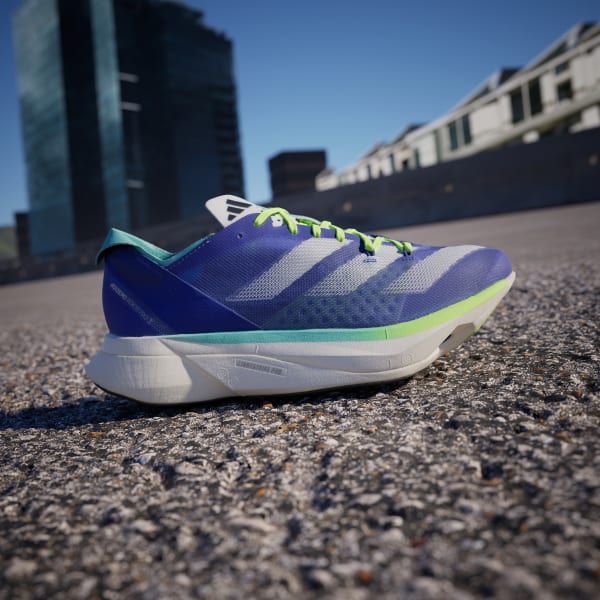
https://assets.adidas.com/images/w_600,f_auto,q_auto/2d9fa49...
In 10 years we'll be writing about how dumb this trend is while we revert to barefoot running
Most others who didn't the barefoot running have all quit.
Interestingly I seem to be able to run for longer barefoot (on socks) than with shoes. There’s something about shoes that makes my legs tire faster.
Less weight on the parts of the body that move most during a run is an obvious benefit of not wearing shoes.
For example converse all stars / vans / boat shoes?
I prefer to feel the pedals when I'm driving a car and use thin soles, but yet walking with these shoes really (excuse the pun) tires out my feet.
I read the book and did some actual barefoot running (got a lot of weird looks) and a lot of friends bought the shoes.
Now I think about it, I’ve not seen anyone in Vibrams for years
Quite frequently people will come up to to me to ask me about my shoes, so there's definitely an interest.
Anecdata: a friend of mine has been running for years, and for years he complained about knee pain. As it turns out he was heel striking the whole time, it completely disappeared since I told him to run 50 meters barefoot to find his "natural" point of contact
> “… was dominated by an aggressive mob mentality around barefoot running”
Really? Most of the barefoot running enthusiasts I encountered were super friendly and open-minded.
> “… the appeal to nature fallacy: a logical fallacy in which a subject is claimed to be good simply because it is natural”
I’m not sure it is a fallacy to revert to tradition (proven heuristics) in a complex realm of limited first-principles understanding. Much of the barefoot running enthusiasm (and general naturalist or anthropologically-oriented problem-solving) is less oriented to proving various theories and more so trying to find gains with a clear awareness of uncertainty.
Personally: I suspect simple shoes best honor the immense structural complexity of the feet and legs (and the integration with the rest of the body). I wear thin-soled shoes in order to maintain healthy lower limbs. As a lover of walks for a clear mind I advocate for simple, thin-soled shoes (but I don’t believe we need an inquisition and I haven’t yet started collecting funds for a mission).
The few times I attempted to wear shoes with significant support I noticed dangerous knee strain that went away upon returning to simple shoes. While there’s no overwhelming body of evidence there and I probably can’t write a paper about it, that’s sufficient signal for me to stick with simple shoes.
I was never a runner/jogger. But I do walk a lot. Especially in summer. For example, if something is 20 walking minutes away and public transport takes 15, I walk.
I wore the Five Fingers all summer, every summer, ever after.
I never had any sore feet when wearing these. And what's more, I have exceptionally strong feet and I attribute it to these shoes. I only found this out when I started tango dancing and several of my teachers told me.
My first pair from London disintegrated, a decade later, in 2017.
Every pair of five fingers I bought after that lasted a maximum of two years.
As such they're both an example of a great product as well as great example of enshittification.
It’s probably more because of this:
> But I do walk a lot. […] For example, if something is 20 walking minutes away and public transport takes 15, I walk.
The shoes I wear most other times are oxfords, monks or brogues however.
These kinda lock your foot in place, metatarsal and arch of the foot are not 'exercised' as much because of the rigidity of these shoes.
I do use more feet muscles in my Five Fingers for the simple fact that these shoes allow me to do that.
You can kinda flex your feet and e.g. choose to land only on the metatarsal and feel safe.