I bought a Bauhaus style watch from a brand called Seestern for $65. https://www.reddit.com/r/ChineseWatches/comments/1jjkf52/see...
For vintage (ignore their new stuff), Enicar, Eterna, Roamer, Rodania, Cortebert, Wakmann, Mido, Certina, early Girard Perregaux, etc. all can be had cheap. Bunch of excellent brands wiped out in quartz crisis that can be had for next to nothing.
Edit: A quick search reveals that there is quite a lot of prior art from the optical community. Darn, maybe I'm not done here.
I've never heard of index matching fluids! Will have to read up on this.
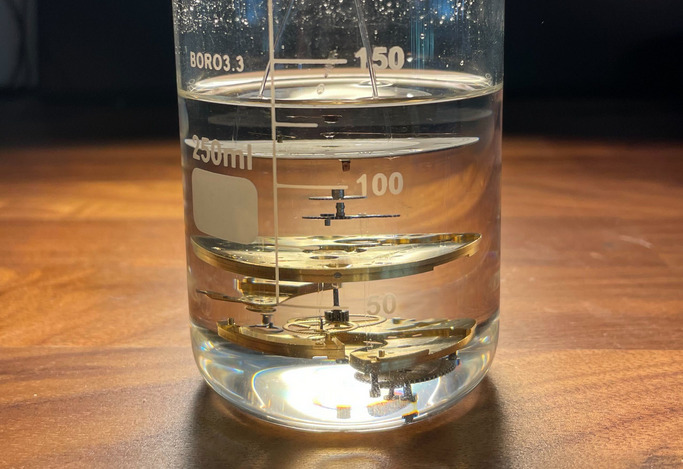
Also, if the plastic can be "invisible", you can also house it in invisible plastic- thus creating, a exploded working model, inside the resin
I am impressed by the quality of your work on this side project and I love that final attention.
I did a resin cast that had a similar "lip" at the edge (I turned a LGA CPU socket into a coaster), and I was able to sand it down fairly easily using regular sandpaper of progressively higher grit, producing a more or less perfect cuboid. The flatness was achieved by taping the sandpaper to a flat surface, and moving the part.
It's been a while, I can't remember if I used some kind of polishing compound at the end or whether the sandpaper alone was enough for a good finish.
Here's the process as explained by a reputable epoxy vendor: https://www.youtube.com/watch?v=9-WYOK90KNo
This would be a similar process to finishing any painted surface. Progressive through the grits, each time removing the scratches from the previous grit, wet sanding with the higher grits. You can then hand polish with polishing compounds you can get at any hardware/car accessory store. You can start with an orbital sander or a belt sander of some sorts. I've done this on guitars I've built.
If you're fairly close it shouldn't be a ton of work.
Source: holy shit can you get a knife sharp using this method.
Video on the project https://vimeo.com/354927033
The author does corss sections of a lot of electronic components and the more delicate ones were cast is resin first. Th "making of" is as cool as the end result!
There are 10x more pocket watches than owners interested. Theyre incredible machines... but their greatest use is practice materials for aspiring watch repair technicians.
They're expensive to repair because few people have the skills and tools. The demand is so low. (I have two)
I actually discovered pretty early on that my interest was more in clocks than watches, but the early explorations in the watch realm were almost entirely applicable to clock repair as well. I have since repaired at least a hundred clocks and pocket watches. Next month I'm going down to the NAWCC school of horology in Columbia, PA to take my third workshop there, this one on the repair of wooden works clocks. The school was closed for a number of years, but has fired back up in the past few and I know they're actively working on getting more watch repair workshops going. Last time I was there they were just putting together a killer watch lab with some very expensive benches and equipment.
You will need a set of flat headed screwdrivers. These are 80% of the tools you'll be using.
If you are approaching middle age, you'll need some magnification. I dont like loupes (those lenses you hold to the eye), and the visor mounted magnifiers are also not that good for me. I got a second hand long armed stereo 10x microscope for £30 which is perfect for me. You might just want a big old magnifying glass.
You might want a movement holder, again you can get super cheap ones, but second hand ones are better (because the shit ones are thrown away). they are basically specialized vices, or tiny little buckets(those are custom to each movement though.)
Next, start off with pocket watches, they are much bigger and more forgiving, and also cheaper.
In the uk: H samual, Thos russel are good brands to look for anything £20 or less.
For america: waltham/elgin (they often have broken balance though so watch out ) Eglins and Walthams look a lot more pretty, and have a better standard of finishing than the english counterparts.
I don't know how viscous SLA 3D printer resin is, but if it could be made viscous enough then it seems like maybe you could just suspend the parts in it, tweaking their positions as much as you want until they're just right, then blast the whole thing with enough UV to cure all of it.
But maybe it could work with something like beads of same refraction index, and then pour resin in when everything is in place? At least it works for water, I've seen it used for decorations and then pouring water over when everything is in place.
Random video showing what I mean: https://www.youtube.com/shorts/LuTlY6DkHQw
Also https://ciechanow.ski/ is an absolute inspiration.
I guess the epoxy's index of refraction depends on all kinds of factors such as the mixing ratio and the conditions under which it cures.
Still, if you’re interested in more of the same sort of thing, worth a look:
I'd imagine Adam getting a kick out of my resin project, but I don't think he hangs out on HN.
The other thing to beware is that the fake market ("replicas") is now unbelievably good - and also include vintage pieces. So scammers could buy very good fakes, artificially age them, and charge a fortune.
The only thing that works is to 'buy the seller' meaning: only buy from reputable sellers/dealers.
Chrono24 and (carefully) using r/WatchExchange are your best bets, but even there - diligence the sellers very well.
The question is whether there is any overlap at all where the price would be high enough to motivate supply (worth it to him) but low enough that there's still demand (worth buying). Also factoring in the cost of marketing, since potential buyers don't just automatically find you.
There are a huge number of business ideas where there is no overlap at all. Finding an overlap even without competition is hard enough. (Then add competition and it gets even harder, of course.)
This company works from photos:
but there should be companies doing 3D --- I distinctly remember a company doing a 3D map of the nearby star systems (which the _Universe_ role-player in me desperately wanted) --- perhaps:
https://www.skyatnightmagazine.com/advice/diy/3d-model-neare...
could be modeled in Lego bricks?
With +4K points, it is being ranked #8 of best HN submissions of all time, a true classic indeed!
What made the time invalid? The synchronization of the seconds didn't match the position of the minute hand midway between the minute markers?
Nice to see that it was a tribute post in a way
It was a nice surprise
It seems like it should be possible to make exploded models that way with more investment in upfront cad and less assembly labor. Perhaps very useful if you want to make many of them.
The room of clockwork/ratchet mechanisms in "Musee des arts et metiers" in Paris is fantastic.
I proposed an archival function at my uni, for historical artifacts held in static collections e.g. the physics lab old computing gear. Turntable, slow rotate, static camera film, done.
This was actually pre-web: I wanted this put in the campus gopher!
That was my only note: it would look incredible if squared off and polished to perfection.
There are resins you can use for projects like that if you want them to last, but they're less fun to work with.
I guess we'll wait and see!
For the UV-stable options, you have polyesters (which are very smelly) and premium aliphatic polyurethanes (which are finicky to work with).
Or just a yellow tint?
(Of course that means creating a new vacuum for every layer, probably).
This is apparently a well known issue among people who create resin-cast structures.