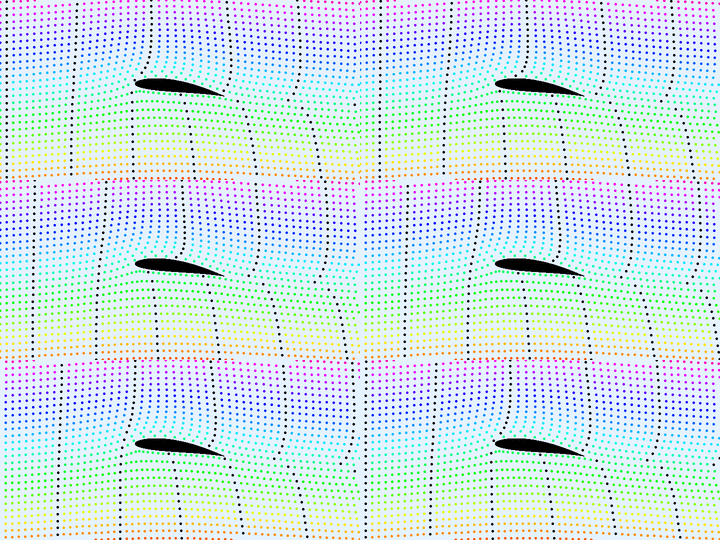
There is no requirement for air to travel any where. Let alone in any amount of time. So this part of the AI's response is completely wrong. "Same amount of time" as what? Air going underneath the wing? With an angle of attack the air under the wing is being deflected down, not magically meeting up with the air above the wing.
If you look at airflow over an asymmetric airfoil [1], the air does move faster over the top. Sure, it doesn't arrive "at the same time" (it goes much faster than that) or fully describe why these effects are happening, but that's why it's a simplification for lay people. Wikipedia says [2]:
> Although the two simple Bernoulli-based explanations above are incorrect, there is nothing incorrect about Bernoulli's principle or the fact that the air goes faster on the top of the wing, and Bernoulli's principle can be used correctly as part of a more complicated explanation of lift.
But from what I can tell, the root of the answer is right. The shape of a wing causes pressure zones to form above and below the wing, generating extra lift (on top of deflection). From NASA's page [3]:
> {The upper flow is faster and from Bernoulli's equation the pressure is lower. The difference in pressure across the airfoil produces the lift.} As we have seen in Experiment #1, this part of the theory is correct. In fact, this theory is very appealing because many parts of the theory are correct.
That isn't to defend the AI response, it should know better given how many resources there are on this answer being misleading.
And so I don't leave without a satisfying conclusion, the better layman explanation should be (paraphrasing from the Smithsonian page [4]):
> The shape of the wing pushes air up, creating a leading edge with narrow flow. This small high pressure region is followed by the decline to the wider-flow trailing edge, which creates a low pressure region that sucks the air on the leading edge backward. In the process, the air above the wing rapidly accelerates and the air flowing above the top of the wing as a whole forms of a lower pressure region than the air below. Thus, lift advantage even when horizontal.
Someone please correct that if I've said something wrong.
Shame the person supposedly with a PHD on this didn't explain it at all.
[1]: https://upload.wikimedia.org/wikipedia/commons/9/99/Karman_t...
[2]: https://en.wikipedia.org/wiki/Lift_%28force%29
[3]: https://www.grc.nasa.gov/www/k-12/VirtualAero/BottleRocket/a...
The function of the curvature is to improve the wing's ability to avoid stall at a high angle of attack.
Symmetric airfoils do not generate lift without a positive angle of attack. Cambered airfoils do, precisely because the camber itself creates lift via Bernoulli.
What is your point? Where do you think lift comes from?
My point is the wing causes a pressure differential by redirecting air. Air speed changes are a side effect of lift not a cause of lift.
The other way around is something (magic fairies?) causes an air speed imbalances, that causes a pressure differential.