A recent paper argued those dots and Ys might form a kind of lunar calendar tied to animal life cycles. That’s where the headlines about “the earliest written language” came from. But specialists in Paleolithic art have already pushed back pretty hard: the associations are often mis-read, the counts don’t fit neatly, and there’s no sign of syntax or actual language encoding. At best it looks like a notation system or proto-writing, not “writing” in the Mesopotamian sense.
So the consensus is: yes, Ice Age people were doing more with symbols than just decorating caves — but no, we haven’t pushed the invention of writing back 35,000 years. The earliest real writing systems still show up in Sumer and Egypt ~5k years ago. These cave signs are another reminder that symbolic thought is very old and very human — but we shouldn’t confuse notation with language.
Proto-writing can be very complex (I remember reading a book where a linguist calls mathematical notation "proto-writing"), but it's not "true writing" until it's capable of communicating essentially any idea you can express in spoken language (it's hard to write "I miss my cat Whiskers" in mathematical symbols) in at least a partly phonetic way (all true writing languages are phonetic to some extent). The earliest examples of that is Sumerian cuneiform and Egyptian hieroglyphs from around 3000 BCE. Whatever this discovery is, it's not true writing.
Early Sumerian symbols depicting kinds of goods (wheat, sheep, beer, etc.), and marks next to these to indicate quantities, are classed as proto-writing.
There's also more general use of symbols to represent ideas or groups, like a cross representing Jesus or Christianity, for example, which aren't classed as writing
> So the consensus is: yes, Ice Age people were doing more with symbols than just decorating caves — but no, we haven’t pushed the invention of writing back 35,000 years. The earliest real writing systems still show up in Sumer and Egypt ~5k years ago. These cave signs are another reminder that symbolic thought is very old and very human — but we shouldn’t confuse notation with language
Okay, so what's the bar for "written language" then?
The specialists in this field appear to be using some criteria for "written language" but it is not clear to me how that criteria might accept maths symbols or maybe roman numerals to indicate counters as a written language while discarding a notation system.
Personally, I would consider that any form of intentional knowledge transmission a "written language".
Scratch a line onto a rock each time you see a full moon? That's written language.
Paint handprints on a cave wall? That's written language too.
How does this discovery fail my criteria?
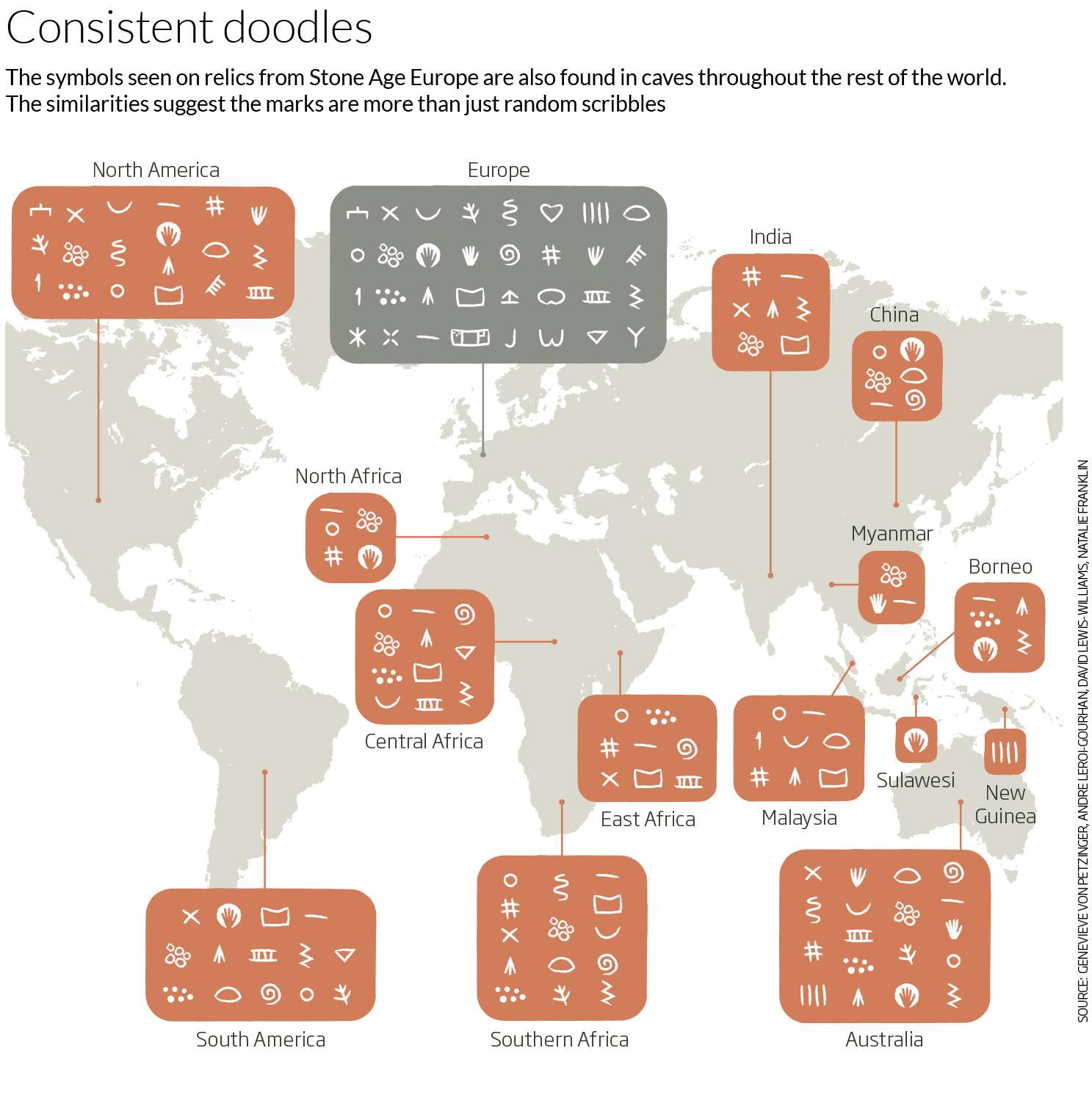
I in particular am not a huge fan of the infographic[0] that uses the same image asset to refer to a spiral, box, sun, dots, etc... for entire continents, for all recorded history.
I would prefer to see pictures of these symbols, and their in-situ neighbors, and a corresponding symbol across a wide distance that's within at most 2-300 years.
We want to feel that language has commonalities, that people traveled long distances and times and kept some common bond. It might even make intuitive sense, if the people share cultural similarities. But it often results in linguists making motivated decisions without enough evidence, like happened with the "Altaic"[1] language family.
[0] https://images.newscientist.com/wp-content/uploads/2016/11/m... [1] https://en.wikipedia.org/wiki/Altaic_languages#Weakness_of_l...
What would be more convincing? A sequence of a few dozen symbols in some particular location, and likely to have been written at the same time (rather than centuries or millennia apart), by the same person (so if there were handprints, the handprints would be the same person's hand(s)), where the number of recognizable symbols is twenty or more. I don't say that would be all that would be needed to convince linguists, but it would be a start.
Do hobo signs count as a language? That seems intuitively much closer to what this might be. How much structure do you need?
The problem I have with “experts” when it comes to this kind of dogma challenging thing is that they are usually extremely biased and limited by that dogma.
Let me put it this way, if you saw those symbols on Mars, would you not consider them a form of communication or language. Ironically, to me at least, the limited ands relatively consistent nature of the symbols itself actually qualifies it as language, not disqualifies it.
There may be 30 or so “common” patterns that appear globally - that would be very interesting if the total pool of symbols was say 50 but much less so if there are thousands of different symbols.
- Smushed oval is water, because it looks like a water drop from the side.
- Hand is a person or family or tribe.
- Hand surrounded by circle is what is around us, water around us, swim.
- Jagged line is danger. Having to dart back-and-forth to get away from a predator or rough sharp rocks.
- Small filled circles are rocks.
- Large circle is large body of water.
- Group of open circles is area that gets rain or is wet.
- Vertical lines are a penetrable forest.
- Crosshatch is an impenetrable area.
- Three lines up to point are a place to gather/sleep/have a fire.
- Four lines coming up is fire/dry brush to make fire.
- Horizontal line is a plain/flat area.
- U-shape is a significant valley or dip.
- Tree-branch looking thing means a place to get wood for fire.
- Snake symbol is snake/going around obstacles/not a direct path.
- Lines covered by line at top is a hut/shelter, because it's made with trees.
- The spiral is home/where to go/journey.
- The X is a rest spot or a place where things are put. People had to be on top of each other for warmth, and spears/tools may go in a pile.
- The rectangle with bent top is ocean, deep water, or pit with water.
These are entoptics. We've tested their neural sources for 40 years.
https://www.jstor.org/stable/2743395
Google entoptics and look at the graphic array.
Any particular evidence to back up that claim?
Your explanations sound arbitrary and about as likely as anything else.
You sir is pissing all over it.
There is no world in which any of those symbols can ever be known, except time travel - and even then there will be a communication problem.
And yet they aren't.
The real linguistic question is not whether the art had representational value and thus was a form of communication: this is known and clear, simply through the frequent nature of pictographic forms of recognizable elements of the environment.
Rather, it is more to what extent there was a systematization of the pictographs through phonetic or phonosyllabic use, and to what extent any such symbol repetition indicates a depth of shared culture across spatiotemporal divides. At what point does it count as 'writing'?
In general, there was clearly shared culture (technology meant that options were somewhat limited, and we have traced major changes such as the ingress of dingoes from Asia to Australia). What we are learning recently is the hitherto dismissed extent to which disparate branches of hominids survived and persisted in pockets across time, how we mixed with them and adopted their features. IMHO grand colonial theories of migration (often patriarchic/single-event/unidirectional) are falling away as novel evidence such as mtDNA shows far longer admixture and pluralistic bidirectional flows of culture, genes and technology.
Personally, having seen some ancient cave paintings near the northern Burmese and Vietnamese borders as well as in Australia and most recently in a book on Baja California, the similarities are striking, but this does not mean people teleported across the globe. It seems early peoples globally worked a broadly similar techno-social palette to leave marks across time, persisting their identity and expression in ways which probably marked social presence, status, ritual and interpretation. Stories became written and illustrated, but only in summary. Usually we cannot recover the actual content because all that is left are cues, other times modern anthropology preserved traditional interpretation. We often see presumed or literal figures, animals (spirits? gods? prey? food?), weapons, abstract markings, celestial bodies. Things that would be notable in such a society. 20th century anthropology has shelves of studies on this stuff. Here in Sydney, a city of 4+ million people, there are many aboriginal sites with engravings of people, emu, fish, dolphins, turtles, whales, kangaroos, reptiles, etc. Further north, even far inland, there exists rock art of early European ships sighted on the coast, suggesting use for record, story-telling, teaching.
We only know of the symbol use (if they were symbols) that happened on media that lasted tens of millennia. If they even painted symbols on deeply underground cave walls, they likely had them on many less durable surfaces as well. There could have been a huge oral tradition augmented by drawn memorization aids on durable but not that durable media. That augmented oral tradition would then occasionally, every few dozen generations or so, due to some exceptional circumstances, spill over to the near-eternal medium of a cave wall.
That infographic has bigger problems.
>> The similarities suggest the marks are more than just random scribbles
Except here are some of "the marks":
x # |||| * 一 (hand)
...
...that the people who drew a hand had hands.
Every single one of the other marks -- and the hand mark, too -- are things you could expect to find if you gave a small child some paper and crayons.
It's literally a bunch of graphic design output showing clean font glyphs! Needless to say, there is no, I mean zero evidence of any kind of symbology of the fidelity being shown. You'll get a petroglyph here or there, and that's it. Stretching those across whole continents and inferring "language" is just ridiculous.
This is, like mid-tier video game art.
1. She's been doing this since 2011, her TED talk a decade ago racked up 2M views, and this book landed a positive review from the curator of the Smithsonian's "hall of human origins"; she's not some rando. Here's her (somewhat outdated?) Google Scholar page: https://scholar.google.com/citations?user=QaDkX_UAAAAJ
2. The actual evidence here is supposedly "a unique database that holds more than 5,000 signs from almost 400 sites across Europe". It could still be misleading of course, but it's a lot more than just a website diagram.
3. You putting "language" in scare-quotes is completely unnecessary, as that's not what she's arguing at all. Rather, she's saying that these symbols should be treated as a milestone on the way to written language ("first indicators of our human ancestors capacity for symbolic meaning"), not full grammars in-and-of-themselves. Given that evolutionary linguistics is in a "pre-Gallilean" phase at best (to quote Chomsky), I'd say any well-cited contributions to the field should be welcomed! Maybe she's wrong, but in a way that leads us to what's right.
I came to the comments to be dubious as well, so I appreciate where you're coming from. But IMO "ridiculous" is going way too far...
... then why is it in the headline?!
I'm not discounting the possibility that someone somewhere underneath this has done something approximating real science[1]. I'm saying that the link I clicked on, and the hypothesis it's pushing, is garbage. And I stand by that.
[1] Though "I made a database" might not rise to the level of clickworthy.
(Which is not to say that I subscribe to her theory--that inference would be yet another fallacy.)
Decided to lurk around and it seems it's a pretty long going thing: https://en.wikipedia.org/wiki/Aquatic_ape_hypothesis
This is the same thing as all those stories about the Impossible Black Hole That Should Not Be There illustrated with something the graphics department threw together in photoshop.
[1] https://www.jstor.org/stable/2743395
[2] https://en.m.wikipedia.org/wiki/Cave_of_Forgotten_Dreams
And just my two cents as an under-qualified former art history teacher...
It's fascinating and totally valid to try to analyze these symbols as proto-linguistic, but it can be even more interesting to imagine the cognitive roll these kinda of abstract symbols might have played outside the scope of language as we understand it.
Trying to imaging the structure of the mind and experiencing reality with a complete absence of language can be immensely mind-expanding, even just as a thought experiment. At least it was for me.
They are the basis for a spatial language of topological parts that have yet to be realized but does integrate with the plastic arts. ie are these the source of pictograms as language? Probably not. Is there are continuity with Kurgan or Chinese ideograms? We can't find them. Is there a continuity between counting tokens and alphabets? Yes, there's a stronger case for that.
There is no such thing as a child developing "independently" in the sense that you are using it here, and anyone who would try would be rightfully sued for child abuse in most countries.
Even a child with prelingual deafness who is denied Sign language and access to Deaf culture (and I recommend looking up what terrible impact that has on such a child's development and quality of life), is still surrounded by human symbols from the day they open their eyes.
For instance, the Alta rock carvings site was used for about 5000 years. They added new ones for some 200 generations. They managed to avoid wiping out the older markings, they managed to avoid the entire place being covered with scribbles. They definitively preferred this site, not any random suitable site, for their petroglyph narrative, whatever it meant. If place-bound cultural continuity can be so strong, who's to say something like it can't have survived journeys too?
(But yes, petroglyphs clearly aren't a language as we know it)
This page is rife with fallacies of affirmation of the consequent.
Although he inhabits the lunatic fringe, I still find the concept of Protong highly interesting, and now that more settled minds are looking at the possibility of a global language, I do have to wonder just how much he got right in terms of identifying the language, itself, in ancient art. I also wonder whether modern researchers could gain anything from his investigation, using more appropriate techniques to glean fact from fiction.
Anyone else know of Szukalski, and can weigh in on this? I confess that my interest is pretty glib (because the yeti thing is repugnant), but I can't help feeling, deep down inside, that maybe the Protong idea has some legs ..
[0] - https://en.wikipedia.org/wiki/Stanisław_Szukalski
"Beginning in 1940, Szukalski devoted most of his time to examining the mysteries of prehistoric ancient history of mankind, the formation and shaping of languages, faiths, customs, arts, and migration of peoples. He tried to unravel the origin of geographical names, gods, and symbols that have survived in various forms in various cultures. Through his research in these subjects, Szukalski claimed to have discovered Polish origins for various ancient places and people, in a language called Protong."
The point with Protong, however, is that there was a globally-spanning civilization which did not have the latency we commonly associate with early human development. The language was supposedly spoken globally by a world-spanning human civilization which was destroyed by the cataclysm, requiring us all to re-develop ourselves.
Like I said, Szukalski was a kook. But contrasting his findings with more scientifically appropriate methods, is certainly of great interest to those of us following along...
With Sumerian cuneiform, some of the earliest examples appear to be inventories and maybe contracts and exchange records. For example this [1] appears to be a food ration token of some kind: Mouth bowl barley 4.
That's about 3100 BC or so. Five hundred years or so later, in developed cuneiform, those symbols still exist. By then they are usually abstracted into unrecognizable wedge shapes and lines. And by then they are definitely words, which had a reading aloud in Sumerian.
But back in 3100 BC, it's an open question whether they were thinking of the symbols that way.
There is an intermediate stage. One of the things you might want to account for is people. And their professions. [2] Again it is unclear if these are words. Eye city. (Guard?) King bull. (Chief herdsman?) What appears to be three tiers of gardener. Getting sophisticated. Within two centuries of that, we start to see the use of the pictograms to represent other values phonetically. A head is read as SAG. So if you want to write a name that has a syllable including SA or SAG you use the head symbol. And this is one of the key steps toward writing. But it is used sparingly at first. Names. Place names. Nouns for which there is no pictogram.
That is to say, more than 90% of the tablets continue to be beer receipts and the like. Around the same time, the kings and priests start to account and take inventory of their ancestors and battles as well. The language was probably Sumerian but there's almost no evidence of the Sumerian language itself in the writing yet. So few words written non-pictographically, no case markers or inflections or adpositions written yet. About 2600 BC the Sumerians start writing with grammatical markers, and the set of pictograms has developed into a system that can represent most of the sounds of Sumerian. And they start writing epic poetry and letters of complaint about their copper shipments being late.
I got a bit sidetracked sorry! My point is that the base-60 numerical system is fully developed at the earliest stage. It is used with the early pictograms.
Something similar may be true for the other meso- civilization in Mesoamerica. There's a fragment of an Olmec or Epi-Olmec stele with a date in the Long Count that, by Maya reckoning, would be in 36 BC. This is hundreds of years before the earliest examples of what is certainly writing, with the Maya. Things are very fragmentary so there is little certainty. But it seems possible Mesoamerican civilizations were recording absolute dates with their calendars, hundreds of years before they developed the ability to write arbitrary text.
[1] https://commons.wikimedia.org/wiki/File:Jemdet_Nasr_tablet_A...
[2] https://commons.wikimedia.org/wiki/File:Proto-cuneiform_Lu2_...
There were older ways of communication, but to be a writing system it needs symbolise a spoken language.
The idea that is being plainly communicated here is that there's a single system of symbols that is so well-understood that it gets passed along to human populations in Siberia that then cross the Bering strait as well as the isthmus of Panama, and these populations over this period maintain this system with such fidelity that they're recognizable as descending from the SAME system of symbols that entirely separate populations in Europe and Southern Africa are also using.
I don't think an alternative intepretation is reasonable to take away from the "Consistent doodles" infographic or the phrasing like "early humans as far back as 40,000 years ago also developed a system of signs that is remarkably consistent across and between continents".
This is either earth-shaking news that demands an entirely new understanding of human heritage, or it's very obvious pseudo-science.
Ig you want to get _really_ conspiracy-theory-ish... doesn't that six star symbol look like the Pleiades? https://en.wikipedia.org/wiki/Pleiades_in_folklore_and_liter... (Some have noted that the Pleiades has suspiciously similar myths associated with them, across the world.)
It's not new or surprising that there are cave drawings and petroglyphs that are much older than the oldest writing, nor that such art is symbolic in some sense. It would be surprising if this art was writing, but this article gives no indication of that.
The nearest thing seems to be the claim that "the signs and the animals were meant to convey ideas just as a written language does", which is linked to an article by Miyagawa et al. ( https://www.frontiersin.org/journals/psychology/articles/10.... ).
I looked at that article. To call it speculative might be an understatement (although the authors are clear that what they are doing is speculating). It includes reasoning like this:
> Waller (2002) points out that the pictures often cluster in areas with enhanced acoustic properties. For instance, in the deep caves of Font-de-Gaume and Lascaux, pictures of hoofed animals such as bulls, bison, and deer appear in chambers in which the echoes, resonances, and reverberation created percussive sounds that resemble hoof beats7, as illustrated in Figure 2. In contrast to this, in chambers that are acoustically quiet, one finds pictures of felines (Waller, 1993a) or simple dots and handprints (Hoffman, 2014).
> Cave art, as analyzed by archeoacoustics, shows a flow of information from one modality to another: auditory to visual. The auditory modality is triggered by external input—thunder, rock tapping, music— and the auditory representation is mentally transformed into external, visual representation. This is a pure form of externalized symbolic thinking where information from one modality is transformed into representation in another modality. We speculate that this activity of information transfer across modalities allowed early humans to enhance their ability to convey symbolic thinking to their conspecifics, as well as their ability to process acoustic and visual input as symbolic (i.e., to associate acoustic and visual stimuli to a given mental representation).
So. . . because cave paintings are found in places where sounds resonate, they helped us communicate symbolically. Uh-huh.
Later they list "striking similarities" between cave art and human language, including as separate points that they "are used for communication", that they "express actions, states, objects, and modification", and that they "externalize internal mental states". Ah yes, as opposed to all those other communication mechanisms which somehow communicate without externalizing internal mental states, and without expressing actions, objects, etc.
The article also heavily cites Chomsky at his most nonsensical (e.g., https://www.sciencedirect.com/science/article/abs/pii/S01497... ), where he speculates wildly about the evolution of language while clinging to tenets which are at best implausible from an evolutionary perspective (e.g., "the optimal conclusion about the nature of language would be that its basic principles are extremely simple"). And that's to say nothing of his upside-down view of language in which communication is regarded as secondary to its function as a "system of thought".
Again, to be fair, the Miyagawa article is up-front about being speculative. But even so, its speculation seems rather extreme and I don't see any actual data supporting the hypothesis that cave art is writing rather than just some form of symbolic representation.
Why do you say that?
This is one of the most commonly understood subfields in the Paleolithic
Entoptics are actual neural gradient patterns of the retina and occipital externalized, from altered states, light-deprivation, trances even extreme expression.
Entoptics are well enough researched (Lewis-Williams, Entoptics: The Signs of All Times) that any New Scientist writer should have at least mentioned this.
40,000 years is 40 chances at other good milleniums occurring
Where cultures weren't using metals as the primary basis of infrastructure, there wouldn't be much evidence remaining of those cultures. Add in glaciers and everything is ground up, except in caves.
This riddle was solved 20+ years ago by Dr. Peratt and his collaborators, but I guess many more years will pass before his work on the subject is widely accepted or someone else with the “right credentials” in the social sciences rediscovers the same explanation and has better luck than a physicist who became wonderfully obsessed with petroglyphs.
Characteristics for the Occurrence of a High-Current, Z-Pinch Aurora as Recorded in Antiquity (2003)
https://archive.org/details/anthony-peratt-characteristics-f...
Part II of Characteristics for the Occurrence of a High Current Z Pinch Aurora as Recorded in Antiquity: Directionality And Source (2007)
https://archive.org/details/characteristics-for-the-occurren...
1. The random insinuation halfway through that ancient humans had secret advanced civilizations seems completely uncalled-for, and would put any discerning reviewer on edge. Which is I guess why this is in a plasma science journal and not an anthropology one?
2. AFAIK, the whole thing only works if A) aliens, B) Sol put off 10-100 times more radiation than it does today, or C) "another source of plasma were to enter the solar system" (???).
3. Figure 30 especially cracks me up, where he argues that a figure with hands and genitals isn't a human, but rather a geometric shape. IDK... seems like a reach. Ditto for explaining spirals as recordings of the sky rather than a basic shape found throughout nature right here on earth.
Are you referring to Peratt’s quoting Mallory? That section of the paper is simply a review of historical work on petroglyphs and insinuates nothing at all. Context is a thing.
No aliens required and such are not entertained in these papers.
Also, it's not about "more radiation" but an increase in "charged particle outflow" (flux).
Anthropomorphization was a human tendency long before someone invented terminology to describe it.
Um, no.
Archaeoastronomy is a field that is borderline fringe science, in large part because it is really easy to overinterpret the data and find spurious correlations because there's just so many variables. To be taken seriously, you have to produce a lot of ancillary data to buttress the interpretation, for example showing that the claimed astronomical features have relevant cultural significance and hence would have reason to be specifically marked.
These papers aren't doing that. They're saying "hey, you can interpret pictograms as features of aurora," which is exactly the kind of argument you would make if you wanted to guarantee ostracization from the community. There's not an attempt to demonstrate a common source, there's not an attempt to analyze a complete context of petroglyphs (as opposed to individual ones) to demonstrate a coherent, single interpretation of a single event. Nope, it's just "some of these common petroglyphs look kind of like aurora features."
“Directionality and source” is literally the sub/title of the second paper and it explores what theory and evidence-data suggest.
Although the second paper had the term “archaeoastronomy” (only) in its index terms, it is confusing (at best) to categorize it that way as the phenomena manifested in Earth’s atmosphere not in outer space among the planets and stars.