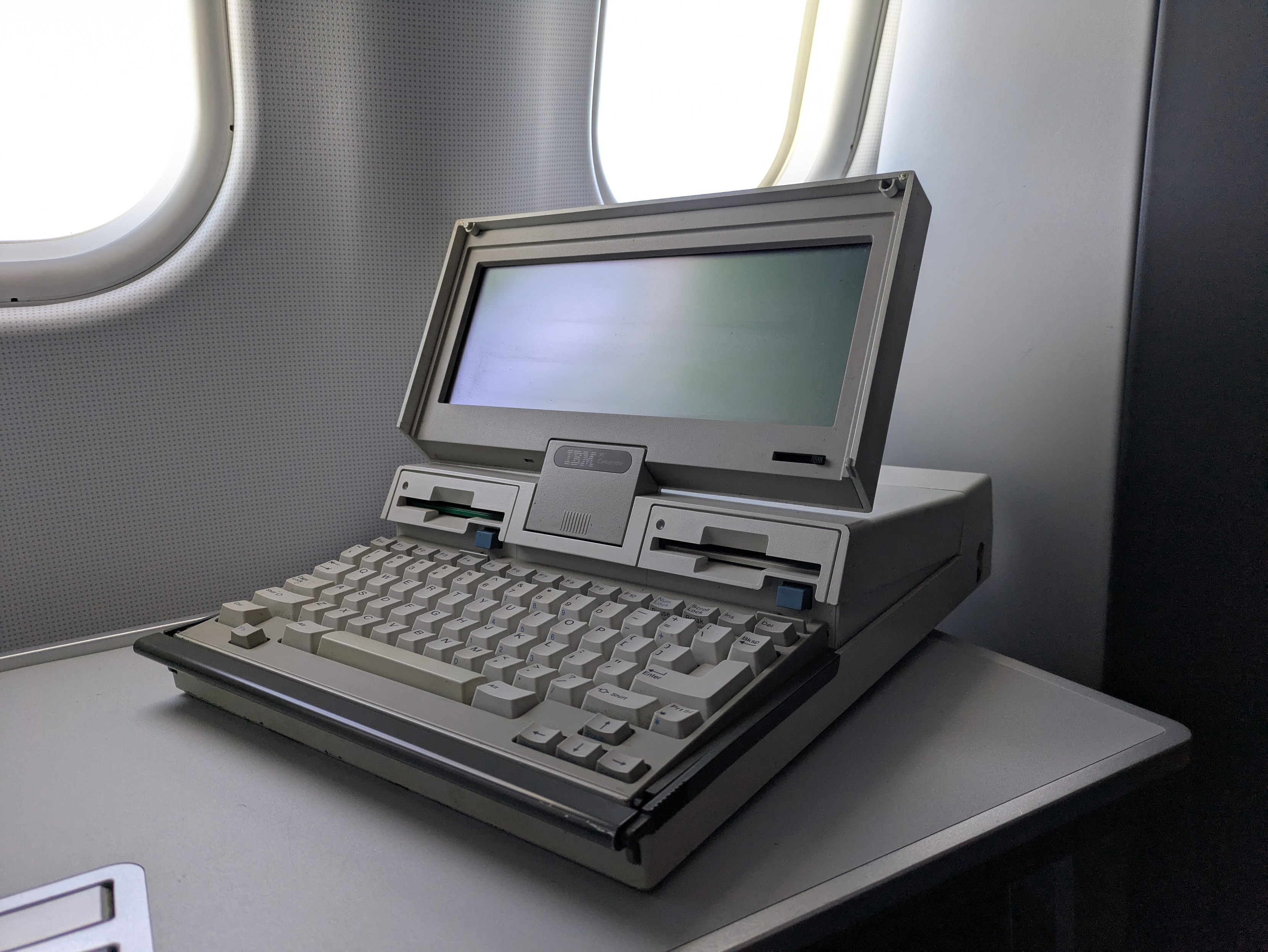
I was allowed to take that beast home with me. I learned so much tinkering with that machine. Eventually, I sold the whole set at a ham fest and I have regretted it often.
Nice to see an appreciation of it, though I would never have looked at it as alligator-like.
https://en.wikipedia.org/wiki/IBM_PC_Convertible has all the details on that machine you could want.
Incredibly forward-thinking modular architecture. Keyboard, memory, drives, serial port, parallel port, even the screen could be replaced just by the turn of a lever or a push of a button.
Fantastic keyboard, even by today's laptops standards.
Ate batteries like M&Ms. I almost always kept it plugged in.
At the time, running it off the pair of 720k floppies was fine. I believe there was a hard drive option, but I never saw it.
Its biggest weakness was the screen. There were backlit and CRT options, which were better and you could just pop off and in.
The screen was grayscale CGA, but there was a TSR called SimCGA which would translate, so you could run EGA programs.
Piccy: https://cdn.social.linux.pizza/system/media_attachments/file...
(Link to post in case that doesn't work: https://social.linux.pizza/@theodric/115256647992228538 )
TRS80 100 https://www.oldcomputers.net/trs100.html
TRS80 Model III https://www.oldcomputers.net/trs80iii.html
Would love to see some genuine creativity / cyberdeck type builds from laptop makers
Back in the early 80’s, Radio Shack made the TRS-80 Model 100 laptop. It ran for 20+ hours on 4 AA batteries.
A few years later, Psion came out with a series of small devices that ran on 2 AA batteries and got 30+ hours of runtime.
With modern electronics and displays, could something like a model 100 be made that could run for hundreds or even thousands of hours on 4 AA batteries?
The P75 had a delightful orange plasma screen, and the keyboard was wired and could be unhooked from the case, and since it was a 486 chip, it could all of DOS, OS/2, and Windows (and apparently it was able to run Windows 95 when that came out).
My main machine at the time was the Amiga 500, and the PS/2 felt like a step down in terms of graphics and so on, but Turbo Pascal was just too magical for me to care.
[1] https://en.wikipedia.org/wiki/IBM_PS/2_portable_computers
I miss that form factor really.
And BTW, I regret that WindowsCE is not the thing anymore. IMO it has the best development infrastructure out there backed with MSVC IDE.
I classify OSes into two major groups: "writer OS" (all desktop OSes primarily) and "reader OS" (all mobiles). But there is a void in between for palmtop form factor devices.
Sigh, probably its only me who needs this ...
(So I guess—expanding on a sibling comment[1]—aesthetics is not the only axis on which “this beats about 75% of the current laptop market.”)
What somewhat puzzles me about these early portables (also including e.g. the Macintosh Portable, sold 1989–1991, in a similar form factor) is the manufacturers’ insistence on putting a (heavy) mains transformer inside the chassis. That could not have helped the weight, so I have to guess they didn’t see it as a problem?..
One interesting solution to this space was GRiD making their battery and power supply the same size and form-factor --- when one was working at a desk, to save space the battery could be removed and placed in a separate charger, while the cord from the power supply to the computer was removed, and it was then placed in the battery compartment and connected to the wall, powering the device.
The transformer was outboard on this machine, like a modern computer. It had its own Velcro compartment in the carrying bag.
Originally, there were portables (sometimes referred to as "luggable"), like the Osborne or Compaq Portable series. The early models were the size of a small suitcase or large briefcase and contained a CRT screen, usually with a detachable full-size keyboard.
Later, portables ditched the CRT in favour of (very readable) gas plasma displays, allowing for greatly reduced depth. The final models were roughly the size of two shoeboxes stacked on top of each other, and were sometimes referred to as a "lunchbox".
Laptops took the opposite approach, reducing height rather than depth. This IBM 5140 was a good early example, but I think the first might actually have been the Data General DG-1 in 1984.
They had a flat screen (usually passive matrix) with a hinge directly behind the keyboard. About a third of the case stuck out behind the hinge, and typically housed the battery (usually lead acid), floppy disk, and HDD.
Unlike the previous luggables, they could just about be used on a lap for short periods. They often weighed around 5-6kg, though, so most of them will have been used on a desk or table almost all of the time.
Notebooks came a few years later (1989-ish), with the NEC Ultralite, Toshiba Dynabook, and Compaq LTE leading the way, and were distinguished by being smaller still - the size of a ream of A4 paper - and having the hinge right at the back of the machine.
They tended to be lower-powered (8086 CPUs rather than 286 or 386), and initially only had a FDD as they were too small to fit a full-height 3.5" hard drive. They weighed around 2-3kg, so actually could be used on a lap.
The limitations of the smaller models evaporated quickly, and notebooks had almost completely taken over by the mid 90s. The last lunchbox portable was probably the Compaq 486 in 1992. There were still a few rugged or workstation laptops being produced right up to the end of the decade, but they were pretty rare by that point.
Where's the line? Is a CHIP or M5 Cardputer portable or laptop?
Is it the hinge needed? In which case is a folding phone, a phone, laptop, or tablet?
(Not meaning to be aggressive. Curious about the fuzzy definition. Wanting to be convinced.)
I'd argue that the two years I spent using it as a laptop, largely on my lap, says it works fine.
I also used it balanced on my knees, curled up in a window nook.