https://landnotes.org/?location=xnd284b0-6&date=1923&strictD...
https://github.com/Zulko/landnotes
My plan has been to overlay historical map borders on top of it, like the Geacron one from this post, but they all seem to be protected by copyright - and understandably so, given the amount of work involved.
https://zulko.github.io/composer-timelines/?selectedComposer...
There are many projects that could be done with with wikipedia and LLMs, for instance "equalizing" all languages by translating all pages into all other languages where they are missing. Or, more surgically, finding which facts are reported in some languages of a page but not others, and adding these facts to all languages.
For now, it seems that wikipedia doesn't want to use generative AI to produce wikipedia pages, and that's understandable, but there may be a point where model quality will be too good to ignore.
Also, back then, their map tiles loading had a very high failure rate when loading, so I wrote a custom caching proxy to make it tolerable (which had built-in retry and also cached any successful response for a very long time).
    -2000000 Stone tools
    -1000000 Using fire
       -6000 Metal tools
       -6000 Agriculture
       -4000 Writing
        1550 Printing
        1888 Telephones
        1888 Cars
        1903 Planes
        1941 Penicillin
        1941 First computer
        1982 Homecomputers
        1983 Mobile phones
        1990 The internet
        2001 Wikipedia
        2004 Facebook
        2007 IPhone
        2022 ChatGPT
If it had a "significance" attached to each event and a slider one can use to set the significance threshold, then it would be what I mean.
https://en.wikipedia.org/wiki/Commodore_64
Nuance around this fact would be completely lost in 100 years, let alone 1000 from now.
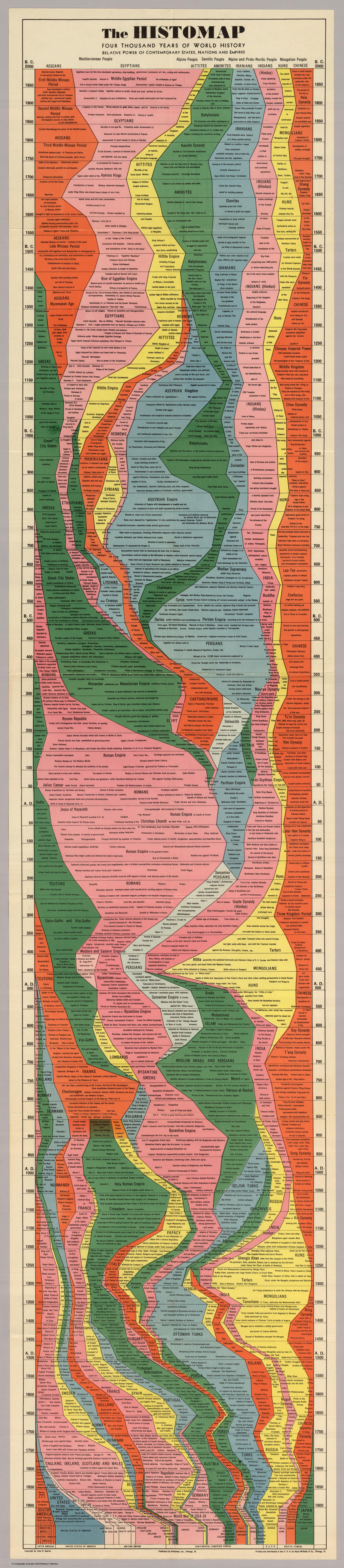
In 1942 he did one for Evolution which is closer to your pitch (log scale Y axis, etc): https://www.davidrumsey.com/luna/servlet/detail/RUMSEY~8~1~2...
https://en.wikipedia.org/wiki/D%C3%A1l_Riata
Edit: The "Scots" are supposed to have conquered the Picts in the mid 9th century leading to what would eventually become Scotland.
> You roleplay as the various Ancient Roman (Year 0) people I encounter as an accidental time traveler. Respond in a manner and in a language they would actually use to respond to me. Describe only what I can hear and see and sense in English, never translate or indicate what others are trying to say. I am suddenly and surprisingly teleported back in time and space, wearing normal clothes, jeans, socks and a t-shirt into the rural outskirts of Ancient Rome.
In think this is a fun way to learn languages too.
And if you don't mine it from somewhere, how do you know what to include? How many people will have heard enough about every part of the world to even be able to research ancient borders?
I would love to be able to slip through time with a slider. Especially if there was enough data on the movement and geographic span of early peoples to represent their story with moving, fading in/out diffusions of color.
And now I am curious! How clearly we have pinned down migration and geographic spans for the history of all human families?
NONE of this is an actual suggestion to do any more work.
It is great as it is!
This is the type of visualization that would captivate me for hours on end on Encarta in my early teens. Granted, those were a bit more polished and engaging, but the right mix of edutainment was fascinating to my developing mind.
The world lost many of these learning experiences after Encarta went away. Wikipedia certainly has much more information and is an improvement in many ways, but it's sorely lacking this type of curated and interactive content. Information is much easier to digest when it's presented in formats beyond text and pictures. Encarta had all sorts of experiences like this, from quasi-3D environments to mini-games.
The early web was certainly a limiting factor in what could be displayed on it, but today it can deliver far richer experiences. Authors like Neal Agarwal, Bartosz Ciechanowski, Grant Sanderson, and to an extent platforms like brilliant.org, prove that this is possible. I just wish that the world's largest free encyclopedia also had this.
0. https://historicalatlas.com/download/ 1. https://youtu.be/WFYKrNptzXw?t=64
This hides thousands of years of independent development in those regions—empires, and creates the false impression that they had no real history before Europe showed up.
It repeats an old colonial story where Europe is the main character and everyone else is treated as secondary.
For example, I'm from Latin America, and the most important empires in South America (Incas for example) were using writing systems based on threads and knots (called Khipu). Sadly, these records didn't survive. While Mesopotamia and Northern Africa were already using glyphs carved in Stone (and bones, and wood, etc). These had a much better chance of surviving.
Then, what happened, is that modern "europeans" (starting in 200BC, roman times) invested a lot of time to research and learn about History. This is something MIND BLOWING. Most civilizations didn't even care about their predecessors (aside from deity or folk tales). And that's why what we know today about Parthia or Greece comes mostly from European sources. Don't get me wrong, multiple civilizations had the concept of "early historians", especially Chinese and arabs. But not everything always survives.
* The Kingdom of Kush maintained *3,000 years of king lists*. * Ethiopian monasteries preserved *written chronicles in Ge’ez* for over a millennium. * Mali’s griots memorized *centuries of dynasty records* with such precision that griots from distant regions told the same histories word-for-word when Europeans finally documented them.
Yet when do these count as "real" history? Only after Europeans wrote them down? Only when archaeology "confirms" what griots already knew?
The map shows detailed Rome but blank Africa, despite these complex states existing for millennia. it's about whose preservation methods and developmental paths count as "real" history worth mapping.
Furthermore, we would have had much more records from non-european sources if many European explorers and colonialists had not gone on a rampage destroying whatever indigenous documents and history they could lay their hands on.
As a Latin American I’m sure you know about how the conquistadors destroyed written records.
Also smaller "cultures" which do not constitute states/kingdoms are shown in the map, albeit without color or borders.
But yeah. Evil Eurocentrism am I right.
The African map is strange. I scrolled until 1722 and it shows some isolated countries and the rest is white. They could do better. (I'm european - pale face)
So yes, the map reflects available documentation. But the very framework - organizing all human history around BC/CE - already embeds a European perspective. The bias isn't what the mapmaker included; it's that European systems became the unmarked "standard" for measuring when history happens. That's structural Eurocentrism: not intentional, but built into the tools we inherit.
https://www.reddit.com/r/MapPorn/comments/1l3xl8x/events_fro...
I agree with others in this thread that this more probably "information-biased" than "eurocentric" on the part of the Atlas creator. Pretty sure they wish non-european history was easier to find and aggregate as it would make the project much more compelling (I certainly had this problem with https://landnotes.org/).
I am hoping LLMs will do a lot of good at bridging gaps and surfacing world historical information that didn't make it yet to centralized projects like Wikipedia.
It obviously only focuses on the Aztecs so hardly a deep dive on all there is to learn.
[1] https://upload.wikimedia.org/wikipedia/commons/2/2b/OttomanE...
https://en.wikipedia.org/wiki/Constitution_of_the_Republic_o...
This map should show the areas of actual rule and control (de facto) and don't accept any territory to belong to a state just because they claim sovereignty.
Four — someone claiming something doesn’t make it true.
I am a firm believer in that good visualization gives you better data. You can probably get a lot of detail mapping of data in wikidata if you make a map that queries "things happening in BBX during these years)
Hard next for me.
Meh.