https://pbs.twimg.com/media/DRT4vNEUIAEJgP3.jpg https://pbs.twimg.com/media/DRT4vNAVAAAT8JP.jpg
They might be misguided or misinformed, but the underlying fact is that women are not as well represented in stem. Just because the reason it's more likely to be misogyny rather than any biological inclination, doesn't make it an outrageous statement in my opinion.
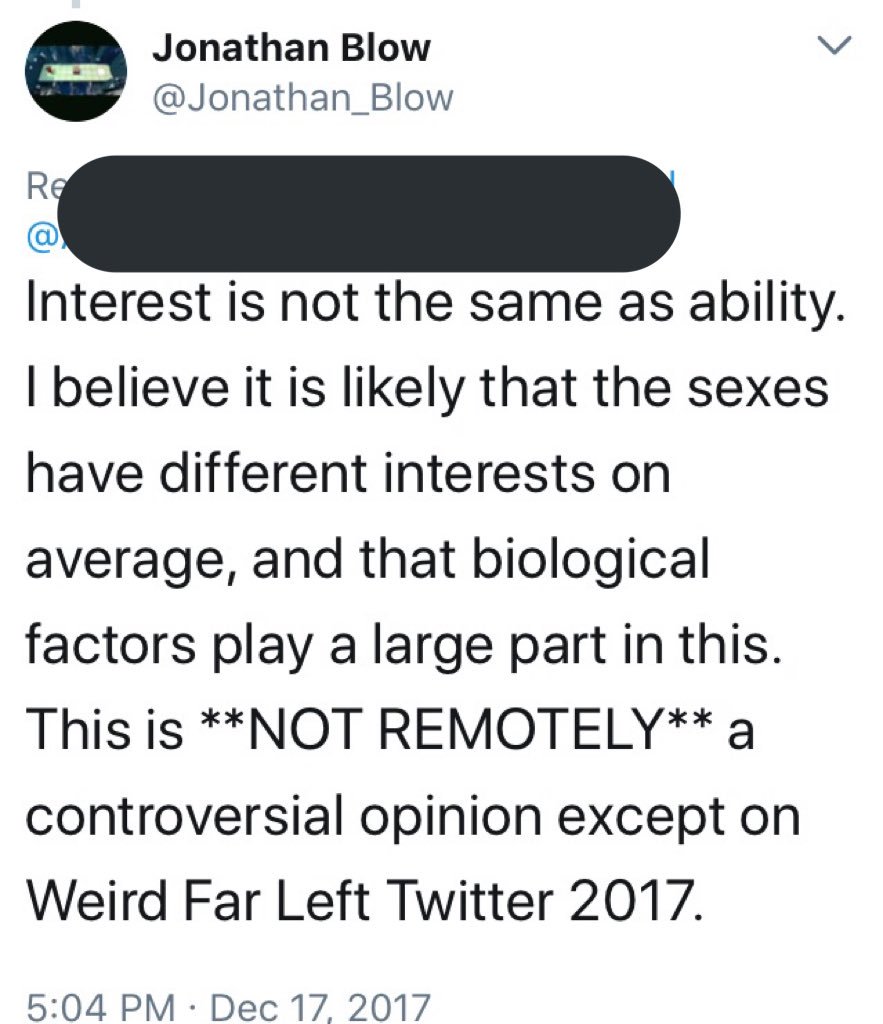
This is "controversial" in that it's a position that is not well supported by evidence and he has repeatedly used his platform in the past to make unsupported claims to the contrary.
Never forget that the social neglect is not exactly healthy, and programming isn't actually that prestigious and externally rewarding, except for maybe the compensation that you can currently earn in some places.
Adding that for example in math or other sciences, we are much closer to gender parity.
https://www.sciencedirect.com/science/article/pii/S016726812...
Plus: Jon never said it's the "primary" factor, as you claim. He said it's a large factor, that doesn't apply at the individual level, but on average. Which is entirely factual and supported by copious amounts of research.
Just because people like you want to be offended by science, doesn't make it wrong, or controversial.
It completely neglects the actual history of the field of computing, even just the 20th century, where the field was filled with women.
It’s only once it became a prestigious field that women suddenly developed a “biological” inclination against it.
1) It was way before it became prestigious.
And
2) An explanation of this needs to account for a great and rapid shift in favor of women, as far as proportion-of-practitioners, that was happening at exactly the same time as the opposite shift in programming, in both law and medicine.
I don’t know what the actual reason is but “it got prestigious so women got pushed out” makes no sense to me, based on the timeline of events in full context. It was very much not prestigious in the ‘80s and early ‘90s, certainly far less so than law and medicine at that time (still isn’t as prestigious as those, outside tech circles—you can see it in people’s faces. It’s high-paid but lower-“class” than those, to this day)
Something interesting that I think a lot of younger people don't appreciate: back in the day, unless your name was Hemingway, it was considered unmanly to touch a keyboard. Anything that involved a typewriter or anything else with a keyboard was distaff by definition, just so much secretarial work. Maybe a journalist's job, if you were feeling generous.
Sounds stupid as hell, and it was, but that's a big reason why women played an outsized part in the growth of computing. First as the 'calculators' in WWII, then as Baudot terminals started to take over, as keyboard operators.
Don't make the mistake of assuming they were all Grace Hoppers or Margaret Hamiltons or Adele Goldbergs, because that simply wasn't the case. Many of them might have been, though, in a less stereotype-driven world.
You have to twist logic pretty fucking hard to find a reason for him to put 88 in his username. He's a guy who thinks he's way more clever than he is and gets upset when it gets pointed out to him.
But we live in a world where the least charitable interpretation of anything comes first, so shrug
Does that make a difference? You could levy the exact same argument about the other two in their respective countries in their respective times. Doesn’t make it OK.
Neither was slavery. Was that OK too? And to clarify (though it’s worrying this point needs to be made), I mean morally.
> throwing around certain bad words like fascist
Fascism has a very clear definition. It describes a particular set of behaviours and actions, all of which you can compare to reality and determine if it’s happening or not. It’s an objective word. If anyone is trying to “dismiss” anything, it’s the people pretending it’s subjective because they support its outcome.
It may well have been morally OK to most people (see: moral relativism), and since you're implying it wouldn't have been OK to you, it's worth pointing out that you probably wouldn't have done anything about it in the relevant time periods.
If you're an American you don't even need to try that hard to make moral relativism visceral: was the displacement (and far worse) of Native American tribes "OK"? I'd say no, but it isn't morally urgent enough to me or the 99%+ of Americans who are unwilling to pack their bags and return the entirety of two continents to the native descendants.
From the perspective of a pre-abolitionist society, it evidently was, but that's not a political issue you're gonna have to deal with in 2025. Consider yourself lucky.
> Fascism has a very clear definition.
First of all, that isn't true. Secondly, even if it was true, it wouldn't matter. You are using the word as a though-terminating cliché. That doesn't work in the long run, you'll just get ignored. As a result, you can pat yourself on the back for calling out fascism while all the behaviors and actions that you believe to be fascist are mainstreamed and affecting people's lives. If I was you, I'd be more worried about criticizing those behaviors and actions on their merits (or lack thereof), rather than trying to tie them to some textbook definition fascism and dismissing them wholesale.