There's value in the index you described as well, but IMO it doesn't make sense to use it as the basis for the overall economy.
1/3 of the households make less than $50k. Mean survival budget is $35k-40k. After taxes, if a third of the population can barely meet a survival budget, an index like this needs to be part of the overall economy.
And the point of the ALICE index is exactly to address what you are pointing out. When wages, social security etc. were increasing proportionally to the essential goods, it made sense to have the CPI include other goods and services, allowing policy makers to use it as a basis for policy directions. However, when essentials become expensive faster than non essentials, it creates a problem for policy makers. It explains the “vibeflation” where policy makers were pushing back hard on economic struggles that most people are feeling by pointing to CPI numbers that show a 2-3% inflation, meanwhile people are struggling and dipping into savings to make things work.
We need to have both.
Not even counting the number of households who are at credit card and other debt limits at close to 30% interest. Trump has given some lip service to trying to get this down to 10%, but it'll really take congress to make anything happen that has a chance of sticking.
A lot of people are very underwater.
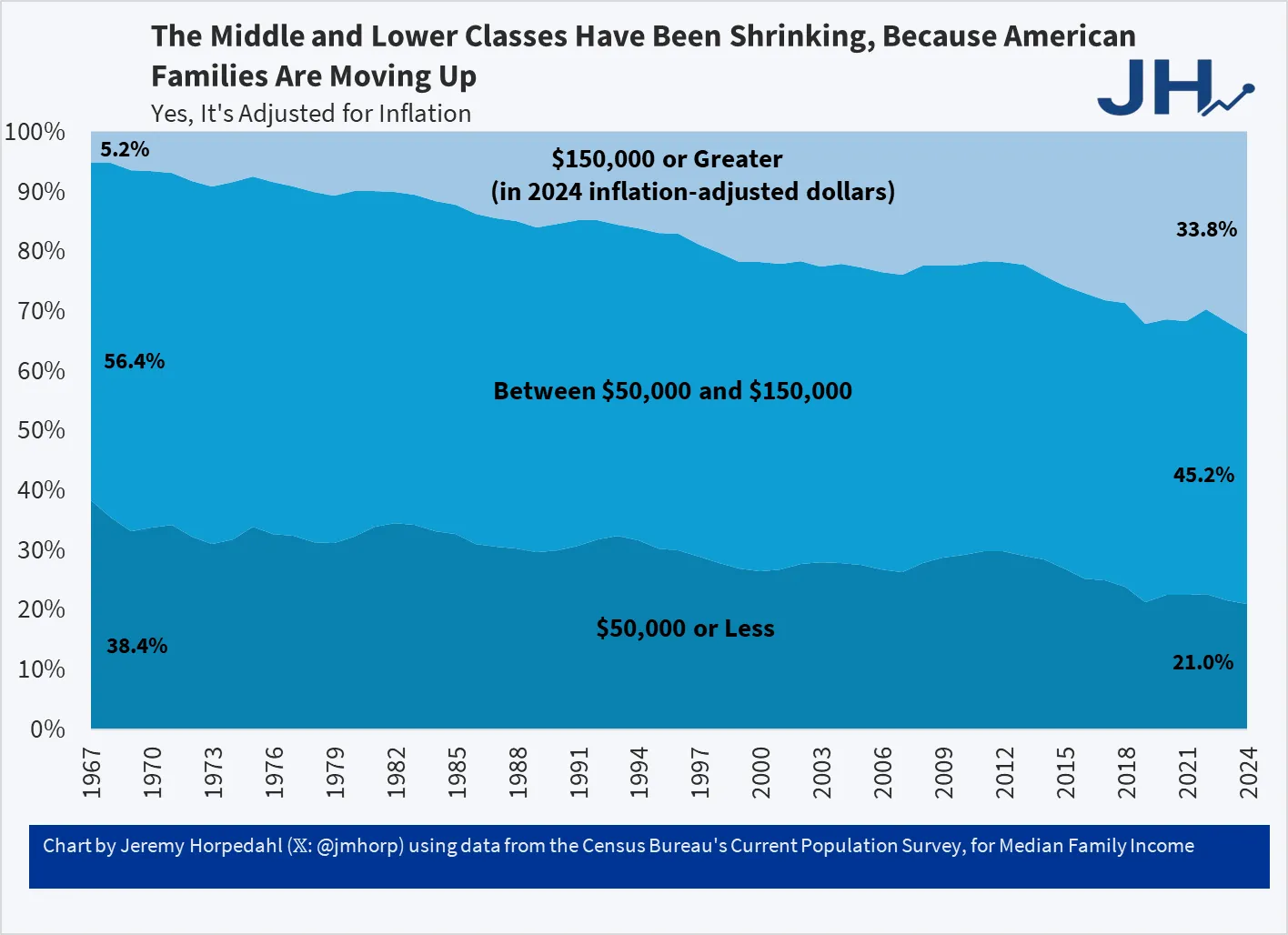
It means increasingly focusing on the spending of the rich, because the population is increasingly richer. Proportion of families making more that 150k (in 2024 dollars) has gone from 5% in 1967 to 33% in 2024, while both middle class (50k-150k) and poor (<50k) have decreased. [1]
[1] https://substackcdn.com/image/fetch/$s_!dtoi!,f_auto,q_auto:...
No single metric tells the whole story, and by taking them in isolation it’s quite easy to lose the forest for the trees.
[1] https://www.wsj.com/economy/consumers/us-economy-strength-ri...