I was just writing about this (scroll about halfway down to the images of Sam Altman - though if you like that, do watch the second video):
https://getartcraft.com/news/world-models-for-film
The best model I've found for this, that almost bakes in full ControlNet capability, is oddly gpt-image-1.5. It's absolutely OP at understanding how to turn low-fidelity renders into final draft upscales.
Here are some older experiments:
https://imgur.com/a/previz-to-image-gpt-image-1-5-3fq042U
https://imgur.com/gallery/previz-to-image-gpt-image-1-x8t1ij...
I just wish it didn't require invoking such heavy-weight, slow, and expensive models to do this. I'm sure open models will do this work soon, though.
The 'how society would look without x' has been a racist trope on 4chan since way before the cited examples.
If you were right that would be easily verifiable. Do you have an example of a post dated before 2018? Maybe you're getting tricked by the fact that 2018 was 8 years ago?
So what? Are we going to bring back generational sin as well?
It is rather Novosibirsk.
> Rule 1 - ALL POSTS MUST BE MEMES AND FOLLOW A GENERAL MEME FORMAT
> All posts must be memes following typical setup/design: an image/gif/video with some sort of caption; mods have final say on what is (not) a meme
Reddit mods, man.
I was wondering what/how many HN users clicked on the image (not knowing it was uploaded to reddit too)
But now I seriously wonder out of those 16k (as of now), how many were/are from the hackernews community and how many from reddit.
Here you go. I had it uploaded after hearing from the magospietato's comment but then saw you talk about the same so I am pasting the same image link here as well
Here, I uploaded the image to catbox.moe if anyone's interested.
https://files.catbox.moe/c4smhd.png
I don't think that catbox is blocked within the UK.
There's nothing more depressing than walking by beautiful historic old buildings only to turn a corner and see a monstrosity of concrete and glass somehow reaching the epitome of bland and uninviting.
If the straight concrete isn’t your thing, they’re also currently extending it with a glasshouse: https://www.snohetta.com/projects/queensland-performing-arts...
You watch a bunch of travel videos and think the place you're visiting is going to be so different but its just the same overcast sky and ocean and washed out color palette as home.
Once you remove all the filters, color correction, and drone shots from influencer travel videos a lot of places look the same IRL.
Then you consider Patagonia or Norway and compare it with the California Coast. The world is full of beauty.
I'd say that despite similarities for places built at the same time as each other, there's a huge range of variation in the places I've been.
First trip to the US was California, and the geography of the hills around Central Valley were substantially different in different places just within that region. Southwest, I saw hills that looked like Bryce's default textures which I'd previously assumed were mediocre approximations rather than based in reality; the Redwoods and Yosemite are very different from each other and the aforementioned, and the hills west of Winters and east of Sacremento are different again, and of course all are different to the Valley itself. On another trip I saw the Bonneville Salt Flats, I've yet to see anything else like them. All these are very different from the views around Zürich, or the UK South Downs (which unsurprisingly given the name is similar to New England and Brittany), and all those are different to the west coast of Wales; when I later saw the Spanish Mediterranean coast and the area around Athens, they reminded me of some of the wine areas around Paso Robles (which shouldn't be surprising given wine).
Within cities, Berlin has incredibly wide streets unlike anything I've found elsewhere; Athens is the exact opposite, with at least a few of roads in the tourist core (near the Parthenon) almost too narrow even for the smaller size of car common in Europe and pedestrian paths only a few cm wider than my elbows are apart, and so many ancient ruins you could practically trip and fall over them. The UK and Germany where I've lived, one can quickly learn to spot which era any given house was made in, with a handful of still-standing medieval buildings in the UK (mostly churches), then typical stylings visible for late 18th century (e.g. Bath), then a gap to the late 19th century to early 20th (in both countries but with more Gothic in the UK and more Neo-Classical and Art Nouveau in Berlin), then another gap where little survives to today, then post-war (British housing estates and DDR soviet style Plattenbau); these are very different to Swiss rural styles, to the narrow buildings you can find in Amsterdam. The UK and France also still retain a lot of medieval castles in various states of repair and museum-ification.
Bologna still has a lot of medieval structures around, including two leaning towers. Venice may be famous for the canals, but the famous ones are not the entire set, the ones I remember seeing went right up to the hotel I was in and functioned like roads, with a similar vibe to the roads of Athens (only without the footpaths at all because footpaths were a completely independent system), while the canals in Amsterdam were broad and felt more like the spaces dedicated to the Straßenbahn and U-Bahn in Berlin.
Budapest felt like a decaying museum to itself, or a ruin in which people nevertheless still lived and worked.
NYC deserves the name "urban jungle", it was like walking through canyons where the "mountains" (skyscrapers) were so distant and large as to defy not just the instant parallax between my eyes, but also the time-delayed parallax one normally gets from walking towards or away from a thing.
Cyprus (caveat: I've only been to Larnaca) was a mix of British road furniture, medieval castle, and a Church that pre-dates England (https://en.wikipedia.org/wiki/Church_of_Saint_Lazarus%2C_Lar...), with the half-finished look to many properties where the rebar was still poking out of the uppermost surface of enough buildings to notice and visible water tanks on most of them (https://www.google.com/maps/@34.9108686,33.6190677,3a,15y,41...)
Nairobi mixed a British 50s-60s Brutalist core (presumably because of who was in charge in the 50s-early 60s) with main streets that were variously poorly repaired and unpaved, and minor streets that varied from "this could be any middle class residential area in Europe" to "this has been accidentally cobbled by people treading plastic bottles into the soil as they pass"; there is another easily recognisable style here, best shown rather than described, this kind of wall lack-of-surface-finishing: https://www.google.com/maps/@-1.2844081,36.9005201,3a,30y,35...
Sun/Light has a lot to do with it. The place linked looks fine/tolerable but put that in the northern of Europe/America and you'll looking at the edge of depression (at least for myself).
The UK is feeling left out and would like a word.
Even so, I think North American cities are on average uglier than most Polish ones. Overall we're not doing so bad but I want the Slavic city memes to continue lest we get Prague or Amsterdam level tourist invasion.
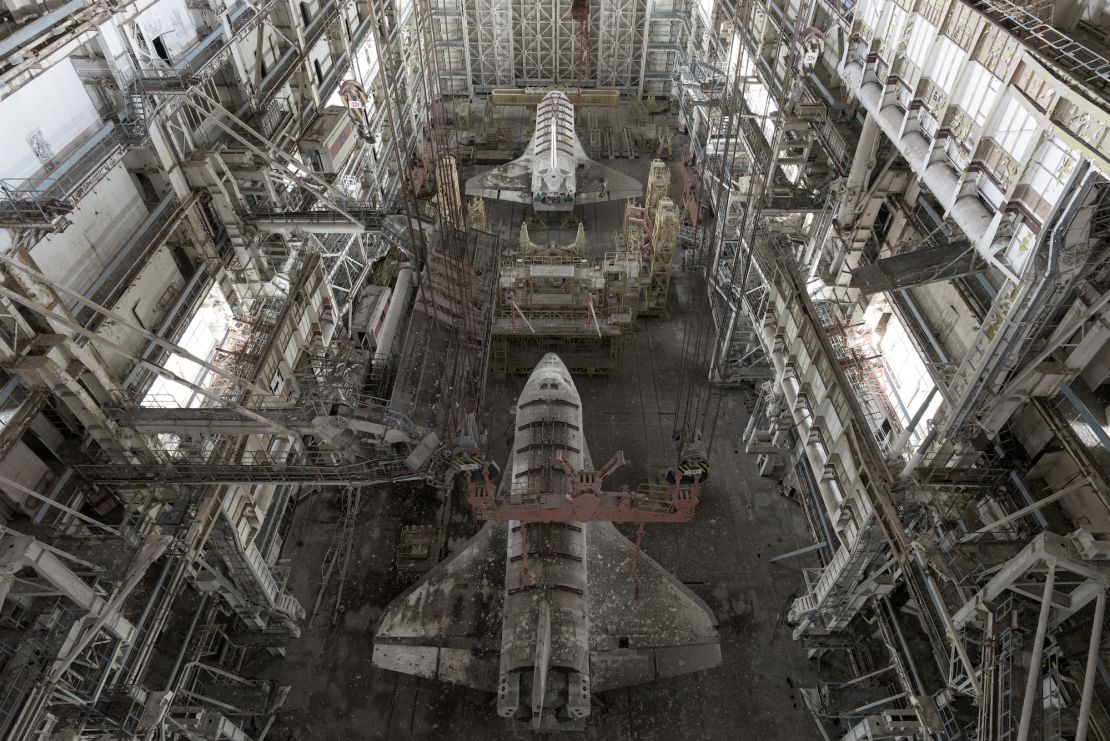
Buran in storage: https://edition.cnn.com/style/article/baikonur-buran-soviet-...
Image link: https://media.cnn.com/api/v1/images/stellar/prod/17103111131...
Because as I see it, a lot of aesthetic decisions in architecture, pretty much anything that goes in the direction of minimalism, is just putting "newness" in the center of perception. And thus absence of "newness" will be in the center of perception when it stops being new. All these clear geometric shapes? They look awesome at the opening ceremony, but two years down the line they are like magnifying glasses for uneven changes in color and the like. Whereas for a more playful surface full of ornaments, those same years would be hardly more than a blink and they can age gracefully, on the aesthetic level (and on the technical level, required maintenance intervals are much longer anyways). Architects who claim to care for sustainability should demonstrate that they consider how the building will look like later in life.
https://old.reddit.com/r/interestingasfuck/comments/u22v09/t...
The beauty of Kintsugi can also be difficult for people to understand. =3
Cities solve this with design requirements and through the approval process. Specifying a minimum spend isn’t going to make the buildings look nice by itself. You’d just get weird budget games being played.
Cities with restrictive planning commissions can push buildings toward certain looks. People get angry about it, though, because it gets harder and more expensive to build things in an era where it’s already too expensive to build.
BTW this is what I love most about HN - the surprising variety of people you can learn from, from billionaire founders to expat bingo-card geeks to Georgian-onion sellers to Dutch pro cleaners...
Any porous material is a terrible idea, you get lots of surface area that you cant reach. Carpet, curtains, upholstery.
Gaps between things should be big enough for how deep they are. Tiny legs under sofas or closets are not useful for anything. Adjust the size of the gaps between wall panels to your favorite kind of insect or rodent.
The funniest one i've seen was a city with a lot of mosquitos where someone put giant neon letters outside under a roof. In a few days it was completely covered in highly active spider turf war dens enough to make a grown man scream. Apparently spiders love roofs and they obviously know flies like light.
Is there a better way? Asking for myself, also.
Any solution that requires the user to bust out a credit card and put down his billing address has way too much friction for the median user to get through.
> Looking for an architect who builds things that still look great even in November rain? Reach out to classical architect Jorian Egge.
Another way he could benefit from this is when people want his skills to build them similar things, so it's basically already an advertisement for his skills.
If the demand continues after this blip I’ll try add ads or make real payments work.
1. Those who just want to see more examples.
2. Those who actually want to use this as a tool. (Even though it may have started as a bit of a gag.)
By having a gallery you'd save a lot of needless tokens so that you can satisfy user 1.
By having a paid actual SAAS option you can get $$ from user 2.
By showing a few tasteful ads as well as buy me a coffee you can get income from user 1.
Flattr took one approach without much success. They represented the problem well though. When someone does something that is of a small but not insignificant benefit for a large number of people, how should they be rewarded? When the reward due, divided by the number of people paying for it, gets low enough it seems to not reach a threshold that it makes sense for any individual to pay.
You could charge a fee above the threshold, and many people do take this path. It is essentially requiring a small number of people to massively overpay to cover those who don't pay at all.
A Universal Income takes the approach that if everyone gets what they need there is no particular requirement to be monetarily rewarded. You essentially have been rewarded for whatever it is you do.
Advertising plays the small threshold thing both ways, They offer you a chance to sell a little corruption below your threshold for thinking it is damaging, and in return they accumulate the corruption and the money and send you the money and deliver the requested corruption to their customers.
Part of the fundamental difficulty is in determining the size of the reward due. How is that determined? There are plenty of people who will offer services to do that if it means they can take a cut. I don't see that path going well unless it is a mechanism governed by strict non-profit rules, and even then I would have doubts.
A purely rule based system would be intrinsically unfair and subject to gaming, but often times this turns out to be the least worst solution. By agreeing to a set of rules people can accept that while flawed, adhering to them by agreement can make a system that cannot be taken over by a malicious individual.
In short, right now, No I don't think there is a better way. There may be people with a financial interest that it remains that way.
Yes, UBI. Then you can create what you want and your livelihood doesn't depend on it going viral.
Like it seems like people are ideologically for or against UBI, but I’ve never seen anyone discuss how the mechanism would avoid this outcome. Like I’m not saying it’s 100% the outcome that would happen on whatever time frame, just that even e.g. a 10% chance of that happening would make it too risky to attempt at scale. And like I don’t accept “some people just love farming” or “a lot of stuff that isn’t needed gets made now”, I need an actual mechanism description.
Pay higher when someone does things. UBI + income. If you want to live better, try doing something that will bring you money, but if you fail, you can still live and try something other next time.
Current model: if you try something and fail, you are homeless and starving.
Once you have control of the money to give out, literally every way of redistribution is as good as UBI. If you calculate how much money would be required for a reasonable UBI.. then imagine what could be done if that money was spent on communal, humane, services then it would be able to revolutionise the world every bit as much.
I'm a psychiatry resident and developper. I have never been paid for my dev work but have produced quite a lot on my free time (site: w.olicorne.org ). I would do psychiatry pretty much no matter how much I'm paid for it.
In my view the most productive people of every field are not incentivized by money and would do it anyway. UBI would free up time and cognitive load of the most productive people I believe. Following a 80/20 kinda rule.
Hence UBI here would mean that the dev would not *have to* monetize.
Like, haven't got your 22nd cocksuckie virus booster? Get lost and die from hunger.
I still think it's a neat idea but I can't be bothered to build a real version
That's not a practical answer but it's my two cents.
It would be more about covering the cost than about making someone rich, but I think that is what most of the people who build stuff care about. Sadly, I don't know a service yet that offers this model.
The whole "subsidize for other visitors" concept is weaker than "pay <creator>".
This person doesn't just do that though. Right after the part where you've uploaded your own examples, there's a reminder: if you had fun buy me a coffee.
Though this is slightly offset by the fact that they state you have 2 free trials and then you pay. It's a complete incentives mismatch if you ask for coffee for something you explicitly presented to them as a marketing offer. Though, I suppose leaving the donation option on doesn't hurt in this case either.
In my experience, donationware works best when the donation request is polite, personal, uncoercive, unintrusive, and comes at a moment of surprise right after you would have seen actual value from a product, and from a product that has not otherwise asked you for any money so far (including showing you ads).
KeepassXC Android is a good example: the guy asks for a beer during octoberfest :)
If one's visitors are gamers, perhaps one might use gaming payment providers to sell an "supporter badge"? But that's perhaps be pushing their envelope.
If one's visitors are from the "rapidly-developing world", with well-adopted candybar-scale micropayment systems - China, India, Indonesia, Brasil, Kenya, SK, Sweden... hmm. Direct access from elsewhere seems still very limited, but perhaps one might use a global payment gateway like Adyen? My impression is transaction cost is more than $0.10 but less than $1.
In the "less-rapidly-developing world", X.com has been working towards a similar superapp with Visa for the US. The Visa/MC duopoly seems to have shifted from its years of preventing US micropayments, to something like "maybe 2030-ish".
"Classical" architecture is (thankfully) dead and will never return. It's too costly and we lack the skilled labour force required. For those that nonetheless demand it, we get cheap imitations of classical details that look worse than a simpler but well-considered alternative.
There have been some promising advances in automated machine carving of stone, but it's still expensive. It has a bright future as part of a hybrid aesthetic enabled by contemporary technology. We need to look forward and not back.
Function error: FunctionsHttpError: Edge Function returned a non-2xx status code
:(
In Polish, we actually have a new word for this: marcopad. It’s a portmanteau of March (marzec) and November (listopad). It describes this cold, rainy weather perfectly: no leaves, no snow, just dirt. It's generally depressing and really makes you think about global warming from December to February.
I've been thinking of something like this for decades, as I mentally compared the utopian displays at construction sites to the existing buildings next to them. Like "wow your fancy new building is going to be so perfectly white and clean, but what will it really look like after 10 years exposed to the elements and no cleaning, like the one next door?"
New construction is sold on a literal blue-sky promise. How does it really look like a decade down the road? All construction has a decades- if not centuries-long lifespan. It's worth thinking about them long-term.
I absolutely love the streak of rust coming off the saddle of arches on the bridge example. That's exactly what I'm talking about.
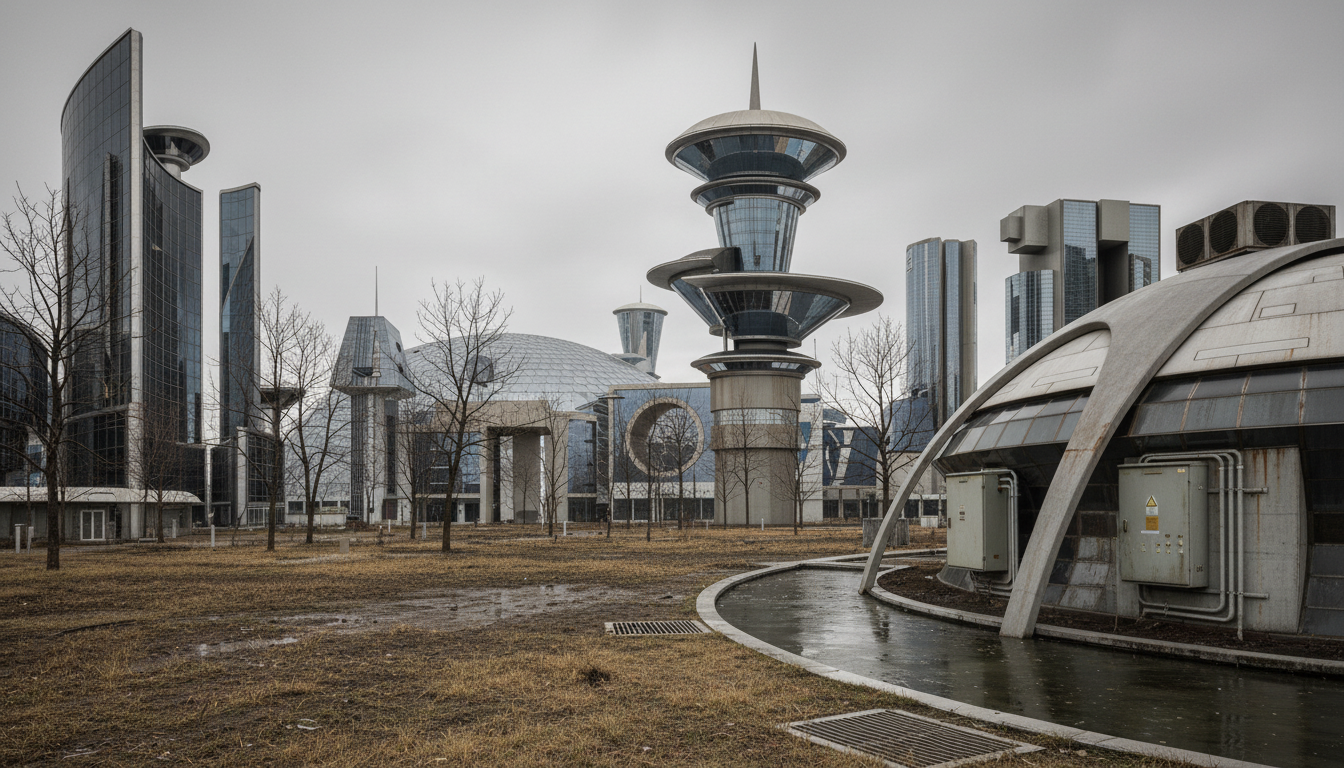
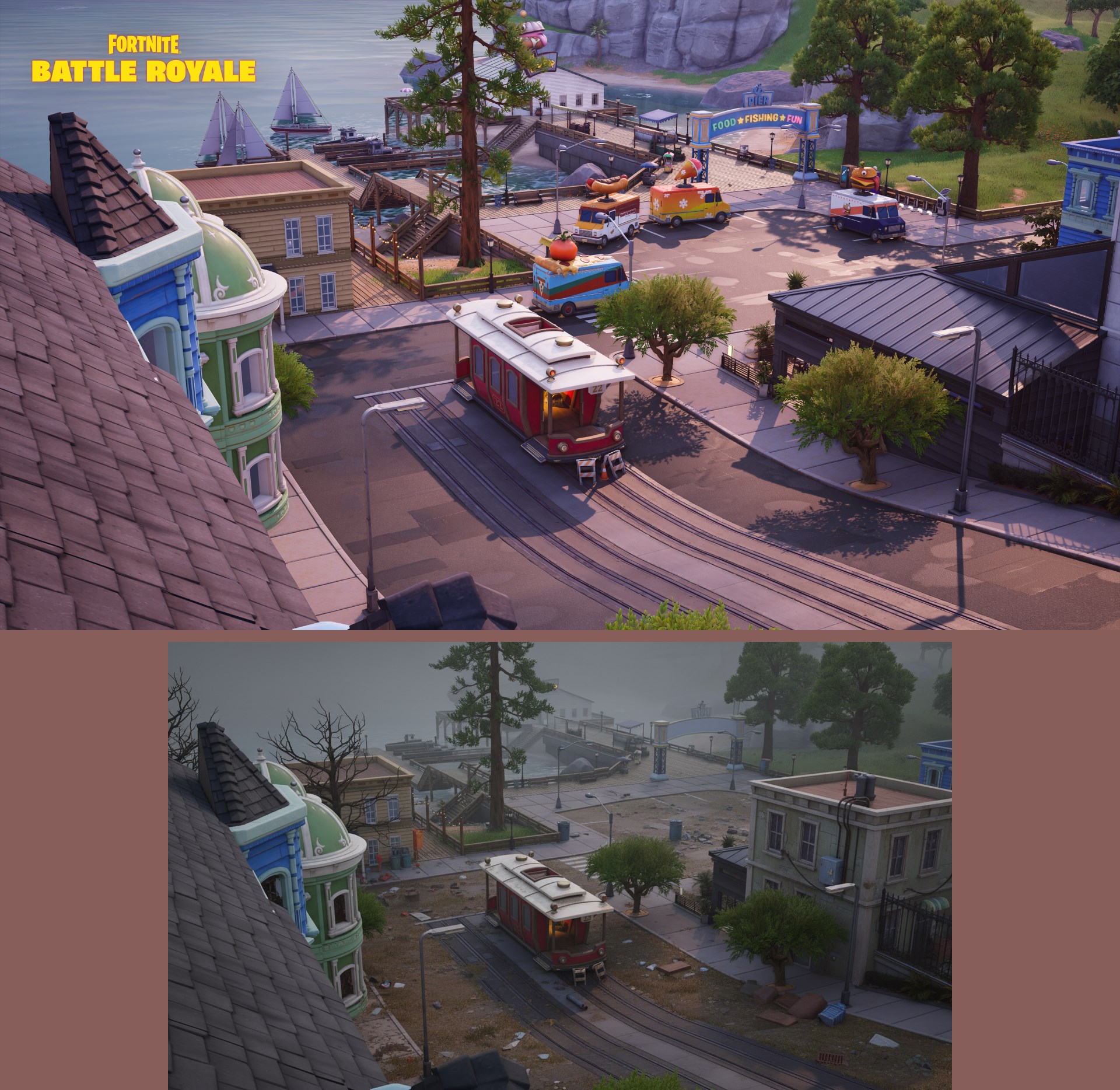
Dreary architectural pictures will be more likely to have electrical boxes, poor materials, etc, so when it moves the buildings from the latent space for cheery bright architectural renderings to dreary wet November architectural renderings, it will be more likely to add some of those details, because that's what's in its latent space.
Don't expect GenAI to be magic.
My father was really happy with some old photos colored, until I pointed out he does not look like him. Strangely enough he wasnt bothered...
It also added drainage that would actually improve the building.
https://files.catbox.moe/i8tfkl.jpg
https://files.catbox.moe/mw8vbc.jpg
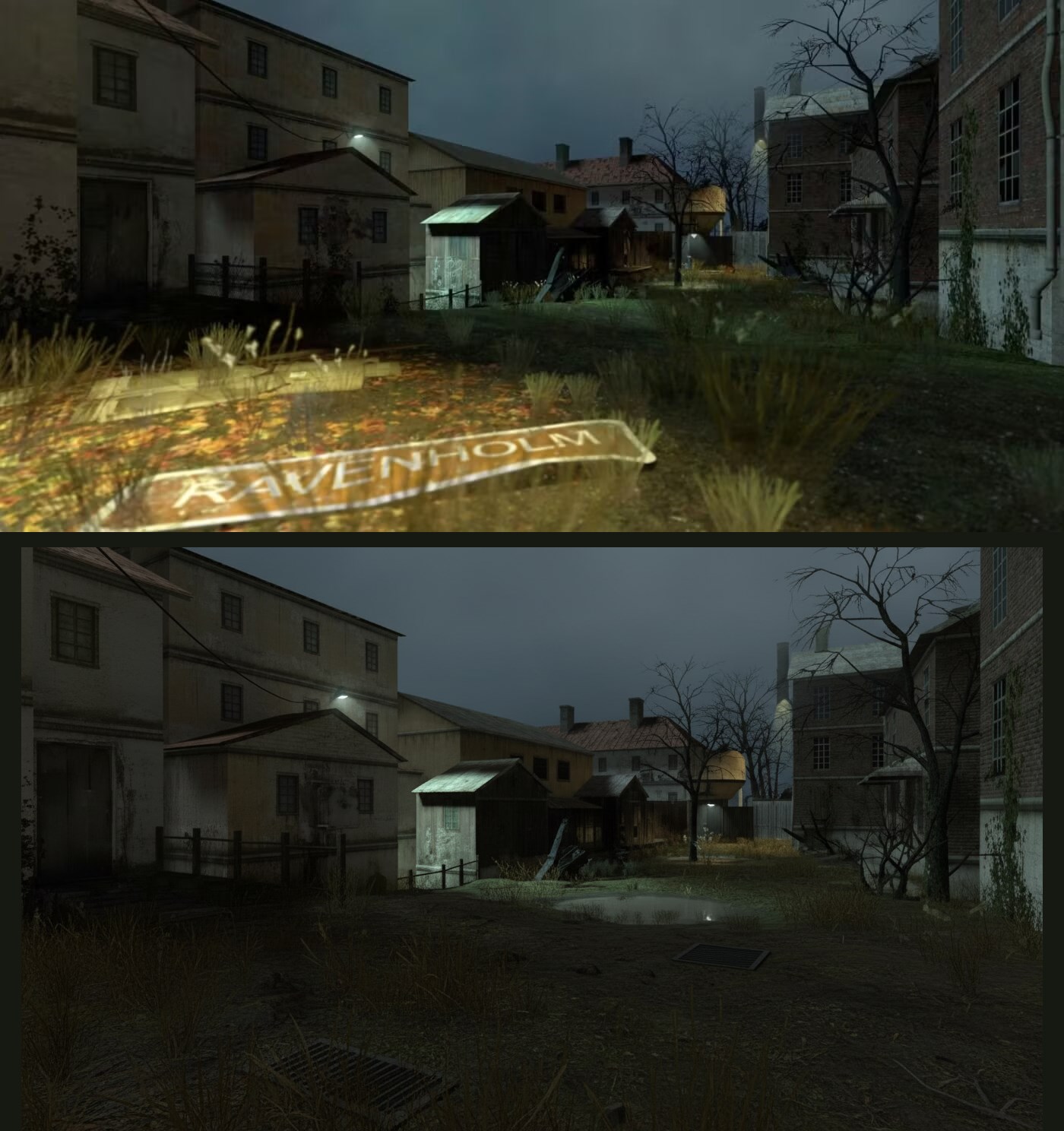
Then I thought what would it make from an already dark and grim scene, like HL2 Ravenholm
https://files.catbox.moe/d7z77h.jpg
but nothing really? Just made the whole thing a different color scheme + changed some architecture
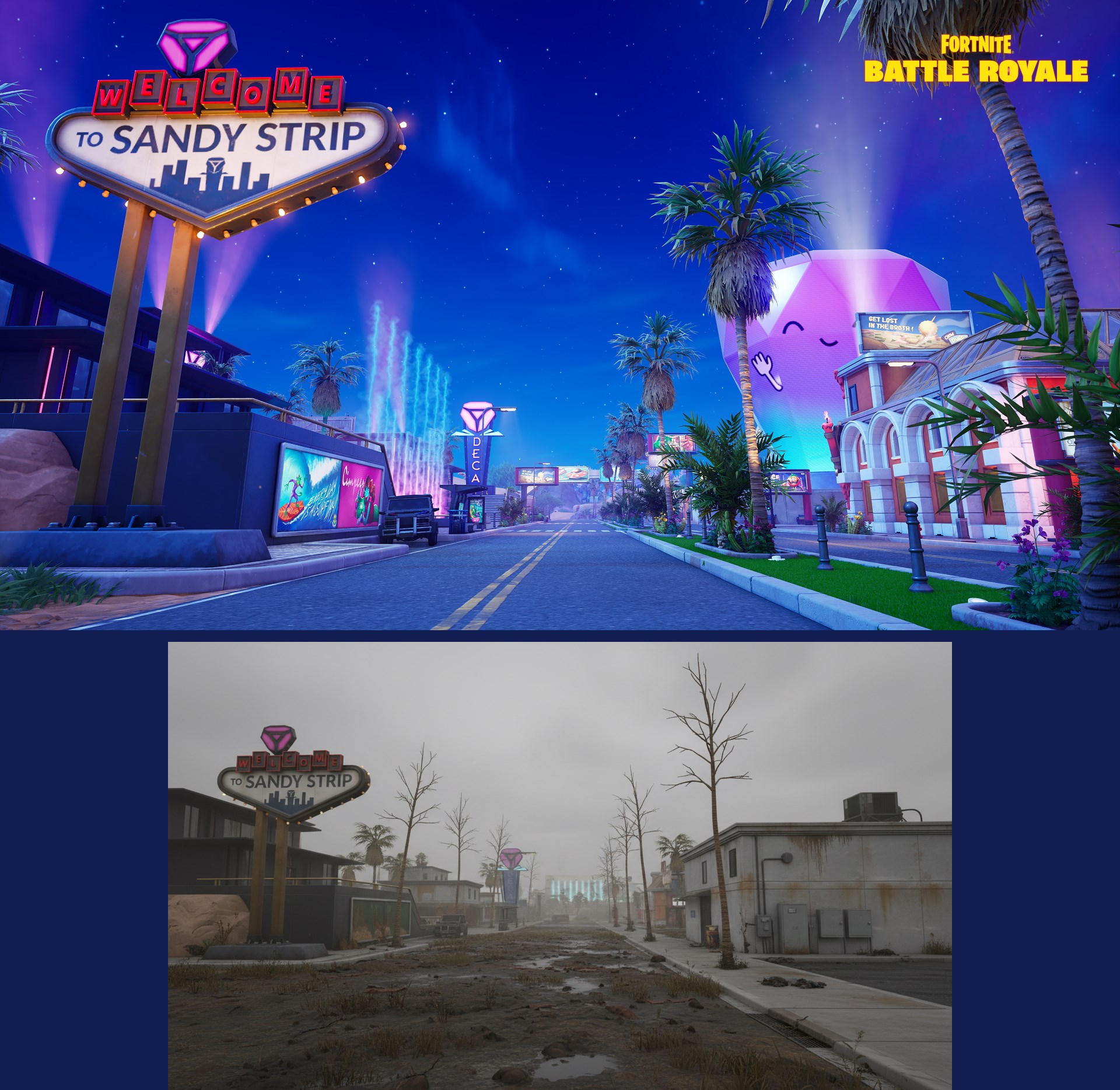
Bottom: Shady Sands
Is there some weird force dropping electrical enclosures on bridges (the cables on top even?) and random places in the street.
Those random protruding manholes next to two other drainage gates nowhere near a slope?
Why are these even the examples.
This is just like turning the HDR tone mapping up to 200%
Would love a version that renders a mix of cars and trucks onto any roads, to show up how crap the experience would actually be out front of road facing building.
On a nice day the render actually looks close to the real thing!
It's Calgary. The landscape will be a lot snowier anytime in November.
Hah, like connected cars talking to each other, the AR goggles/lenses will talk to each other so each person can broadcast a unified beautifed version of their face to others.
Maybe the Grok AR goggles will have Grok features...
Edit: oh, it's right there at the bottom of the page!
{ "image_generation_prompt": { "subject_focus": { "primary": "Architectural exterior scene", "constraint": "Strictly preserve original building geometry, facade details, and structural layout", "reference_adherence": "High structural fidelity to input image" }, "environment_and_season": { "season": "Late November, very late autumn", "weather": "Post-rain, overcast, gloomy, high humidity", "sky": "Heavy grey cloud cover, diffuse white/grey light, no direct sunlight", "ground_texture": "Wet asphalt/pavement, highly reflective puddles, wet concrete, scattering of wet brown decaying leaves" }, "vegetation_details": { "trees": "Leafless branches, dormant skeletal trees, sparse lingering brown foliage", "color_palette": "Desaturated greens, browns, greys, russet, damp earth tones", "state": "Winter-ready, wet bark, dormant landscaping" }, "human_element": { "density": "Sparse, minimal crowd", "clothing": "Heavy winter coats, scarves, boots, muted colors", "activity": "Walking briskly to avoid cold, holding closed wet umbrellas, hurrying, heads down against the wind", "mood": "Solitary, cold, urban transit" }, "photographic_style": { "medium": "Realistic architectural photography", "camera": "35mm lens, sharp focus on architecture", "tone": "Cinematic, moody, desaturated, cool color temperature, blue-grey tint", "quality": "8k resolution, high dynamic range, hyper-realistic textures" } } }
Transform this idealized architectural rendering into the most brutally realistic, depressing photograph possible. This is the WORST CASE scenario - what the building will actually look like in reality:
- Set on a dreary, grey, overcast late November day with flat, lifeless lighting - The sky is a uniform dirty grey, threatening rain - All trees are completely bare - just skeletal branches against the grey sky - The landscaping is dead, muddy, or non-existent. No lush gardens, just patchy brown grass and bare dirt - Remove ALL people, the scene should feel empty and abandoned - Any water features should look stagnant and grey - Add realistic weathering, dirt streaks, and construction residue on the building - The building materials should look how they actually appear, not the idealized clean version - Include visible utility boxes, drainage grates, and other mundane infrastructure usually hidden in renders - The overall mood should be bleak but realistic - this is what buyers will actually see on a random Tuesday in late autumn - Maintain the exact building, angle, and composition, just strip away all the marketing polish
The goal is honest truth, not beauty. Show what the architect's client will actually see when they visit the site.
That really captures the vibe in Kendall square on the weekend, but for maximum "honest truth" there should be double-parking, delivery trucks and ubers stuck in traffic waiting on a thousand people to scurry across the street from the subway entrance, huddling against the cold. Some dirty snowbanks and grey slush puddles in the crosswalks would really nail it.
It would probably sell better, because you’re just showing them how their building will look, instead of how it might look.
I wanted something to tell me what was adult about the image, by feature set, in order to display just those images
Worked pretty well, never released/launched it - just needed more capital for the marketing. But then that market cratered - were were going to use the classification attributes on NFTs, since the marketplaces let collectors sort by attributes, so it would have been easy to "find out the market value of particular physical features", and we could have empirical data on what physical attributes people value, instead of just anecdotes
kind of good that we didn't deal with the NFT market in general, project would still work though, just less revenue from sales possible
> Under Assembly Bill 723, real estate agents and brokers who display photos of a home that have been digitally altered with editing software or artificial intelligence must include a “reasonably conspicuous” statement “disclosing that the image has been altered.”
https://www.sfchronicle.com/realestate/article/california-la...
To address it you actually need to force them to provide the originals alongside the edited pictures.
20 years ago buildings never turned out like their renderings promised but now they do.
One think I wish is if I could get it halfway. I don't need it to look dreary, I just want it to look real instead of overly optimistic.
Anyway, if we used this anti-filter on social media then perhaps teens would not be so depressed.
Those things dont just grow like lichen or something, they are planned. It put a bunch of them on the pedestrian bridge as well and a lot of fat cables like from Akira or something.
He had a website, and the sample pic is a girl lying on her back, and in the "after" picture she's wearing a bigger cup-size..
Think more automated Lightroom than crowdsourced Photoshop.
It doesn’t add or remove anything from the scene, it just fixes bad lighting, color cast, perspective, and sharpness, basically what any decent photographer already does in post.
If anything, it helps photos reflect how the place actually looks in real life instead of dark, crooked, yellowish snapshots.
What ProntoPic does is basically what a professional real estate photographer already does in Lightroom: fix lighting, white balance, perspective, and sharpness. No adding pools, no changing furniture, no fake sunsets, no staging things that aren’t there. My girlfriend is an interior designer, so I see firsthand how much effort goes into making spaces look 100% accurate but well presented.
The goal isn’t to misrepresent reality, just to make photos look like they were taken properly.
In practice this mostly helps small hosts and agents who don’t have the budget or time for professional shoots. Right now they’re uploading dark, crooked, yellowish photos that actively hurt bookings (like the ones in the hp, real examples).
I guess I need to make it clearer in the site. Thank you for the feedback!
Also, the model goes a bit overboard with the electrical appliances. I had to laugh at the bridge one.
Apart from that, it's a great idea!