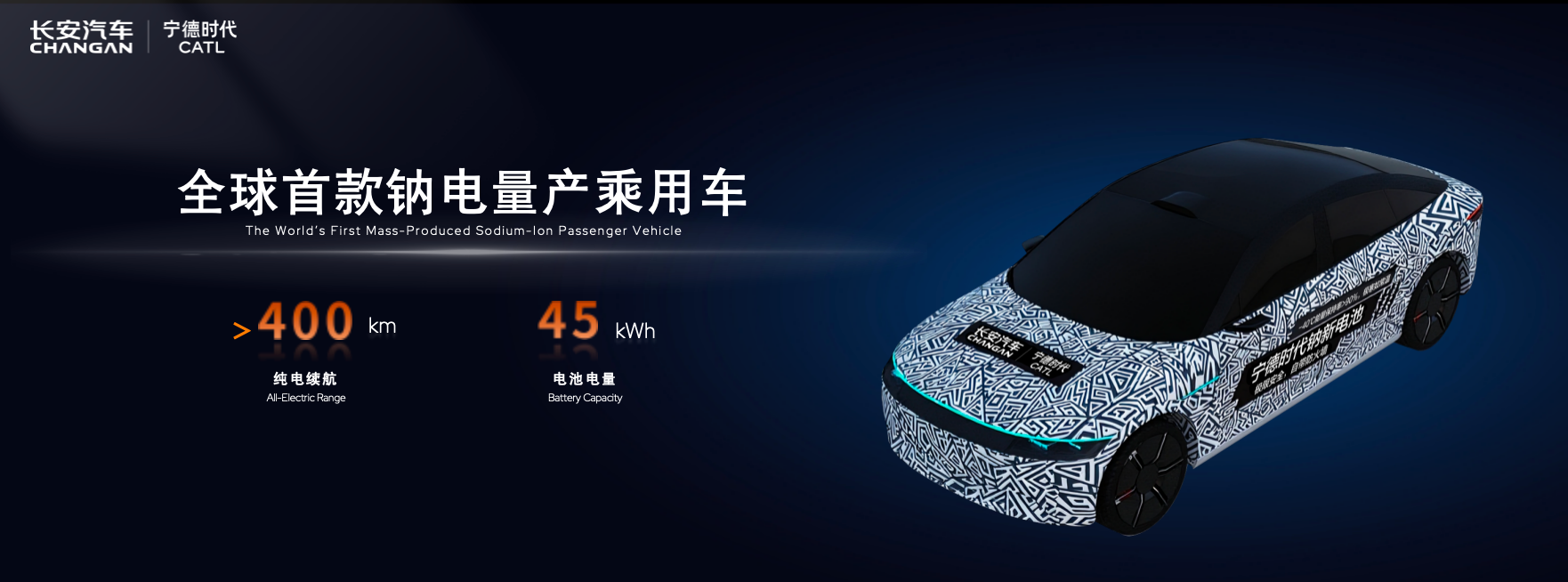
The CATL Naxtra sodium-ion battery will debut in the Changan Nevo A06 sedan, delivering an estimated range of around 400 kilometers (249 miles) on the China Light-Duty Test Cycle.
It delivers 175 watt-hours per kilogram of energy density, which is lower than nickel-rich chemistries but roughly on par with LFPThink of it this way, Sodium metal is abundant and cheap with 30x the energy storage (and energy transfer) of other solutions yet nobody has used it in almost any product ever (including as a coolant). The volatility of Sodium is why. Unless they have a solution to this, then I would be shorting whoever is insuring these batteries.
You should also consider shorting Morton [0]. They sell sodium, combined with chlorine, one of the nastiest elements around! And for products that go in people's homes! On food!
If they have not solved the problem, I still wouldn't recommend shorting any companies. Shorting a stock and waiting for years for it to drop is not a great strategy.
Huh? See https://www.terrapower.com/natrium/ -- and it's not exactly a new idea.
Also not uncommon to use sodium-filled exhaust valves in car, motorcycle, and aircraft engines.
I've seen that repeated a lot but I still can't buy sodium batteries cheaper than lifepo...
This is a big difference because there are all kinds of other factors besides energy capacity that can affect the efficiency of the whole system, and therefore affect range.
Most notably, air is about 28% denser at -40°C than at 25°C, so drag is about 28% higher. So you would expect roughly 28% less range at high speeds even if the battery has no capacity loss whatsoever.
As someone else mentioned, climate control also consumes a lot more power when it has to maintain a larger temperature difference between inside and outside.
With my gas car, I haven't noticed 30% worse fuel consumption at –30°C compared to +30°C [0]. To be fair, I haven't closely measured the fuel consumption at different temperatures, but I probably would have noticed such a big difference. This is just anecdotal of course, so your values may actually be correct.
[0]: It does occasionally get down to –40°C here, but my car won't usually start then, so I've slightly shifted your temperature range to the values where I've driven most.
>your values may actually be correct
Note that a 28% increase in drag results in a roughly 22% decrease in range, because 1/1.28 ~= 0.78. Also there are other losses (like rolling friction and constant loads like headlights or cabin heat), so range doesn't scale perfectly with drag. Drag is the main source of loss at highway speed, however
But TBF same factors affect ICE cars
I'd add though that rolling resistance tends to be higher, on average, in winter too. When there's often a bit of snow on the roads... Less so on high speed highways admittedly.
[1] https://www.reddit.com/r/askscience/comments/l2cq6b/comment/...
Even at 30kmph it's already the majority of the resistance and it scales exponentially with speed so you can imagine how much it matters.
As long as you have a heat pump harvesting the waste heat to keep the battery up to temp.
But might be significant on short drives, 10kW for the first 3 km is massive.
https://electrek.co/2026/02/05/first-sodium-ion-battery-ev-d...
AFAIK most EVs already use heat pumps today, so the future happens whenever sodium batteries become mainstream.
Obviously Tesla and the like are more luxury cars but if EV is to become mainstream they need to compete with ICE Kia's and Volkswagen.
But if they add buttons back as planned, I might be willing to try a new id.4 in 5-10 years.
https://www.energy.gov/energysaver/fuel-economy-cold-weather
At -40F (-40C), it's generally good practice to just stay inside and not drive at all...
Is that actually true once the engine has reached operating temperature?
> Fuel economy tests show that, in city driving, a conventional gasoline car's gas mileage is roughly 15% lower at 20°F than it would be at 77°F. It can drop as much as 24% for short (3- to 4-mile) trips.
Not sure the engine ever reached "operating temperature" on that drive.
1) winter blend fuels have less energy per volume, that doesn't make your engine any less efficient by energy but it does by volume of gas
2) lots of temporary cold effects: fuel vaporization, thick lubricants, etc. these things become less of a problem as the engine warms up but some energy is still lost on long drives
3) air resistance: all aerodynamic forces are linearly proportional with air density. At a constant pressure there's about a 15% difference in air density between the hottest and coldest places you can drive (and thus 15% less drag on a hot summer day than a cold winter day). aerodynamic forces are proportional to the square of your velocity and they become the largest resistive force around 50mph -- so at highway speeds you're losing efficiency because you have to push more air out of the way
4) energy used to maintain temperature: this is hard to calculate but some engine power is lost because the energy is used heating up the engine block and lost to the environment
5) the Thermodynamics 101 engine efficiency goes UP with increased temperature, but it's got a lot of real world effects to compete with, no spherical cows and all
Since the Lithium battery prices dropped, there are many Sodium battery companies simply abandoning the research or shuttering. Not a good sign when smart people jump ship.
The Na cells also have lower energy-density, and currently fewer viable charge cycles. One can still buy evaluation samples, but it takes time to figure out if the technology will make economic sense.
Best regards =3
There could be other reasons. Maybe they just cannot compete with CATL.
we can always afford to wait and see.
Have a great day =3
https://carnewschina.com/2026/01/22/catl-unveils-worlds-firs...
(The motorcycle is real, and has been out for years. This is just a battery upgrade.)
[1] https://insideevs.com/news/786388/verge-motorcycles-donut-la...
There's a lot of reasons to think that that battery might be a scam... unlike most batteries, including sodium ion ones... If it's not a scam it will certainly upset the battery market eventually.
"Chinese battery giant CATL and automaker Changan Automobile are preparing to put the world’s first passenger car powered by sodium-ion batteries on public roads by mid-2026."
CATL is more credible than Donut, but both are making forward-looking statements.
CATL is "we're going to mass produce this specific well known technology" and while there's some question as to precise numbers for their implementation of it they aren't claiming anything surprising. A worst they're somewhat over optimistic and fail to be a commercial success. At best they're slightly under optimistic and are slightly more successful than anticipated. We can be confident they aren't flat out lying (though they may be exaggerating) because the claim is so mundane.
Donut is "we're going to produce a technology capable of achieving targets that haven't even been demonstrated in a (public) lab. We won't tell you what specific technology. We're going to put this miracle battery in motorcycles, because we can". At worst they're flat out lying to scam investors - but if they're not lying, even if they're over optimistic, they've made a significant advance in the state of the art that will eventually (once it's not just put in motorcycles) have widespread repercussions.
OTOH, there are seemingly more lithium iron phosphate (LFP) battery ev options now - rivian now uses LFP, Ford mustang mach-e has had a LFP variant since fall 2023 (and should have other models using LFP in 2027), I think the 2026 chevy bolt uses LFP, etc.
The US administration has basically told them to do so.
So don't expect any innovation on this front from the middle of the North American continent. It's being actively sabotaged.
Any US automaker relying on Trump staying in office is playing with fire. Yes, you may see reduced or zero press releases and budgets for EV research being "reallocated" on paper so the toddler in chief doesn't get a public tantrum - but assuming there will be free and fair elections this year, it is highly, highly likely that Congress will be solid blue and reinstate a lot of what Trump has cut down, only this time as an actual law that is far harder to cancel than executive orders.
And everyone not hedging for this possibility will wreck their company's future.
Don't expect any movement on EV legislation unless and until Democrats take back the White House in 2028
That and threw tariffs on the auto makers parts and imports such that their businesses are under threat?
GM just axed the Bolt again. The only domestic affordable EV. Stellantis killed all of theirs, from what I hear. And Ford has pulled back as well.
I wouldn't recommend EVs in any climate without home charging.
I assume it's just that its internal resistance rises when it's cold, but I might be wrong.
Yes. It's mostly wasted as heat inside the battery. I think there's also a temperature relationship to open-circuit voltage? But the predominate effect is from elevated internal resistance.
You can read about EIS here: https://www.gamry.com/application-notes/EIS/basics-of-electr...
Sodium would need to be more efficient to be lighter, which it isn't
This means that if you do not use the car for some time, you may need to recharge it before you can use it again. This may be a problem if the car is left far from a charger.
Otherwise I agree with what you said.
interested in hot desert weather performance which often gets lost in the averages.
Decided to keep my battery devices in a cooler with cool and frozen water bottles to drink when I return. Phone, camera batteries, and a portable vehicle starter.
[0] https://cdn.motor1.com/images/custom/worlds-first-mass-produ...
[1] https://insideevs.com/news/719013/2024-tesla-model3-epa-rang...
The reason this is so exciting for me personally is for stationary energy. Because the raw materials are so abundant and have good cold weather performance, both grid and home level energy storage costs should come down significantly as this is commercialized further.
Since it's also cheaper, it's likely that Na-ion will be adopted by cheaper city runabout type EVs, while premium long range EVs will continue using Li-ion.
There are already large battery swapping schemes in China with thousands of stations. Even if we don't get to 5-100 charging at 5C+ there's nothing stopping this from not being a problem.
If the arrow of time is to be believed, many of the complaints and gripes and "well aktuallys" from 10 years ago are solved already. And there seems to be no slowing down.
Fast charging would fix it. If you could go from 15 to 80% in truly under 10 mins that would work too.
Battery swapping is talked about a lot but AFAICT it hasn't really been successful anywhere. It just seems like a lot more hassle than plugging in, and with charging speeds constantly increasing the payoff is shrinking too.
Looking into it more. Maybe something like supersaturated solution of sodium acetate (plus water) in a sealed pouch with a metal disc. Bending the disc triggers crystallization, releasing stored heat (around 130–140°F for 20–60 minutes). Boil them to reset.
So you could boil and reset them during charging and click them off if needed in cold weather.
Granted, you have a minor bootstrapping issue wherein you need the battery to be warm before you use battery power, but at very low % of the battery's power capacity I suspect it's less of an issue.
A quick search suggests that sodium acetate used like this stores 230kj/kg (i.e. 64 Wh/kg in the units used for batteries) [1] which is significantly worse than the sodium ion batteries being discussed. Same order of magnitude though, so maybe there's a better material that would make it work.
[1] https://www.sciencedirect.com/science/article/abs/pii/S13594...
Crustal abundance up to 1000x that of lithium - pretty much every nation has effectively unlimited supply, it's no longer a barrier or a geographically limited resource like lithium.
No significant damage going down to 0V, can even be stored at 0V - much safer than lithium which gets excitable once out of its prefered voltage range.
Cold weather performance down to -30C - northern latitude users don't have as much range anxiety in the winter.
Basically, the only problem I see is that companies that have made significant long-term investments in lithium could take a big hit. Countries that banked on their lithium reserves as a key future resource for will have to adjust their strategy.
Lithium batteries will likely still have a place in the high performance realm but but for the majority of run-of-the-mill applications - everything from customer electronics to EVs to offgrid storage - it's hard to see how sodium-ion wouldn't quickly replace it.
I don't doubt that sodium ion has a place... but whether it takes over as the dominant battery type for portable applications strikes me as very dependent on the future of lithium extraction. It seems like a place that has a lot of room to grow more efficient and thus more competitive on cost.
https://battery-news.de/en/2026/01/26/catl-presents-sodium-i...
So lithium-ion batteries will never be replaced in smartphones or laptops by sodium-ion batteries.
But there are plenty of applications where the energy density of sodium-ion batteries is sufficient. Eventually sodium-ion batteries will be much cheaper and this is why they will replace lithium-ion batteries in all cheap cars and for most stationary energy storage (except when lower auto-discharge is desired).
I think (hope) this niche will start to make a comeback as the underlying tech continues to get cheaper. You are starting to see glimmers of it in the low low end with some micromobility cars in Europe just providing phone holders instead of screens.
Theres some EV owner costs because of infrastructure, but the base cost is not as luxury. Its luxury because americans refused to see value.
Given the difficulty of radiating heat away I would have expected the opposite.
Especially considering the incentive to send up as little battery as possible, and the very predictable day/night cycle leading to the ability to precisely predict how small a battery you can get away with...
Rated: 230 miles
10°F with 70°F climate: 160 miles
10°F with no climate: 190-200 miles
Most of the winter it tells me I can only do between 100 and 120 miles. It is definitely half the EPA range with climate controls disabled at 0F. (Ask me how I know).
I love driving it in the winter. I don't have a pressing need to go long distances, so that is not a current concern. Not having to stand outside in the bitter cold to fuel up in absolutely awesome.
There are EVs on the market that do much, much better than mine in cool weather and I now know what to look for.
To really penetrate the midwest it will take a car that can realistically do a road trip to Florida from say Duluth, MN or Michigan's UP in the winter.
Because not only do folks in the midwest drive long distances without a second thought, they sometimes do it in the cold of winter so they can get a break from the snow.
So yes still getting 90% of the range at -40C does sound attractive.
That right there is a big problem to begin with. The headline EPA number only reflects reality if you have a mix of city and highway driving. The problem is that people only care about range when driving 75mph. I think the headline EPA number should reflect that reality.
The EV described in the article has a standardized range of 250 miles. This isn't a range monster in any condition. There is some gesturing that Sodium batteries don't require as much active heating in cold conditions. But nothing is quantified.
As usual with sci-tech broadly and batteries specifically: it's exciting that sodium batteries are coming to market; we can be optimistic that maybe in the future they will provide lots of range, or be less expensive, or maybe less flammable than today's lithium batteries. But the marketing hype is running miles ahead of reality.
That is exactly the substance of the headline.
If we put aside the politics, what are the actual statistics behind lithium battery fires today? And don't LFP's have negligible fire risk?
I feel like my gasser F250 had a higher risk of spontaneously combusting.
No one burned to death inside a Tesla while driving normally. It's always following a crash.
And I've been following Polish firefighters reports about EV fires and they are very interesting - basically saying that in all recent cases of EV fires they were contained so quickly even the interior was largely undamaged - something that practically never happens with regular cars. Some of these have been in underground garages too, with difficulty of access - but nowadays they just know how to approach an EV fire and containment isn't a problem.
"The Long-Range Version sets a new record for light commercial vehicles with a single-pack capacity of 253 kWh, achieving a maximum range of 800km."
That would be some 720 km at -40 C if the numbers are correct. I'm not well versed in this area and not sure if these batteries are comparable to those in personal vehicles, but the ones I've heard owners talk about have a reach at about half that if it's cold at all.
You are correct that range for many cars with Lithium (NMC) batteries is halved when the ambient temperature is below about -10 C. But an important caveat is that this applies principally to short trips where the battery never warms up such as driving 10 km into town and back to do some shopping. On long continuous journeys the decrease in range is much less marked.
This text is not present in the article. Are you looking at a different article?
The marketing hype is the true range monster