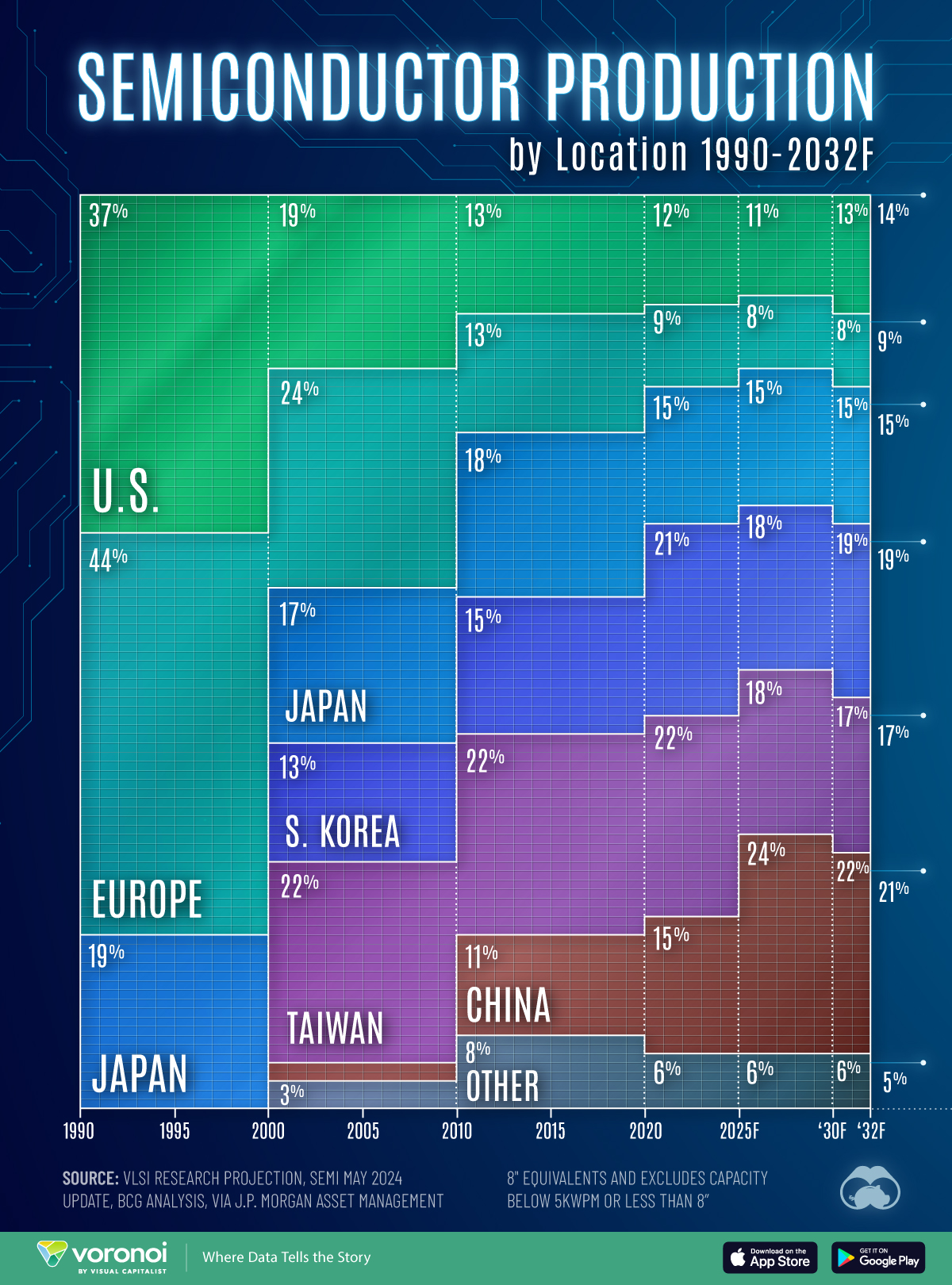
Meanwhile Europe only got 40k WSPMs of 12+ nm capacity: https://overclock3d.net/news/software/bringing_advanced_semi...
The problem is that unlike Airbus, which (highly inefficiently) can be made in multiple countries, you can't really spread out parts of a fab that way. The most you can do is fab machines + chips + chip packaging. Netherlands already has fab machines and in packaging there isn't a high margin.
That leaves chips, and you can be sure that whoever gets the fabs, the other EU countries will throw a shit fit and demand counter investments to compensate. And on top of that there is also regional animosity. So even if it makes logical sense to pop the fab down in the middle of the blue banana, it won't make political sense because France and all of South and East EU will be angry about "the rich getting richer".
And how are we gonna do that exactly? EU runs on national interests of those footing the bill, mainly France and Germany as the largest net contributors.
When you're relying on national subsidies to build and run a factory and adjacent infrastructure in a country, you're tied to national interests and demands of those countries footing the bill for all that infrastructure.
So the likes of France and Germany aren't gonna give billions in subsidies from their taxpayers' money to semiconductor companies so that they can incorporate in Netherlands to dodge taxes and then create jobs in low-cost Poland and Romania instead of at home, even though that's already been happening to an extent in other industries over the last 20+ years.
It's the same with arms purchases now. France blocked Ukraine from using its money to buy British made weapons that are already available, since it expects that money to go back into the French economy, not to the economy of a competitor, even if the much needed weapons will arrive much later.
Yeah I know, UK isn't EU anymore, but the point still stands, as EU nations are still economically competitors to each other and they're not gonna spend their tax money to fund competing economies even in the EU block.
Airbus currently has two factories finalizing the airplane assembly: one in Toulouse and one in Hamburg. You could copy this model and just open different fab in different countries to spread production.
Also, another model is one country making wafers, one country making EUV-lithography machines and parts, one country mining and refining silicon, etc.
China didn't become the manufacturing giant it is because of a single product, they did because the whole supply chain was moving there while the EU and US were only concerned about higher-margin products and activities.
I'm sure some town in Italy wishes it was still the world's #1 diode manufacturer or something.
"a fab" or "the fabs"? We are commenting on news about TSMC building fabs in 3 countries across 2 continents, multiple fabs in each - I counted 23 of them here [1].
Surely, the EU can commit to a few fabs and research labs in different countries, semis are equipment and labor intensive, there's work for more than the EU. There's no need to build all of them at once, a clear commitment will suffice.
[0] https://www.visualcapitalist.com/wp-content/uploads/2025/01/...
If you just do nothing within half a decade or so you'll be far behind the cutting edge and at that point the decline gains its own momentum
That's not at all how it works. You're talking as if you're buying a plug-and-play Xerox copy machine that you can just unbox and start printing copies of your work and make money.
Buying the latest EUV machines doesn't get you the latest nodes and economically viable yields.
Intel, Samsung also have the latest ASML machines that TSMC has and yet they haven't caught up to TSMC because there's a lot more to semi manufacturing that just the machine itself.
If Germany just buys an ASML machine it would be an expensive paperweight without the process know-how that engineers at TSMC have amassed over the decades in order to get the most economically competitive yields.
Even if this fab is 3 times more expensive then other ones, the result of not having one will tank the entire economy and GDP of a nation if things go bad.
We speak here about trillions of damage while a fab costs only a few billions.
This is like a complete non brainer.
We get what we deserve.
While capitalism is a good model, it needs to be kept balanced, restricted..
Shareholder primacy is ruining everything, too much influence in politics from too many external sources.
Europe is already a great place to build your life and despite the narrative about "EU killing businesses with over regulations", Europe is an exporter, that is EU makes physical things in large quantities(that's why USA is able to blackmail EU with tariffs). EU produces and exports so much, more than it consumes. Its closer to China than USA in this regard, you can check out the recent stats here: https://ec.europa.eu/eurostat/web/products-euro-indicators/w...
The infrastructure is in place and there are both many nuclear reactors that were decommissioned early or not yet commissioned but canceled/put on hold as well as regions with plenty of sunshine or hydro power opportunities and also has all the expertise to re-work those quickly.
It's really a political decision to push for something like that or not. Geopolitics may eventually make it happen, who knows? At this time it makes more economical sense to make the tools and send them close to the larger supply chain of electronic products production.
Agreed. Its countries' long-standing equivalents of America First policies mean that they spend far more on their own citizens, import far fewer people, and leave most of the charitable, defence, and research spending to the US taxpayer. Good for them.
Europe is great in many ways but lacks the dynamism exactly because of its highly controlled immigration policies instead of free market ones. Bureaucrats actually are terrible at picking who should come. A major example are the Turkish immigrants to Germany, where they imported huge numbers of Turkish immigrants for their booming car industry in the 60s and instead of just treating them like normal people they did this "guest worker" thing and as a result those Turks failed to integrate and remained in the low socioeconomic status with exception for some high profile cases like the inventors of the mRNA vaccine or the Crysis founders. In other places like UK or USA, Turkish immigrants tend to have much higher socioeconomic status.
If EU end up doing its chip and energy industry push, better be following the pre-Trump era immigration policies because that's how USA got is all the workforce that make USA leap ahead in many industries. Some French or Swedish immigration officer would not be picking people better than industrialists or startup founders. Immigration and its integration are not Europe's strong traits.
EU leaders and VCs gave up on the electronics industry 20+ years ago and just kept offshoring it to the cheapest suppliers to lower costs and increase shareholder value.
You can validate this by looking at which sectors pay the highest EU wages and you'll see that hardware and electronics are not in the top.
And working in the electronics industry requires highly skilled knowhow and academic specialization, and you're not gonna attract people there if you don't pay them top wages if they can get more money and an easier job somewhere else like writing CRUD SW or pushing pencils in a bank.
Good enough can be good enough and then aim for fun/interesting/challenging/fulfilling work instead of a fatter check.
THis idealism always goes away once you have to buy a home, and realize you're working more hours and getting less money than your mates in other industries that are easier to get into, so you start to switch really quick.
People aren't selfless when it comes to being exploited by private sector entities, they'll always go towards the ones with the best wage/hour ratios.
People aren';t stupid. Why would they voluntarily choose to work harder and be less well off? It's not like this is working for the public good like medicine, firefighters, EMT, education, etc.
This keeps ppl locked in to the TSMC universe. The Japan and US fabs produce just a fraction of what these countries need.
There is an established playbook that the Chinese have used for decades when taking over an industrial sector from other countries. They funnel vast amounts of state funding into it, sell at or below cost for decades, win the low end market, and then slowly and gradually move up the technology chain. It's worked for almost everything, but it's this last part that just isn't working for them with semiconductors and aviation. They aren't capable of catching up fast enough in these two fields. These are sectors that are both too large for any one country to do well on their own. Even for someone as large as China. It requires a global supply chain.
Aviation is functionally caught up, as in if PRC wants to throw together a narrow or wide body on domestic components short term, they can at scale and service domestic market with less fuel efficiently. The primary reason COMAC uses western components is for faster global certification.
PRC Semi progress beating western analysts of catchup, instead of 10 years to EUV they're looking ~7/8 years. Again global semi supply chain is just a handful of countries with fraction population as PRC. And all western semi players projected to have talent shortage in the 100,000s, so that moving goal post likely going to move slower and slower vs PRC convergence.
Semi easier medium/long term problem since PRC _only_ country projected without semi talent shortage, i.e. current trends and forces point to inevitable convergence and PRC.
Ironically aviation harder problem because exporting outside of PRC market is matter of geopolitics vs pure technical/state capacity.
Looking at trend lines, west simply not capable of staying ahead.
The past is of no value in predicting the future right now.
That was before the current administration wiped out the very idea of "soft power" and put everything including NATO up for disposal.
There is, frankly, no way for anyone to trust the US again until the US undergoes steps similar to post-1945 Germany.
So the time of military US protection is behind us.
In an interview reported by Reuters, he said he’d impose 150%–200% tariffs if China “went into Taiwan,” and when asked about using military force against a blockade he said it “would not come to that” because Xi “respects me” and knows he’s “crazy.”
https://www.reuters.com/world/trump-says-he-would-impose-tar...
> What are you going to do when none of the Taiwanese workers turn up for work, or worse they do turn up and sabotage the fab.
You’re going to offer them a lot of money, citizenship, and exfiltration of their family to turn up at work, and threaten them with lifetime in supermax if they sabotage anything.
What US judge isn’t going to allow you to do what the hell you want under national security provisions if it comes to that?
This is exactly the attitude I'm talking about. You can't operate a fab based on coercion. It requires positive relationships. There are simply too many people involved doing things that the would-be coercers don't understand.
The idea that an entire TSMC fab is going to commit treason en mass is about as believable as thinking that NASA faked the moon landings and covered it up en mass. Large groups of people don't behave the same way as small groups of people.
If the US wants a fab, just give Intel money to build one. Trying to steal one from TSMC is a nonsensical plan. At least Intel would know how to operate their own fab.
The current US security apparatus is led by highly incompetent and corrupt people willing to sell the country down the river, so I would not count on them coming up with a plan, much less a reasonable plan, for anything.
Have you seen the US security apparatus's track record at coming up with reasonable plans for what happens after the military victory? See Iraq, Afghanistan, etc.
The U.S and Japan indeed will have less incentive to defend the sovereignty of Taiwan, but other reasons remain to ensure the statu quo remains. Purely geopolitical, not just industrial.
As soon as we get the right semiconductor supply chain stateside can switch up on that island and reach parity with the rest of the world’s contribution to that issue: none.
Also, not sure why everyone forgets about it. People should have learned from the experience of the pandemic that the cutting-edge foundry nodes are not really the crucial ones, as being the bottleneck of industrial infrastructure. A delay of the next-gen iPhone or RTX gaming card isn't that catastrophic. But a shortage of embedded MCUs, which are actually fabricated by mature nodes, could stall the entire industrial base of a country.
Japan can't even sell arms to Taiwan right now. Even starting selling arms would be a huge change, let alone a mutual defensive pact.
It's extremely hard to change the constitution of Japan. It's the only constitution that has never been revised since WWII. LDP has been pushing this agenda for decades and nothing really happened.
It’s easy to ignore or work around it though, just like it routinely happens for every other constitution in the world.
In reality no such thing happened and one YouTube video of a handful of protestors doesn’t make it so.
What she did say is that a Chinese attack on Taiwan _could_ clearly become an existential threat to Japan. Note that key word _could_
Which… of course it could!
Japan hosts multiple US military bases. If it developed into an armed conflict between the US and China then it’s exceedingly likely that Japan would be attacked. Think Chinese missiles aimed At Yokosuka, just south of Tokyo.
Not only that but Japan and China have multiple territorial disputes. It’s not hard to imagine China deciding to go all in and settle those as well.
But it will happen one way or another. Taiwan's Sovereignty is completely depending on one single country, the US. It's not like that Taiwan can just say no if the US demands more diversified chip production.
They’ve become the trolls under the bridge and will squeeze every passerby for every dollar they’ve got.
The days of cheap computing have been in decline and are now dead, replaced with giga profits for this companies who managed to the the indispensable links in a chain with no or minimal competition.
Realistically it's probably just that Japan is politically stable and safer than the other options in the area, while remaining fairly close to the rest of the supply chain.
Reunification with Taiwan has been a major policy goal of the CCP since the civil war and is one of Xi’s explicit policy goals. He just reaffirmed this commitment as part of his New Year’s speech.
Historically China has lacked force projection capability. However it has had a multi-decade modernisation and military build-up which has drastically changed this situation.
Further we’ve seen significant tightening of CCP control over society and in particular the military in Xi’s term.
A straight forward analysis of these events, in line with Xi’s public statements and past Chinese actions, is that the ground work is being laid for encirclement of Taiwan followed by China taking over, by force if necessary.
Literally have ongoing border disputes with practically all of their neighbors, a few of which they’ve been shooting at (India) and ramming at sea (the Philippines) in the last few years.
This was after 13 years of friendship between India and China, where India had supported China in many ways including supporting the Communists getting the UN Security Council seat reserved for China. China and India had signed a friendship pact just a few years before.
> Perhaps there are not many instances in history where one country has gone out of her way to be friendly and cooperative with the government and people of another country and to plead their cause in the councils of the world, and then that country returns evil for good
That’s how India’s PM described this barbarous act of betrayal.
This was a good demonstration of how China views its neighbours. As vassals to be brought to heel from time to time, rather than equals. And China will use violence to achieve these aims. That’s the Mao doctrine, followed by every Chinese leader since.
And before you try any nonsense of “oh that’s old news”, China is annexing Bhutan today to put pressure on India to make territorial concessions. (https://youtu.be/io8iaj0WYNI). China is annexing international waters in the South China Sea. China is attempting to annex islands controlled by Japan. China also has border disputes with Russia.
Educate yourself instead of uncritically spreading Chinese propaganda.
From Wikipedia: "There had been a series of border skirmishes between the two countries after the 1959 Tibetan uprising, when India granted asylum to the Dalai Lama. Chinese military action grew increasingly aggressive after India rejected proposed Chinese diplomatic settlements throughout 1960–1962, with China resuming previously banned "forward patrols" in Ladakh after 30 April 1962."
The border was guarded about as well as the US-Canada border on the Indian side.
The surprise war caught India completely off guard. The surprise was so effective that China captured all the territory they wanted, killed thousands of Indian troops and declared a unilateral ceasefire before India could marshal a response.
Prime Minister Nehru was badly shocked by this betrayal. He never recovered from it. His health deteriorated rapidly and he died a little over a year later.
Consider that maybe a 2 minute skim of Wikipedia teaches you very little. Certainly not as much as reading many books on this subject, which I have.
This is the Chinese way since at least Zheng He and treasure ship voyages.
Like, the centre of the world would be Asia today if Mao hadn’t needlessly (and profitlessly) trashed that goodwill.
The 1962 war secured the road route between Tibet and Xinjiang. Very strategically valuable.
It also had the effect of uniting India, killing some budding separatist movements. It also made the Indian government prioritise strengthening the army for the first time, which meant the army was ready to fight Pakistan to a draw in 1965 and a victory in 1971.
So the war strengthened both China and India, and poisoned relations between them. Which was fine with Mao, he didn’t really care about good foreign relations.