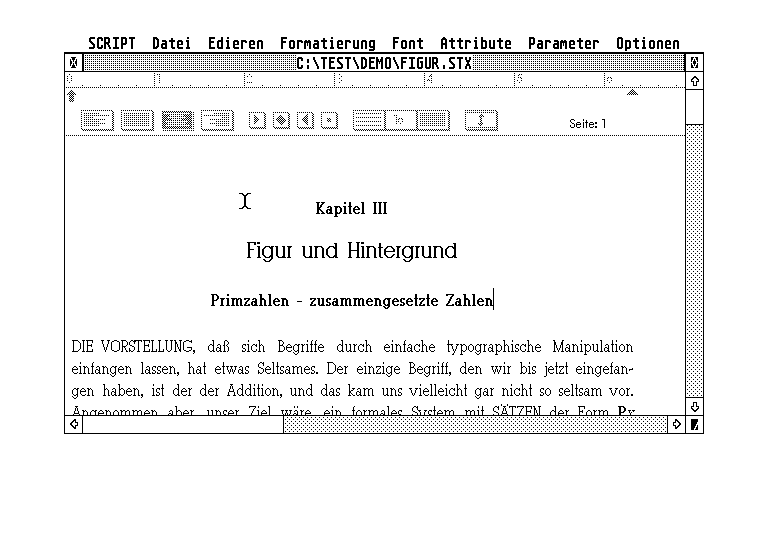
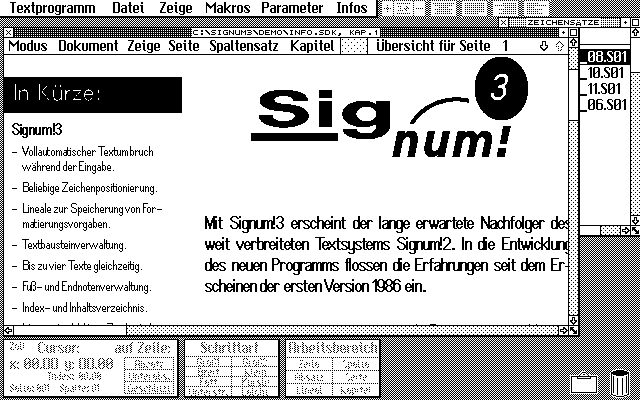
Same, don't remember the name though. But it was WYSIWIG and I'd use it to create character sheets for our D&D games. And then I'd print them on a dot-matrix printer on continuous paper. Oh the memories!
Does anyone know what data structure? Why not use it in modern word processors?
The other features are impressive too:
* Tempus-Word NG is based on a frame orientated layout similar to DTP programs. But contrasted to the usual method of “draw frame - connect frames - flow text” you create a general frame layout that is used automatically during text input. The positions of all layed-out frames is repeated automatically on all pages with this layout. You can create as many layouts as you want.
* Integrated Database
* Document manager
* Page numbering of Contents and Index listings are always up to date.
XyWrite is supported in a similar fashion: https://mendelson.org/xywin.html (but I just helped folks use that, never actually found it comfortable myself).
I kind of wish all these small/tight/efficient programs could be gathered up and ported to an optimized OS for the Raspberry Pi....
There were tons of amazingly well-made commercial software packages that have just been lost to time; in a large part due to open-source and other free options getting "good enough" - but many had features that simply don't exist anymore.
That Raspberry probably can run all the peak Win98SE stuff, today.
On the other hand, there you didn't have that many powerful packages on any system, besides Quark & the various Adobe tools du jour everything paled in comparison.
For word processing, being forced to use Word was/is usually worse than for DTP, though. But feature-wise, everything seemed to converge during the 90s, so "having" to use Word instead of e.g. WordPerfect was less and less of an issue.
With some exceptions of course, most famously GRRM and other people who got into things very early sticking with the first thing they learned (i.e. WordStar), or apparently some journalists being really into XyWrite.
Once you know the pattern, every so often you'll see a piece about a writer or journalist and the funky software they use and you can just wait for it... it's going to be Wordstar, XyWrite, one of the XEDIT editors, sometimes Wordperfect for DOS. Rarely Word for DOS. Neal Stephenson uses emacs, but he's an outlier in a lot of ways. I think there was a piece linked here recently by a journalist who uses the macOS TextEdit for note-taking, which dates back to NeXSTEP. (not exactly the same thing, but consider)
A Canadian science-fiction writer, Robert J. Sawyer, made an Archive available complete with extensive resources on how to use it. In addition, fully text-searchable PDFs of the original manuals, totaling over 1,000 pages, were also available. He is a dedicated WordStar user.
I don't use it. But i tried an old version and it was fast as f...
It is written now in C++
"I never had a license! Well, even then you can have one - if you absolutely want to. . Depending on your bid, we will then contact you." https://tempus-word.de/en/download/index
I guess they found out they make out more that way than setting up a ko-fi account. It also insures the soft and its legacy doesn't become bloated over time. It is also possible that given it uses old tech (GEM) and probably assembly code, the software as it is would not be more easily portable than it is now using emulators.
1 MB RAM, 1.44 MB floppy drive
SM 124: 640x400 pixels, monochrome
https://en.wikipedia.org/wiki/Atari_ST https://www.atarimuseum.de/1040st.htm
The software used a special driver to get better than standard quality from the then most common 24 pin printers (laser printers where much expensive) by kind of double-printing, I forgot the details. It looked really good though.
https://www.planetemu.net/screenshots/Atari%20ST%20-%20Appli...
https://stcarchiv.de/tos/1990/11/script-2 (German)
"Script" was the cheap version of their better product "Signum".
With a 24-pin printer the output beat vector fonts on a 300dpi laser printer at the time. The actual resolution was higher than a single pass of printing with the 24 pins. Signum! would advance the print head in minute amounts and overprint to achieve its remarkable quality.
Printing a single page at maximum quality took a while... Think minutes per page instead of pages per minute. But it was very impressive.
Fond memories!
In opening up a few ancient files to answer another question about formatting, I found some long forgotten notes on how to make my Epson LQ400 24 pin printer work at 360dpi rather 180dpi, which may have been the same for you: First you had to install it as a NEC 24-pin 360dpi printer rather than 180dpi printer. Then, because it used fonts of half the size, you needed to switch fonts. So I had two fonts disks, one with 180dpi installed fonts and one with 360dpi fonts, and used the ASSIGN.SYS file to switch between them. It also seems to have taken twice as long to print out at 360dpi, and used twice as much printer ribbon:-)
There were a good number of these kinds of application back then. Steve was one, GFA Basic another.
There was an annual fair in Düsseldorf, the Atari ST Messe, which was impressive in its size. I went for several years in a row until the ST sadly started losing its relevance.