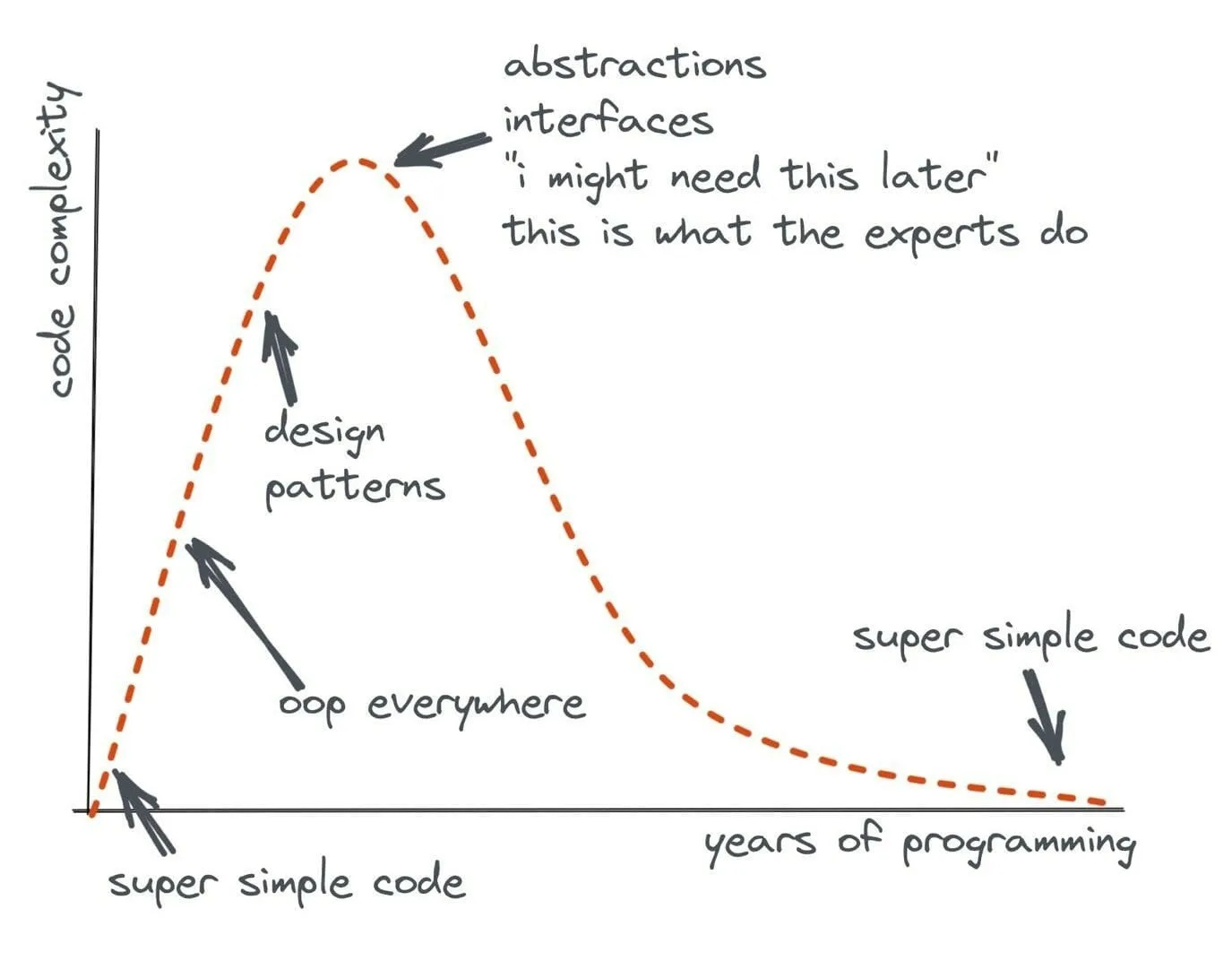
I’ve watched this exact dynamic play out: one person ships the boring implementation, nothing breaks, everyone moves on. Another person ships the “platform” version, there are docs, diagrams, an internal talk… and now there’s a subsystem that needs to be explained to every new hire. Guess which one looks like “impact” on paper.
The part I think is under-discussed is that complexity has a carrying cost that rarely gets charged to the builder. The team pays it later: more surface area, more failure modes, more time spent reading before changing. In that sense, unearned complexity is like taking on leverage. Sometimes it’s the right move, but you should need a business case, not just enthusiasm.
What’s helped on teams I’ve liked: make “simplicity” legible by treating it as a decision record. In the PR/ADR, explicitly list the two “cooler” options you didn’t take and why, and write down the trigger conditions for upgrading later (“if p95 > X for Y days”, “if we add a second producer”, etc.). That turns “implemented feature X” into “made a deliberate tradeoff, reduced risk, and defined a clear escape hatch.” It also forces the room to argue with specifics rather than vibes like “future-proofing.”
Also +1 on the interview point. A lot of system design interviews are accidentally training people that the goal is to draw more boxes until the interviewer nods. The more senior move is usually: start simple, instrument, set thresholds, and only then add machinery. But that’s harder to “perform” in 45 minutes than rattling off Kafka and sharding.
If an org wants to fix the incentive, I think the question to ask in reviews isn’t “how big was the thing you built,” it’s “did you make the system easier to change next quarter.” That’s the kind of impact that compounds, and it’s usually correlated with simplicity.
This has been my personal mission and motivation to go into management. I see my job as making sure engineers are rewarded for building the simplest thing that works.
So far the best way to align incentives that I've found is a simple policy: We'll ship whatever you want, but we know your phone number and you're on-call for your systems. At least 2nd tier on call.
It's a little mean but you'd be surprised how quickly engineers start simplifying stuff when they feel like they can't get anything done because someone's always asking questions or triggering alarms about that weird thing they built 3 months ago.
> A lot of system design interviews are accidentally training people that the goal is to draw more boxes until the interviewer nods. The more senior move is usually: start simple, instrument, set thresholds, and only then add machinery
I do the system design interview. The easiest way to fail is to over-design the solution. I am going to ask deep probing questions and you better have answers. My favorite answer is when people go "Oh yeah you're right, this box doesn't add any value, we can remove".
But that's an unpopular approach these days where many companies are obsessed with minimising the bus factor to the point that their IP is as replaceable as their employees.
These days its turned less into bus factor and more into got-fed-up-of-wage-compression-and-left factor
No takers yet.
Two questions:
1) How did this principal engineer get this title?
2) How is he going to get the next one?
By delivering, or helping the team deliver, outsized returns on engineering hours invested.
If a design is bloated, a good principal engineer should point out gaps, help simplify the solution and enable the team to deliver faster. That definitely gets noticed.
“Hear me out: what if instead of deploying a fleet of web servers to handle 10M identical GET requests per second, we put a handful of servers behind a few Varnish caches with a 1 second expiration?”
“Wait, this thing is spec’d to serve 3000 requests per day and an acceptable downtime of 20 hours per week? Kubernetes is cool, but why don’t we spin up a single VPS and run the whole stack on it?”
There’s a subtle art to talking dev teams down off a ledge, but sometimes the simple path is better in every way. Being able to spot those times is golden. And, of course, knowing when the simplest reasonable version is still quite complex and being willing to roll with it is equally important.
The best engineer I know who can work with huge complex systems in a big company usually starts with a complex solution then after he understands what he wants to achieve thinks backwards and reimplements it in the fewest possible lines of code change with the already complex system.
Every large company has a ladder for promotions that includes many words that basically come down to "complex." "Drive a year long initiative" or "multiple teams" or "large complex task with multiple components" are all examples I've seen.
What is funny is you can dance through the hoops for 3-5 years for promo. Or grind leet for 100 hrs and get it by jumping.
Person A writes some code that just works, no one hears about it and the developer may tend to fade into the background.
Person B made a lot of mistakes is always stepping in to fix problems and be the hero, and everyone forgets that they caused those issues in the first place.
When it comes time for promotions, Person B is fresh in everyone’s mind due to the heroics performed to fix their own code over the weekend. They can take credit for the features being shipped and the operational work done to help run it.
Meanwhile, Person A is overlooked, they just shipped some solid code and were able to get a good night sleep.
I'm back to being a senior in a new org and I try to be person A, but be extra communicative of what I'm working on and how it impacts and why it's important.
I find I spend more time trying to understand how to explain the value my work has to the business (screenshots, demos, docs) than trying to actually do my work. But I think it's important though, otherwise I'll be the person A who never gets promoted.
I relate to this a lot. I was a product owner for a while and made sure we could always explain the value of what was being delivered to stakeholders in language they would understand and matter to them. We spent a lot of time on preparing the demo, running it through internally, providing feedback, tweaking the wording, gathering metrics, etc. In many cases the developer was really interested in the technicality of a certain function, but we’d push them to shift focus to the value that was being delivered to the people we were presenting to. The last thing we want is for people to tune out, because someone is deep diving into code no one understands or really cares about seeing.
In my view, it doesn’t matter what you do if no one understands what you did or why it matters. If we can tell the story well, we will be valued. As a result, the team got great feedback, was highly valued, and our management felt we were miles ahead of every other team.
Fast-forward to now… I chose to move back to an engineering role. We don’t do demos anymore, despite protests from the team. No one knows what we do. We’ve seen multiple people laid off from the team and our direction is all over the place. It feels like we can never catch up, which is a far cry from the days when my boss was telling me to take a 3 month vacation, because of how far ahead we were.
This small shift in focus and opinions around things like demos has dramatically changed the team, how the work is viewed, and the team’s morale. It’s been very upsetting.
I think it's easy to state this sort of opinion, it sounds good on the surface, but I don't feel it stands up to scrutiny. I'd like to see some evidence or studies done to see if this is actually a trend.
Simple solutions are good enough some of the time, perhaps even most of the time, but often fall down with edge cases. But edge cases add up, and dealing with them is complicated.
For example, calculating pay for hourly paid workers is a "simple" problem. Deduct start time from end time and multiply by rate. Covers 90% of the workforce.
But the other 10% take much more work. That team that rotates an on-call worker (which earms an allowance), who gets a call (first hour is free, next is double time etc.)
So it is with software. Adding 2 numbers is trivial. But what about overflows? What about underflows? What if one number is infinity? What if it's i?
The simple solution is "just add, ignore edge cases". The complex solution handles the edge cases. Which is better in the long run?
Unnecessary complexity is a microservice architecture to do the same thing.
But also, just because there is complexity in the domain doesn't mean there needs to be complexity in the software. An elegant, simple solution could be implemented for calculating payroll or adding infinity. That's the hard part though.
Would you want to be in charge of simplifing this architecture for a 'senior staff' title for 4+ years?
This is just one of many examples who have this sort of complexity and it is celebrated, and the microservices hype (originated from Netflix and overhyped by Thoughtworks) have somewhat caused this madness and for some, it has turned into a mountain of technical debt to maintain.
Unless you have a very good reason to save a company from drowing over it's own complex infrastructure costs to run itself, attempting to simplify this architecture will be met with feroucious backlash by other teams of senior staff engineers, hundreds of meetings with risk officers and being blocked because of forever meetings with architects.
Since they made me in charge of this, at least management already is aware of the problem. Convincing Some engineers to start on a new greenfield project to replace their old solution is also not difficult.
The excuse always comes back "but it's extendable", how many implementations of a ConfigurationSingleton could you have in an application?
Put the class in and if you need the interface later any refactoring tool can easily create it when you have that second class (which 99% of the time will never happen).'
This is what worries me when people say AI is great for boilerplate, I worry this is the kind of boilerplate they'll be creating because they've put "must be well designed and extendable" in their AGENTS.md.
A long time ago I also used structuremap to automatically wire up default implementations of interfaces, which reduced the need to write boilerplate code enormously. It also helped separate concerns because separating out interfaces means I could concentrate on only the specification of the class.
An interface specifies a contract that its users can depend on. Having one saves me from reading implementations of dependencies when reading a class.
People who are easy to work with get promoted, and that is downstream from building simple solutions.
As a practicing architect (of buildings) I had a special fondness of working on minimalist projects. Buildings are a complex problem space. You typically can't design out unnecessary complexity entirely. So you have to work backward from goals (the finished condition) to infrastructure (the building structure) to figure out how to make the end product look like almost nothing (Mies's "beinahe nichts").
That's all to say that "complexity impresses" as the article says, but the discerning understand that simplicity can be even more impressive.
It also puts me in the frame of mind of another famous one - Fred Brooks's "No Silver Bullet" [1] and the idea of essential vs. accidental complexity. Or as I like to think of it in a slightly more nuanced way - not necessarily "accidental" but at least "incidental."
[0] https://www.folklore.org/Negative_2000_Lines_Of_Code.html
[1] https://worrydream.com/refs/Brooks_1986_-_No_Silver_Bullet.p...
At first people were like "Well, you didn't do much" but when they saw the value things changed drastically. It's a bit of marketing you have to do to help bring people along.
Often perceived impact is correlated with complexity, sadly.
Don't feel sorry for me though, they still paid me well enough, and I'm happily doing my own stuff now :)
Firstly, simple design places higher demands on developers than complex design. You need sufficient experience and a deep understanding of the business to create a design that is just right. Otherwise, after several iterations, your code is likely to become bloated—for example, a single file exceeding 2,000 lines or a function stretching over 500 lines.
Secondly, I strongly agree with a statement I once read (though I can’t recall the exact source): "Good code isn’t written perfectly from the start—it’s shaped through continuous refactoring. You need to refactor it at the right time." However, most companies simply don’t allocate time for such refactoring, as new requirements keep pouring in.
Under these constraints, it becomes clear that most companies tend to favor complex design as an engineering trade-off. We have a range of tools for complex design, such as SOLID principles, design patterns, and DDD. But there’s little guidance on simplifying design. I rarely see blogs discussing how developers should judge whether a design is over-engineered or what constitutes a just-right design. In such cases, having some design is better than having none at all—after all, many companies truly operate without any design, relying solely on copying existing solutions.
You don't need some fancy overarching design to avoid that. Just don't do it - break up functions as you're writing them, following standard bottom-up design practices. That doesn't require "deep understanding of the business". It doesn't even require experience, just a minimal amount of education, following advice such as "functions should do one thing" and the single responsibility principle. A couple of random blog posts about this:
https://medium.com/codex/should-functions-be-small-e76b45aa9...
https://blogs.oregonstate.edu/devindaniels/2025/01/16/functi...
> But for Engineer A’s work, there’s almost nothing to say. “Implemented feature X.” Three words.
To me, this is the main problem. Engineer A is unable to describe the impact of their work, how the work affected the business. Your manager isn't responsible for promoting your own work, you are.
> Engineer B’s work practically writes itself into a promotion packet: “Designed and implemented a scalable event-driven architecture, introduced a reusable abstraction layer adopted by multiple teams, and built a configuration framework enabling future extensibility.” That practically screams Staff+.
Maybe it's just the narrow of the article, but if promotion only looks at complexity and not quality of delivery and impact on the business then this isn't a good engineering team to be in.
There are many cases where simplicity is celebrated and recognized. It's up to the engineer to know what the impact of their work is, if they can't do that then that's on them.
… the impact of my work is more often than not opaque to me, the person doing the work. More often than not I'm not the one setting the priorities, and way more often than not the real world impacts like "we brought in $X M with that feature you wrote" is quite simply not visible to me because "that's not what engineers do".
I would love to know these things, I'd love to have that level of visibility, but finance at tech companies is nearly always a black box. Best I get as an engineer is that I know how much cloud compute costs, so I can figure out the expense side of stuff.
If anything, I usually have to go for far more intangibles: "this internal manager was happy", "this adjacent team had all their wishes and desires fulfilled", etc.
Otherwise, stuff feels like it plays out like the bits you quoted from TFA.
This isn't an engineering problem, it's a sales problem.
Also, you don't even have to be good at this stuff anymore. Any management nitwit would eat that up on a performance eval, and I had GPT write it for me.
Prompt: "Write up the most corporate self eval possible for someone who identified a simple solution in only 50 lines of code, instead of creating an over architecture mess. Keep it to just three sentences"
My principal is: you don't have to do it right now, but make sure you could do it if you need to. This mainly comes down to avoiding assumptions. Simplifying assumptions can make things easier, but designs that don't leave room for extension make it really difficult to add those things later. It's a difficult balancing act, but I greatly appreciate any engineer who recognizes it and can manage it.
You would think that things not breaking should be career-positive for SysAdmins, SREs, and DevOps engineers in a way it cannot be for software devs. But even there simplicity is hard and not really rewarded.
Unix philosophy got this right 50 years ago — small tools, composability, do one thing well. Unix reimagined for AI is my attempt to change that.
> Now, promotion time comes around. Engineer B’s work practically writes itself into a promotion packet: “Designed and implemented a scalable event-driven architecture, introduced a reusable abstraction layer adopted by multiple teams, and built a configuration framework enabling future extensibility.” That practically screams Staff+.
What are these companies where you have unlimited money to pay engineers to solve problems in less efficient ways??
In a good interview, the interviewee would ask clarifying questions; perhaps get told to build something simple that works; and then follow-up questions would expand towards bigger scale to test the breadth of knowledge and experience of the candidate.
The thing being evaluated is not blindly repeating random "best practices", but understanding and adapting to requirements.
I also promote and advocate for people who push for simple solutions with as little infrastructure as possible.
Saving every team from doing X manually, saving so and so many engineer hours per year. At cost Y per year instead in one team. The higher X and lower Y the better.
Backups did not exist. Now they do and work every time.
I wrote the top customer appreciated feature, associated with an increase with X increase in whatever metric.
"It was really hard" shouldn't come into it, or not as much by far.
https://www.awesomesoftwareengineer.com/assets/resources/arc...
If you have 10 teams working on the same product, you probably need service boundaries.
Another concept I like is that we should optimize for next year's AI. Don't migrate to a monorepo if your only motivation is the performance of today's agents, because a year from now this may be a non-issue. Of course other motivations may still be valid.
If you want to do great work, do great work. If you want to be promoted, do what it takes in your organization. If someone told you those are the exact same thing, stop listening to that person.
  - once is happenstance
  - twice is coincidence
- three times is a patternI think overengineering leading to promotions can only happen in organizations so large that engineering managers are isolated from business impact considerations, because that is usually the overarching metric.
The hard part is that its a cyclic problem, you learn the importance of simplicity only by observing how complexity may not always be adding value. As a principal or staff if you suggest the engineers to simplify things, they may even see it as a missed opportunity for promotion.
I've was promoted for producing a significantly simplified replacement for an existing system that was critical. it happened because the culture rewards engineering excellence.
If it was made simple from the start, it would have likely been seen as an easy and solved problem, and you never would have been brought in, as no one would ever think about it again.
First of all, unless you're at a tiny startup (where quality of engineering isn't even on the horizon), you don't really get promoted by your manager. You get promoted by your manager's manager. Your manager simply "proposes" your promotion, almost as an idea.
Obviously your EM doesn't wanna propose ideas that will be indefensible, so the decision to propose you is a function of roughly four variables:
0. How consistently you've shipped stuff. It can be the most complex, terrible, haphazardly put together piece of shit, implemented in 6000-line functions, but if it ships when you said it would ship, and the feature works on launch -- really works, without causing incidents and headaches over the next two weeks, you're golden
1. How much effort you made in terms of energy exertion. This is usually counted in hours of work. You're a lot more likely to get promoted if you spend 16 hours at the office, even if 15 of those are just watching mountain bike review videos in a small tab opened on the side, with your noise-canceling headphones on
2. How much enthusiasm / good intent / positivity you exert. Engineers who are "excited" about the company and the privilege of having a job in it and are demonstrating creative thinking in the interest of "changing the world" (read: "increasing shareholder value") are more likely to get proposed for promotion than those who know better
3. How much everyone around you likes you. The proverbial "soft skills". If everyone around you says "that person is incredible, I love working with that person, they're so smart / hard-working / nice / pleasant", both in public and in private, you're much easier to promote
With rare exceptions, your direct manager probably understands pretty well who's actually doing what, how, when, and how much, in terms of substance and not fluff. But their manager is too far removed from it all. Their manager, in fact, likely wants to make sure there's no favoritism or anything funky going on, so when your manager proposes you for promotion, their manager wants to see objectively measurable stats, proving that you deserve the promotion.
It's really difficult (read: impossible) for your manager's manager to tell an easy project from a challenging project made easy by you being so competent. Your manager's manager wants a war story, with dramatic character development, and an unlikely victory by the protagonist, against all the odds. Yes, during public Q&As they will say that they prefer you work smart, not hard. That it is foolish to measure programmer productivity by lines of code written or number of hours spent with noise-canceling headphones on at the office premises. What they won't mention is that they simply have no other way of measuring programmer productivity. Go ahead, ask them during the next all-hands. You'll get nothing of substance. "Here at ACME, we trust your manager", they will say.
So.
When your manager walks into that 1:1 with their boss, their boss wants to hear that you have, single-handedly, written gigalines of code, 16 hours a day, clicked <3 on every CTO message in the Engineering channel on Slack, and managed to do so without making everyone else in the company hate you.
Nobody who controls your promotion ever actually reads your code, or understands your solutions. Nobody ever loads up your architecture diagram or your implementation when discussing your promotion. Something to keep in mind. People in a position to give out "career rewards" are too busy, distracted, and uninvested in you personally to pay attention to anything other than quick, easily observable and defensible impressions.
One angle is also... when you hear: "well yes you delivered on time and it works, but this is because it was an easy task"
Run!
The only valid excuse is whether the risk is worth it vs the potential gains. But the solutions that I prefer are the ones that offer minimal changes with massive gains rather than co-ordinating with hundreds of teams for years over an unrelated change.
If you have to do the latter for a tiny code change, then the architecture was most certainly built on a bad foundation, riddled with hundreds of brittle moving part waiting for an incident.