On the other hand, a lot what the company does today just sucks. Set prices are outrageous. Printed bricks get replaced with stickers and many sets feel like display models than something you can play with. The Mindstorms/NXT line had huge potential but then just sort of fizzled out. And the push towards smartphone-dependent toys feels weird. Who actually wants their kids staring at a phone to play Lego?
It's so sad, because the core product is basically perfect.
There's tons of lego-knockoffs and of not even such lesser quality that the difference can be perceived by casual inspection. The set-to-set quality bar is really where it is, especially among their set lines not targeted at children or low-end of market.
But none of those sets have any kind of staying power. There's Expert/Creator/Modular sets from 20 years ago that sell for $500-1000 _opened and pre-built/re-disassembled_. That's all brand power.
So they're less about $/brick (though i know people scrutinize it) and more about price point and brand. Phrased differently, having your brick company race to the bottom sounds like a losing strategy.
That you personally would prefer lower prices does not mean they "should" be lower. Those lower costs of production, to Lego company, "should" mean higher profits, not lower prices, and again--good for them!
Not sure exactly how Lego prices have evolved but, as others have said, Lego is a brand and is unique. Their sale prices have little to do with their costs.
>The newer ones have more details, look slicker, but have a lot less "meat"
I presume that the 2022 model has as target audience nostalgic adults, but otherwise I agree, the new sets seem far more fragile then the ones released a decade ago. I think this is due to a recent focus towards adults from LEGO.
My child did build it some years ago, now it's in his room.
Many of them are a really bad and expensive purchase if you only care about the theme itself, like the latest Death Star (or almost any Lego Star Wars set). You can usually buy a similar and cheaper non-lego model. Or the Titanic set too.
My kids get some of the specialty sets, build them, then hours later they’re either taken apart or heavily modified.
The specialty sets can provide some interesting unique pieces too. My kids have a photographic memory of each of those special pieces and which set they came from. They’ll remember them and search until they find that exact piece.
> Sets become collectible, perishable, trends can form, secondary markets exists, etc. It's simply about the baseline, not the principle. Sorry.
I don’t know what this is supposed to mean, but you can completely ignore secondary markets and collector sets if you want.
There are more sets and pieces than ever. You don’t have to collect anything.
I had the same skill (still do). Imagine following the instructions the first time. A part you're encountering for the first time stimulates the memory. I knew my collection like a dragon's hoard. For instance, I owned twelve white 1x2 tiles, all from Coast Guard Station, so that was the limiting piece when building tiny space-fighters...
> My kids have a photographic memory
How do you know it is photographic memory? More than one of your kids have it? Do you know why or what may have contributed to its development?
And for $100 you get a lot of bricks to play with and let your imagination go wild. Just don't buy sets aimed at adults and IP fansumers.
Adults collect them, true, but there are whole lines dedicated to them.
The Game Boy was much more affordable. Less whimsical, but brought back memories of taking apart electronics and marveling at what these circuit boards and components could possibly be doing.
These aren't being bought by kids and if the entire market becomes nostalgic adults, eventually they all die.
This is one of those instances where it feels like people are terminally online. Or like the meme of the guy standing in the corner while everyone else is having fun at the party. You can find Legos being given away in a local buy-nothing group. It's still just as magical for kids as it ever was. These complaints are only from an adult who doesn't play with Legos. Who cares if sets become collectibles? Get other sets and have fun with Legos. These are toys that are meant to be played with. Play with them.
- they have a finite production capacity
- they have a finite warehousing capacity
- there is a certain number of sets which will be bought
- crates of bricks without an established design have a limited appeal and while a consistent SKU, don't have the baked in demand a new set will have
Some of the classic 80s themes, like Space and Castle, primarily used regular bricks of reasonable sizes in a very limited palette of colours, with a few special parts unique to the theme. They were much more suited to taking apart and building your own creations.
These days, there's just too many specialised and small parts, and too many colours. Even if you buy a big grey Star Wars set, you'll find that the internal structure is often brightly coloured to make the instructions clearer - but this isn't ideal if you want to take it apart and build something else.
Older sets had larger foundational and platform pieces which gave a good starting place for new creative builds.
Today, airplanes fuselages, wings, and car chassis are instead built up piece by piece.
It’s hard for my 6 year old to start creative builds that are stable when he hardly has any pieces larger than 2x6 across dozens of sets.
My wife found a huge mixed bin from the 80s and 90s at an estate sale. It really helped.
It's a little out of date, but the conclusions are still relevant.
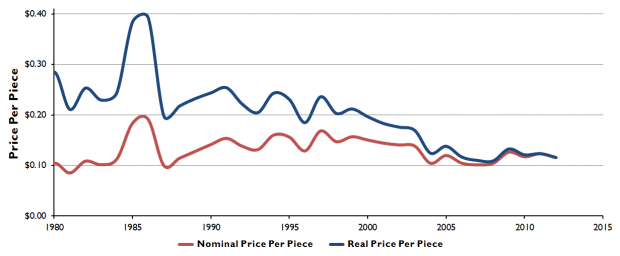
Main things of note: Brickheads are pretty economical as a "parts pack." No significant correlation between per-piece pricing and IP licensing (except for Star Wars). Star Wars and City sets are overpriced.
Well, people did complain about the whole 'special pieces' trend that you praise.
I wish I had hobbies as cheap as LEGO now...
The best way to enjoy Lego is to give it to some kids and watch them get creative with it. Unlike all of the Internet complaints, kids have no problem having fun with Lego and being creative in their own ways.
They stopped doing the many unique parts because it was bankrupting them.
It's also a shame because it's really good for mechanical rapid prototyping and you can bend and cut it in a pinch and it stays put. But buying vintage Meccano to abuse like that is expensive and feels like a war crime.
No app. No Bluetooth. Just wires and a simple controller built to be used and understood by children.
Even when I was a kid, I wasn't keen on graphic designs on the pieces. I liked the uniformity of consistently-colored pieces. Most graphics only make sense in the context of the set they were packaged in. Stickers give the customer flexibility. Use them when you build the set, and remove them later if you take the set apart and don't want them anymore.
Killing Mindstorms was a head-scratcher to me. Hell, there was an entire international tournament built around Mindstorms. I know FLL still exists, but why kill that darling specifically?
NXT still kicks ass by the way. I have a backup of the NXT programming environment somewhere, it can be coaxed into running on Windows 11.
On display sets for multiple hundred Euros however it just looks cheap due to different surfaces and colors - especially as no one is ever going to disassemble these sets.
It just feels to me like AFOLs poopoo on any set for having stickers, without considering the advantages stickers have from the POV from the POV of a child with few LEGOs and fewer dollars.
They are cheap!
To print on a piece you must run the inkjet assembly line, do QC on it.. With early Collectable Minifig series, I heard they outsourced that. I imagine inkjet lines that run all day for one piece type (maybe having changeable jigs.)
It's cheap to print a whole sheet of stickers!
Another approach that isn't so cheap is: in-mold transfer printing sheets. I learned about this at plastics shows around 2000; Apple used it on the all-in-one spotted iMac in 2001-ish.
Now since Lego ships perpetually ships 1x4s and 1x2s with black smileys or such, I guess carbon black in-mold transfer must be cost-effective. (That's a guess)
I know we're gonna be arguing taste in stickers forever.
I coached FLL 9+ and Junior FLL 6-8. FLL moved on to Boost and Java programming. These days I only do high-school FIRST.
I haven't seen this push? The new Lego Smart stuff is explicitly "screen free play". There is an app but it's just for firmware update and configuration and you can't even connect it unless the brick is on the charger.
The ones I know of are the Mario ones, but they apparently need a phone anyway to setup the little characters.
Plastic parts bags are getting replaced by paper ones, but the booklets aren't going anywhere.
I hate app obsolescence, and licenses that expire on your old hardware (Microsoft Word..) I exhibit 1980s video games. The hardware just continues to work. It's a disgrace what happens to mobile games, they just disappear. (Whattaya do, save all your old phones? I'm hating on you, Atari Classics app on iPad 2; revoked my paid license to use it.)
But to be fair, Lego has gone to great lengths to keep their companion software alive. Still, the nature of mobile: apps require constant updates to stay listed for new OS versions.
For one, Lego Commander existed uselessly on my phone long after it ceased to work... until one iOS it wouldn't install anymore.
Lego giving you a CD with software and instruction was a comfort (challenge: find a CD drive!) but only Mindstorms really.
For desktop apps in the 2010s, Lego relied on Silverlight to get Mac and PC compatibility. So what happens when you rely on a Microsoft framework... still as late as 2015 I was still able to download Mindstorms 2.0 (introduced 2002??) from Lego.
With instructions pdfs, Lego has been ok to let hobbyists reproduce the downloads (last I saw.)
Another thing Lego did was to provide SDKs for Mindstorms (a while after the community reverse-engineered a lot of it...). Opening it up that way was encouraging. (Lego even started distributing HiTechnic's 3rd party sensors, the folks that reverse-engineered the Mindstorms 1.0 RCX.)
I was part of the fan movement from 1998-2001 that hammered on the message for Lego to open things up. What happened is that they hired several of us :)
https://upload.wikimedia.org/wikipedia/commons/0/04/LEGO-kom...
>minimal mold lines
I think this comes from higher tonnage (clamp force) molding machines. Injected plastic exerts force at the mold seam. Pressing the mold open by even a teeny tiny amount is unpalatable. Mold lines also can result where a mold has insertable parts, like sliding rods to form inner holes.
But those models do look rad!
And then they sued the pants of everybody that tried to do the same thing to them.
Yes, it was a shame. After Lego lost in court (to Hilary Page's heirs I think by then) I believe they finally atoned for that.
Still, Lego didn't just sell the Kiddicraft brick unmodified. Lego patented the tubes inside, which gave it superior clutch power. (I have a lot of 2x4 bricks with "Pat Pend" molded on them!)
As I've heard it, Ole Kirk Christiansen had seen Hilary Page's brick as a sample from a molding machine vendor. Lego previously made wooden toys (until his son Godtfred allegedly set the factory on fire) and was casting about for what production to invest in for the future.
The Kiddicraft brick was a little rectangular box, no tubes inside. A lot of brick toys came out in the 60s that were little shells with varying clutch power.
For a museum of the many brick toys, go to https://www.architoys.net
In particular, Betta Bilda, Block City, American Bricks.
https://smallscaleworld.blogspot.com/2024/02/l-is-for-legos-...
The tubes came (much) later. Even the boxes were direct copies.
Is it? It's not like it's hard to keep producing the pieces to the same original specifications. If they snapped then they snap now.
It’s extremely hard to build consistent products to the spec.
There are a lot of knock-off LEGO on the market now. We get them as gifts. Some of them stack okay, some are too tight, some are too loose.
It’s hard to manufacture at scale at these tolerances and keep it that way for decades.
It speaks to Ole Kirk Christiansen's impossible standards: "Even the best is not good enough" (Det Bedste Er Ikke For Godt.) (usually translated "Only the best is good enough.")
Much more strenuous in Danish than the usual quoted translation! but I know some Danish, and most of all that's how Kjeld Kirk Christiansen explained it to an American audience at Brickfest 2003 (IIRC the year).
As I commented elsewhere, it's not 60 years. Sure, the outer dimensions have not changed and are very strict metric Lego Units. [1] But there have been continual improvement that render old and new less than wonderful to use together. You don't really want to mix 70s-early 80s bricks.
Conversely, if you're reselling those old sets, you need to find vintage pieces (though also Lego would use up older pieces and begin to use newer ones in that set)
But bricks from the mature design of the 80s even didn't age so well (clutch too hard, walls can warp), and there have been many improvements to the interior of a brick. All for sound engineering reasons. Thinner walls and internal voids to prevent warp, subtle changes to fine-tune clutch power.
It's a story of continual improvement, but it makes the old bricks seem less wonderful.
Weird thing Lego started to advertise in the 2000s: Lego bricks reach the proper clutch power after 7 insertions! I guess you have to stress-work the new plastic...
[1] I've used a micrometer on pieces of various age and can't get a difference from the outside. Doesn't help that they compress under measuring.
edit: I know you can get thousands piece brick sets from third parties or random bulk set sales on Amazon... the issue is the random bits are from the current sets mostly with little reuse value, and the bricks sets are from third parties of questionable tolerance compared to real lego. I just want to be able to get a classic 1000-3000 piece set of classic bricks/pieces from Lego proper, even if it's $100-200 total, still way more than 3rd party but maybe not the same margins for Lego as the bespoke sets.
edit2: there are some "Lego Classic" sets that are closer to what I would like to see, this is probably the closest.
https://www.amazon.com/dp/B0B5FMF8BF/
But even then, maybe need that many more bricks that are just bricks... again, there are third party sets that are all block variants that are much bigger/cheaper... would just be nice to be able to get more of those without paying an arm and a leg.
Given the crazy assembly that is happening in the adjacent room, my kid would vehemently disagree.
Perhaps sets of a given physical size have more pieces now compared to before? Not sure.
Lego’s net profit margin is only about 19%.
They couldn’t lower prices much even if they wanted to.
The two options would be that either the perception is unsubstantiated but persists, or there has been a continuous decline for the last 40 years. I'm strongly leaning towards the latter. I also having the same issues in the 00s looking at old sets from the 80s, and looking back now the 00s look much better than what we have today. Obviously not in every way, and not all recent sets were bad. But overall I have the feeling that there's been a steady trend that the bricks got better but the sets got worse
You can even get a model of post-explosion Chernobyl. Not to mention all the sci-fi tie in from Star Trek to Warhammer that real Lego hasn't signed contracts for. But if you want an 60cm Gloriana class, there it is.
Plus Technics-ish sets and bulk boxes that aren't 75% special body panels that only fit that specific model, since Technics itself mostly seems to have been downgraded to the automotive brands advertising department.
This year's isn't huge: https://www.lego.com/en-us/product/fire-station-with-fire-tr...
But the police station is pretty big: https://www.lego.com/en-us/product/police-station-60316
(To me this looks more fun, but I'm a pirate guy: https://www.lego.com/en-us/product/police-prison-island-6041... )
> many sets feel like display models than something you can play with.
That's because they are. There probably never been this many adults building lego than today.
> The Mindstorms/NXT line had huge potential but then just sort of fizzled out.
That's a small niche in today's world, a child is too young for arduino/feather/cyberbrick/whatever.
That’s what I thought when comparing to my childhood sets, but it doesn’t stop my kids from loving them and playing with them.
My kids are learning a lot of cool building tricks from the advanced sets that I never thought of as a kid. Lots of angle pieces, hinges, and creative building.
Yes they are aggressively targeting "grown ups" with many sets, but they also have very playable sets. I don't see any problem with having different offerings.
There are enough sets for everyone to find something interesting if they are into Lego.
I've bought a decent amount of Duplo and Lego kits for my son (currently 3 years old) and it's great value.
It has momentum because they haven’t let quality and innovation slide. They know customers will be out with pitchforks if quality drops.
Real shame that they discontinued Mindstorms, though.
Some of the first forays resulted in notably lower-quality bricks.
This was all done planned and implemented by this one consulting guy (MCK?), who became CEO after delivering his report from his consulting company, Lego was near bankrupt back then - he started with all this subbranding shitty stuff and the "colorful" bricks and introduced all these many many "single-use-case-bricks" for more and more sets.
Being a collector of stuff ever since I was a kid (toys, comics, cards, physical media, printed collateral, etc), and being in my 40's (target market / demographic for expensive nostalgia) living in 2026 (the world is a casino! everything's a collector's item!), it is a little annoying to see LEGO appear to turn into something that it wasn't .. but objectively that doesn't eradicate the fundamentals of LEGO, and I'd rather see them be a healthy company with longevity (via current product strategy) than wither and die on the vine out of stubbornness.
That said, aside from leaning on the AAA IP that drives prices through the roof in some lines, I do wish they'd stop with the tech gimmicks (Hidden Side, Smart Bricks), renew one of their focuses on real tech/engineering-adjacent platforms (Mindstorms / NXT / a modern version of these), and acknowledge that wealthy adults aren't the only customers. It really prices out young, fertile minds who a lot of their product and ethos should be directed towards.
Of course, that's a huge problem right now with anything that can command aftermarket prices as collectibles! [3]
[0] - https://knowledge.wharton.upenn.edu/article/innovation-almos...
[1] - https://blog.firestartoys.com/how-the-lego-company-almost-we...
[2] - https://www.toypro.com/us/news/710/learn-the-story-behind-le...
I must say, the new smart bricks with all sorts of sensors(color, gyro, distance etc) triggers the inner child in me. I can’t wait to get them for my kiddo and teach him how that magic actually works beneath.
The regular LEGO at this points feels “just plastic” and I won’t feel bad offloading that purchase to AliExpress.
As the other replies are saying, it's mostly brand power. If your complaint is that $500 for a Falcon is monopolistic because there's no competition because nobody else can legally sell Falcons, the monopoly is really with Star Wars not Lego, they're just delegating it to Lego. You're always free to find your cheapest source of bricks perhaps from other manufacturers and build your own equivalent.
As for stickers and apps and the other stuff... yeah that's the enshittification that also always accompanies capitalism. It's lamentable but it only changes if enough customers vote no with their wallets.
Why get up at all, when gravity always just pulls me back down?
A detail I didn't realise until I was an adult was the difference between the black and grey technic connecting pins. They look interchangeable, and for a lot of things they are.
But there's a fraction of a mm raised lines on the black one, and it's enough to produce significantly more friction, and that difference is utilised in designs.
And apprently there's now a new version of the black one, and people notice these things, and measure them - this article gives an idea of just how these tiny changes, well below tolerances for some of the "knockoffs", can produce a different effect:
https://ramblingbrick.com/2021/01/27/what-if-they-introduced...
EDIT: I think I also had some dark grey pins, but I don't remember if they were high or low friction
I think the black ones were a later addition, likely late nineties.
Which is presumably why I didn't notice until my son started playing with it, as I'd stopped playing with mine by then.
Imho, this is, objectively, not true (anymore).
Pantasy with GoBricks are superior in coloring and fit; Cobi are excellent for things that should not be taken apart anymore (like tank models); Lumibricks are excellent in fit and have amazing illumination solutions that are lightyears (haha) ahead of lego.
But "should not be taken apart anymore" fits into an entirely different category for me. If you don't need to be able to take them apart any more, it fundamentally changes requirements.
We have a set (something with Spiderman IIRC) that attached wheels with yellow pins that allow for better rolling of wheels. The black pins are too tight for this indeed.
That compulsion doesn't seem present in freeform building, and there's been zero interest in it in our household. I know that's not true for all, but it seems like a lost art. Maybe it's because the IP sets show how but not the why it's constructed in a certain way, so given a bag of Lego most wouldn't know the process of creating something they can see in their minds eye within the constraints of the available bricks.
My parents still have all my Legos from the 90s, including the instructions, and I've been able to rebuild a bunch of the space ships with translucent neon accents. It's pretty sweet and my kids love it.
I for the love of God can't comprehend why LEGO Classic has 4 shades of blue. It makes everything worse.
Tons of dimensions on 100k/yr injection molded(and otherwise) parts have similar dimensions. (Although admittedly, after testing in pre-production, I don't know if they are tested again and have drift)
Lego has been making the same parts for decades and their parts are extremely simple. I imagine their 1-off parts for intellectual property based sets do not have this requirement.
I think Lego has a huge incentive to promote this idea that they are high quality to justify the enormous price of decades old technology.
The history here is deeper than most people realize. The United States spent fifty years (roughly 1800 to 1853) at the Springfield and Harper's Ferry armories trying to achieve what LEGO now does routinely: parts manufactured to tight enough tolerances that they are truly interchangeable without fitting. In 1853, a visiting British inspector randomly selected ten muskets made in ten different years, disassembled them, mixed the parts, and reassembled ten functional muskets using only a screwdriver. Tolerances of a thousandth of an inch. It was considered impossible by most of the engineering establishment of the time.
The way they got there was by building machines, then using the parts those machines made to build better machines, then using those improved parts to build even better machines. A virtuous circle of transferring skill from human hands to tooling. This is the actual origin story of what historians call the American System of Manufacture, and it's the foundation the entire modern automotive supply chain sits on.
So yes, any competent injection molder holds tight tolerances today. But that's precisely the point: the reason it seems unremarkable now is that two centuries of compounding precision made it so
Also to correct you, LEGO has been making most of the parts for decades, some have had changes due to new materials (which you can read upon online) but besides the ones that remained the same (not really), many new system elements got released in the last decades and new I.P tied elements get released on a yearly basis.
In the late 90ies, I regularly played with my uncle's old LEGOs from the late 60ies and early 70ies. They were stored in an unheated attic for 25 years. I remember that some of the old bricks didn't "snap" at all anymore to my newer bricks. They were either extremely difficult to stack onto a new brick, or didn't have any friction left.
"Precision, for LEGO, isn't an engineering choice, it's a brand promise." - The classic "It's not just x, it's y", just minus the "just".
"One philosophy optimizes for cost, the other for perfection." - Again we see the x/y structure; AI writing often features these forms, eg comparisons (x vs y), conversions (x into y), negated emphasis (not x, but y), etc.
"When you have multiple parts in an assembly, use statistical analysis for tolerance stack-up rather than worst-case math. Traceability matters. Track your defects so feedback turns precision into reliability." - More x/y followed by a short stinger ("Z matters"), and the closing sentence again follows the "x/y" pattern.
For funsies I tossed the whole thing into a purported AI detector and it said 90+% confidence of AI. I don't trust those types of things very much and suspect they have high false positive rates, but I have read that AI writing generally has measurably lower entropy, so maybe it's plausible, and in this case it aligns with my existing beliefs, so it obviously must be true.
This was the tell for me.
They're made by sinker EDM, not wire. The physics are similar but it's a radically different process.
> But in an assembly system like LEGO's, small errors accumulate. Stack ten bricks end-to-end and the cumulative tolerance is ten times larger.
That's not how these tolerances work. The super tight tolerance is the interference fit on the stud. This is a diameter. You don't stack diameters together. Each connection is independent. Where you can get tolerance stackup is brick height and stud spacing. Although even here random errors tend to cancel out as you mix lots.
>LEGO's system reveals timeless truths about manufacturing. Process control beats precision machining. A stable, repeatable process produces better results than chasing the tightest possible mold tolerances. Invest in monitoring rather than just tighter specs.
The whole article says the opposite. Lego relies on precision machining and tight tolerances. Process control is necessary in addition to these.
The article never mentions what piece has a 0.002mm tolerance. Is there any such piece? If there's no such piece, then "0.002mm tolerance" is not just "misleading without context", it's straight up false.
Initially I thought this meant a lego minifig head has 128 internal cavities, but finally realised it means a single mould now makes 128 heads.
> A 2x2 brick can withstand over 4,000 Newtons of force, which lets children build tall structures.
> But in an assembly system like LEGO's, small errors accumulate. Stack ten bricks end-to-end and the cumulative tolerance is ten times larger. This is why LEGO models larger than 1 meter become difficult to build
> The lesson isn't that everyone should match LEGO's tolerances. It's to understand what your product actually requires, then build your manufacturing system to deliver that at the scale and cost your business model demands.
I know I'm tilting at windmills, but come on.
Lego does indeed have very tight tolerance, but I don't know if the numbers are in the public domain.
Pretty sure this is false. Old bricks had way higher clutch power, so high that it was deemed too difficult to separate. Sometime in the 90's the grip strength was reduced.
This false claim is underpins the entire article :(
This is just manifestly NOT TRUE. The outward appearance may be the same. There were intentional improvements to the walls and tubes that make fit less than perfect. Generally, today's brick requires less force to snap and un-snap, because the compression is focused onto fewer points. (I guess this lowers the "hoop strength".)
Older bricks can be either: completely loose, or clutch so hard to each other they are the devil to take apart.
I have many bricks from 1962 onwards. The oldest 2x4s and 2x2s were made of cellulose acetate (CA) (in North America, intermediated by Samsonite.) CA were softer, and either had less clutch power to begin with, or lost it over time. When I got them in the 70s, they fit but wouldn't reliably stick to each other, nor later 70s-80s bricks (all ABS plastic by then.) (CA bricks were mostly red, and they have a pale orange tint.)
70s-80s bricks did not always age well. Aged 1x4 or 1x8 bricks can have the outer wall bowed inward slightly. This is a mold engineering problem anyway. Later, 80s bricks were improved by slightly thinner walls and some reinforcing tabs. The older, aged bricks can stick brutally to each other and to newer bricks.
The 10x10 baseplates didn't age well (these were once box-tops! Tog'l Toys also had the baseplate as a box-lid.) Possibly made of polycarbonate (PC). Other large plates in ABS-- for instance 6x16 (Auto Chassis, red) -- have warped. They were also more brittle to begin with.
So inside Brick geometry has changed over the decades. 60s-70s bricks are closer to plain boxes with tubes inside - as the Kiddicraft prototype of the 50s. In the 80s, the outer walls got thinner and had tiny studs where the studs contacted the wall. And the tubes changed from cylinders to just slightly clover-leaf inside, so that a tube over a single stud now formed 4 points of contact, and came apart with lower shear force. (I believe this also made it easier to pry a plate off of a larger plate.)
I have Fabuland sets from early 80s, whose plain bricks are so stiff, they are positively brutal to snap onto each other or 90s bricks.
The brick geometry of today is much improved. And the ABS is more "plastic", perhaps more "B" (butadiene rubber) or less "S" (styrene): I can drill it more cleanly.
Mid 80s and 90s bricks will interoperate just fine with today's. But bricks from before that period didn't age so well (and their corners, I believe, used to be harder.)
Also interesting is that in very large models, there is decoupling between sections. Lego has design rules for how large a well connected chunk of Lego can be, which are driven by the tolerances. Above that you are then loosely coupling those large "chunks".
It's also why knockoff bricks can feel fine for small builds and then fall apart (sometimes literally) on larger ones. If your per-part tolerance is 3x worse, it doesn't matter much for a 20-piece build, but for a 2000-piece build your cumulative error budget is blown long before you're done. The failure mode isn't that any individual brick is bad, it's that the composition doesn't hold.
I'd be curious whether Lego publishes or talks about those chunk size design rules anywhere. That seems like the actually interesting engineering story, more so than the per-part tolerance numbers that get repeated in every article about them.
My recent experience calls bs on pulling them apart.
What I don't remember was every kit being made up of so many small, weird pieces.
Apart from those Star Wars kits, everything I had were generic blocks and strips (not sure what they're called, the ones that are 1/3 the height of a block) and some different designs of people. The closest I had to previous special sets was a town thing that my brother and sister had before me (they were 10 years older), which was a bunch of large floor tiles with roads and grassy areas with studs, some flowers pieces (single stud) and a handful of special buildings. But they were designed to be relatively generic, and the fun was using those building blocks to make a new city each time, not trying to recreate exactly someone's model. Apart from the flowers and the men, basically everything was a standard part, except perhaps a different colour.
When I was a teenager, the trend had become sets with lots of specialised parts for one specific model, such that they didn't really make sense as generic pieces. I enjoyed the technics kits because the early ones were just generic building blocks (apart from the wheels and rack and pinion, but again they could be re-used in lots of subsequent designs), but more and more the kits in the shops were for specialised models with unique pieces that were never designed to fit aesthetically with anything other than the model they came with. I'm sure _some_ people built other things with them, but equally I'd bet than probably 90% of those kits were built exactly once following the instructions and then never disassembled again.
Lego did not have Star Wars sets until 1998. The original Lego Millenium Falcon set 4504 would have retailed for right around $100. Which was high, but just as high as the bigger Castle sets at the time.
[1] https://www.lego.com/en-us/service/help-topics/article/lego-...
You mean a little brother?
Legos don’t have draft.
That means nothing to 99% of you, but someone else here must understand what the implications of that are for releasing from molds at a mass scale.
https://medium.com/@bsather/breaking-down-the-perfect-design...
For production parts we’re looking at drafts around 3 degrees. Which is… not what they have even considering the tuck back in!
3 degrees on a lego brick would be a difference of .3mm over its height. For comparison an amoeba is about .5mm. If you're zoomed out enough that you can see the length, you're not going to be able to discern the angle. The only way you'd see it is to check for the gap between the wall and a precision square.
When I started seeing the non-generic "build one thing" sets, with appropriately high sticker prices, Lego lost it's luster. The additional downside of ending up with special purpose pieces, just made it worse.
The precision with which the blocks are made is comparable to Ford's use of Gage blocks to make perfectly interchangeable parts across the globe. It's fascinating just how many of something can be made in this manner, and how the costs just keep slowly going down as the quantity scales up.
A balanced 16-cavity mold costs 3-4x more than a single-cavity mold but only produces 16x the parts, which is why they only make economic sense above 500,000 units.
https://archinect.com/features/article/149974598/the-brief-a...
I wish one of their competitors would take up this dimension standard --- it would be a lot more useful for making structures which interact across dimensions/rotations.
Sure, some puzzles and books survived, but the Lego stands out. If he ever has children they are in for a treat…
It's a pain in the ass to put together, pain in the ass to move, pain in the ass to collection. The costs are out of this world and most collectors don't even build their sets, they keep it in the box from 20 years ago. At least with Hot Wheels you can see the car inside even when still packaged.
I thought this forum was for intellectual discussion, full of intellectual people. You're a pseudo-intellectual at best.
Let me add this: 4. no spare parts available. So when I break weird Chinese invention the whole set becomes useless without that very special part. It happened few times and I got back to used Lego sets.
> 10 microns
"Micron(s)" is a deprecated word since 1967 and "micrometre(s)" must be used instead. The reason is that it is a non-standard word; if "micron" is accepted, then we should also accept the nonsensical words "millin", "nanon", "kilon", etc. The metric system is supposed to be easy to learn with consistent rules and as few special cases as possible.
> 4.8mm ... 0.01mm ... "0.002mm tolerance"
These numbers are correct, but it's harder to quickly skim the text and make comparisons because the number of decimal places vary. It would be better to write 4.800 mm, 0.010 mm, 0.002 mm to make the reader's job easier. Or convert everything to whole micrometres, like 4800 μm, 10 μm, 2 μm.
> withstand over 4,000 Newtons
Almost correct, but the unit must be decapitalized to "newtons". This is similar to how other name-based units are decapitalized - like "100-watt light bulb", "12 amps", "3 gigahertz".
> 2-3 Newton insertion force
It must be written as "2–3 newtons". When the unit name is written out in full, it follows normal English pluralization rules (e.g. metres, seconds, volts, pascals, kelvins, ohms, teslas). The only exceptions are hertz and siemens, because they already end with -s or -z.