Yup. And for most purposes, that's enough. An app does not have to be productized and shipped to general audience to be useful. In fact, if your goal is to solve some specific problem for yourself, your friends/family, community or your team, then the "last step" you mention - the one that "takes majority of time and effort" - is entirely unnecessary, irrelevant, and a waste of time.
The productivity boost is there, but it's not measured because people are looking for the wrong thing. Products on the market are not solutions to problems, they're tools to make money. The two are correlated, because of bunch of obvious reasons (people need money, solving a problem costs money, people are happy to pay for solutions, etc.), but they're still distinct. AI is dropping the costs of "solving the problem" part, much more than that of "making a product", so it's not useful to use the lack of the latter as evidence of lack of the former.
Having worked extensively with vibe-coded software, the main problem for me is that I have tuned-off from the ai-code, and I dont see any skin-in-the-game for me. This is dangerous because it becomes increasingly harder to root-cause and debug problems because that muscle is atrophying. use-it or lose-it applies to cognitive skills (coding/debugging). Now, I lean negatively to ai-code because, while it seduces us with fast progress in the first 80%, the end outcome is questionable in terms of quality. Finally, ai-coding encourages a prompt-and-test or trial-and-error approach to software engineering which is frustrating and those with experience would prefer to get it right by design.
Before AI for the last 8 or so years now first at a startup then working in consulting mostly with companies new to AWS or they wanted a new implementation, it’s been:
1. Gather requirements
2. Do the design
3. Present the design and get approval and make sure I didn’t miss anything
4. Do the infrastructure as code to create the architecture and the deployment pipeline
5. Design the schema and write the code
6. Take it through UAT and often go back to #4 or #5
7. Move it into production
8. Monitoring and maintenance.
#4 and #5 can be done easily with AI for most run of the mill enterprise SaaS implementations especially if you have the luxury of starting from the ground up “post AI”. This is something you could farm off to mid level ticket takers before AI.
Just doesn't have the same ring to it.
But there's not one tool there that triggered a major boost in output or number of apps / libraries / products created - unless I missed something.
Sure, total output has increased, especially since the early 2010's thanks to both Github becoming the social network of software development, and (arguably) Node / JS becoming one of the most popular languages/runtimes out there attracting a lot of developers to publish a lot of tools. But that's not down to productivity or output boosting developments.
That's true, but even the "last step" is being accelerated. The 10% that takes 90% of the time has itself been cut in half.
An example is turning debug logs and bug reports into bugfixes, and performance stats into infrastructure migrations.
The time required to analyze, implement, and deploy those has been reduced by a large amount.
It still needs to be coupled with software engineering skills - to decide between multiple solutions generated by an LLM, but the acceleration is significant.
I launched a vibe coded product a few months ago. I spent the majority of my time
- making sure the copy / presentation was effective on product website
- getting signing certificates (this part SUCKS and is expensive)
- managing release version binaries without a CDN (stupid)
- setting up LLC, website, domain, email, google search indexing, etc, etc
This is true, and I bet there are thousands of people who are in this stage right now - having gotten there far faster than they would have without Claude Code - which makes me predict that the point made in the article will not age well. I think it’s just a matter of a bit more time before the deluge starts, something on the order of six more months.
https://github.com/williamcotton/webpipe
https://github.com/williamcotton/webpipe-lsp
(lots of animated GIFs to show off the LSP and debugger!)
While I barely typed any of this myself I sure as heck read most of the generated code. But not all of it!
Of course you have to consider my blog to be "in production":
https://github.com/williamcotton/williamcotton.com/blob/main...
The reason I'm mentioning this project is because the article questions where all the AI apps are. Take a look at the git history of these projects and question if this would have been possible to accomplish in such a relatively short timeframe! Or maybe it's totally doable? I'm not sure. I knew nothing about quite a bit of the subsystems, eg, the Debug Adapter Protocol, before their implementation.
Code is just one part of puzzle. Add: Pricing, marketing and ads, invoicing, VAT, make really good onboarding, measure churn rate, do customer service…
A lot of vibe coders are solopreneurs. You have to be very consistent and disciplined to make final product that sells.
I think this represents a fundamental misunderstanding of how these AI tools are used most effectively: not to write software but to directly solve the problem you were going to solve with software.
I used to not understand this and agreed with the "where is all the shovelware" comments, but now I've realized the real shift is not from automating software creation, but replacing the need for it in the first place.
It's clear that we're still awhile away from this being really understood and exploited. People are still confusingly building webapps that aren't necessary. Here's two, somewhat related, examples I've come across (I spend a lot of time on image/video generation in my free time): A web service that automatically creates "headshots" for you, and another that will automatically create TikTok videos for you.
I have bespoke AI versions of both of these I built myself in an afternoon, running locally, creating content for prices that simply can't be matched by anyone trying to build a SaaS company out of these ideas.
What people are thinking: "I know, I can use AI to build a SaaS startup the sells content!" But building a SaaS company still requires real software since it has to scale to multiple users and use cases. What more and more people are realizing is "I can created the content for basically free on my desktop, now I need to figure out how to leverage that content". I still haven't cracked the code for creating a rockstar TikTok channel, but it's not because I'm blocked on the content end.
Similarly I'm starting to see that we're still not thinking about how to reorganize software teams to maximally exploit AI. Right now I see lots of engineers doing software the old way with an AI powered exo-skeleton. We know what this results in: massive PRs that clog up the whole process, and small bugs that creep up later. So long as we divide labor into hyper focused roles, this will persist. What I'm increasingly seeing is that to leverage AI properly we need to re-think how these roles actually work, since now one person can be much responsible for a much larger surface area rather than just doing one thing (arguably) faster.
In both cases, AI is making people think they can achieve things that were previously judged to unachievable, whether those things are building an app without any effort and getting rich, or effecting regime change without any actual strategic planning.
Having done this professionally for a very, very long time, software engineers aren't particularly good at launching products.
Technology has drastically lowered the barriers to bring software products to customers, and AI is a continuation of that trend.
Only a few get lucky with funding, only a few have a profitable business.
I really dont know how to respond to these requests. I am going to hide out and not talk to anyone till this fad passes.
Reminds of the trend where everyone was dj wanting you to listen their mixtrack they made on abbleton live
Apparently new iOS app submissions jumped by 24% last year:
> According to Appfigures Explorer, Apple's App Store saw 557K new app submissions in 2025, a whopping 24% increase from 2024, and the first meaningful increase since 2016's all-time high of 1M apps.
The chart shows stagnant new iOS app submissions until AI.
Here's a month by month bar chart from 2019 to Feb 2026: https://www.statista.com/statistics/1020964/apple-app-store-...
Also, if you hang out in places with borderline technical people, they might do things like vibe-code a waybar app and proudly post it to r/omarchy which was the first time they ever installed linux in their life.
Though I'd be super surprised if average activity didn't pick up big on Github in general. And if it hasn't, it's only because we overestimate how fast people develop new workflows. Just by going by my own increase in software output and the projects I've taken on over the last couple months.
Finally, December 2025 (Opus 4.5 and that new Codex one) was a big inflection point where AI was suddenly good enough to do all sorts of things for me without hand-holding.
Really the one thing that conclusively has changed is that the 'ask it on stackoverflow' has become 'ask it an LLM'. Around 95% of the stackoverflow questions can be answered by an LLM with access to the documentation, not sure what will happen to the other 5%. I don't think stackoverflow will survive a 20-fold reduction in size, if only because their stance on not allowing repeat questions means that exponential growth was the main thing preventing them from becoming stale.
These tend to be utilities, and a lot of AI coding either reduces the need for utilities, or uses them but doesn't publish to a package index.
The amount of useless slop in the app store doesn't matter. There are no new and useful apps made with AI - apps that contribute to productivity of the economy as whole. The trade and fiscal deficits are both high and growing as is corporate indebtedness - these are the true measures for economic failure and they all agree on it.
AI is a debt and energy guzzling endeavor which sucks the capital juice out of the economy in return for meager benefits.
I can't think of a reason for the present unjustified AI rush and hype other than war, but any success towards that goal is a total loss for the economy and environment - that's the relation between economics and deadly destruction in a connected world, reality is the proof.
YoloSwag (13 commits)
[rocketship rocketship rocketship]
YoloSwag is a 1:1 implementation of pyTorch, written in RUST [crab emoji]
- [hand pointing emoji] YoloSwag is Memory Safe due to being Written in Rust
- [green leaf emoji] YoloSwag uses 80% less CPU cycles due to being written in Rust
- [clipboard emoji] [engineer emoji] YoloSwag is 1:1 API compatible with pyTorch with complete ops specification conformance. All ops are supported.
- [recycle emoji] YoloSwag is drop-in ready replacement for Pytorch
- [racecar emoji] YoloSwag speeds up your training workflows by over 300%
Then you git clone yoloswag and it crashes immediately and doesn't even run. And you look at the test suite and every test just creates its own mocks to pass. And then you look at the code and it's weird frankenstein implementation, half of it is using rust bindings for pytorch and the other half is random APIs that are named similarly but not identical.
Then you look at the committer and the description on his profile says "imminentize AGI.", he launched 3 crypto tokens in 2020, he links an X profile (serial experiments lain avatar) where he's posting 100x a day about how "it's over" for software devs and how he "became a domain expert in quantum computing in 6 weeks."
Technically, that's as "Memory Safe" as you can get!
They can only be interested in one thing, self-advancement. No other explanation works! If they were interested in self-improvement, they might try reading or writing something themselves! Wouldn't it show if they had?
I recognize that models are getting better, but consider: if you already don't understand how programming or LLMs work, and you use LLMs precisely to avoid knowing how to do things, or how they work (the "CEO" mode), each incremental improvement will impress you more than it impresses others. There's no AI exception to Dunning-Kruger.
I recognize that "this" is a difficult thing to pin down in real time. But in the end we know it when we see it, and it has the fascinating and useful quality of not really being explainable by anything else.
Unless and until the culture gets to a place where no one would risk embarrassing themselves by doing something like this, we're stuck with it.
I have a news feed, work tab for managing issues/PRs, markdown editor with folders, calendar, AI powered buttons all over the place (I click a button, it does something interesting with Claude code I can't do programmatically).
Why don't I share it? Because it's highly personal, others would find it doesn't fit their own workflow.
But based on the hype (100x productivity!), there should be a deluge of high quality mobile apps, Saas offerings, etc. There is a huge profit incentive to create quality software at a low price.
Yet, the majority of new apps and services that I see are all AI ecosystem stuff. Wrappers around LLMs, or tools to use LLMs to create software. But I’m not really seeing the output of this process (net new software).
I do think there would be value in sharing your setup at some point if you get around to it, I think a lot of builders are in the same boat and we're all trying to figure out what the right interface for this is (or at least right for us personally).
Emacs with Hyperbole[0]?
But it requires A LOT of work to make sure it is actually safe for people and organizations. And no, an .md file saying “PLEASE DONT PWN ME, KTHX” isn’t it at all. “Alignment” is only part of the equation.
If you’re not afraid to dive into rabbitholes, here is how it works: http://community.safebots.ai/t/layer-4-browser-extensions-pe...
0. It runs way too fast and far ahead. You need to slow it down, force planning only and explicitly present a multi-step (i.e. numbered plan) and say "we'll do #1 first, then do the rest in future steps".
take-away: This is likely solved with experience and changing how I work - or maybe caring less? The problem is the model can produce much faster than you can consume, but it runs down dead ends that destroy YOUR context. I think if you were running a bunch of autonomous agents this would be less noticeable, but impact 1-3 negatively and get very expensive.
1. lots of "just plain wrong" details. You catch this developing or testing because it doesn't work, or you know from experience it's wrong just by looking at it. Or you've already corrected it and need to point out the previous context.
take-away: If you were vibe coding you'd solve all these eventually. Addressing #0 with "MORE AI" would probably help (i.e. AI to play/validate, etc).
2. Serious runtime issues that are not necessarily bugs. Examples: it made a lot of client-side API endpoints public that didn't even need to exist, or at least needed to be scoped to the current auth. It missed basic filtering and SQL clauses that constrained data. It hardcoded important data (but not necessarily secrets) like ports, etc. It made assumptions that worked fine in development but could be big issues in public.
take-away: AI starts to build traps here. Vibe coders are in big trouble because everything works but that's not really the end goal. Problems could range from 3am downtime call-outs to getting your infrastructure owned or data breaches. More serious: experienced devs who go all-in on autonomous coding might be three months from their last manual code review and be in the same position as a vibe coder. You'd need a week or more to onboard and figure out what was going on, and fix it, which is probably too late.
3. It made (at least) one huge architectural mistake (this is a pretty simple project so I'm not sure there's space for more). I saw it coming but kept going in the spirit of my experiment.
take-away: TBD. I'm going to try and use AI to refactor this, but it is non trivial. It could take as long as the initial app did to fix. If you followed the current pro-AI narrative you'd only notice it when your app started to intermittently fail - or you got you cloud provider's bill.
Like I've been making things, and making changes to things, but I haven't published any of that because, well they're pretty specific to my needs. There are also things which I won't consider publishing for now, even if generally useful because, well the moat has moved from execution effort to ideas, and we all want to maintain some kind of moat to boost our market value (while there's still one). Everyone has reasonable access to the same capabilities now, so everyone can reasonably make what they need according to their exact specs easily, quickly and cheaply.
So while there are many things being made with AI, there is ever-decreasing reasons to publish most of it. We're in an era of highly personalized software, which just isn't worth generalizing and sharing as the effort is now greater than creating from scratch or modifying something already close enough.
The premise is that AI has already fundamentally changed the nature of software engineering. Not some specific, personal use case, but that everything has changed and that if you're not embracing these tools, you'll perish. In light of this, I don't think your rebuttal works. We should be seeing evidence of meaningful AI contributions all over the place.
There's a very real problem of low effort AI slop, but throwing out the baby with the bathwater is not the solution.
That said, I do kind of wonder if the old model of open source just isn't very good in the AI era. Maybe when AI gets a lot better, but for now it does take real human effort to review and test. If contributors were reviewing and testing like they should be doing, it wouldn't be an issue, but far too many people just run AI and don't even look at it before sending the PR. It's not the maintainers job to do all the review and test of a low-effort push. That's not fair to them, and even discarding that it's a terrible model for software that you share with anyone else.
I see the same with AI. Some companies will use AI quietly and productively without much fuzz. Others are just using it as a marketing tool or an ego trip by execs but no real understanding.
Still early innings but i bet this plays out the same way - not everyone will have the time sink to vibecode all the software workflows they require.Maintainance iwse and security wise holes will still remain for the personaly non tech user. Devs and orgs will probably limit the usage to a helper sidecar rather than the hyped 100% LLM generated apps. Reminds me about the hype
The real output is happening in private repos, internal tools, and single-purpose apps that never get published anywhere. I've been building a writing app as a side project. AI got me from zero to a working PWA with offline support, Stripe integration, and 56 SEO landing pages in about 6 weeks of part-time work. Pre-AI that's easily a 6-month project for one person.
But I'm never going to publish it as a PyPI package. It's a deployed web app. The productivity gain is real, it just doesn't show up in the datasets this article is looking at.
The iOS App Store submission data (24% increase) that someone linked in the comments is a much better signal. That's where the output is actually landing.
First, I find that I'm using a lot fewer libraries in general because I am less constrained by the mental models imposed by library authors upon what I'm actually trying to do. Libraries are often heavy and by nature abstract low-level calls from API. These days, I'm far more likely to have 2-3 functions that make those low-level calls directly without any conceptual baggage.
Second, I am generalizing but a reasonable assertion can be made that publishing a package is implicitly launching an open source project, however small in scope or audience. Running OSS projects is a) extremely demanding b) a lot of pain for questionable reward. When you put something into the universe you're taking a non-zero amount of responsibility for it, even just reputationally. Maintainers burn out all of the time, and not everyone is signed up for that. I don't think there's going to be anything remotely like a 1:1 Venn for LLM use and package publishing.
I would counter-argue that in most cases, there might already be too many libraries for everything under the sun. Consolidation around the libraries that are genuinely amazing is not a terrible thing.
Third, one of the most recurring sentiments in these sorts of threads is that people are finally able to work through the long lists of ideas they had but would have never otherwise gotten around to. Some of those ideas might have legs as a product or OSS project, but a lot of them are going to be thought experiments or solve problems for the person writing them, and IMO that's a W not an L.
Fourth, once most devs are past the "vibe" party trick phase of LLM adoption, they are less likely to squat out entire projects and far, far more likely to return to doing all of the things that they were doing before; just doing them faster and with less typing up-front.
In other words, don't think project-level. Successful LLM use cases are commit-level.
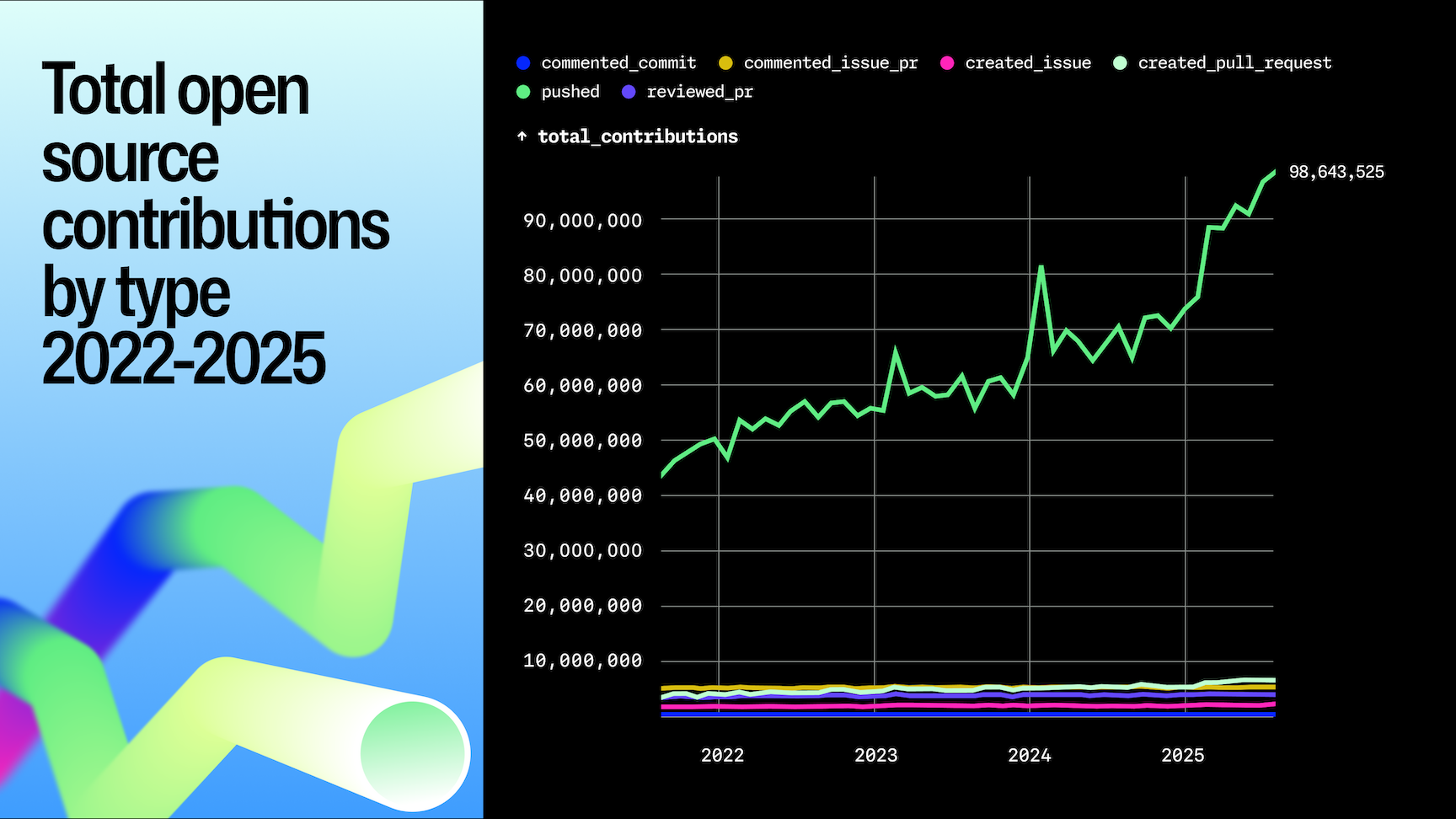
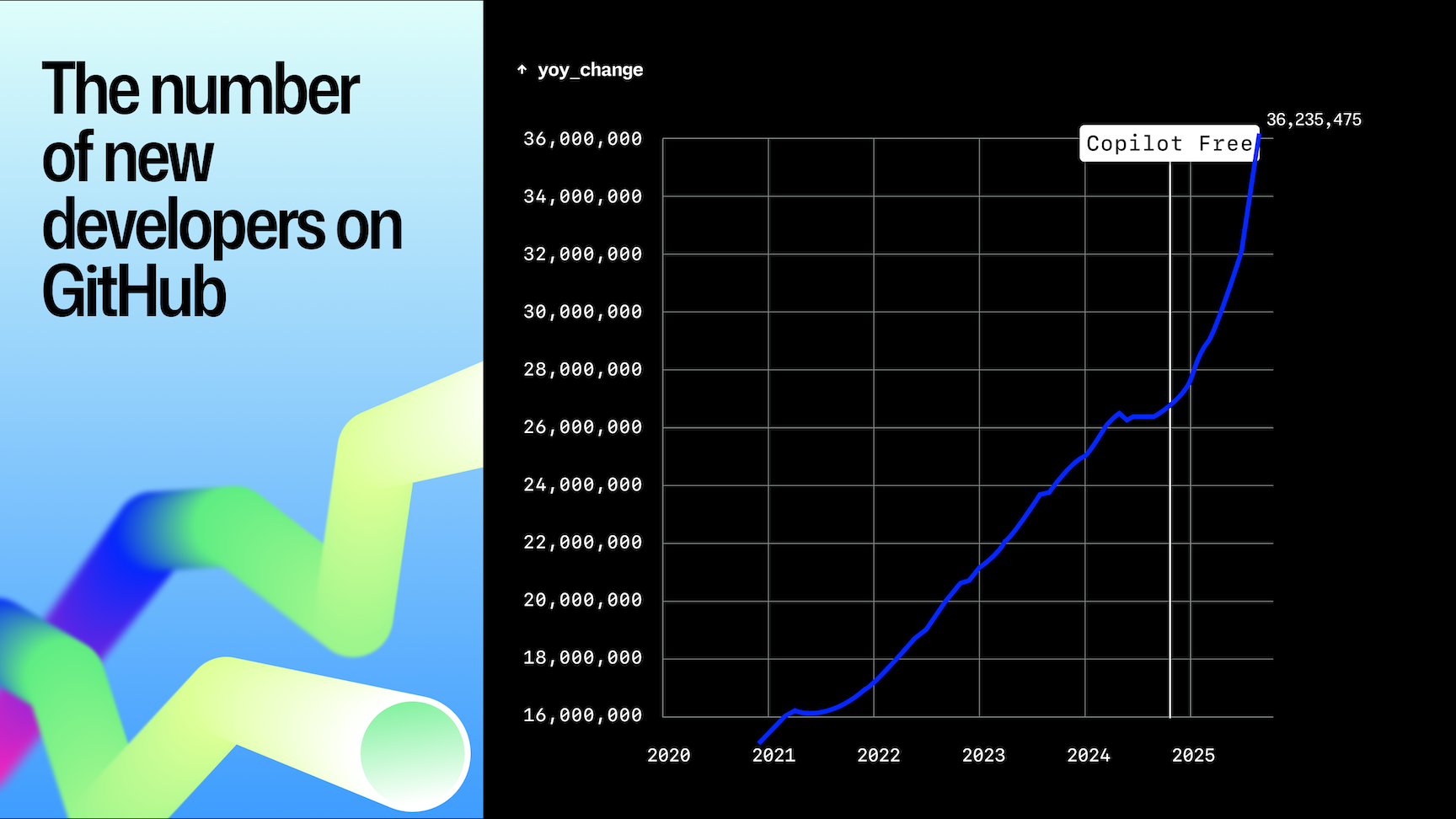
Also using PyPI as a benchmark is incredibly myopic. Github's 2025 Octoverse[0] is more informative. In that report, you can see a clear inflection point in total users[1] and total open source contributions[2].
The report also notes:
> In 2025, 81.5% of contributions happened in private repositories, while 63% of all repositories were public
[0]: https://github.blog/news-insights/octoverse/octoverse-a-new-...
[1]: https://github.blog/wp-content/uploads/2025/10/octoverse-202...
[2]: https://github.blog/wp-content/uploads/2025/10/octoverse-202...
Detractors of AI are often accused of moving the goalposts, but I think your comment is guilty of the same. Before Claude Code, we had Cursor, Github Copilot, and more. Each of these was purportedly revolutionizing software engineering.
Further, the core claim for AI coding is that it lets you ship code 10x or 100x faster. So why do we need to wait years to see the result? Shouldn't there be an explosion in every type of software imaginable?
Personally, I see the paid or adware software market shrinking, not growing, as a testament to the success of LLMs in coding.
There are many small, different, and one-time tasks that don’t fit full blown apps. Which I would characterize an AI building a novel app as building a house out of random bits of lumber. It will work but will have no cohesive process and sounds like a nightmare.
Pre-ChatGPT, in ~2020, there were about 5,000 new packages per month. Starting in 2025 (the actual year agents took off), there is a clear uptick in packages that is consistently about 10,000 or 2X the pre-ChatGPT era.
In general, the rate of increase is on a clear exponential. So while we might not see a step change in productivity, there comes a point where the average developer is in fact 10X productive than before. It just doesn't feel so crazy because it can about in discrete 5% boosts.
I also disagree with the dataset being a good indicator of productivity. I wouldn't actually suspect the number of packages or the frequency of updates to track closely with productivity. My first order guess would that AI would actually be deflationary. Why spend the time to open source something that AI can gen up for anyone on a case by case basis specific to the project. it takes a certain level of dedication and passion for a person to open source a project and if the AI just made it for them, then they haven't actually made the investment of their time and effort to make them feel justified in publishing the package.
The metrics I would expect to go up are actually the size of codebases, the number of forks of projects that create hyper customized versions of tools and libraries, and other metrics like that.
Overall, I'd predict AI is deflationary on the number of products that exist. If AI removes the friction involved with just making a custom solution, then the amount of demand for middleman software should actually fall as products vertically integrate and reduce dependencies.
It's like looking at tire sales to wonder about where the EV cars are.
In the last few months, Gemini (and I) have written for highly personal, very niche apps that are perfect for my needs, but I would never dream of releasing. Things like cataloguing and searching my departed mom‘s recipe cards, or a text message based budget tracker for my wife and I to share.
These things would never be released or available as of source or commercial applications in the way that I wanted them, and it took me less time to have them built with AI then it would have taken me to Research existing alternatives and adapt my workflow/use case to fit whatever I found.
So yeah, there are more apps but I would venture to say you’ll never see most of them…
Besides, it's working for me. If it isn't working for others I don't want to convince them of anything. I do want to hear from other people for whom it's working, though, so I'm happy to share when things work for me.
But the mistake is to expect a huge productivity boost.
This is highly related to Amdahl's law, also The Mythical Man-Month.
Some tasks can be accomplished so fast that it seems magical, but the entire process is still very serial, architecture design and debug are pretty weak on the AI side.
1) I'm a former SWE in a business role at a small-market publishing company. I've used Claude Code to automate boring processes that previously consumed weeks of our ops and finance teams' time per year. These aren't technically advanced, but previously would have required in-house dev talent that would not have been within reach of small businesses. I wouldn't have had the time to code these things on my own, but with AI assistance the time investment is greatly reduced (and mostly focused on QA). The only needle moved here is on a private Github repo, but it's real shipped code with small but direct impact.
2) I used to often find myself writing simple Perl wrappers to various APIs for personal or work use. I'd submit these to CPAN (Perl's equivalent to PyPI) in case anyone else could use them to save the 30-60 minutes of work involved. These days I don't bother -- most AI tools can build these in a matter of seconds; publishing them to CPAN or even Github now feels like unnecessary cruft, especially when they're likely to go without active maintenance. So, my LOC published to public repos is down, even though the amount of software produced is the same. It's just that some of that software has become less useful to the world writ large.
3) The code that's possible to ship quickly with pure AI (vibe coding) is by definition not the kind of reusable code you'd want to distribute on PyPI. So, I'd expect that any productivity impact from AI on OSS that's designed to be reusable would be come very slowly, versus "hockey stick" impact.
The caveat here is to say it hasn't helped with this YET. It's very possible that one or more people/companies come up with a way to have AI handle this process whether it's from a purely autonomous approach like ralph looping until done, deploying and then buying ads or posting about it or from an AI CEO approach of managing the human or hiring humans to do some of those tasks or from a handholding den mother approach of motivating the human to complete all the necessary steps.
Yes, you do produce more code. But LoC produced is never a healthy metric. Reviewing the LLM generated code, polishing the result and getting it to production-level quality still very much requires a human-in-the-loop with dedicated time and effort.
On the other hand, people who vibe code and claims to be 10x productive, who produces numerous PRs with large diffs usually bog down the overall productivity of teams by requiring tenuous code reviews.
Some of us are forced to fast-track this review process so as to not slow down these "star developers" which leads to the slow erosion in overall code quality which in my opinion would more than offset the productivity gains from using the AI tools in the first place.
The thing is I'm not really sure your going to be able to distinguish how something was built unless the developer volunteers that information.
The tools for generating AI code aren't yet capable of producing code that is decent enough for general purpose use cases, with good robust tests, and clean and quality.
The quantity is there. Nobody's asking "does this thing actually work" before hitting deploy. That's the real gap.
IE, using agents to iterate through many possible approaches, spike out migrations, etc might save a project a year of misadventures, re-designs, etc, but that productivity gain _subtracts_ the intermediate versions that _didn't_ end up being shipped.
As others have mentioned, I think yak-shaving is now way more automated. IE, If I want to take a new terminal for a spin, throw together a devtool to help me think about a specific problem better, etc, I can do it with very low friction. So "personal" productivity is way higher.
In that they obviously have no real utility, sure. There hasn't been a paradigm shift, they still suck at programming, and anyone trying to tell you otherwise almost certainly has something to sell you.
> So, let’s ask again, why? Why is this jump concentrated in software about AI?...Money and hype
Don't get me wrong: there are real productivity gains to be had, but the reality is that building small one-offs and personal tools is not the same thing as building, operationalizing, and maintaining a large system used by paying customers and performing critical business transactions.
A lot of devs are surrendering their critical thinking facilities to coding agents now. This is part of why the hype has to exist: to convince devs, teams, and leaders that they are "falling behind". Hand over more of your attention (and $$$) to the model providers, create the dependency, shut off your critical thinking, and the loop manifests itself.
The providers are no different from doctors pushing OxyContin in this sense; make teams dependent on the product. The more they use the product, the more they build a dependency. Junior and mid-career devs have their growth curves fully stunted and become entirely reliant on the LLM to even perform basic functions. Leaders believe the hype and lay off teams and replace them with agents, mistaking speed for velocity. The more slop a team codes with AI, the more they become reliant on AI to maintain the codebase because now no one understands it. What do you do now? Double down; more AI! Of course, the answer is an AI code reviewer!. Nothing that more tokens can't solve.
I work with a team that is heavily, heavily using AI and I'm building much of the supporting infrastructure to make this work. But what's clear is that while there are productivity gains to be had, a lot of it is also just hype to keep the $$$ flowing.
And even “product engineers” often do not have experience going from zero to post sales support on a saas on their own.
It is a skill set of its own to make product decisions and not only release but stick with it after the thing is not immediately successful.
The ability to get some other idea going quickly with AI actually works against the habits needed to tough through the valley(s).
a) there are likely many more active, eager contributors all of a sudden, and
b) there's suddenly a huge amount of new papers published every week about algorithms and techniques that said contributors then eagerly implement (usually of dubious benefit).
More cynically, one might also hypothesize that
c) code quality has dropped, so more frequent releases are required to fix broken programs.
That is, I expect the numbers (at least the frequency of downloads, if not the number of new packages) to go down over time as AI makes generating functionality easier than hunting down and adding a dependency.
The number of new packages could still go up as people may still open-source their generated code, for street cred if not actual utility. But it's not clear how much of those incentives apply if the code is not very generally useful and the effort put into is minimal.
But I have been absolutely flooded with trailers for new and upcoming indie games. And at least one indie developer has admitted that certain parts of their game had used the aide of AI.
I also noticed sometimes when I think of writing something, I ask AI first if it exists, and AI throws up some link and when I check the link it says "made with <some AI>".
So I'm not sure what author is trying to say here but I definitely feel like I am noticing a rise in software output due to AI.
But with that said, I also am noticing the burden of taking care of those open source projects. Sometimes it feels like I took on a 2nd job.
I think a lot of software is being produced with AI and going unnoticed, they don't all end up on the front page of HN for harassing developers.
I’ve done some experiments with reading gedcom files, and I think I’m quite close to a demoable version of a genealogy app.
Biggest thing is a tool for remotely working musicians. It’s about 10000 lines of well written rust, it is a demoable state and I wish I could work more on it but I just started a new job.
But yeah, this wouldn’t have been possible if I hadn’t been a very experienced dev who knows how to get things live. Also I’ve found a way to work with LLMs that works for me, I can quickly steer the process in the right way and I understand the code thats written, again it’s possible that a lot of real experience is needed for this.
And you can even see the number of new games that disclosed using generative AI (~21% in 2025). [2]
And that's probably significantly undercounting because I doubt everyone voluntarily discloses when they use tools like Claude Code (and it's not clear how much Valve cares about code-assistance). [3]
Also no one is buying or playing a lot of these games.
[1] https://steamdb.info/stats/releases/
[2] https://steamdb.info/stats/releases/?tagid=1368160
[3] https://store.steampowered.com/news/group/4145017/view/38624...
I have no plans of publishing them or making the open source, so it will not be a part of this metric. I believe others are doing this too.
It should be Useful, Accurate, Consistent, Available and Usable.
Doesn’t AI just largely help quickly deliver Available and (to some degree) Usable?
Of course these are specific workplaces designed around moving tickets on a board, not high-agentic, fast-moving startups or independent projects—but they might represent a lot of the developer workforce.
I also know this is not everyone's experience and probably a rare favorable outcome of productivity gain captured by a worker that is not and won't stay the norm.
Measuring python packages to indicate AI-based production is like measuring saw production to measure the effectiveness of the steam engine. You need to look at houses and communities being built, not the tools.
What I do very successfully is low stakes stuff for work (easy automations, small QoL improvements for our tooling, a drive-by small Jira plugin)
And then I do a lot of crazy exploring, or hyper-personal just for myself stuff that can only exist because I can now spawn and abandon it in a couple days instead of weeks or months.
Not just an app but someone set up us the bomb!?
As far as totally new products - I built one (Habit.am - wordless journaling for mental health) and new products require new habits, people trying new things, its not that easy to change people's behavior. It would be much easier for me to sell my little app if it was a literal plain old journal.
While it’s interesting to see that in open source software the increase is not dramatic, this ignores however many people are now gen-coding software they will never publish just for them, or which winds up on hosting platforms like Replit.
I don't blame people for responding to the title instead of the article, because the article itself doesn't bother to answer its own question.
i know maybe this is not to your analysis as its about open source stuff, but this is the sentiment i see with some companies. rather than have 10x output which their clients dont need, they produce things cheaper and earn more money from what they produce. (and later lose that revenue to a breach :p)
Are there any agentic sales and marketing offerings?
Because being able to reliably hand off that part of the value chain to an agent would close a real gap. (Not sure this can be done in reality)
- product hunt or app sumo is something i believe everyone tries to get a submission to which would truly measure how many new apps are we having per month these days
A lot of the real value shows up as workflow compression instead. Internal tools, one-off automations, bespoke research flows, coding helpers, things that would never have justified becoming a product in the first place.
Same with vibe-coded stuff.
I think this might be more of an comment on software as a business than AI not coding good apps.
When you are developing library it's exact opposite - you really care about how it works and which interface it provides so you end up writing it mostly by hand.
You don't need as many libraries when functionality can be vibe-coded.
You don't need help from the open source community when you have an AI agent.
The apps are probably mostly websites and native apps, not necessarily published to PyPI.
"Show HN" has banned vibe-coded apps because there's been so many.
200 years ago text was much more expensive, and more people memorized sayings and poems and quotations. Now text is cheap, and we rarely quote.
This is more useful for discussing what kind of projects AI is being used for than whether it's being used.
Self plug, but basically that’s the TL;DR https://robertdelu.ca/2026/02/02/personal-software-era/
But since late last year even when it’s not part of the requirements leading app dev + cloud consulting projects, I’ll throw in a feature complete internal web admin site to manage everything for a project with a UI that looks like something I would have done 25 years ago with a decent UX.
They are completely vibe coded, authenticated with Amazon Cognito and the only things I verify are that unauthenticated users can’t access endpoints, the permissions of the lambda hosting environment (IAM role) and the database user it’s using permissions.
Only at most 5 people will ever use the website at a time - but yeah I get scalability for free (not that it matters) because it’s hosted on Lambda. (yes with IAC)
The website would not exist at all if it weren’t for AI.
Now just to be clear, if a website is meant for real people and the customer’s customers. I’ll insist on a real web designer and a real web developer be assigned to the project with me.
It seems like all tech executives are saying they are seeing big increases in productivity among engineering teams. Of course everyone says they're just [hyping, excusing layoffs, overhired in 2020, etc], but this would be the most relevant metric to look at I think.
Im not saying that AI is bad, infact, its the opposite, its one of the most important tools that I have seen introduced in my lifetime. Its like a calculator. Its not going to turn everyone into a mathematician, but it will turn those who have an understanding of math into faster mathematician.
the real growth is in apps that use ai as a feature, not ai-first packages. like every saas just quietly added an llm call somewhere in their stack. thats hard to measure from dependency graphs.
No. Many projects explicitly release on a fixed schedule. Even if you don't, you're going to get into a rhythm.
There's a deeper problem with using PyPi to measure the success of vibecoding: Libraries are more difficult to program then apps. Maybe vibecoding is a good way to create apps that solve some specific problem, but not to create generally useful libraries.
They're in the app stores. Apple's review times are skyrocketing at the moment due to the influx of new apps.
But that's not really what we were promised.
superpowers/get-shit-done type bloated workflows that try to do everything.
this seems a bit different but still in the same mental category for me
(557,000 new apps to Apple’s App Store; a 24% jump from 2024). Who is right?
"THE APPLE APP STORE IS DROWNING IN AI SLOP" https://x.com/shiri_shh/status/2036307020396241228
Arguably makes the remaining 20% even harder to handle.
I'm sure that AI can be a huge boost to great, mature developers. Which are insanely rare in an industry that has consistently promoted brainless ivy league coders farming algo quizzes for months.
But those with a huge sensibility and experience can definitely be enabled to produce more.
But the 20% is still there and again, it's easy to make it way harder because you're less intimate with the brittle 80%.
Try it out and don't stop trying. If something improves at this rate, even if you think it's not there right now, don't assume it is going to stop. Be honest about the things we were always obviously bad at, that the ai has been getting quickly better at, and assume that it will continue getting better. If this were true, what would that mean for you?
As mentioned in a comment here:
> Maybe the top 15,000 PyPi packages isn't the best way to measure this? > Apparently new iOS app submissions jumped by 24% last year
Looks like most LLM generated code is used by amateurs/slop coders to generate end-user apps they hope to sell - these user profiles are not the type of people who contribute to the data/code commons. Hence there's no uptick in libs. So basically a measurement issue.
Plus you all have LLMs at home. I have my version that takes care of exactly my needs and you can have yours.
Number of iOS apps has exploded since ChatGPT came out, according to Sensor Tower: https://i.imgur.com/TOlazzk.png
Furthermore, most productivity gains will be in private repos, either in a work setting or individuals' personal projects.
All of the above are huge software markets outside of the typical Silicon Valley bubble.
Making Unpublished Software for Themselves
One issue is, I think maybe a lot of people are making software for themselves and not publishing it - at least I find myself doing this a lot. So there's still "more software produced than before", but it's unpublished
LOC a Good Measure?
Another question is like Lines of Code, about if we best measure AI productivity by new packages that exist. AI might make certain packages obsolete and there may be higher quality, but less, contributions made to existing packages as a result. So actually less packages might mean more productivity (although, generally we seem to think it's the opposite, conventionally speaking)
Optimizing The Unnoticeable
Another issue that comes up is maybe AI optimizes unnoticeable things: AI may indeed make certain things go 100x faster or better. But say a website goes from loading in 1 second to 1/100th of a second... it's a real 100x gain, but in practice doesn't seem to be experienced as a whole lot bigger of a gain. It doesn't translate in to more tangible goods being produced. People might just load 100 pages in the same amount of time, which eats up the 100x gain anyway (!).
Bottleneck of Imagination
I think also this exposes a bottleneck of imagination: what do we want people to be building with AI? People may not be building things, because we need more creative people to be dreaming up things to build. AI is only fed existing creative solutions and, while it does seem to mix that together to generate new ideas, still the people reading the outputs are only so creative. I've thought standard projects would be 1) creating open source alternatives to existing proprietary software, 2) writing new software for old hardware (like "jailbreaking" but doesn't have to be?) to make it run new software so that it can be used for something other than be e-waste. 3) Reverse engineering a bunch of designs so you can implement some new design on them, where open source code doesn't exist and we don't know how they function (maybe kind of like #1). So like there is maybe a need for a very "low tech" creation of spaces where people are just regularly swapping ideas on building things they can only build themselves so much, to either get the attention of more capable individuals or to build up teams.
Time Lag to Adapt
Also, people may still be getting adjusted to using AI stuff. One other post detailed that the majority of the planet does not use AI, and an even smaller subset pays for subscriptions. So there's still a big lag in society of adoption, and of adopters knowing how to use the tools. So I think people might really experience optimizing something at 100x, but they may not know how to leverage that to publish it to optimize things for everyone else at 100x amount, yet.
Social Media Breakdown?
Another problem is, I have made stuff I'd like to share but... social media is already over-run with over-regulation and bots. So where do I publish new things? Even on HN, there was that post about how negative the posters can be, who have said very critical things about projects that ended up being very successful. So I wonder if this also fuels people just quietly creating more stuff for their own needs.
Has GDP Gone Up or Time Been Saved?
Do other measures of productivity exist? GDP appears to have probably only gone up a bit. But again, could people be having gains that don't translate to GDP gains? People do seem to post about saving time with AI but... the malicious thing about technology is that, when people save 10 hours from one tool, they usually just end up spending that working on something else. So unless we're careful, technology for some people doesn't save them much time at all (in fact, a few people have posted about being addicted to AI and working even more with it than before AI!).
Are There Only So Many "10x Programmers"?
Another issue is, maybe there are only a minority of people who get "10x" gains from AI; at the same time, "lesser" devs (like juniors?) have apparently been displaced by AI with some layoffs and hiring freezes.
Conclusion
I guess we are trying to account for real gains and "100x experiences" people have, with a seeming lack of tangible output. I don't think these things are necessarily at odds with each other for some of the aforementioned reasons written above. I imagine maybe in 5 years we'll see more clearly if there is some noticeable impact or not, and... not to be a doomer / pessimist, but we may have some very negative experience from AI development that seems to negate the gains that we'll have to account for, too.
two that are drawn from my own experience are:
- meaningful software still takes meaningful time to develop
- not all software is packaged for everyone
I've seen a lot of examples shared of software becoming narrow-cast, and/or ephemeral.
That that doesn't show up in library production or even app store submissions is not interesting.
I'm working on a large project that I could never have undertaken prior to contemporary assistance. I anticipate it will be months before I have something "shippable." But that's because it's a large project, not a one shot.
I was musing that this weekend: when do we see the first crop of serious and novel projects shipping, which could not have been done before (at least, by individual devs)... but which still took serious time.
Could be a while yet.
With a caveat.
If you were to compare my workflow to a decade ago, you wouldn’t see much difference other than my natural skill growth.
The rub is that the tools, communities and services I learned to rely on over my career as a developer have been slowly getting worse and worse, and I have found that I can leverage AI tools to make up for where those resources now fall short.
So they are all producing products to produce products. My guess is 50% of token usage globally is to produce mediocre articles on "how I use Claude code to tell HN how I use Claude code".
- The 80/20 rule still applies. We’ve optimized the 20% of time part (a lot!) but all the hype is only including the 80% of work part. It looks amazing and is, but you can’t escape the reality of ~80% of the time is still needed on non-trivial projects.
- Breathless AI CEO hype because they need money. This stuff costs a lot. This has passed on to run of the mill CEOs that want to feel ahead of things and smart.
- You should be shipping faster in many cases. Lots of hype but there is real value especially in automating lots of communication and organization tasks.
However, PyPi is not really the best way to measure this as the amount of people who take time to wrap their code into a proper package, register into PyPi, push a package, etc... is quite low. Very narrow sampling window.
I do think AI will directly fuel the creation of a lot of personal apps that will not be published anywhere. AI lower the barrier of entry, as we all know, so now regular folks with a bit of technical knowledge can just build the app they want tailored to their needs. I think we´ll see a lot of that.
I am just tired boss. I am not going to look at your app.
It's a great change for a human person. I'm not pretending I'm making something other people would buy nor do I want to. That's the point.
On the one hand, I couldn't hope to do anything close to what I'm doing without AI, on the other hand "write an app to teach me to pass high school exams" is utterly out of reach of current frontier models ...
That being said, I've personally put 3 up recently (more than I've published in total). I'm sure they have close to zero downloads (why would they? they're brand new, solve my own problems, I'm not interested in marketing them or supporting them, they're just shared because they might be useful to others) so they wouldn't show up in their review. 2 of these are pretty meaty projects that would have taken weeks if not months of work but instead have been largely just built over a weekend or a few days. I'd say it's not just the speed, but that w/o the lowered effort, these projects just wouldn't ever have crossed the effort/need bar of ever being started.
I've probably coded 50-100X more AI-assisted code that will never go to pypi, even as someone that has released pypi packages before (which already puts me in a tiny minority of programmers, much less regular people that would even think about uploading a pypi project).
For those interested in the scope of the recent projects:
https://pypi.org/project/realitycheck/ - first pypi: Jan 21 - 57K SLoC - "weekend" project that kept growing. It's a framework that leverages agentic coding tools like Codex/Claude Code to do rigorous, systematic analysis of claims, sources, predictions, and argument chains.It has 400+ tests, and does basically everything I want it to do now. The repo has 20 stars and I'd estimate only a handful of people are using it.
https://pypi.org/project/tweetxvault/ - first pypi: Mar 16 - 29K SLoC - another weekend project (followup on a second weekend). This project is a tool for archiving your Twitter/X bookmarks, likes, and tweets into a local db, with support for importing from archives and letting you search through them. I actually found 3 or 4 other AI-coded projects that didn't do quite what I wanted so it I built my own. This repo has 4 stars, although a friend submitted a PR and mentioned it solved exactly their problem and saved them from having to build it themselves, so that was nice and justifies publishing for me.
https://pypi.org/project/batterylog/ - first pypi: Mar 22 - 857 SLoC - this project is actually something I wrote (and have been using daily) 3-4 years ago, but never bothered to properly package up - it tracks how much battery is drained by your laptop when asleep and it's basically the bare minimum script/installer to be useful. I never bothered to package it up b/c quite frankly, manual pypi releases are enough of a PITA to not bother, but LLMs now basically make it a matter of saying "cut a release," so when I wanted to add a new feature, I packaged it up as well, which I would never have done this otherwise. This repo has 42 stars and a few forks, although probably 0 downloads from pypi.
(I've spent the past couple years heavily using AI-assisted workflows, and only in the past few months (post Opus 4.6, GPT-5.2) would I have even considered AI tools reliable enough to consider trusting them to push new packages to pypi.)
But people are desperate for data right? Desperate to prove that AI hasn't done shit.
Maybe. But this much is true. If AI keeps improving and if the trendline keeps going, we're not going to need data to prove something equivalent to the ground existing.
Except none of them are open source so they don't show up in this article's metrics.
But it's fine. Keep your head in the sand. It doesn't change the once in a lifetime shift we are currently experiencing.
I've wanted to make video games forever. It's fun, and scratches an itch that no other kind of programming does. But making a game is a mountain of work that is almost completely unassailable for an individual in their free time. The sheer volume of assets to be created stops anything from ever being more than a silly little demo. Now, with Gemini 3.1, I can build an asset pipeline that generates an entire game's worth of graphics in minutes, and actually be able to build a game. And the assets are good. With the right prompting and pipeline, Gemini can now easily generate extremely high quality 2d assets with consistent art direction and perfect prompt adherence. It's not about asking AI to make a game for you, it's about enabling an individual to finally be able to realize their vision without having to resort to generic premade asset libraries.
Game development just isn’t something AI can do well. Good games are not just recreations of existing titles.