I bought BeOS in the late 90's and enjoyed it immensely like a breath of fresh air in a sewage pipe. BeOS died.
With my track record I really, really should've bought Windows. Twice, to make sure.
It wasn't that hard to boot into Be, but I suppose most users wouldn't bother because all games and applications were on Windows anyway. Ultimately, lack of apps was probably what held it back, although Microsoft's commercial practices definitely played a role in curbing OEMs and app developers.
* https://en.wikipedia.org/wiki/Hitachi_Flora_Prius * https://news.ycombinator.com/item?id=44217322
AIUI the intended exit was either an acquihire (Apple gets JLG back and the Be Inc. "journey" ends once people tidy up) or maybe Apple's software side fully embraces Be Inc. (after all JLG is sure he's correct about what Apple should do) and absorbs the entire entity as Be's operating system BeOS becomes the new Apple OS.
That part isn't crazy, it's the early 1990s, affordable CPUs have virtual memory support, the physical size limit is looming, software reliability is worsening, Apple's 1980s co-operative multi-tasking operating system is not up to the job. If you understand the big picture it's obvious that you want something closer in principle to a Unix. You could hire somebody to build one (as Microsoft had for "Windows NT") or some people might build one in their bedrooms (Linux) or you could buy one which already exists, so, that's what Be Inc. set out to be.
In the end Apple decided that if they're going to re-hire an executive who they have fired previously it should be Steve Jobs. The moment they've made that decision, Be Inc. was superfluous -- JLG knows Steve isn't going to hire him, Steve hates him, so next the priority now is to help the money get out so that investors will continue talking to JLG. Fortunately the Dot Com bubble happened, Be floated on typical bubble era nonsense, about how their system is somehow perfect for the Internet, and that was enough for the big money to get out, leaving the wreck for the poor Be fans who were still buying even after the last dregs were gone.
https://mitsloan.mit.edu/ideas-made-to-matter/working-defini...
But PenPoint had a lovely UI and, if memory serves, an API much like Apple's Objective C.
Microsoft had a hand in killing PenPoint, just as they did with BeOs. Jerry Kaplan told the story in his book "Startup".
From the website: "Genode is based on a recursive system structure. Each program runs in a dedicated sandbox and gets granted only those access rights and resources that are needed for its specific purpose. Programs can create and manage sub-sandboxes out of their own resources, thereby forming hierarchies where policies can be applied at each level. The framework provides mechanisms to let programs communicate with each other and trade their resources, but only in strictly-defined manners. Thanks to this rigid regime, the attack surface of security-critical functions can be reduced by orders of magnitude compared to contemporary operating systems."
Eventually I think the setup gradually bit rot with no updates and unsupported hardware, so I reluctantly had to go back to Linux. I remember Ubuntu and Gnome 2 started to look pretty nice (well, for an inferior desktop environment) in the early years of 2000.
(Unsurprisingly, years later Gnome came out with Gnome 3 and killed all the good stuff that Gnome 2 had accumulated. I can only wait and see how long Mate desktop survives.)
I still keep a Haiku VM around and boot it every now and then.
Others who had windows or macs had to "telnet" into a remote Unix workstation in an engineering lab to do the same.
Still have it, last time I checked it worked well.
BeOS had pervasive multithreading and a slick UI. The BeBox had dual CPUs, a novelty at the time and many years before multi-core CPUs.
Linux was still very new, and didn't have much of a GUI at all (maybe basic X, but this was long before Gnome, KDE, Englightment, etc)
Mac System 7 didn't have protected memory or preemptive multitasking.
Windows 95 was brand new and while a big improvement over Windows 3.1, was still very prone to crashing.
But this was 1995. Linux (or BSD) on the desktop didn’t really exist, Apple’s OS was System 7.5, Microsoft’s was Windows 95. BeOS was a preemptively multitasking, multimedia operating system, with a transactional file system. Nothing else like it existed, at that time.
I am risking the one full-time paid developer of Haiku popping up here and shouting at me, because he's done that a few times before and even written to my editor-in-chief to complain. Sadly for him, my former EIC was a hardcore techie -- it's how I met him, long before either of us worked there -- and he was on my side.
https://www.theregister.com/2023/01/11/haiku_beta_4/
Unix is a 1960s design for minicomputers. Minicomputers are text-only standalone multiuser computers. That is why things like handling serial lines (/dev/tty -- short for TeleTYpe) are buried deep in the core of Unix, but networking and graphics aren't.
There is an absolute tonne of legacy baggage like this in Unix. All Unixes, including Linux kernel 7.0. We do not use minicomputers any more; nobody even makes them. We don't have multiuser computers any more. In fact, we have multi computers per user. Modern servers are just PCs with lots of connections from other computers not from people.
In the early 1980s the Lisa flopped because it was $10K, but the Mac did well because it was $2.5K and had a GUI and no shell. The future, woo, etc.
The Mac was black and white, 1 sound channel, no hard disk, no expansion slots, and in cutting down the Lisa, Apple discarded multitasking.
Enter the Hi-Toro Lorraine. Intended to be the ultimate games console, with a powerful full-16 bit Motorola 68000 chip (a minicomputer CPU on a sdingle die) amazing colour graphics, multichannel stereo sound, but it could plug into a TV.
Commodore bought it, renamed it the Amiga, and tried to develop a fancy new ambitious OS, called Commodore Amiga Operating System: CAOS.
They couldn't get it to work so it was canned, and a replacement hastily cobbled together from the research OS Tripos written in BCPL and some new bits. It had a Mac-like windowing GUI, full preemptive multitasking (with no memory protection because the 68000 couldn't do that), and it fit on a single DD floppy (~880 kB) and into 512 kB (1/2 MB) of RAM.
It was a big hit and set a really high bar for expectations of what an inexpensive home computer could do. It ran rings around the Mac and could emulate a Mac with excellent compatibility.
A decade later a lot of people missed that. PCs and PC OSes were very boring by comparison. Sure, reliable, fairly good multitasking by then, dull grey UIs. Linux was a thing but it was for minicomputer fetishists only, and looked like it came from 20 years before Windows or Mac. (Which in a way it did.)
So a former Apple exec set up a company to make a modern geek's dream machine. Everything had true colour graphics and stereo sound now, so that was a given, not a selling point. It had to have a snazzy very fast very smooth GUI, it had to have excellent multitasking, screaming CPU performance because RISC chips were starting to take off. Mainstream computers struggled with >1 CPU so multiple RISC CPUs was the selling point, and amazing blindingly smooth multimedia support, because PCs and Macs could just about play one jerky grainy little video in a postage-stamp sized window in 267 grainy pixelated colours.
The BeBox was to be the mid-1990s geek's dream computer. Part of how they did it was an all-new multitasking single user OS with a very smooth built in GUI desktop, best-in-industry media support, built-in TCP/IP networking. All the cool bits of Windows NT, multitasking as good as Linux but pretty, a desktop better than Windows 95, and it threw all the multiuser stuff in the trash, all the boring server stuff in the trash, because FOSS OSes did that tedious business stuff.
It was beautiful.
It flopped.
The company pivoted to selling its OS on the other PowerPC kit vendor: on PowerMacs, with reverse-engineered drivers. It flopped. Classic MacOS was just barely good enough: crap multitasking, crap virtual memory, but loads of 1st class leading pro apps. BeOS had almost none.
So Be pivoted again. It ported its shiny new C++ OS to x86. You could buy multiprocessor x86 PCs in the late 1990s. I had one.
It was amazing on PC kit. It booted in under a tenth of the time that Windows sluggishly lurched into life. It could do blinding 3D like spinning solid shapes while movies played on their surfaces, and it did it all in software.
I reviewed it. I loved it.
https://archive.org/details/PersonalComputerWorldMagazine/PC...
But it still had almost no apps and while Microsoft could not prevent OEMs installing it, it could prevent them from installing a bootloader:
https://birdhouse.org/beos/byte/30-bootloader/
Be sued.
https://www.theregister.com/2002/02/20/be_inc_sues_microsoft...
It wasn't enough.
It pivoted into internet appliances but too late.
Me, I felt it should have done a deal with Acorn which was the only company with affordable multiprocessor ARM workstations at the time.
https://liam-on-linux.livejournal.com/55562.html
Haiku is an all-FOSS ground-up rewrite, but with the original desktop, which was FOSS. It's a lovely mixture of the Classic MacOS Finder and the Windows 95 Explorer, with the best bits of both but none of the bad bits.
Haiku is lovely. It's got a huge amount of Linux compatibility now. That means lots of apps, fixing the one big killer problem of BeOS.
But it is much bigger and much slower. It's still 10x smaller and 10x faster than any FOSS Unix but the original could boot in 5-10 seconds to the desktop in 1999 on a Pentium 200 from a PATA hard disk. A modern PC with an SSD should load it in half a second, but Haiku still takes 10 seconds or so. Good, sure, but not as impressive as BeOS was 25 years ago.
So true. I had an old Dell Latitude D620, 3GB/500GB, 1.66ghz Intel Core Duo Processor and it was sound that tripped me up. Haiku was lightning fast on this machine.
I think that eventually I might've gotten sound to work but... this was many years ago and the laptop was mostly for testing light-weight distros on modest hardware.
But Haiku has the soul.
We don't need to clone UNIX all over the place.
To work around this, all window messages in ported apps are marshalled to execute sequentially. Small additional overhead, and the system doesnt spread available threads, so noticably slower.
Compare a native Haiku app with a ported app, one is smooth as ice while the other isnt. Users notice it. This is on many core systems.
Sit down and do the work needed to get Ruby running properly on Haiku instead of sitting here complaining and basically admitting that you're just being a noisy spectator... On HackerNews, no less.
What doesn't work about it? We have Ruby in the software repositories, and Ruby is required to build WebKit (and we build WebKit on Haiku), so clearly it works for that much at least. I don't see any open tickets at HaikuPorts about bugs in the port, either.
Then again, there is a golden opportunity to become a Ruby contributor, road to fame on Ruby contribution list.
BeOS 5 could even be installed on a Windows FAT32 partition alongside Windows (it created a 50MB virtual disk).
At one point in time I had Windows 95, Windows 2000, Linux (possibly Slackware) and BeOS 5 all running on the same single PC.
But that's not what this is. Or not only:
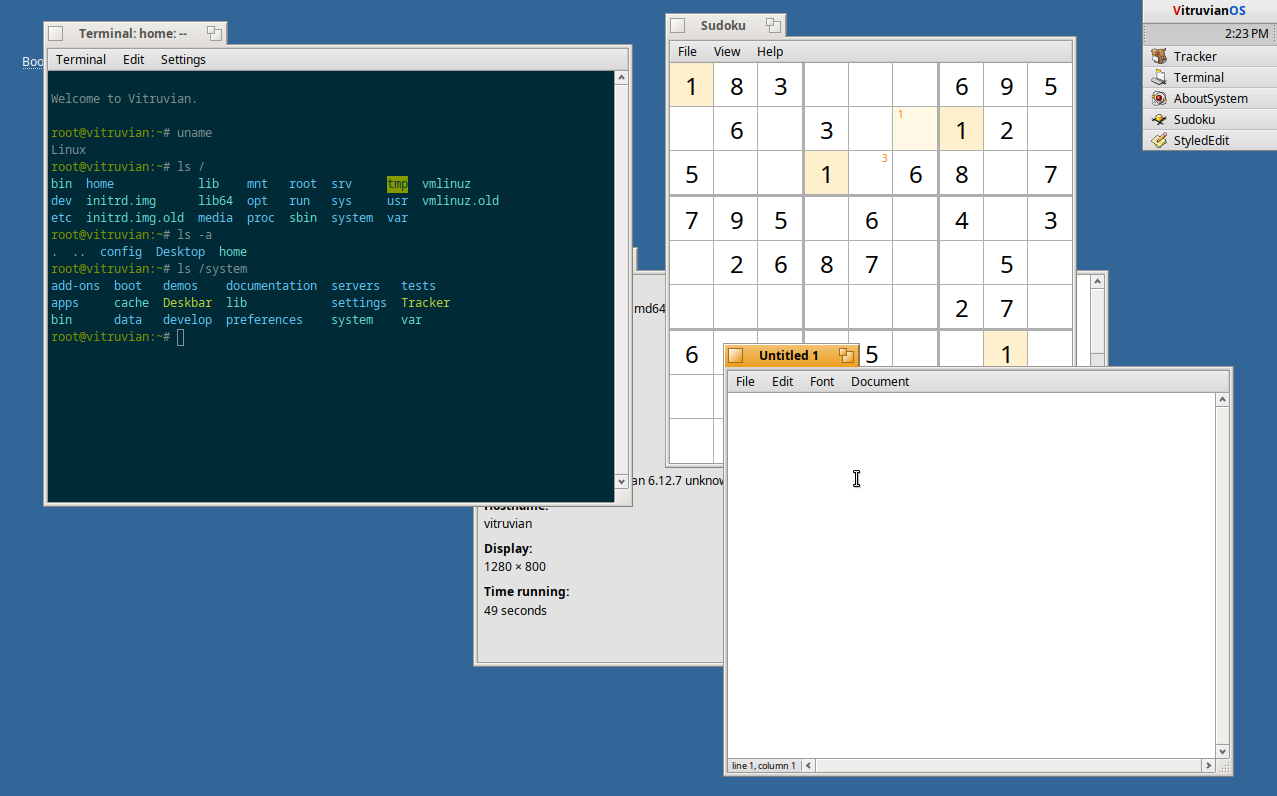
Nexus Kernel Bridge
    Nexus is Vitruvian's custom Linux kernel subsystem that brings BeOS-style
    node monitoring, device tracking, and messaging to Linux — making it
    possible to run Haiku applications on a standard Linux kernel.
It claims to run apps from Haiku, the current open-source implementation of a modern BeOS.
[1] - there's a reason why a bunch of BeBook reads the same as some of the oldest parts of Android documentation
Of course, at that time, it was impossible to know which OS would win the wars, so BeOS became my favorite. However, Linux developed very quickly during those years, I got into college and started using UNIX there, winmodem drivers appeared, and that's what I ended up using.
But BeOS still holds a very dear place in my heart. It really was superior to anything else during that era.
To me the UX and experience on it was (still) ahead of its time. It ran stuff on a Pentium 90 like it was a 400mhz beast running NT.
Demonstrated here (animated):
https://www.haiku-os.org/docs/userguide/en/images/gui-images...
BeOS came up with “Binder” for doing inter process communication. Just before Be Inc. was acquired by Palm, some Be engineers somehow convinced management to release Binder as open source, which came to be known as OpenBinder.
After the Palm acquisition many Be engineers moved to a startup called Android Inc, and adopted OpenBinder for IPC. And the rest as they say, is history.
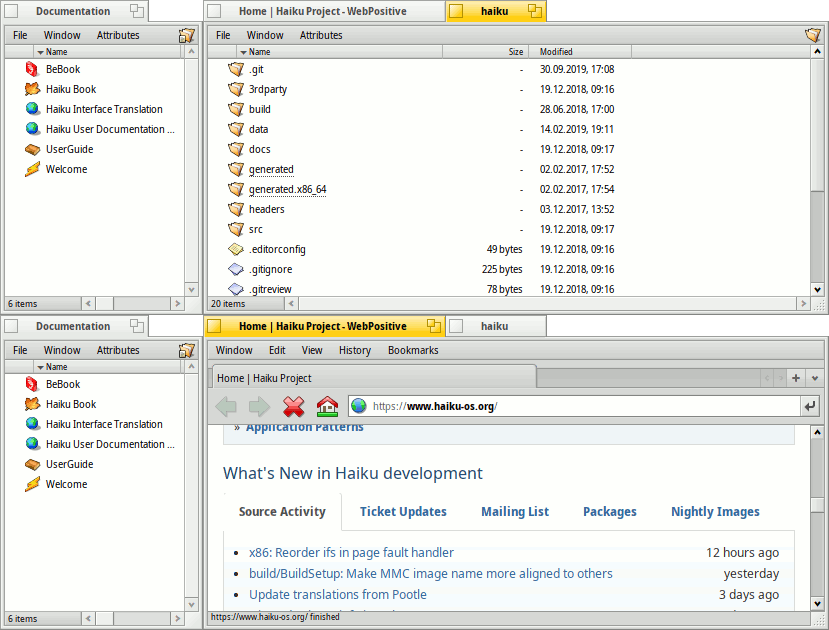
Haiku retained all of this and bring something new like combining various windows into single tabbed one - not sure if any other system has such feature. Or... toolbar in file manager - which is something I really missed back then in BeOS.
Back then BeOS was much more stable and faster than my daily Win98SE, even working in that image file on FAT32 partition.
Kinda makes you wonder, how things would go if Apple would pick BeOS as their OS instead of Jobs' NeXT. Would it still looks same or it would go thru all stages we've seen - with glass, transparency and then flatness and darkpatterns producing minimalism.
In retrospect though, the company wasn't making a technology decision. They were making a decision between Jobs and Gassee. Jobs came with NeXT and Gassee came with Be.
I don't think the technology mattered that much in the large scale of things. Jobs brought with him a strategy for moving personal computing from a technical market category to a fashion market category - either to make technology fashionable or to make fashion technical (however you want to look at it). It's a strategy that started with candy-coloured iMacs and ended with iPhones.
Gassee brought a really cool OS.
Apple made the right choice.
Yes and no. The core of the purchase decision was really based on the technology. Ellen Hancock (Apple's CTO at the time) actually did a decent analysis of BeOs and NeXTStep. She was actually against some aspects of the purchase, and was not in favor of Be. She was also not in favor of the NeXT kernel. It is painful to say as a Be employee at the time, but Be internals were fragile, some technologies were very shallow, the kernel was brittle and under constant churn and we had big problems with our decision to have a C++ API. Gil Amelio liked Steve and Steve did a good job selling both a vision and the NeXT technology. BeOs was a really cool demo that was getting pulled into the direction of a real OS but had a long, long way to go. There actually was a possibility that Apple could have also gotten the Be code, but the board didn't go for it. As it turned out, most of the primary BeOs developers ended up at Apple via Eazel. The ones that didn't ended up at Google via Danger Research/Android.
It was uphill all the way before that point, and downhill ever since.
Nexus is Vitruvian's custom Linux kernel subsystem that brings BeOS-style
node monitoring, device tracking, and messaging to Linux — making it
possible to run Haiku applications on a standard Linux kernel.I don't know exactly why, but child me thought that was so interesting, since every other OS at the time seemed unable to.
The real what-if for me is pondering what might have been had HP and other vendors not caved to the Wintel cartel in abandoning their plans to include BeOS as a preinstalled OEM option. Microsoft was sued by Be in civil court and Be won their case, but it was too little too late.
When Gassée left Apple, he took many of Apple's best with him. If we want to know what Apple would have looked like under Gassée, I think it's easier to look at how many products he killed. Much of Apple's leadership was trying to force budget computers like the PC industry was building. Gassée would have none of it. He was focused on exceptionally good hardware married to exceptionally good software, knew the handheld devices would be vital in the future, but he didn't like boring things. I imagine that Apple built around Be would have delivered many of the same things, but wouldn't have become just plain brushed aluminum everywhere.
The curious part would have been the OS. BeOS and NeXT are wildly different.
So I can well imagine Apple fucking this up and getting aquired.
Another cool one that was around was QNX.
And of course you can just spin it up in a VM if you only want to play a bit.
I think Haiku got more traction because at the time people felt that it should run BeOS software without recompiling. I have long wondered what would have happened if BlueEyedOS would have gotten most of the effort.
https://gitlab.com/haydentech/cosmoe-classic/
This has evolved into a new UI layer for Wayland, on top of Linux...
I wrote about it last year:
https://www.theregister.com/2025/06/25/cosmoe_new_cpp_toolki...
Only be able to drag a window around the screen from the top left corner
Additionally, meta+middle-mouse-drag allows one to resize a window from anywhere in the whole window!! (it chooses the closest corner when the drag starts) and this, being able to resize a window without needing to put the mouse in a usually-very-thin window border, is extremely liberating in my opinion! To the point where I really miss it on sub-windows where the app is handling resizing/etc itself!
There's a Windows app I used to use that supports the same kind of thing for Windows (different key I think), no idea if there's one for Mac I'm afraid - or whether it can be configured to work that way, but there probably is one so it would be worth investigating if this sounds useful to you I'd say!
Taekwindow:
https://ttencate.github.io/taekwindow/
I rarely use Windows but any box I do need to use for a while, I put Taekwindow on it. I only want the Linux feature of middle-clicking the titlebar to send to the back, myself, I don't want or need moving or resizing, but they're there.
There is also a library version where you can use the Haiku API to write Linux apps.
I do have to say... in all my years of software development, as far as system APIs go, BeOS/Haiku has by far been the most pleasant and easy-to-use API I have ever seen, so this is a very welcome addition for me.
As some contrast, consider something like GNUStep. You are never going to get macOS out of GNUStep, no matter how hard you try, because it is too high level (Cocoa) while simultaneously too ambitious. Similarly, with alternate kernels like ReactOS you will never get full replacement of Windows because it is too ambitious and intractable.
The intersection of this project though, it is a cunning insight in using the hardware support of Linux and shedding the graphics layer for something a lot simpler with a minimal kernel module to support the existing mechanics of BeOS. This is more in line with wine, which is and has been useful for a long time, but is even easier. This doesn't mean it will achieve massive user base, but it seems like it will mature fast enough into something dedicated fans can enjoy and use productively.
I don't think it makes sense for desktop applications, it may make sense if sound latency is a priority but even then stock kernel delivered lower latency in many cases.
> and adopts KISS principles. Anyone can rapidly feel at
>home and use V\OS. User experience, workflow and comfort
> is key.
What is more intuitive than a button to close a window without a X, in order to make people from every other OSes feel at home https://v-os.dev/img/photogrid.png
-- When words have no meaning
Cheers
Because sometimes I learn unexpected things and get another perspective even when I could search for it myself.
Does this help?
Perhaps I can place the monitor on my scanner and take a “screenshot” that way xD
Re: refresh rates I can’t find a good stat with a brief googling but it’s a Boox Mira, E Ink VB3300-NCD
You can tolerably watch video so somewhere north of 20fps but there’s ghosting. A friendly button on the front of the display is there to do a hard refresh if the artifacts build up too much. But yes I should do a comparison on how different desktop environments do, with animations turned off etc, scrolling that jumps line by line like vim or eMacs will work better than smooth scrolling for instance.
Talking about BeOS, this is the most fantastic piece of technological fiction I read about:
https://www.haiku-os.org/legacy-docs/benewsletter/Issue4-8.h...
https://www.desktoponfire.com/interview/846/an-interview-wit...
I'm not cool enough to run VitruvianOS either, but i'm glad it exists.
I wonder what they will do to support BeOS' MediaKit. It has packet streams with realtime delivery.
[0] https://v-os.dev/blog/2026/02/10/haiku-runtime-on-linux/
There exists at least one rootless X11 server for BeOS/Haiku that would run on top, that shouldn't be too difficult to port (knock on wood ...)
"VitruvianOS is an alternative Linux desktop with a singular philosophy: the human at the center."