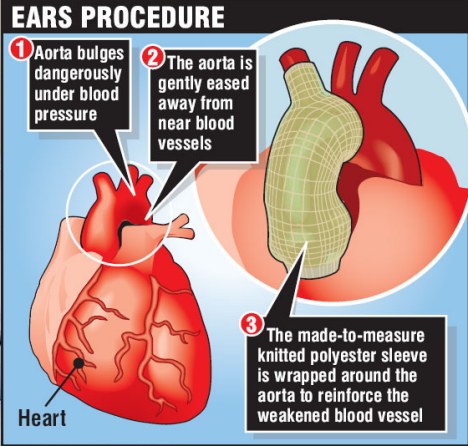
Generally the trend in vascular surgery these days is to less invasive procedures such as a stent graft.
So, hey, points to the BBC for writing an article about something that continues to be interesting instead of something that's "brand new".
I am not that familiar with Marfan's or this case, so I don't know if this device is useful in this case (http://www.medtronic.com/patients/heart-valve-disease/about-...), but there are stent-grafts that also replace the aortic value so that the stent-graft can be used close to the heart, and you can be sure that medical device companies are looking at ways of using stent-grafts in close proximity to the aortic valve without requiring its replacement.
I suspect a lot of kids who lost their basketball dreams in a heart-attack will be lining up for this procedure.
This sounds like a great thing.
The "garden-hose wrap" method described in this article was not mentioned to me, probably because it would have no use on the more important failure, the stretched valve.
However, I was given a clear choice of replacement valve: metal or tissue. Tal Golesworthy presumably would have had the same choice, but the article doesn't mention that there is a choice.
The metal (actually metal frame with a carbon-fiber flap) replacement valve lasts pretty much forever. On the minus side, it sometimes has a harmless, but audible "tick" noise, but its main drawback is that it can be a source of blood clots, hence the need for the lifelong course of blood thinner. Miss a few days and you could have a stroke from a clot.
I opted for the tissue valve, which is taken from a pig (or a cow, if you object to pork products). All its cells removed, leaving only the collagen form, so there's no host-graft immune reaction. It's silent, it doesn't encourage clot formation -- but it doesn't last forever. At some point in the next decade I'll need another one.
The new valve and about 7 inches of new Dacron aortic arch were sewed in. The surgeon commented afterward that my removed aorta "felt very soft" and was "poor quality tissue" and that I was "fortunate" that it hadn't failed.
This leads me to wonder: a common failure mode of the aorta is Aortic Dissection[2] in which the tube delaminates. Rather than bursting, the lining separates from the supporting wall, and high-pressure blood gets between the layers and spreads them, reducing the cross-section of the pipe. (It's reputed to be one of the most painful experiences possible.) My wonder is: while the "hose-wrap" fix described in this article might prevent ruptures, would it be an effective preventative for aortic dissection?
[0]http://en.wikipedia.org/wiki/Annuloaortic_ectasia [1]http://en.wikipedia.org/wiki/Marfan_syndrome [2]http://en.wikipedia.org/wiki/Aortic_dissection
This is me:
Even if it could measurably reduce the chances for known risk groups, would it really be prudent to perform open-heart surgery on a patient without a current condition?
Tangent: why have humans (animals in general I guess) evolved pain receptors inside their bodies?
[1] http://www.ucl.ac.uk/operational-research/the_team/TomTreasu...
However, IIRC, Tal's version is based on one that is custom-built to fit the patient, and of course uses more advanced materials.