http://4.bp.blogspot.com/-AQTRoWPB3n4/Tbn5O99q6lI/AAAAAAAARG...
Though it wasn't mentioned in the movie, Brad Bird described Edna as "half-German and half-Japanese". The walls of this room resemble Japanese rice-paper walls -- but the divisions are arranged as in a Piet Mondrian painting. Mondrian was Dutch, not German, but there's still a sense of Asian and European art styles mixed here. I never noticed that before.
Fuck this movie is so good.
True story: I once was on Maui, and stopped inside a curio shop. The owner of the shop, a little Japanese woman, came out from the back and smiled at me -- and I'll be God-damned if she didn't look exactly like Edna -- perfectly sculptured hair, glasses, and all. I found myself actively looking for a secret lab behind all the blown-glass trinkets. It was only after this incident that I found out Edna was conceptualized as part Japanese; and today I wonder if someone at Pixar didn't visit the same shop, meet the same woman, and incorporate her into Edna's design.
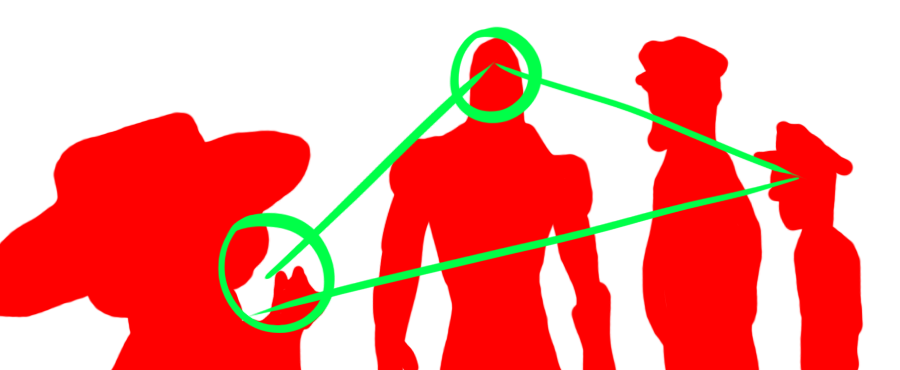
Mentioning triangular composition so often was strange. I guess it's a basic filmmaker thing? (don't line up talking characters in a line?) Moving the camera out-of-plane of the conversation allows the viewers to more easily understand the flow of conversation, who the characters are paying attention to, and who we should be paying attention to.
Okay yeah, if you draw those lines, you get a triangle. But why did the author exclude the one guy? Why is this an example of some triangle-y thing, and not an example of an quadrilateral whatever?
The author is just massaging and manipulating the data to make whatever points he wants.
Especially computer games and Pixar movies are often directly reusing famous scenes and camera angles.
[1] Disclaimer: I'm a big fan of "Three Colors", especially "Red".
And it's quite debatable whether Kieslowski belongs to this list, something you're clearly aware of... or you wouldn't have put a note in to justify yourself ;)
[1] https://en.wikipedia.org/wiki/The_Story_of_Film:_An_Odyssey
Relevant link: The use of light in cinema: http://imgur.com/a/cpLno
But if you're going to talk about who defined animated films (and even more so if it's a Japanese person), then Miyazaki's work pales in scope and influence compared to Osamu Tezuka - and HE in turn readily admitted being inspired and influenced by Disney and Fleischer cartoons.
The first chapters deal with the creation of the Snow White film, and the startup culture within the Disney studios at that time.
Co-incidentally, both authors are referenced in the film The Incredibles (the original subject of the OP's post)