Just because these artists and engineers are talking about a Mac does not make their functions exclusive to the platform. Also, going back 30 years you have to endure some turd-Macs along the way (some brilliant ones too). Many jokes were had at the expense of our Mac brothers in the late mid to late 90's (even early 00's) about their platform of choice as we ran circles around them in gaming, graphics and pretty much any other benchmark besides money spent.
It's not the case now (switch to Intel changed that) but I would love to see a similar piece in praise of the PC. And no I don't mean just Windows, I'm talking about the generic term. Computers are awesome, let's not fall in love with a corporate brand and think it's fundamentally something different when it's not.
But the simple fact is that Apple's original Macintosh was the definitive introduction of modern personal computing to the general public. It's not an arbitrary "30 years of personal computing"... it's commemorating a watershed moment.
The Apple ][ was more popular by far than the original Mac, and even so it wasn't the first definitive PC. I remember seeing a lot of Commodore PETs around when I was young... way more than Macintosh.
Well, I should clarify. The Amiga was -demo'ed- in 1983 but not released until 1985.
Mac brought to the mass many things we take for granted today -- graphical interface, mouse, all-in-one form factor, SSD, etc.
Once popular brands -- IBM, Compag, Gateway, DEC, Sun -- are gone. Mac is still here and going strong. Not remarkable at all?
The turnaround started with Mac OS X, in 2001. That's what really started turning heads. The intel macs five years later helped, but it really was the wow factor of having a great Mac- or Mac-like (considering Aqua was the most radical departure Apple had made from the System 6/7/8/9 UI lineage up until that point) interface on top of real Unix, with all of its tools. It put to bed all sorts of concerns with architecture, open source/free software, macho "real programmers" insecurities, etc.
For fun read this, 2 yeas before the switch to Intel: http://www.apple.com/pr/library/2003/06/23Apple-and-IBM-Intr...
Or the Acorn Archimedes of the time, which was turning in floating point benchmarks 10x faster.
(I am happy to be downvoted for the joke, so just keep going :) )
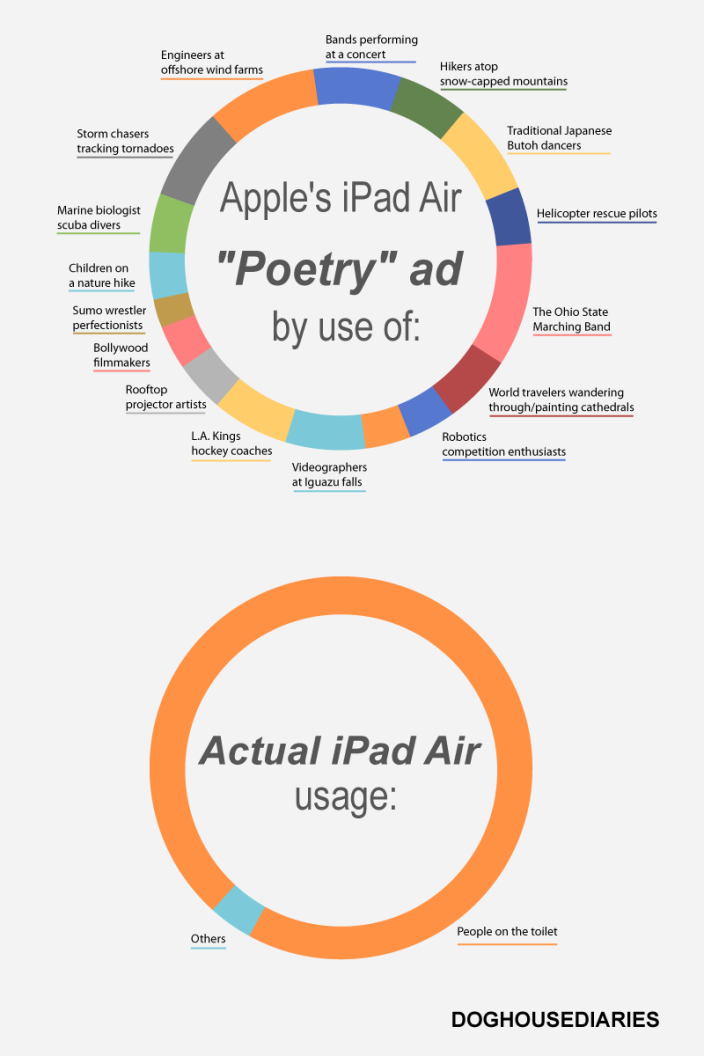
We can live without wind turbines and scuba diving, but shitting and having something to read on the crapper is essential.
It is also really, really hard for those of you too young to have been there for the Mac's introduction/launch to understand just how amazing this piece of tech was in comparison with the popular alternatives at the time.
It was so unbelievably alien and so intimately familiar at the same time. I am a long time gadget/tech lover and there has been no single event that I remember with such vivid clarity.
Also, there is no single piece of tech that I have ever wanted to own so badly. I actually switched careers (design/illustration > programming) so that I could afford to buy one!
I think it's okay to have a moment like this for the faithful. Yes, it's a bit indulgent, but it will be over in a day or two.
"Folklore.org: Anecdotes about the development of Apple's original Macintosh, and the people who made it"
I don't own a single Apple device, but I still find the stories fascinating. It makes me wish I could've worked with those engineers.
Today there are new people somewhere trying to do something that seems difficult, maybe impossible, and certainly rather pointless to the outsiders looking at it from the comfort of the establishment's balcony.
I'm pretty sure it's easier to look for those people today than it was in 1980, when you still needed to be physically in the right place.
Now I'm more than willing to accept that I'm not the exact target for this video, and that the subject matter of the following video makes it a slightly unfair comparison, but the contrast to the quality of the Steve Jobs tribute video is vast: https://www.youtube.com/watch?v=0y2WpieYRks
The latter video literally takes my breath away.
And, more the fault of my mind than the copy, but "a tool for exploring new fields [that I otherwise couldn't]" - the same could be said of a machete. :)
Expensive compared to what? Because to do the things you can do with a $1000 PC, you needed $100,000 or more before depending on the field.
Your personal typesetting engine? 128-channel audio recording? With effects? Video editing? Bitmap editing? CAD?
Those are all things that existed only for high end workstations or specialized devices before the personal PC, and the Mac played a huge role in the development of this (it will take years for Windows to catch up.
Democratisation doesn't mean it also magically broke poverty barries.
I actually prefer the timeline view (of the same people):
http://jamesfriend.com.au/pce-js/
In some ways it's quite remarkable how little has changed.
http://en.wikipedia.org/wiki/Usage_share_of_operating_system...
(The illusion that all designers are on Mac is probably because HNers don't often meet the ordinary designers who have a boring corporate job or are struggling freelancers somewhere far away from San Francisco.)
I love Windows, but the recording industry lives on Macs.
- 1984, original Macintosh
- 1985, Jon Appleton, pioneer in electro-acoustical music and key figure in the development of the digital synthesizer
- 1986, April Greiman, seminal figure in the New Wave graphic design movement
- 1987, Theodore Gray, co-founder of Wolfram Research
- 1988, Ahn Sang-soo, pioneer in Korean typography
- 1989, John Knoll, co-inventor of Photoshop
- 1990, Craig Hickman, creator of Kid Pix
- 1991, John Maeda, artist and pioneer of motion graphics
- 1992, David Carson, graphic designer and art director of Ray Gun magazine
- 1993, Robyn and Rand Miller, creators of Myst
- 1994, Hans Zimmer, composer
- 1995, Dave McKean, comic book artist and filmmaker
- 1996, Tinker Hatfield, Nike shoe designer
- 1997, Louis Rossetto and Jane Metcalfe, creators of Wired magazine
- 1998, Alex Townsend, creator of the Computer Bus that helped bring computer access to Manx schools
- 1999, Moby, electronica artist
- 2000, Nick Knight, prolific fashion photographer
- 2001, Takagi Masakatsu, musician and filmmaker
- 2002, John Stanmeyer, photographer for TIME and National Geographic magazines
- 2003, Philip Jackson, founder of Sportstec that makes sports analysis software
- 2004, Noemi Trainor, principal of Mexico's Varmond School which is spearheading a digital-first educational program
- 2005, Jürgen Mayer H., architect
- 2006, Jad Abumrad and Robert Krulwich, co-creators of the Radiolab podcast
- 2007, Nicholas Felton, prolific graphic designer known for his "Feltron Annual Reports[1]" and supposed progenitor of Facebook's timeline
- 2008, Es Devlin, prolific costume designer
- 2009, Dr. Pardis Sabeti, pioneer in genetics research and bioinformatics
- 2010, Dr. Maki Sugimoto, surgeon who uses 3D printing to model patients organs to help prepare for surgery
- 2011, Zach Sims and Ryan Bubinski, co-founders of Codecademy
- 2012, Daito Manabe, artist who specializes in electronic and holographic installations
- 2013, Éric Fournier, Sakchin Bessette, and Dominic Audet, co-founders of Moment Factory
- 2014, the new Mac Pro
[1]: http://feltron.com
Not that it's significantly better, but there are 5 women, not 3: April Greiman, Jane Metcalfe, Noemi Trainor, Es Devlin, and Dr. Pardis Sabeti. However, they did choose Rosetto instead of Metcalfe for 1997's main photo, so there's a case to be made for 4 (though Metcalfe is in the photos when you scroll down).
http://www.theverge.com/2014/1/21/5307992/inside-the-mind-of...
I've heard of Commodore users having that affinity for C64s and Amiga owners and a few other manufacturers... I've never heard a person say they fell so in love with their Compaq Q2150... There's something special about the Macintosh. I think it's that it's so clear that the manufacturers really cared about the user experience that they inspired the same in the software developers for the platform.
I love writing in C and compiling on OS X, Linux and FreeBSD with the same Makefile!
CLOSEUP OF FINGERS TYPING
VOID_0 I love Macs because they have the unix core, so you can compile anything written for linux servers natively without using a virtual machine.
CLOSEUP OF CODE BEING TYPED
CLOSEUP OF TERMINAL COMPILING CODE
VOID_0 So yeah, that's pretty neat I guess. I mean it's not that flashy or anything, I'm really just using it as a fancy text editor. The build quality of these things is pretty good. All my friends are doing the same thing on cheaper linux computers, but I don't like those as much.
The Mac's 25th anniversary went by rather unremarkably under Steve's management, if I remember correctly. He famously gave the Apple's museum to Stanford as soon as he returned.
A company as old (for this industry) and successful as Apple must always look relentlessly to the future in order not to fall too much in love with its own accomplishments to prevent it from reinventing itself.
Either you are inside their walled garden, or out (the better place for me).
Where's my captive frontend dev to explain this to me when I need him?
This roughly corresponds to the decline and near extinction of the Mac. Having programmers leave your platform is a very, very bad thing.
Still, I liked the colorful Macs a lot. They cheered up daily work. A pity, that we are back to gray boxes.
I saw numerous blog posts of parroting this advertisement, even in my morning daily commute news paper.
Windows: People just don't have the same affection for Windows: it tends to be something that's used, grudgingly, often for work, rather than something that people are genuinely pleased by. I'm sure people will disagree, of course, that's just a big generalisation. Also, since Windows is available on a whole range of hardware, it suffers (in this specific regard) from the same fragmentation as Linux: there's isn't so much one single thing to get attached to.
The thing is, Linux doesn't have the PR machine that Apple does, nor the number of fans among journalists, nor the recognition by the public.
They are the poster boy for a corporation despite having screwed up incredibly so many times over the years, nearly fallen off a cliff and treating their customers like crap ("you're holding it wrong" for example) and still only maintaining a minority market share on the desktop and handset market. Also they have several system architectures and complete API rewrites over the years that mean their client-base rewriting the entire universe every time they move the goalposts.
For comparison:
MSDOS is 32 years old. Stuff still runs from day one.
Windows is actually 28 years old. Stuff still compiles from day one (windows' original API isn't much different to today's windows). Stuff still runs from circa 1995 on current machines.
Unix is 45 years old. Stuff still compiles and runs from circa 1974.
I agree there are many benefits to backwards compatibility, and in some cases it is warranted (though these days you can use virtual machines to achieve much the same goals). Apple made a different choice, and their platform is all the better for it. I like that they deprecate things and don't keep us held back by ancient technology.
There have only been two instances of that: 68k to PPC and then Mac Toolbox to Cocoa. Carbon held the gap for a number of years by porting Mac Toolbox APIs to use modern things like protected memory. Both of those events were necessary and welcomed changes.
PPC to Intel was not a major rewrite for anyone except people who already knew what they were doing.
What's the problem here? Providing new APIs that reflect the advancements in software technology made in the last 45 years is a _good thing_.
Besides HN links, where one might indicate "autoplay" there are also popup pages that play music and tons of other sources of unwanted audio.
I have seen it on some posts before.
It's Jan 2014, still my power horse and going rock solid, i'm quite happy.
I found this also annoying reading iWoz, it was as though there were no other computers out there at the time, but the Tandy Trash80, the Pet and Sinclair's computers were all doing very nicely when Woz was "inventing" the computer.
What could be probable reasons for the same?
I'm referring to the 'What they did with it" section in Your First Mac page (https://www.apple.com/30-years/your-first-mac/).
>What could be probable reasons for the same?
The circles for each year are generated off of the results from the three-question survey Apple is conducting on that page (click the "Tell us about your first Mac" button below the lede). The questions are:
1. Which Mac was yours? (which determines the year)
2. Where were you? (which ostensibly determines which localized site your responses will count towards)
3. How did you use your Mac?
So the size of the gaming circle in a particular year is determined merely by the number of people who filled out that survey, self-reported that they bought their first Mac in that year, and said they used that first Mac for gaming.
But sheesh, this ad is schmaltzy even for me!
The actual photos and stories following the video are MUCH better and I enjoyed taking a trip down memory lane. :-)
It still sort of works but the plastic is all broken off. I should probably throw it away, it was beautiful though.
btw, this post is risky for my karma, but I am always suprised to see very old mac still frequently used.
The glass covering is way easier to clean than my old plastic Mac laptops, and most of their plastic cases are cracking.
0:18 -- Air Review - H
1:10 -- Moderat - Bad Kingdom
1:56 -- Air Review - Young
If you scroll past the video to the timeline, then click on any of the sections, it'll expand and say who the person is and what they did.
apple didn't invent a lot of the technologies they're famous for - the mouse, the windowed GUI, postscript, desktop publishing, etc. they did, however, make it accessible. they took it from the research labs - PARC especially - and let us mere mortals use it.
i recall in the late 80s going in to my dad's engineering offices in middle school to type up papers and have them laser printed. that was revolutionary, a truly transformative moment in computing. it took MS quite some time to come to parity.