On the flip side, you could go about doing what you're doing under the presumption nobody is maliciously targeting your user base. In this scenario, it's possible you have a couple bad actors that see a net benefit greater than your bug bounties and are silently stealing and selling supposedly secure code from your users. You could be supporting a hacker black market where they sell and trade codebases to popular online sites. Imagine how easy it would be for them to find vulnerabilities in these sites if given access to the source code.
That, my friends, would be a catastrophe.
That's the beauty of bounties, it allows people to decide whether they want to do the right thing or not, if there was no bug bounty more people are just tempted to exploit the bug.
Could someone explain in simple english, how did they overlook known & well documented bugs that got them hacked (e.g. Bug 3 about cross domain injection). I'm wondering if someone of Github's caliber can be hacked so easily, what about the rest of the masses developing web apps. Especially all those new crypto-currency exchanges popping up left & right.
I've been toying with Django. Reading through the docs makes me feel that as long as I follow the safety guidelines, my app should be safe. It feels as if they've got you covered. But this post rattles my confidence.
Cheers !
https://github.com/github/rails
http://www.kalzumeus.com/2013/06/17/if-your-business-uses-ra...
> I . . . decoded _gist_session cookie (which is regular Rails Base64 encoded cookie)
In Rails 4 the session cookie is encrypted with a server-side secret, so the end user can't decipher it.
They're all pretty bad. SQL injection was a boondoggle for years until people wised up, or more likely moved to the then-newly-popular ORMs, but it still got Bell Canada recently. Target is #36 on the Fortune 500. That wasn't a webapp based attack, but even companies of their considerable resources still get security that wrong. Sure, you can tell yourself a startup is more tech focused and better positioned to get security right. But do devops building for server stacks and platforms they don't fully understand while pushing code multiple times a day really have both the skills and time to focus on security?
What do you think makes Github that much better than all the rest?
It's assured that a ton of Rails apps are vulnerable, it's just that no one has found them, or more likely, is not publicly releasing or actively exploiting them.
Also, Rails doesn't address for all security pitfalls. Some of its mechanisms are actually underdeveloped and require rolling lots of checks by yourself, such as for proper session termination, IIRC.
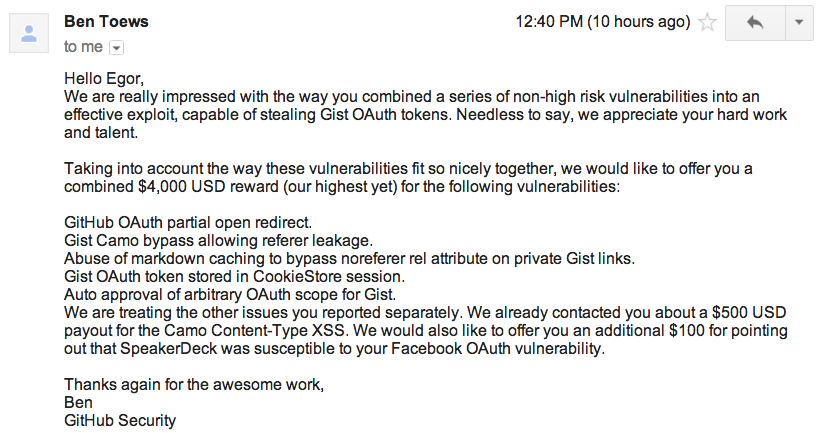
$4000 !? Wow, I'd love to be able to make $4000 on the side just doing what I love.
> Interestingly, it would be even cheaper for them to buy like 4-5 hours of my consulting services at $400/hr = $1600.
This sounds like a pretty clever strategy for marketing yourself as an effective security consultant.
EDIT: $4000!? wow. so money. such big.
Can anyone recommend some reading material or some first steps I can take to work towards moving to a more security-focus career?
Thanks.
http://www.matasano.com/matasano-square-microcontroller-ctf/
Is there an easy way to see what vulnerabilities other websites have had and fixed, and to check if your site has them as well?
Maybe it's just me, but asking for donations after saying you bill clients at $400/hr seems weird to me. I wish I could bill at that rate.
There were always people complaining "Add a donate address"
Now "why you added a donate address". Oh, Internet.
And that's before legal costs and possible restitution.
</jokeruiner>
(At least that's how I imagine it must work. I've never consulted.)
> Oh my, another OAuth anti-pattern! Clients should never reveal actual access_token to the user agent.
From what I understood by reading the OAuth RFC is that front-end intensive applications (a.k.a. public client) should have short lifespan access tokens (~ 2 hours) and the back-end takes care of reissuing a new access token when expired.
Can someone clarify on how to make a those calls from a front-end application without revealing the access token?
http://2.bp.blogspot.com/-xqPTMgxhYmY/UvUCrsc9C8I/AAAAAAAADk...
If it's something you're interested in, go for it. I just worry that people see this like the promise of gold in a faraway land and go rushing in, not thinking about the real distribution of success.
I see that your a sysadmin so if network hacking is more you speed I would download Metasploit[2] and start hacking old linux or windows distros.
[0]http://www.amazon.com/The-Web-Application-Hackers-Handbook/d... [1]http://itsecgames.blogspot.com/2013/07/bee-box-hack-and-defa... [2] http://www.metasploit.com/
Friends don't let friends code in Fails frameworks.
But github, seriously? Why do you guys fail so hard at security?
Too much Brogrammer rather than programmer methinks.