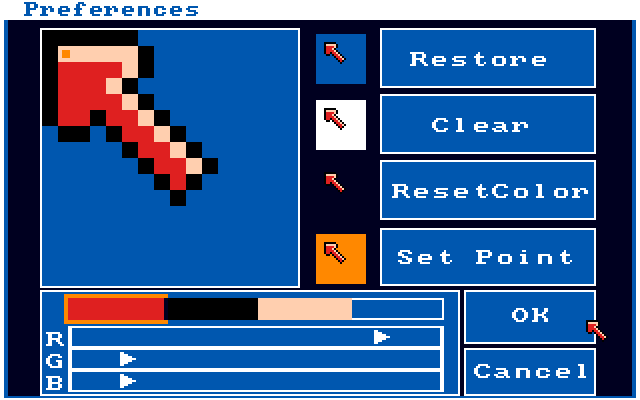
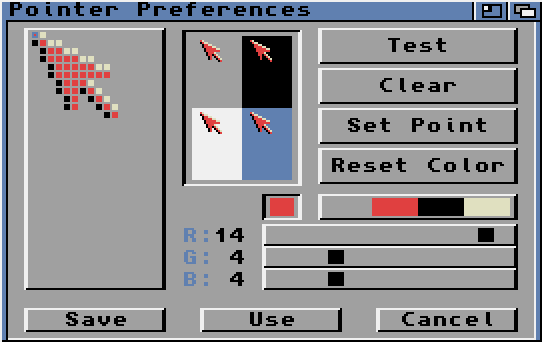
I think that utility was a 16x16 grid, and indeed the easiest to see arrows utilsed the vertical, although actually a cursor which uses the horizontal and diagonal isn't bad either.
[1] http://toastytech.com/guis/amiga1cplpointer.png [2] http://geekometry.com/wp-content/uploads/2013/11/amigaos204-...
EDIT: It's possible i was inspired by the (lack of) landscape in Airborne, which i also played a lot:
The loading animation was the banana peeling. It blew my 10 year old mind.
I still feel it combines the precision of a crosshatch with the visibility of an ordinary mouse arrow. Perhaps I should recreate it for the Mac...
Strictly speaking (after observing myself pointing) it's "outside your elbow", right? Which coincides roughly with "width of your shoulders" when your elbow is at your side or your elbow is straight, but can differ by up to the length of your upper arm...
This was the case as far back as the original Mac; I'm not sure which cursors were used on systems before that.
It's instructive to observe the circumstances when the cursor changes: there is some indication of context change, but also the design of the cursor in each context is important.
Your pointing/clicking finger will appear to be pointing in an upper-left direction, somewhere between 0' and 45' – exactly like the classic arrow-cursor.
Even if a designer with contemporaneous experience explicitly denied that was n influence in choosing the orientation, I wouldn't believe them. The congruence is too strong.
One good prank was to set someone's click point to outside the cursor.
[1] at my father's office, govt agency, something like an early x window system... can't recall
ps: actually, both physical interface mesmerized me, keyboards were curious creatures for me, here's a similar model of what was used http://goo.gl/gyD7R6 ( I love the non flat keys and the 0, 00, 000 series )
The second-highest-rated answer on Stack Exchange (46 votes and climbing) claims that another reason for the left arrow cursor in early GUIs was to put the hotspot at (0,0) to save time in the mouse position calculations:
http://ux.stackexchange.com/a/52349/43259
The answer cites this Reddit comment as its source:
http://www.reddit.com/r/explainlikeimfive/comments/1qhzym/wh...
That comment is a direct copy of this Yahoo! Answers comment from 2009, which says that the Xerox Alto worked this way, but cites no source for the claim:
http://answers.yahoo.com/question/index?qid=20090520113724AA...
In fact, the Alto did have multiple cursor shapes, and the hotspot wasn't always at (0,0). For example there was this cross in a circle:
http://www.guidebookgallery.org/articles/thexeroxaltocompute...
and a right-pointing arrow:
http://toastytech.com/guis/saltobravo.png
Let's ballpark the CPU overhead. According to this article, the Alto executed about 400,000 instructions per second, with an instruction set modeled after the Data General Nova 1220:
http://www.guidebookgallery.org/articles/thexeroxaltocompute...
Here's a brief description of the Nova instruction set:
http://users.rcn.com/crfriend/museum/doco/DG/Nova/base-instr...
There are four accumulators, with an ADD instruction that adds one accumulator to another (and a similar SUB). There are LDA and STA instructions that load and store memory, addressed with a displacement and an optional accumulator (e.g. to access into a structure using a pointer).
It seems reasonable to assume that at some point in the mouse refresh code, we will have the mouse's X value in one accumulator, and a pointer to the cursor structure (containing the cursor bitmap, hotspot, etc.) in another.
So to adjust our X value using the hotspot X from our cursor structure, we simply need an LDA to load the hotspot X into another accumulator, and an ADD or SUB to do the calculation. Repeat that for Y, and we've added a total of four instructions.
At 400,000 instructions per second, these calculations would add a 1/100,000 second overhead to the mouse calculation.
A worst case might be that we don't have a free accumulator when we need it. So that would be another STA and LDA to spill one temporarily.
If we have to do that for both X and Y, it would put us at eight instructions total, or 1/50,000 second.
Still probably worth doing it to get the flexibility of custom cursor hotspots. :-)
This hit the BS detector for me too, mainly because it goes against some of the rules of thumb I have found useful for optimization. For example, the need for smooth and stutter-free ui notwithstanding, if something only happens in response to user input you are less likely to see important gains from this sort of CPU microoptimization. Even on a very old machine, it should be obvious that the computer adds integers much faster than you can move your finger (otherwise there would be no point of having the computer, am I right?) On the other hand, if you had to compute more on every frame or for a substantial amount of onscreen objects, that's where the real gains are going to live, because the numbers add up much more easily.
The fact that some engineer tinkered with the computer representation of the pointer for code efficiency reasons, does not change the fact of hundreds of years of history in which teachers pointed at an angle from the right. I'm sure that if you hunt up old movies (black and white ones) where there is a school/university lesson being portrayed, you will see a pointer in use in this pose.
2. Forget pre-computers... If you draw an imaginary line from my mouse/hand to the cursor, it is approximately parallel/overlapping with the line of the arrow pointing.
Some systems make this easy (click the 'flip cursor' box, done!). Others make you spend an hour trying to figure out where to get custom cursors and how to install them. >:(
Actually, quite easy to put anything you wanted as a mouse pointer on the Amiga.
PS: "SRI licensed the computer mouse technology to Apple, Xerox, and other companies. The mouse became commercially viable in 1984, three years before the patent's expiration." - http://www.sri.com/work/timeline-innovation/timeline.php?tim...
I'm not sure if that's how cursors work.. just a thought.
edit: grammar is hard
The tilt had a symbolic hidden meaning... It is pointing to the North-West to MS headquarters in Redmond.
For the main cursor, use a combination of Cursorcerer and HotMouse.
Wow. Of all the good that OSX inherited from UNIX, why did it have to wreck any notion of a reasonable directory structure?
Without meaning to be argumentative, what would be ideal? In the absence of an actual better solution, one can explain the success of an obviously sub-optimal but existing solution by "worse is better" (https://en.wikipedia.org/wiki/Worse_is_better).
Really often times it just comes to do one guy/gal trying something new flying by the seat of his/her pants. And a few people like it so they keep it, and it propagates.
Agreed here.