For people wanting to look at the code it's at https://github.com/Fordi/eyegame
Also, what's the license?
I was going to do it myself but ~24 hours later here we are :P
thank you internets!
Bah! That's not a knife. This is a knife: twitch FPS gaming. Quake Live at 250 FPS, refreshed at 144hz, with < 5ms RTT latency. Reaction times can be compared in almost individual milliseconds. I'll put the reaction times of the best Quake Live player (rapha/cypher/evil, whoever) against the best baseball player any day.
Interestingly, my vision is extremely good. I've often surprised people with how far I can see clearly. So screw this app: learn how to play a twitch FPS well: http://www.quakelive.com/
Keep in mind that the ball is coming straight on, and the batter must discern trajectory (rising, falling) and spin (which affects how the ball curves) and velocity quickly enough that you still have time to move the bat.
For example, a fastball and a changeup both drop at the same rate and spin at the same rate. One is coming at 100mph, the other at 75. Since the ball is heading straight for you, you must perceive speed by measuring how quickly the ball is moving through your eye focus.
Worse, you are expected to bat in an intentional direction. Meaning that you have to hit the ball on an precise spot in the sphere with an intentional amount of force. It's not enough to just swing hard. I'd guess the bat has to be in the right location with a time accuracy of less than a millisecond.
The good batters make good money for a reason.
http://sportsillustrated.cnn.com/more/news/20130724/the-spor...
Large salaries are not necessarily enough. If you select the top 100 people in the world for natural talent in reaction times, how many would meet all of the requirements for being a good baseball player?
Baseball players make good money only if they can combine a top 0.01% reaction time with all of the other skills. There may be plenty of people that can top that one aspect but could never compete for those contracts.
Hitting a headshot of another player that can go in any direction / velocity while you yourself are traveling in any direction velocity all _before_ that player kills you can be very challenging and depend on very high skill and reaction times
The amount of money a player makes compared to someone in another sport has no bearing.
http://www.baseballnation.com/2012/6/29/3104332/is-there-an-...
http://www.reddit.com/r/science/comments/1y9m6w/a_neuroscien...
When might we be so lucky as to see an Android or Linux version? or better yet, a platform agnostic web based app?
I think the app must use web-based resources, and their site was slammed yesterday. I could do nothing but give it my name, and then it would go to a black screen and sit there -- no feedback, no activity, for minutes. I was left thinking I had wasted my money.
Today the app loads and runs successfully. The interface is bad. Really bad. Text-overlapping-other-text-and-graphics bad.
The controls are iffy. You're supposed to tap various images but sometimes the taps are off by an inch or more.
Nevertheless, it seemed to do pretty much what it is supposed to. It concluded my first session, congratulated me, and died. I checked and it saved my progress, so there's that.
I'm not totally put out since I got to do the exercises, and it seems plausible that it might help my mediocre vision. I hope the usability, design, and load issues are fixed soon.
Their purchase page has mysterious Apple and Windows icons, with a message saying "Is Now Available on the iPad".
But is there a Windows version, which the Windows icon would suggest? Or is it Windows Phone? OSX version? Web version? It says "Available on the App Store", but on my iPhone I can't find it.
And if it's only available for iPad, it doesn't even make sense that the site has a purchase page.
- video interview with researchers Seitz, Deveau and Ozer: https://www.youtube.com/watch?v=EKbbF66cyqI
- short published article on the baseball study: https://www.cell.com/current-biology/fulltext/S0960-9822(14)...
- lots more technical info about the app and the study (supplemental data to above article): http://download.cell.com/current-biology/mmcs/journals/0960-...
http://www.reddit.com/r/science/comments/1y9m6w/a_neuroscien...
http://bigthink.com/neurobonkers/the-app-that-trains-you-to-...
A researcher charging money for an app based on an effect which he has not finished studying -- no blind study yet -- is a really... odd... thing to do in my opinion. Were it me, I wouldn't charge before the blind study is done.
http://openi.nlm.nih.gov/imgs/512/312/2680596/2680596_pone.0...
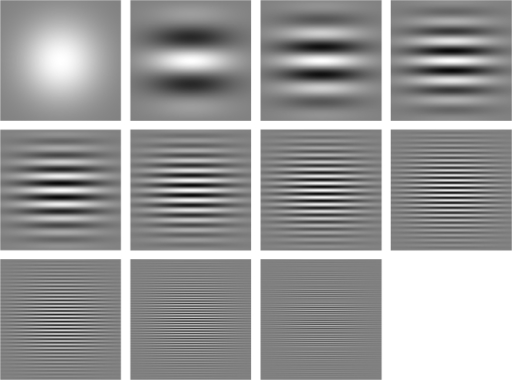
It looks similar to this:
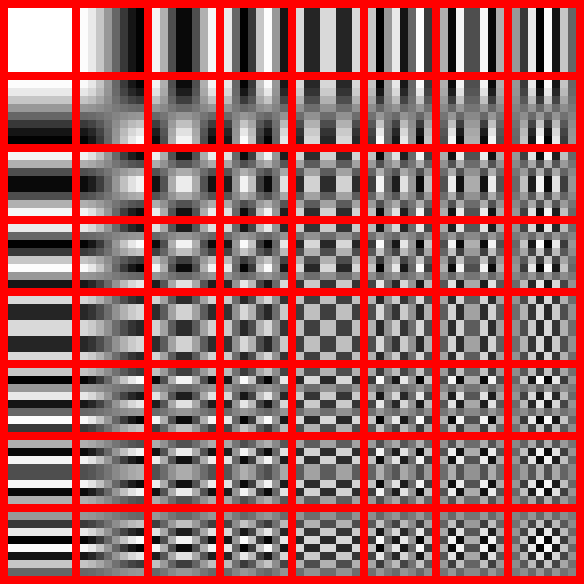
https://upload.wikimedia.org/wikipedia/commons/2/23/Dctjpeg....
You'll see these all over the place if you read studies about vision. The (highly oversimplified) reason is that if you imagine the edge-detection processes of a mammalian brain as a set of filters, the impulse response of one of those filters would be a Gabor patch.
This is related to why the DCT is so effective for vision applications, although perhaps less significantly than you might imagine just by looking at the patterns.
Somethings we get in front of a computer too much and your eyes begin to loose the ability to see things farther. It's all about training the muscles.
At 4m10s she shows the one I'm practicing the most now, training to focus. I like to do it one eye at a time, and then both. I don't aways use the thumb, I like to go to a park and do it between trees, when I'm on a bus I do it between the window's borders (because it's not transparent) and things out side.
Blink is very important to, try to remember to blink, so it's always lubricated enough. I tend to blink less when I'm on a computer, it's something I'm trying to work on.
I'll give it a few more months to see how it reflects on the eye doctor exam.