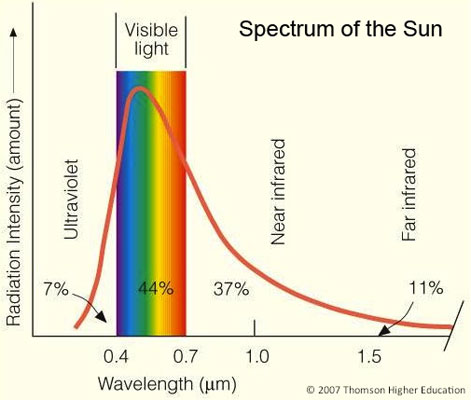
Another interesting idea would be to create solar panels that only convert the lost spectrum into {electricty -> required spectrum} [3]
[1] http://bernardkatz.com/wp-content/uploads/2012/07/spectrum-o... [2] http://www2.estrellamountain.edu/faculty/farabee/biobk/pigme... [3] http://mitei.mit.edu/news/transparent-solar-cells
<<
Solar is ~20% efficient LED's are less than ~40% efficient so you would need more land area for solar farms than you save by growing indoors. On top of that you need to pay for all your capital costs. There are other issues, but if this was close to cost effective you would be seeing this in Iceland which gets little sunlight in the winter and has cheap energy costs. Instead they use suplimental lighting inside green houses to boost production.
>>
I thought the vertical stacking makes more efficient use of the light than the single layer you find in a farm or green house. It means that even though the light is produced inefficiently the vertical stacking is intended to cancel out that inefficiency by using the light more efficiently. Moreover, the optimization of the plant's exposure to light through automated means adds to increased efficiency in the plant's use of the light.
If every grower did this, it would (or could) destroy Monsanto's business model. I love it.
Now that might be recoverable via reductions in waste and lower water consumption (see article) but it isn't automatically a net win, it might be a net loss overall. Need data.
Also: 'He is also able to cut discarded produce from 50 percent to just 10 percent of the harvest, compared to a conventional farm. As a result, the farms productivity per square foot is up 100-fold, he says.
By controlling temperature, humidity and irrigation, the farm can also cut its water usage to just 1 percent of the amount needed by outdoor fields.'
These are serious productivity gains, but, as you say, they have to be balanced against electricity use.
From a personal point of view, I strongly support this type of growth for a couple of reasons: more food for less cost, cities gain food independence, natural land use and abuse gets curtailed dramatically. Now if we could only switch more people (me included) to a vegetarian diet.
Now that cannabis growing is legal here in Washington, though, it will be interesting to see whether outdoor growing can compete. The advantage of being able to precisely control your plant's growth cycle is pretty significant even compared to getting your power for free from the sun.
[1] http://www.bloomberg.com/news/2013-03-10/fukushima-seeks-rev...
In the US I don't see this helping with common food stock (wheat/corn/cotton/soybean/tobacco/...). I could see this used for presentation foods (foods we judge more from looks) since you can control everything so much more you will likely get more products that can demand a premium price.
Another good point is reduction or elimination of e coli & other pathogens caused by livestock runoff & workers shitting in the fields.
That's a real agricultural industrialization.