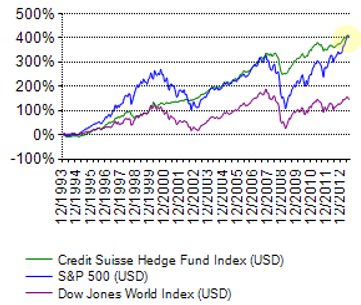
Hedge Funds on average do not outperform market indices such as S&P 500. I'm curious as to whether this was TechCrunch's take on the problem, or the startup's?
Buffet (S&P500) is leading against hedge funds on the aforementioned long bet: http://fortune.com/2014/02/05/buffett-widens-lead-in-1-milli...
Disclaimer: I am on Buffet's side on this long bet. Management fees are the devil. I am all-in for low-fee index funds.
Venture capital is different because it is both correlated with market returns and the average fund significantly underperforms the market,[1] so getting good returns in venture capital is pretty much a question of getting allocations in the top 20 funds, which are persistently the best. They have the best returns in part because they have the best reputations and thus access to the deals that provide the highest returns (top entrepreneurs would take Andreesen Horowitz's money over money from Unknown Partners on the same terms).
1: http://www.kauffman.org/~/media/kauffman_org/research%20repo...
http://fortune.com/2014/02/05/buffett-widens-lead-in-1-milli...
How do you suppose one tell which hedge fund will do better and which won't beforehand? Past performance? We know that's not a good indicator. If you can tell which hedge funds will do better in the future, you probably can tell which stocks will do better, and then why not just got it yourself without giving someone else 2 and 20?
We agree that S&P500 and hedge funds have different risk factors.
The point is that S&P500 is a lot less riskier and with better returns than an average hedge fund.
From what I recall, one of the big problems that any reactor project has is that the reaction has a tendency to destroy the reaction chamber. Not just the heat, but the neutron radiation can completely screw up the reaction chamber walls, which then need replacing. It's one of the reasons the ITER project is so large, to make it relatively robust in the face of such destructive power. I also remember reading a while back that the force from the electromagnets in the ITER project is sufficient to launch the entire reaction chamber off the ground, something like 5000 tons...
Having said that, I think it's cool that they're attempting it and I think that fusion projects have been grossly underfunded in the past. The reason why it's always 30 years away is because they're always cutting the funding!
I'd love to be proven wrong on this, but I imagine they'll have unexpected escalating costs surrounding the actual building of a working durable reactor and the company will die before it gets off the ground.
Just of late I came across this graph which says something similar: http://i.imgur.com/JyUZDe2.jpg
One of our major advantages is that we're a bit more ambitious about deploys and we try not to limit you to a certain format: you can deploy any type of application on Flynn, not just web apps, but regular applications and services like databases, mail servers and so on. We then let you connect all of these together via service discovery. Meaning that instead of limiting you to a plugin system, Flynn allows you to write your own "plugins" that behave just like regular apps.
I have observed that hospitals invariably manage to saddle me with ridiculous "processing fees" and suchlike and add around $100 or more to my expected charges every time I visit them. I usually just pay up to avoid the nuisance of dealing with administrators who cannot seem to be able to communicate over email, and possible damage to my credit if I try to challenge it. I strongly suspect this is the case for a lot of middle-class Americans.
I'd gladly pay the same amount to Fixed to act as an intermediary between me and said 70s-era administrators, if only to let them know that someone is looking carefully at their exorbitant charges, and possibly even contesting them.
What am I missing? Thoughts?
Also, it certainly doesn't mean they'll put Kash out of business if they do (and if the Kash team succeeds). For example, I don't expect Amazon Local Register to put Square out of business.
However, I clearly see the many benefits for the retailer. They are saving money on transaction fees, avoid charge backs (maybe?), get paid more quickly, and is free for businesses charging under $100k.
I think in the back of my mind when I posted my previous comment was the classic chicken-and-the egg problem. Lots of benefits for retailers, but only if customers use it. Possible benefits for customers, but only if retailers accept it. I think that many of the other larger existing players in this space already have most of the infrastructure in place (eg, Square) and have brand recognition to boot. So, I see a very large uphill battle for Kash in this space with their business model. However, as you point out, it isn't necessarily a zero sum game and Kash could exist along side competitors. It will be interesting to see if they can differentiate themselves in some way and/or execute better in some way.
To be clear, Sliced is open only to accredited investors and has a minimum investment of $20,000.