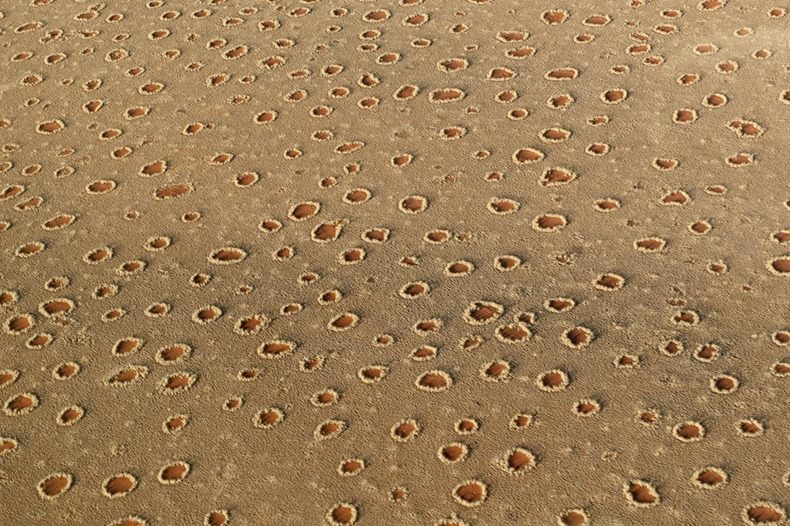
You can see the fairy circles in this Wikipedia page: http://en.wikipedia.org/wiki/Fairy_circle_(Africa)
Or this Google Images link: https://www.google.com.au/search?q=namibia+fairy+circle&safe...
1. http://ichef.bbci.co.uk/wwfeatures/624_351/images/live/p0/26...
2. http://ichef.bbci.co.uk/wwfeatures/624_351/images/live/p0/26...
3. http://ichef.bbci.co.uk/wwfeatures/624_351/images/live/p0/26...
4. http://ichef.bbci.co.uk/wwfeatures/624_351/images/live/p0/26...
5. http://ichef.bbci.co.uk/wwfeatures/624_351/images/live/p0/26...
After whitelisting the Brightcove widget in Ghostery, I can see the images.
See http://pmneila.github.io/jsexp/grayscott/ and select "holes"
Maybe this model could be used to analyze this hypothesis.
"Some theories are still holding strong though, and Cowan jokes that each scientist sees the solution in terms of their own particular area of expertise: the insect biologists think the circles are created by ants or termites, the plant physiologists think it’s grasses, and the chemists think it’s gases. Cowan, a microbial ecologist, proves no exception."
Can't think of a better summary of science!
The notion that these circles are the result of large-scale self-organization on the part of the grasses (and maybe other creatures) is an intriguing one. I have a very speculative novel that plays around with the idea of evolution operating on all scales: http://www.amazon.com/Darwins-Theorem-TJ-Radcliffe-ebook/dp/...
While Newtonian physics was the go-to explanatory metaphor for several centuries, it's plausible that in the 21st century we'll start to see metaphorical evolutionary explanations become more common. If we can encourage that habit in ourselves and others it may help us see more creative, non-linear solutions to our problems, rather than the simple Newtonian action/reaction, force/motion model.
You'll have to switch to satellite-view yourself.
https://www.google.com/maps/place/Namibia/@-24.9646371,15.93...
what do you guys make of this? is this non-grass circles or did that grass just die
its clearly will-o'-the-wisps
http://en.wikipedia.org/wiki/Fairy_circle_%28Africa%29#Forma...
Their origin is still a mystery. In a way that's comforting, that nature often doesn't yield secrets so easily and we can be astounded and fascinated by the beauty of the things we discover.
The recent idea that the circles are the result of grass growth limitations due to water and nutrient availability, it still doesn't account for the circular voids. Similar conditions exist in S. Arizona where I grew up. Plants were sparse in the desert, there were native grasses too, but no fairy circles.
Maybe there's something about the root system of the grass that makes them chained together, but such regular circles at regular intervals wouldn't be explained by this mechanism. I wonder if the circles move, that might tell something. Maybe the circles are too small to track by satellite, or too remote to warrant keeping track from space.
Well many have speculated about the phenomenon, tests have been done and theories discarded, and all we have to show for it is more speculation. The mystery will be revealed some day...
I'd like to go visit this for a few reasons, not the least of which is that one of my favorite NC beers is named after it.
It seems the rocks-sliding-across-the-desert mystery could have been solved the same way many years ago.
Tschinkel dug for termites in one or two circles and returned in 2007 to investigate, and hopefully prove, his hypothesis. “It took us about three days to establish, without a doubt, that termites were absolutely nothing to do with this,” Tschinkel says.