- I sign up to donate at least a dollar a day.
- There is a growing list of non-profits supported.
- I get emails with newly added ones.
- For each non-profit I get to choose to either:
a) add a full additional dollar a day for that organization
or
b) add the new organization to a list of organizations that split my daily existing donation amount.
or
c) skip it.
I dislike this implementation for a number of reasons.
* From the non-profits perspective, re-occuring and emotionally invested donations are much more valuable than a one off big shot of money.
* From my perspective I will never donate to an unknown entity regardless of filtering criteria. I have limited resources and believe I can have the impact I want to have by chosen where to use those resources.
* If this system catches on I imagine it will result in many a controversy, which may just be the price dollaraday.co is willing to pay, but it sure seems like an unnecessary distraction.
I've actually looked into that model. You wouldn't have to have partnerships with nonprofits, you can just mail them checks (they are already set up to receive donations and you don't need permission to donate!)
The wrinkle with that concept is with pass-through donations, the donor can't claim a tax exemption unless the pass-through entity is also classified as such. The way around it is to set up a clearinghouse with a bank that authorizes the pass-through entity to write checks on behalf of members. Then when you donate your $1 a day, it goes into your bank account, and checks are written from there every month to the charities of your choice. Then you have to figure out pricing and transaction fees with the extra overhead you're introducing across sending payments to multiple nonprofits.
Maybe it's not a big deal with $1 a day, but if you want to scale to supporting bigger recurring donations people are going to want a tax exemption.
It's a good start but I think it needs to be thought out more to become a viable product.
• You can read about our selection process in our FAQ: https://dollaraday.co/faq#calendar
(We welcome feedback, if you have it.)
• You can always view a calendar of upcoming nonprofits on site: dollaraday.co/calendar
• All of our donations are anonymously processed by Network For Good,Inc. a registered nonprofit, and are US-tax deductible.
That's your choice, of course, but then I think you're not their target audience. This service seems tailored for people who would gladly give some money to charity, but don't feel like researching effective non-profits on their own.
IMO, it is actually an excellent model. People who just want to buy warm fuzzy feelings of helping people can donate with almost zero hassle, having all thinking outsourced from them, Dollar a Day has a chance to distribute those funds in an effective way, and non-profits will likely know in advance that they're getting $ThisManyDollars in the next 4 weeks, which will give them some little chance for planning things.
> If this system catches on I imagine it will result in many a controversy, which may just be the price dollaraday.co is willing to pay, but it sure seems like an unnecessary distraction.
I think it will only be a distraction to people who like to participate in stupid controversies. Unless they start donating to ISIS or KKK, the only source of controversies will be trolls and "journalists" trying to make a quick buck.
That's really the problem. If you would gladly give money to charity, but don't care enough to even research who you're giving to, the chance that you help create lasting change and a shift in thinking about yourself versus others is unlikely. Don't get me wrong, being able to raise money for charities (assuming it's a good cause) is undoubtably a good thing, and will have a positive impact, but this is the kind of shallow giving that doesn't create lasting change. I believe true impact comes not just from dollars but people having their hearts invested in causes they believe in.
If you're willing to trust Dollar A Day to spread your money to charities, why not just cut out the middle-man and find one charity you trust and believe in to give to?
Or an organization that provides family planning support, or that funds stem cell research.
There have been plenty of stories over the years of non-profits that do shady things with donations or engage in activities against parts of the population, should this site ever accidentally pick one up, that is where the problem will be.
That's the big one, IMO. Would definitely like to see b) implemented. It would work similarly to Flattr, but specifically for curated lists of non-profits with good track records.
I'm not at all trying to detract from what they have chosen to spend their time building. I'm simply giving my perspective which can be taken as feedback for the builders or alternatively just sideline commentary on the problem space they are addressing and is interesting to a number of us who care about using our money to impact the world.
There is a fine balance in communities like HN between giving honest feedback/having honest discussions about a topic vs. everyone just being a negative critic and armchair quarterbacking anything anyone builds. I think it's often best to sandwich real feedback in some positive encouragement to avoid the negative critic spiral. On the other hand, sometimes I think that's the same sugar coating as "no offense but..." in which case I skip it.
However, I _hate_ the idea of donating to a black box. True, Dollar a Day publishes its criteria for selecting nonprofits, but those criteria are highly subjective. And, according to the FAQ, there's no way to opt out of donating to a particular featured nonprofit that you don't want to support. Heck, even if you cancel your monthly "subscription," your money will still go to all of the nonprofits that are in the queue for the rest of the month.
I understand the organization's decision to make things simple to start out, but I hope that it soon offers a way to opt out on a charity-by-charity basis (it could be as simple as a link in the daily email), and pro-rated refunds so that if you decide to stop donating on Day 1 of the month, you're not on the hook for days 2-30.
You could defer all the "no" dollars into a pile so the user could add a bonus dollar in the same way for another day.
Edit: I think you added this to your reply already! I love the idea, though.
To solve this exact problem our model is a bit different. Our daily email features one cause and outlines two charities addressing the problem in a different way.
(Ex Cause: breast cancer Charity 1: Research Charity 2: Support for survivors. You can choose to donate to either of those or if you don't like the cause of the day you can rollover your donation to the next day.
Rollover as much as you like :) We have a few users rolling over 10 days in a row until they hit a cause that resonates with them.
On one hand I agree that it would be nice to opt out of charities you disagree with. However I think in doing so it would destroy "Dollar a Day's" USP.
To me the USP of "Dollar a Day" is: Completely hassle free donating at an affordable cost ($30/month) which gives you almost endless positive feedback (i.e. every day you're reminding of why you're a "good person").
As soon as you start adding complexity then the USP changes from "completely hassle free" to "something I have to check every single day." Plus people will have to grasp how the whole skip system works (e.g. if I skip a day, is it still $30/month? If it is then where does that $1 go? What if I skip tons of days? What if I don't redistribute that $1 by the end of the month, where does it go, etc).
So I agree with your point, but I disagree that "Dollar a Day" should implement it. Instead they should stick to their USP and make very sure they don't mis-fire on the charity selection front (e.g. "Today is a $1 donation to the Republican Party," "Today is a $1 donation to Susan G. Komen," etc).
A useful feature might be the ability to opt out by category or keyword. Maybe I'm not interested in animal charities, or maybe abortion is against my religion, or maybe I don't trust any charity with the word "global" in its name for some petty reason. Whatever it is, I need to be able to opt in to funding the 29 charities I'm cool with and opt out of the one I don't like.
What's the differentiation?
Dollar a Day looks great, but it basically boils down to you donating to a non-profit that grants to other non-profits and sends you a daily report: they direct the funds and curate the recipients.
One Today also has a nice challenge-match feature.
The notifications display perfectly on my moto 360 too!
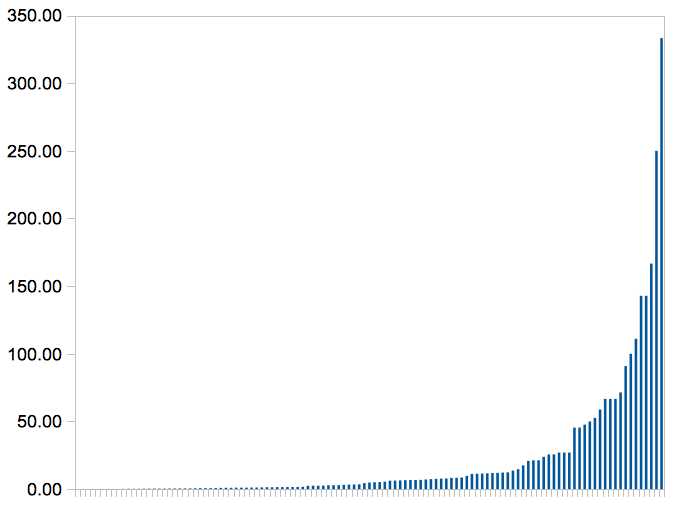
Vertical is "$/DALY" which is basically the cost-benefit ratio of a medical treatment. $100/DALY would mean $100 to give someone an additional healthy year of life. The horizontal axis is a wide range of developing world medical interventions, lined up from worst cost-per-daly to best. You can see that the very best ones are much better than most of them, though even the "worst" ones are still excellent value for the money both in absolute terms and compared to what additional health spending gets you in rich countries.
However, I do worry about that last point. One of the most important part of NPO fundraising is around building a relationship with the donor. Dollar a Day seems to take that piece out of the fundraising process, for better or worse.
Best case, outsourcing your donor outreach to Dollar a Day opens you up to thousands of new donors who get to learn more about you.
Worst case, it's Groupon for non-profit donations; taking away your ability to market your brand and spamming you into a few million inboxes who will likely unsubscribe after a 3-6 months of daily emails.
I personally like non-google options, and competition is a generally a good thing
I _DO_ wish you would display this information a little more prominently instead of burying it in the FAQ. There are many companies that fundraise for non-profits that take a cut of donations and are _not_ nonprofit themselves. You aren't doing this. Good!
Q: Is Dollar a Day a nonprofit?
A: Yes, we’re a nonprofit too! Dollar a Day was built by a team of (almost entirely) volunteers, and our minimal expenses are covered by a few direct donations. Dollar a Day makes no money, in any way, from donations on this site.
It states they also disburse the donations, which may actually end up being a rather good deal. That is, collecting money via creditcard AND getting that money to a local NGO in Mali is not going to be cheap.
But regardless, 4% does sound like a lot, especially if they disburse to e.g. US based organisations that work abroad.
If the bitcoin ecosystem matures it'd be able to help a huge deal in this regard. Circle just launched offering free and instant purchase using bank or credit, and Bitpay offers 0% payment processing in 33 countries.
Anyway, I hope people consider checking out the give well foundation. Giving well is extremely important, and I'm concerned that getting a daily email with some organisations, without any data, analysis etc, we'll be giving very ineffectively to the guys with the most magical story, and perhaps, to the guys with the most money spent on marketing vs aid. Now I definitely am of the opinion that this is okay (great Ted talk on this), BUT if you could spend better, I'd encourage that.
The best example for me was this. Millions of people worldwide are blind due to cataracts, often due to malnutrition. You can largely and often completely 'cure' these people from their blindness with a cheap $20 operation that commonly happens in countries like India. Alternatively, you have blind people who can't be cured, often born blind. We can improve their quality of life, but in say the US it'd cost $20k to completely raise, nurture and train a guide dog.
So we have a choice to either cure someone's blindness completely, or literally spend three orders of magnitude (1000x) more to improve a blind person's life.
As you can imagine, getting one million donors to drop $20 would be a hugely successful campaign. But if they all spent it on guide dogs, it'd have much less of an impact of merely 1000 people donating $20 to completely cure the blindness of a similar number of people.
That's why giving well is so important. I fear apps and services like these diminish that. I hope we all appreciate our influence and act accordingly by carefully considering who to give your money to.
Lump sum method has two advantages:
1) Easier to keep track of for tax filing.
2) Your employer might have a donation match program. Again it is easier to file a form and tell them to make a matching donation.
More than that though, I think it'd be neat if this group hooked up with giv2giv.org and each day/dollar would create a new, well-funded endowment. And maybe give users a way to vote for their favorite reruns or something so there'd be a bit of a feedback loop.
Anyway, congrats to them for a basically good idea. I agree that there are some refinements that would make it a bit more palatable for me personally, but I dig it. I love innovation in this space.
My biggest lessons learned were:
1) Find and vetting 24 great organizations was difficult. 2) Getting people to spend $15/year (how we covered costs) was a challenge, so keep your expectations on audience engagement incredibly low. 3) Revenue through sponsorships won't keep the lights on.
Regardless - best of luck.
The detractors are missing two important points:
1) People like being part of a larger movement.
2) People like knowing their donation as impact. I would rather be part of a team donating $1,000 then just donating $1.
I signed up for the free email, but if I like what I see I'll be joining.
The tax-deductability of charitable donations has always sat weirdly with me. It's not exactly charitable if you're not actually sacrificing anything; it's more a rearrangement of your tax allocation. That can be a good thing in and of itself, but if you're going to claim donations on tax, it's not really something you should get a warm, fuzzy feeling for (in my opinion). I have a regular payment to MSF happening every month, and it doesn't really sit right with me that I can claim it on tax (and I don't).
On the other hand, this is a good argument against the libertarian dot-point that private charity 'would happen if we weren't taxed so much'. Given that you can offset your tax by your charitable donations, it becomes a zero-sum game, so why aren't people currently donating at the levels libertarians say they theoretically would? In the US, you can deduct up to half your gross income from tax, and given that the tax load is less than 50%, you can at least convert your income tax to charitable donations, and then start this theoretical "extra charity" that would apparently spring into action.
Tax-deductible doesn't mean that the money comes straight out of taxes, it means that you don't pay taxes on the donation. So you give $1.00 to get out of your marginal rate, something like $0.28 or $0.35, in taxes.
In order to eliminate your entire tax burden (per your libertarian comment), you would have to donate considerably more than you pay in taxes. You'd have to donate everything you made above the 0% tax bracket (getting down to a net income of about $15,700 for a married couple.) There are actually people who do it -- pacifists who refuse to pay taxes that could fund wars, for example [0]. But even then it's only possible if your income starts low enough.
[1] http://www.irs.gov/Charities-&-Non-Profits/Charitable-Organi...
From what can I tell, the game theory itself is essentially one big argument about libertarian ideas.
Usually the way to avoid voting attacks is to take the hotornot approach and only present random startups for rating by users. But that doesn't prevent sybil attacks - in order to prevent those you need signup to be expensive. How do you do that? Requiring text to a mobile number used to work until Google Voice. Now what?
This kind of thing is different from people going door to door, collecting money; instead of someone actively going to you in order to convince you to give to some "good" (according to them) cause, you are the active participant. There isn't much immediate social guilt of having to say "no", in this case. People who collect for charities in the usual, door to door or through other means of confronting people probably want to play on people's feeling of social dignity and that they don't want to appear to be stingy. So then the average person ends up giving to a lot of different charities - because they all ask for a little at a time - and knowing little about each one.
But why would I deliberately want to diversify my charity, if I'm the one who is actively subscribing to it? Isn't it better to research a few good ones, and actively pursue those? Why give up that choice to some other entity, and make it practically impossible for me to keep up with all the different causes (you can't and won't feel motivated to research where every dollar you give goes to, when it all goes to different things). Another user here has it right - it's a black box. And apparently for no good reason.
2. How do these Organizations pay for developer costs , website, office maintenance and employee salary ?
Do they take cut from donation and donate rest of the money ? If that's the case then its pretty much scam.
Susan Komen for women's breast cancer collect millions of dollar. Innocent people pay thinking money is going to cancer research. But they instead pay their CEO some $500k+ salary. What a shame !
I must ask this is starting a non-profit new legal scam in United States to collect money ?
They pay operational expenses from a percentage of the money they raise.
Just because they pay operational expenses doesn't make them a scam - that's how any non-profit operates.
The best non-profits contribute the greatest percentage of their revenue to helping people. I believe this is the case here.
Do you want the best person running a company like this? Or would you prefer the cheapest person running a company like this?