Sorry for my cynicism/sarcasm, but I see the book campaign as Eric Schmidt positioning himself for his next role. He's trying to secure his personal Google legacy as he gets ready for an exit. I can't imagine it's all that enticing to go from CEO to chairman in a company where the founder takes back the CEO role... how much influence does that leave you?
I couldn't agree more with you. I was expecting some fact-based, data-driven insights/perspectives from Google - so, for me I'd say the "insights" seem disappointingly shallow because they are just "opinions".
I keep hearing that one of the big way in which "how google works" is different is that their "people operations" (HR) runs very differently from other companies. I would have loved to understand - how?
"What's different now?" is such a, I am sorry to say, stupid question. Depending on anyone's opinion, their world view, whether they think macro or micro - the answer can range from "nothing at all" to "everything is different". Lets take communication as an example - "what's different now?" - depending on who you talk to, they can argue that the fundamental needs are just the same (just forms have evolved) or someone can argue that things are radically different now because of X (where X could be snapchat or any new-age medium etc.). The same is true for entertainment - I have had discussions where I was convinced that the "fundamental need to be entertained" is just the same, but I also see so many new media around (so of course, its different now).
It would have been great if they had given more insights on how a successful internet age company truly works from the inside - a bit more than "its best to work in small teams, keep them crowded, and foster serendipitous connections". I thought Eric/Google could contribute a new perspective to this discussion, given their vantage point. Otherwise its just another tautological business/self-help book.
I am a bit disappointed because Google's vantage point in this world is so unique (they see so many things in the world, that others don't - given their reach & size) - that they could have really added something very positive and new to "What's different now".
The whole point about "Smart Creatives" also seems so shallow - for hundreds of years and maybe before, "Smart Creatives" as they have defined it, are having tremendous impact! Where is the "So what?" I understand that this is just a teaser to encourage people to read the book. If so, its just bereft of any fact-based, data-driven, truly unique perspectives or insights that I, personally just won't bother.
It felt that the insights were coming from Google's unique vantage point - i.e. their domination over search. I believe that there are many areas in which a company like Google can add great insights to the world (e.g. how to build a great company from scratch) and that when they share them, it ought to feel like "only Google could have come up with this".
If I read a book from someone senior at say Apple about best practices for managing a global supply-chain - then I'd be very curious to understand their unique point of view.
So my first comment about this being "disappointing" is coming more from that angle - Are these insights only Google can give? I am not sure (although it doesn't invalidate the insights themselves). Now, my second comment that I found them shallow, could be because like you say "I already get it" (although frankly, I don't think so - I feel that I don't get this stuff :) I am just always super curious to learn stuff from Google et al).
Really? I thought they were enticing. This is a slideshow promoting a book, so I'm not expecting great insights or data, but rather an overview of what subjects the book is touching on. Most of those ideas are very abstract, and I think they did a great job of visualizing them. I like this slide for example: http://de.slideshare.net/ericschmidt76/how-google-works-fina... And from the book I would now expect there to be one chapter about how to implement a culture where everybody feels intitled to raise their opion and submit new ideas.
>Who knew!
From my limited work experience I would say companies still make the same mistakes, and haven't catched up on a lot of very very obvious ideas...
Why do you think that decision makers won't see themselves as being "smart creatives"?
I asked a senior team member to have a look at the notes I had made, and see if they were ready to show to the wider team.
His advice?
"Go build something, then we can have meetings"
Coming from an academic background I find this type of thinking very refreshing.
Thanks, I'm very curious about this aspect of Google's culture.
Sometimes greenfield projects or rewrites also permit lots of 20% time, because you've got existing implementations, so you can have some people maintain the old one and some people go work on the new rewrite using new tech.
I'm one of the unlucky ones with very little free time at the moment. :)
Twenty percent projects were a real thing, but less than five percent of engineers participated. As far as I could tell, side projects were not the way to get ahead. The people who advanced were the ones who did what their bosses told them, full stop. For all that Google makes a big deal about having an egalitarian peer-based culture, the end result was remarkably strict and top down. That Japanese proverb about nails fits Google to a T.
You don't get in trouble for not working enough hours. A six-hour day is more than enough effort to keep you employed. As in most corporate jobs, you could probably get away with 2-4 (spending the other hours at your desk, but learning skills for the next job) if it's not obvious.
You get in trouble for 20%T (being "distracted") if it pisses your manager off, if it looks like you're trying to engineer a transfer off an undesirable project, or if you appear to be putting 50% of your time into the project.
The reason 20%T usually fails (on employee-initiated side projects) is that it's really hard to launch at Google without a full-time launch. The standards are really high. You have to cover a lot of bases that you wouldn't be expected to worry about in a startup, and you'll need to get enough SRE (reliability engineer) support to cover 24 hours. It's not unreasonable that Google is that way, because they have an understandable brand concern when it comes to reliability in new services.
Most successful uses of 20%T are to engineer a transfer, but managers are wise to that and not supportive. That game is actually a bad thing, because it means that to get a transfer requires auditioning, dividing your efforts, and putting your standing on your main project at risk. It's actually a lot harder to transfer to a good project within Google than to get a job at Google. This also means that you can 20%T for the purpose of transferring, only to get screwed on "headcount" and have put your standing on your main team at risk for nothing.
I don't think that your typical, run-of-the-mill manager is going to punish you for 20%T alone, but if the Perf gods decide that he has to stick someone with a "2.9" (bad Perf) this cycle, then having one foot out the door puts you at risk of being the one thrown under the bus. And once you get a 2.9 it's impossible to transfer.
-- Googler saying.I'm not arguing with your position, just reflecting on the slides. They seemed to be saying 'this is how you (not google) should be doing it', ignoring the kind of cash flow that is required to make that happen.
But one of the key points so far is a 50/50 mix of engineers/other-roles.
If you're swamped with work - especially if it's busywork! - there's a case for an internal product. If it's not busywork - it means you need to hire ;)
If you can't afford to hire, you've got bigger problems.
Gracias.
As for the presentation itself, maybe it's because I'm becoming more and more grumpier with age and haven't drunk my coffee yet, but there's something to be said about today's langue de bois, with expressions like "smart creative" and "Internet Century" being some worthy examples.
I work at a telco, so just imagine the amount of BS I hear being touted (but not applied, of course) everyday... It's no different than this - smart employees, innovation, moving fast,... - just presented in a lousier fashion. :)
And don't get me started on pictrues in the presentation. It really feels like clip-arts all over again. I just hope they don't add them to Google Docs.
Because it was ;)
It list three examples which are mostly true. But the same answer could easily have been said any time in at least the last 120 years -- and it was. I think the complaint about the shallow content in this presentation is completely justified, because there's nothing really new about the idea of change.
Steam power. Electricity. Telegraph. Telephone. Mechanical calculators. Slide rules. Cheap aluminum. Flight. Punch card sorting machines. Linotype machines. Each of those are examples where technology transformed business sectors.
The telegraph made it possible for information to reach around the world on the same day it happened. Ham radio enthusiasts talked to each other around the world, including bouncing TV signals off the moon. Scratch off the names and it's the same ideas that this presentation promotes as something somehow new. It's assumes the fallacy that what you grew up with was slow and unchanging.
It's difficult to read much of the research literature from the 1960s without hearing people talk about the "information explosion" and there being too much change and things out of balance.
Mail order is an 1800s example of "barriers to entry melting away" and is how Sears gained its fame. So was the rise of the daily newspaper, subsidized by advertising that made is possible for people to know what was available.
"Power has shifted from companies to consumers" ... Hello, the 1930s called. Consumer Reports wants to know if you would like a subscription so they can pay for rigorous testing. Or do you seriously think that mass edited unrestricted feedback can't be gamed?
"Individuals and small teams have a massive impact." etc. That sounds a lot like the HP Way, which has as point #1 "We have trust and respect for individuals"
Except, oddly enough, the Google way doesn't mention ethics. Compare to the HP Way where "We conduct our business with uncompromising integrity." and that as a good corporate citizen HP will "meet the obligations of good citizenship by making contributions to the community and to the institutions in our society which generate the environment in which we operate.
Does Google consider ethics less important than business nirvana?
What is new in this presentation that HP didn't cover in the 1960s?
Larry Page claims to want to be a modern, successful Tesla [1], and I believe and appreciate him for that, but some of his actions since he took the reins again (G+, Android) are ones you'd rather expect from an Ellison or Gates. Probably that's a good tradeoff for being able to sustain innovation at a massive scale, but I'm just wondering whether some of the decisions he makes are just plain uninspired, rather than ruthless.
This being said, Larry is still the reason I want to work for Google at some point in the future. I feel like he's one of the very few high-profile CEOs that appreciate ideas and cool shit more than money, and that's something I think hackers in particular need to appreciate.
0: https://plus.google.com/+RipRowan/posts/eVeouesvaVX
1: http://www.businessinsider.com/larry-page-the-untold-story-2...
This might mean that we can make the world a better place by raising their expectations even higher. In other words, if no one will work for Google unless they are given the environment and autonomy to do truly great things, as measured by a well-considered external standard, then Google might just be forced to do great things.
We all know Google has done some things that are not so great. Regulation is one tool the public wields, but perhaps we can do something about that from the inside as well.
There are places that simply don't give a shit about "smart creative" types, and there are places that claim to have a Google-like culture but in practice are just regular old boss-centric jobs. Every CEO wants to be like Google, but very few actually commit to it.
It usually starts like this: the CEO wants to have smart creatives and delegate decisions. But then he thinks about all that hard-won money he'll be throwing at an employee, so he hires someone middle level or fresh out of college "with huge potential". Then he systematically micromanages the guy, because he just can't make that jump. The poor soul either abides (not so smart creative after all) or quickly runs out of steam (this guy will quickly start looking at job posts). Eventually the new hire disappoints in some way and the CEO cynically complains about the failed promises of the cool tech company culture which he tried to implement.
Seeing a very successful company like Google follow these principles, and win, might influence decision makers in a positive way.
Upper middle class dudes from elite academic institutions create businesses. What's the new thing? Maybe I'm misstating this and I'm just going to piss away what few points I have less, but hasn't business always been this way?
Railroads killed the stagecoach, the lightbulb killed gas lamps, Craigslist killed the newspapers. Amazon might well kill Google, but if they do, its not necessarily a new thing.
I'm curious, why is everyone nowadays so obsessed with growth? Is growth really that much more important than revenue? What if you strike a balance between the two?
I remember reading what one of the WhatsApp's founders once said: "[..] we focused on business sustainability and revenue rather than getting big fast [..]" And it looks like they did alright.
Seriously, who upvotes this?
They've launched two succesful products in their entire history (search engine and gmail), the rest has been bought or only work because they're given away for free.
An from what i've heard, internal culture with meetings that explain what should people at google think to really be a "googler" is turning into an orwelian nightmare ("but it's for the general good" isn't an answer to limited personnal opinion).
http://image.slidesharecdn.com/howgoogleworksfinal1-14101217...
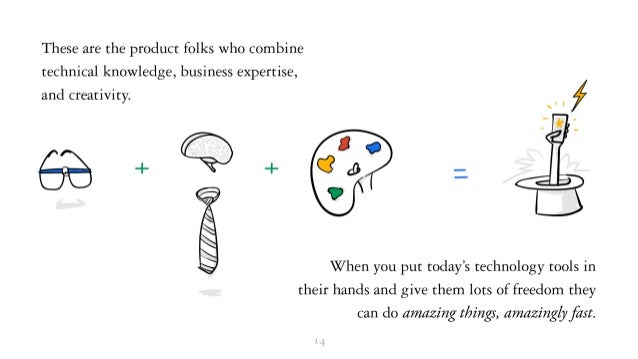
(Technical knowledge + business expertise + creativity)
You also need:
Luck + Hard (smarter) work
Not an exact quote but an idea that was expressed in the slides. I'm curious as to how one achieves this....if this was a sincere bit of advice then I'd love to learn more about what he meant!
Anyone remember this?
Uhh.... I think at least a hundred commenters on HN who've gone through Google hiring would disagree with you.
That's what they get from imitating Apple, the poster child of whitewashed generic stock presentations.
Many things cannot be created individually, no matter how smart and creative you are. Think of pyramids, space ships, - or even GMail. It's about leveraging the resources of a big company.
And not to forget the low risk: you build something while you are on salary vs. building something for equity that may or may not worth dollars in the end.
Also apparently American-type slavery was a historical abberation. A typical slave in the past was not unlike a salaried employee today. He was well-treated, earned good money for his services and was able to free himself after accumulating enough of it, which is not unlike the FU money many a startup founder wants to have.
[0] - http://en.wikipedia.org/wiki/Egyptian_pyramid_construction_t...
Because not everybody wants to build a company.
I made my own company,in the end I become greatly successful, but it took a lot of work, my savings, risks, people around(friends and family), telling me I was crazy, that I should be working for the man because it was safe.
It is not for everybody. I have people working for me that are smarter and more creative than me, but they don't want to be leaders, or do public speaking, or go out of the lab, talk to the customer, or making risks.
If you make a company, or if you work for yourself, you need to do all those things and more in a competent way.
I can't speak for everybody, but there are plenty of things I can do at Google that I cannot do on my own. Google engineers have access to world class compute clusters, CDNs, data analysis tools, and state of the art libraries for machine learning, speech, nlp, dnn, etc. Having resources like that available empowers creative people to hack around on their big ideas.
I've certainly found myself at odds between projects I'd Love to tackle versus bills that Have to get paid. After enough failures and false starts, it becomes less personal risk and more general survival. I look forward to going out on my own again and trying some more, but I need to contribute to my current employer first as I save up the energy and resources for my next personal endeavor.