https://news.ycombinator.com/item?id=1269951
I read it about a year ago, and it was probably the single most important article I've read in my entire life.
Some background: I've been using computers since I was a little kid. Used to play videos games a whole ton. Around the age of 15, I started having severe RSI-related pain in my hands. Even after I stopped gaming, I could never get away from the keyboard and mouse, because I was a technology professional.
Fast forward 15 years. I'd been dealing with constant pain every day for as long as I could remember. My hands hurt even when I wasn't typing. It was bad enough that I was considering changing my line of work.
I'd tried every type of medical remedy under the sun. I'd seen (many) doctors, physical therapists, chiropractors, acupuncturists, etc., but I couldn't find any sort of treatment that provided anything but temporary pain relief.
Through some stroke of incredible luck, I stumbled across this article randomly while looking for something else. I read it and found Aaron's experience closely mirrored mine in a lot of ways. I immediately bought the book he recommended, started reading it on my Kindle, and began following the advice contained within.
Two weeks later, I was almost entirely pain-free. Now a year out, I can type all day without even the slightest twinge of pain. Seem too good to be true? I probably would've said the same thing if it hadn't happened to me.
I will say one thing -- I've recommended this book to a number of people at this point, but not all of them have had the same kind of result I have. I've noticed the ones who really buy into it and become convinced that their pain has a psychosomatic basis see their pain disappear. The ones who still stick to the idea their pain is caused by an previous injury or old age -- those folks don't seem to get much benefit.
Dr. Sarno's theory can be stated simply: Most muscular/ skeletel pain is usually the result of early infantile and childhood trauma which has been repressed. The emotion involved is invariably that of profound anger and rage.
So repressed childhood trauma causes RSI. I'm not saying that body pains can't be psychosomatic, but that's a heck of a conclusion there. It sounds like some serious placebo effect. I'd love to see it tested against a similar but different explanation (a belief in your brainwaves being blocked by the lizardmen who run the government, for example).
Regardless of what works - any signs of RSI should be acted on immediately! It won't get better by itself.
After using the ergonomically suicidal Apple Magic Mouse and Apple wireless keyboard, I developed RSI after just a couple of months. I having my wrists and forearms massaged every night until the tightness went away (for the night), and I switched to a mechanical keyboard, a nice-sized gaming mouse, and started mousing with my left hand at work.
I haven't had any RSI symptoms for over 2 years, and still just alternate mousing hands (left-handed at work, right-handed at home), and use a mechanical keyboard without a 10-key (keeps your mouse closer to a neutral position for your body).
Here's what I use at work, if anyone is interested:
Mouse: http://www.amazon.com/Razer-Deathadder-Infrared-Gaming-Mouse...
Keyboard: http://www.amazon.com/Storm-QuickFire-Rapid-Tenkeyless-Mecha...
I bought the book immediately, which is odd for me because I am extremely skeptical but it is a pretty good indication of the dire situation I found myself in.
Within the first 20 pages I knew I had been had. The author is really proud of himself for being the only health care professional to finally connect the dots, and he takes at least the first half of the book telling as much.
Looking back at the blog post and even this comment it is weird that no one actually acknowledges the "process" or provides any sort of detail on their own situation and what really worked for them.
https://news.ycombinator.com/item?id=8359390
[...] but perhaps also the hundreds of thousands of people in the United States alone who suffer from conditions like chronic back pain, fibromyalgia, chronic pelvic pain, tinnitus, temporomandibular joint disorder, or repetitive strain injury, where, typically, no amount of imaging, nerve testing, or surgery manages to uncover an anatomical explanation. [...]
http://www.rsi.deas.harvard.edu/mb_what_is.html
I am 11 years free of any wrist pain. I use a cheap crappy keyboard that came with an old Dell computer and a normal mouse to program about 60 hours per week.
Let's expand on the psychosomatic illnesses a little. Now (several years later) I know that there are a number of symptoms that are caused by my mind. I know when to expect them, I can make a pretty good guess whether a given problem is mind-caused or not. What I can't do is cure them completely, still working on that. But I do know that Sarno is right.
Now, before you hit "reply" and go all-scientific, think for a moment. The problem we have is that we don't have ways to "measure" the mind. You can't easily just form control groups and do clinical trials. What works for one person might not work for another. So I can understand why doctors would rather stay away from the subject and pretend that the body and the mind are entirely separate (which is actually demonstrably untrue). They can't do anything else, as a doctor is sworn to only use scientifically-proven methods.
I see this discussion come up regularly. There are usually two groups that form: people who managed to deal with their illnesses and people who say that all this psychosomatic illnesses talk is hogwash. I am in the former group and I am worried that the latter group prevents many people from healing. So, if you suffer from things like RSI, joint or tendon pain, back pain, muscle pain, jaw pain, frequent sore throat (yes), frequent sinus/nasal infections (yes), at the very least do yourself a favor and read one of Sarno's books. I'd also suggest other sources, but I simply don't know of any, except an increasing number of studies that show that we don't understand the "placebo effect" and that the mind has much more to do with physical health than was previously thought.
Obviously, nobody suggests that any illness can be cured just by reading a book or thinking about it. There are certain physiological aspects of your body that your mind can influence and some that it can't. From what I observed myself, the two main "tools" are changing muscle tension and restricting blood flow.
And finally: nobody (least of all Sarno) is saying that you should avoid talking to doctors. The first step is always to seek medical help and eliminate any physical cause. What should alarm you is when after multiple visits to doctors you're not getting any closer to curing the problem. Unfortunately, very few doctors will tell you clearly that they have no idea what is going on, so you have to listen and think. If you're doing test after test, if your doctors say "well, let's try [medication name here]", the problem you are observing might be the symptom, not the cause.
"just an area of soft tissues suffering from mild oxygen deprivation." http://www.rsi.deas.harvard.edu/handout.doc
Couldn't symptoms be treated by increasing blood flow with exercise or stretching, for example? If stress is a cause, wouldn't it be relieved by reducing symptoms?
But wait, there's more!
If you call in the next thirty minutes, we'll double the offer!
That's two magic books, two stress balls, all for the same low, low price!
1. Fix your posture. 2. Use ergonomic devices. 3. Exercise to strengthen your core and back muscles, and counteract your sedentary lifestyle.
Details below.
1. Posture
The main cause of RSI is bad posture at the desk. Both the way you type and use the mouse, but importantly also the way you sit.
There's little point treating the symptoms if you don't treat the cause. Looking around my workplace, I see pretty much no-one in the correct posture.
- The back of your chair should be in contact with your back, i.e. actually touching it at all times.
- You should be right under the desk. If your chair has arm rests that stop you from getting under the desk, get a new chair.
- Top of screen at eye-level (most people have this spot on).
- Keyboard a little back from the edge of the desk.
- Elbows at approximately 90 degrees
- your wrists should not be at an awkward angle as they approach the keyboard.
2. Ergonomic devices
Get a good sized keyboard. Don't use awkward keyboard shortcuts, e.g. alt-tabbing on a Mac running virtual box requires your left thumb to reach underneath the other fingers. This is bad. Re-map common shortcuts or use two hands.
Get a mouse that has a natural (hand-shake/vertical) grip. e.g.
http://www.amazon.co.uk/Wireless-Vertical-Ergonomic-Optical-...
This reduces the stress on your wrist. Made a huge difference to me. Check out the reviews.
3. Exercise
My physio recommended swimming, as physios so often do! It will strengthen your back and core, to help you sit up straight.
However, she also recommended walking. Walk at lunch and in the evening, to get away from the sitting posture.
This has pretty much cured my RSI. Take it or leave it! :-)
I went to physical therapy, which identified problems with my neck and shoulders, and then we began working on those muscle groups and some of my core. I should note that these exercises were very gradual, such as using no weights or 1-2lb weights -- I didn't go straight to lifting!
After a few months of this, most of my symptoms have disappeared (I only went to phys therapy for about 1.5 months; afterwards I was able to keep doing the exercises at home). Also, my wife has noticed that my posture has naturally improved as a result of the exercises, such as my shoulders no longer rolling inwards.
I still have some remaining long term problems that I've had for a decade, but now I can sit and use a computer the whole day with very few problems. Of course, everybody's situation is different: physical therapy, surgery, and "The Mindbody Prescription" mentioned elsewhere have not helped a friend of mine. But at least in my case, it was a bit humbling to realize that all I really needed to do was exercise (and I'm not overweight, either).
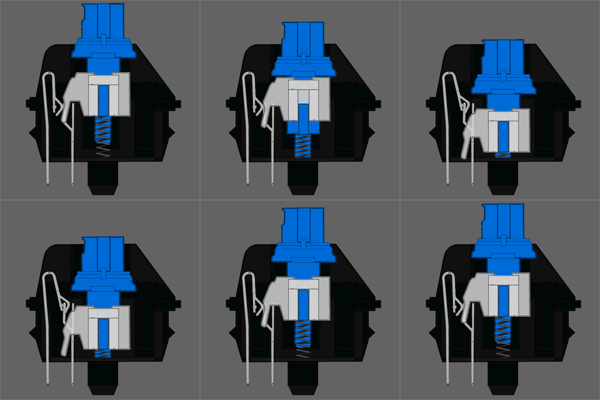
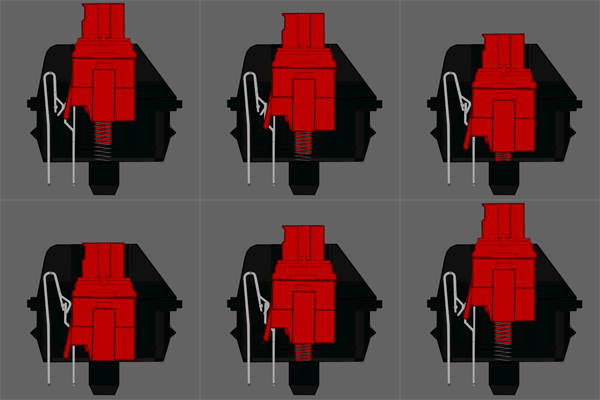
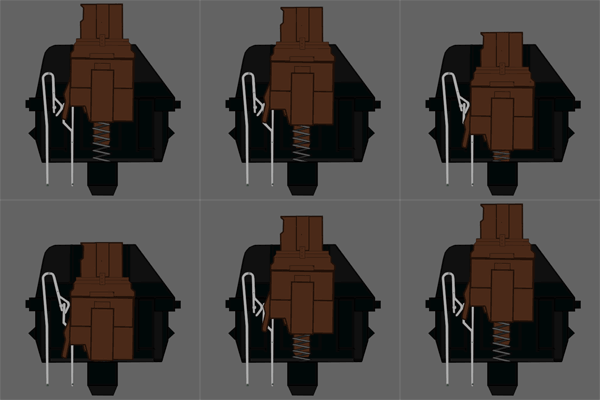
Something else that helped me was getting a quality mechanical keyboard with low actuation and learning how to use it without bottoming out. The model that I like (CM Storm Quickfire Rapid) is unfortunately no longer made, but it uses Cherry MX Brown switches (not loud, but still has an actuation point) and has no numeric keypad, so I can keep the mouse close by without having to stretch my shoulder. I use blue switches at home, which have a more clear actuation point and thus are probably better for a mechanical keyboard novice, but they are probably too loud to use in an open office environment. This guide is very helpful for understanding the how & why of mechanical keyboards: http://www.overclock.net/t/491752/official-mechanical-keyboa...
I've designed and built my own chording keyboard, which should be 10x less stressful to type on than a normal keyboard. I also have an eye tracker that I'm going to program to use to replace most mouse tasks.
I don't like the idea of inaccurate input that makes noise (me speaking) that could disturb others in an office. I have a feeling that being too noisy for an open-concept office might limit my career options in the future. But I would still rather live with that than live with RSIs.
I do really like the idea of running Windows in a VM and proxying the commands to linux. That was previously one of my qualms with voice control: that I'd have to switch to Windows.
My other idea is to switch to a mass-motor gesture and eye-tracking based system using an Oculus Rift with an IR camera mounted in an eye socket. That might be an interesting and fun way of programming even if it wasn't to solve an RSI problem.
I also have another Tobii EyeX sitting in a box as it's a Windows only thing and wondering if it's worth giving that a try after all...
However I could see myself using voice commands that activate Macros or other actions. I just bought a Nexus9 and am going to try to use it for coding, I can definitely see potentially using voice commands to augment that workflow.
1) Kinesis Freestyle2 keyboard
2) mouse that fits my hands (razr doesn't)
3) listening to the body (!)
4) stretching (especially in the morning)
5) Lots of physical exercise / gym / swimming
6) speech recognition for all text (emails+code comments)
I find it hard to believe that it can be cured simply by changing your mind, but knowing that there are cures certainly helps.
Almost forgot the most important part: a good chair. No slouching! Ever! This is more against upper back pain, but I guess neck tension is related to arm pain.
This is one of the best reasons for me to have a startup: to be able to work when and only when my body tells me that it's okay.
The huge advantage that the keyboard has as an input device is that there's zero delay-- if I make a mistake, I can go back and fix it as soon as I'm able to see and react to it. Speech recognition has this inherent delay to it-- it has to delay execution of a command until it's concluded that there's no other possible interpretation of what you just tried to say. Speech is a lot slower than I can react-- the inherent lag there just seems intolerable.
I suppose one could get used to it if it came down to "use speech recognition or find another job", though.
You're also completely correct about how when you speak a chain of commands, one of the commands in the middle getting messed up can invalidate the rest. That happens a lot. You learn to speak in shorter chains, and also to make the commands phonetically distinct.
That said, both the delay and the inaccuracy problems can be greatly ameliorated by a fast CPU and a good sound card. I don't have any benchmarks, but I have noticed the difference since upgrading.
I had hand/arm problems not long after starting my first programming job, but I have solved them now.
My main advice would be to get a good chair and desk. I have a RH logic 400 chair and height adjustable desk, with an Imprint Cumulus Pro floor mat. I also use a Kinesis Freestyle 2 keyboard. All together this cost about £1700, but it was absolutely worth it. I spend approx 50% of my time standing which I find much more comfortable than sitting.
My other piece of advice would be to take regular breaks. I recently became self employed which allows me to intermingle work with exercise, socialising and eating as I want. This really helps with fatigue. At least try to take a short break once an hour. I found jawbone up good for this as you can set it to vibrate after you have been sat idly for too long.
Finally, if using the mouse is a problem, learn to use your non-dominant hand. This has pretty much solved my problems with my mouse hand.
[1] http://www.mainespeechtherapy.org/content/4021/Voice_Disorde...
Also, choose a keyboard that works for you. Different people have different opinions; the one I use was a $3 no-name one, but it felt right.
Easily overlooked is using the shift, control and alt keys correctly. It's left-control + backspace, right-shift + 1, right-alt+F4 (to pick examples that work on Qwerty and Dvorak). Otherwise you're still stretching.
A USB touchpad is a zero force mouse substitute, though a little annoying for positioning; I ended up using one for clicking in combination with an optical mouse for positioning. Has anyone yet released a mouse with zero force clicks? Microsoft released one with zero force for half a dozen useless functions, annoyingly, everything except left and right clicks.
I've been a full time developer since 1998 or thereabouts, but have been coding since I was a child. Early on when I started working full time I found myself quickly getting RSI fatigue and tingling symptoms. I switched to a Microsoft ergonomic keyboard and various trackballs; this greatly ameliorated the growing pain.
In the past few years, however, I've made the switch to gaming grade laser mice (e.g. the Logitech G9X) and have almost no issues. The high sensitivity and precision these allow for at high DPI settings are great vs RSI. Furthermore, since a shoulder fracture earlier this year (now healed) when I was forced to use only mainly left arm for some time, I've kept up the use of left hand mouse. At clients I'll have it on left hand side, at home office on the right hand side. I believe ambidextrous use of the mouse has a lot of benefits, spreading the effort level being the biggest of them.
For keyboards, I touch type and made the switch to mechanical keyboards (Logitech G710+ with O ring dampened MX Browns) around 1.5 years ago - I'm not getting any additional pain as a result. I am however kind of interested in getting a more ergonomic mechanical keyboard for use at client spaces, to preemptively combat the RSI risk. Was held off by the cost, however I guess this means I'll be reading reviews of the TEK vs the Kinesis Advantage again shortly. ;)
As a related issue, I believe back pain is just as critical as RSI. The only way for myself to combat this is through consistently exercising. I ride 100-150km per week, mainly commuting but also MTB XC single trails whenever time permits, and try to get my deep squats, deadlifts, shoulder presses and bench presses done 1-2 times per week at gym. Only riding isn't enough; I find the gym work essential for fighting back pain, no matter what kind of chair I use - which happens to be a Herman Miller Aeron at home, and some random chair at work.
Long post, sorry. My final comment / tip will be to set up JustGetFlux for those late night coding sessions. I'll leave it at that. :)
I got Samsung Note 12.2 2014 pro because it has a huge screen. If I need to do a small amount of programming, I use Splashtop to accept Swype input into my Windows laptop just across the room.
If anyone has better ideas for an extreme case of RSI, please let me know. Thanks.
(Albeit, like you, mice started giving me trouble after about 8 years of mousing. The problem was gripping while moving the wrist. Solution? Trackball.)
(EDIT: Tangentially, I keep my eyes in shape with "preventative" eyewear: I don a pair of (weak) reading glasses ~33% of the day to shift the focal point of my monitor further away. Keeps eye strain at bay.)
Today, as a musician, I'm quite conscious of the health of my hands and wrists. When I hear musicians complain about wrist pain, I always tell them to evaluate their computer use.
In the interval, I switched to a standing desk and it did _amazing_ things for my hands. I tend to slouch when sitting, and just standing while I worked for several periods a day reduced the pain a lot.
As someone with fairly severe RSI, making the change from my normal rubber-dome keyboard over to the Blue Cherry MX switches about 2 years ago has made things significantly better. The pain and discomfort is largely gone-- its still there, of course, but its hardly noticeable.
I'm not sure of the effects of mechanical keyboards with regard to RSI, but if you're a hard typer, they might help train your hands to not bottom out the keys.
http://www.daskeyboard.com/blog/wp-content/uploads/2011/08/C...
http://www.daskeyboard.com/blog/wp-content/uploads/2011/08/C...
http://www.daskeyboard.com/blog/wp-content/uploads/2011/08/C...
Bottoming out on the keys and using excessive force because of a lack of tactile feedback on the keypress are leading causes of injuries, because they provide a sudden jolt (when the key stops moving, but your finger doesn't) and unnecessary strain (to generate the extra force). Bottoming out in particular is bad, because you end up momentarily pressing against the keyboard frame with the full force you pressed down on the key, doing nothing but straining your wrist, while if you stop the downstroking on a spring loaded key before bottoming out, you'll end up stopping your motion in a cushioned manner (and the key assists a little bit in retraction).
The thing about rubber dome keyboards is that they are the cheapest kind of keyboard. So you'll find a lot of absolutely awful ones out there. For example, you'll find ones where the amount of force you need to push in the key is unpredictable (keys feel "sticky"). You'll find ones where it takes too much time for the keys to come back up after they're pushed down. You'll find keyboards that have almost no weight, so you can't type without moving around the keyboard.
In contrast, people pay $100-$200 for a mechanical keyboard (they are a specialty item) and the build quality reflects that. For that money, you usually get something which has a weight in it (so it doesn't feel like you're typing on a hollow plastic shell), has reasonable ergonomics, and key action that is at least tolerable.
I find that I am a heavy typer (I press the keys hard) and I could never get used to mechanical keyboards. I was always "bottoming out." Unfortunately, the hard stop on a mechanical is even harder than the hard stop on a rubber dome. It's like hitting a wall. There are mods you can make to mechanicals to fix this, but you have to do it yourself. (For example, you can put rubber bands underneath each key, to get a more gradual stop when you bottom out.)
Right now I use a good quality rubber dome keyboard with an included trackpad. I find that keeping the keyboard in the correct position on my lap is a lot easier when I don't need a keyboard tray. It really is all about ergonomics.
My advice to you would be to stop lifting weights for a while. Just use machines or something to avoid putting pressure on your wrists. And then get a good quality keyboard. You will need to try it out before you find the right one for you. You'll probably have to order a few online before you find one you like. You will also need to start using good typing posture so be sure to research that.
However, I've started to experiment with combining the leap with a mouse--i.e. left-hand over the leap and right-hand on the mouse--to control a single hand grabber/toucher/pointer object. I assign broad movements to the mouse and much finer movements to the Leap. It seems to work well, in much the way that arms work for large motor control and wrists work for fine motor control.