1. disrupt IE/MS - i can say for certain they originally backed Firefox for this effort and only decided to split away to build chrome in the first place because they felt starting fresh they could build a better core and i believe they did.
2. enabling more people to build on the web, enables more of their ads to be shown. Firefox achieves this just as well as chrome. IE was dominating not too long ago and you could argue much of google's ad revenue growth can be attributed to more people having access to a higher quality web.
That said... I don't see why you should believe google would need or desire to sell data from what it might collect from Chrome. More likely they see it as a means to ensuring web dominance by ensuring the web is never locked down by one mega corp. It's similar in away to what they have done in the mobile space. Android is more of a technology to disrupt Apple and ensure it can't be dominate, but really does google have any control over Android?
https://support.google.com/chrome/answer/1181035 contains info on how the encryption works.
chrome://terms/ links to https://www.google.com/intl/en/chrome/browser/privacy/ which links to http://www.google.com/policies/privacy/ to define "how we use information we collect." From that page: "We use the information we collect from all of our services to provide, maintain, protect and improve them, to develop new ones, and to protect Google and our users. We also use this information to offer you tailored content – like giving you more relevant search results and ads."
Your full browsing history is a treasure trove of information useful for making Google's core services (search and ads) more effective. They would be stupid not to use it to improve the quality of their services. I challenge your assertion that Chrome is an altruistic endeavor.
References:
"Get predictions in the address bar" https://support.google.com/chrome/answer/95656?hl=en
"Logging policies for omnibox predictions" https://support.google.com/chrome/answer/180655?hl=en
It could be said Google already have your browsing history (of sites that they serve adverts on, or that use their analytics). I doubt Chrome's syncing data would give them any more information than what they have already.
and it's quite easy to block Google from tracking your browsing habits using GA or Ads: just use an Adblocker and something like Ghostery, RequestPolicy or Disconnect to block Google Analytics.
2) It's not an accident that Google's webservices work best (sometimes only) in Chrome.
They're way past the "disrupt IE" goal. They're into the "tightly couple our web service and Chrome and try to force out other options" goal.
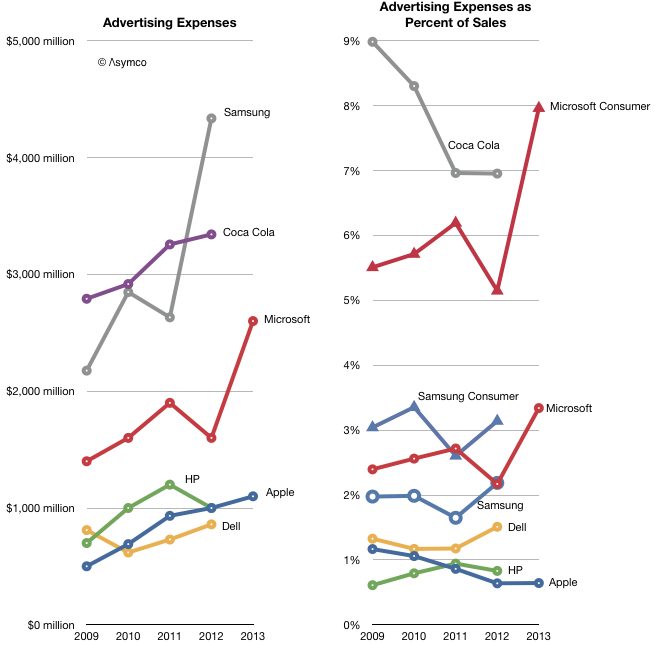
(http://www.asymco.com/wp-content/uploads/2013/11/Screen-Shot...)
I can't find a source for the figure right now, unfortunately. And the whole thing is a guess, since Google doesn't release this information. All it releases is overall sales/marketing spending, which in 2012 was about $6 billion if I understand right (see <http://www.quora.com/How-much-does-Google-spend-on-advertisi...). That includes salaries for the marketing folks, etc, not just direct spending on campaigns.
As I recall, the $1b estimate broke down something like 30% actual spend (primetime TV ads, ads all over the London Tube, etc, etc) and 70% in-kind placement (i.e. "every search you do on Google with another browser shoves an ad for Chrome in your face"). I'll see if I can hunt down where I saw that...
> That's 3 times Mozilla's entire budget
Yep.
A web service that only works in Chrome? Maybe you mean web application (web service would be really odd to work in just one browser). Do you have a source for this regardless? I hadn't heard of this.
As for concrete examples, Hangouts only works in non-Chrome browsers (including ones with WebRTC support) if you install a Google-provided binary blob. Which you may not be able to do.
Gmail only supports offline access in Chrome (see https://support.google.com/mail/answer/6557?hl=en the "two exceptions" bit). Whether not having offline access to your mail counts as mail "not working" is up to you, I guess; for me it counts as "not working".
Various Google properties use UA sniffing to deliver degraded content to non-Chrome browsers. https://bugzilla.mozilla.org/show_bug.cgi?id=921532#c9 is an example.
https://bugzilla.mozilla.org/show_bug.cgi?id=973754 is an example where as far as I can tell they built the feature around non-standard Chrome-only functionality even though Firefox supports the standard version.
Google news menus don't work in standards-compliant browsers because they rely on a Chrome/WebKit bug. See https://bugzilla.mozilla.org/show_bug.cgi?id=1083932
Google patent search uses UA sniffing and locks out various browsers as a result. See https://bugzilla.mozilla.org/show_bug.cgi?id=1013702
Google Translate will fail to work in Firefox unless you have Flash installed (good luck on Mobile).... or spoof the Chrome UA string. See https://bugzilla.mozilla.org/show_bug.cgi?id=976013
They do fix these bugs sometimes (the UA sniffing ones, where they just got the sniffing flat out wrong, tend to get fixed once someone diagnoses them). And sometimes not.
I wouldn't let Google off the hook so easily.
More like, they want to ensure that if/when it is, they are that one mega corp: https://i.imgur.com/AIxYzl9.jpg
If you ask me, the only reason they haven't moved even faster in this direction is because they're afraid of triggering the same legal action that Microsoft did back in the 90s with IE, but that doesn't mean that they wouldn't love to have that form of dominance - it can only help them.
Chrome kicked off the browser performance wars, especially javascript. A fast and performant web was important to any strategy Google could have had, regardless of their status as a good or evil company.
That it's a performant browser is a side-effect.