What advantage do you see for using a Linux distro as your primary desktop OS rather than Mac or Windows?
Is there anything other OSs can change/add that will make you move towards non Linux OSs?
1) the customization options (tiling WMs ftw)
2) the ease of replicating the production environment I work with
3) the package managers
4) the everything-is-an-ascii-stream metaphor and the ease of creating and using tiny, tiny executables (e.g. shell scripts, daemons, composable cli utils, etc)
5) the complete and total freedom to install and use whatever I want, whenever I want without ever having to pay for anything at all, and more importantly ever have to ever think about entering a product key or having to register anything.
6) the tiny, tiny performance requirements and extremely wide hardware support
7) the networking toolage (ssh, curl, wget, scp, rsync, etc being either already there or one apt-get away)
8) the general feeling that complicated things are abstracted away only if it's possible to do so. The fact that things break transparently, or at least more transparently than the competition. The fact that it's beneficial to Debian that failures and shortcomings be discussed publicly and at length rather than being held behind closed doors to maintain a credible commercial image.
I would really like it if some OS could re-implement the, as I said, everything-as-an-UTF8-stream w/ networking as a first-class citizen, the blank slate UI to be built from scratch (and a few shells), while shedding the legacy crud of teletype-era in-band signaling keycodes, the X window systems, and so on, which I admit is very, very unlikely as it implies re-implementing almost all of the stack, at once, in a backward-incompatible way, all to re-implement a model (the CLI) that is seen as a technical relic to almost everybody except me and Neal Stephenson.
Let's just say, then, that I will switch OS when someone will be offering a consistent, minimal and usable UI metaphor, while accomodating the motor tics I developed using Vim for the last few years.
Chief among these concerns: isn't it a little insular to create an OS that will only be used by people with the utility to write their own software? At some point, the software must be developed on the OS it runs on, and most software will be for mainstream users (outside of server-side code). This is theoretically solved by stuff like POSIX, but now we're talking about abandoning those standards in favor of more modern ideas.
There is definitely some discussion to be had on the topic of how to build and market a new desktop OS stack in open source. I have a lot of ideas around UI/UX for both hackers and mainstream users, but I'm very conscious of how little I know about system architecture, especially after reading articles by people who have built stuff like Plan9. If people are sufficiently interested, let me know and we can start a listserv or something to bounce around ideas.
Which, on the other hand, I think is rapidly evolving, now that OOP is out of its hype phase, and can now be evaluated a bit more (pun almost intended) objectively, and freed from its unnecessary parts, and that front-end JS and functional reactive techniques are bringing new ideas and especially terse and powerful notations and abstractions to describe UI layouts and interactions, to the table.
One can dream of an invention-of-the-C-language-like situation where a team of lone hackers harness the power of a bump in expressive power to formalize the current state of their UI metaphors and reimplement it from scratch and then build upon that at tremendous (relative) speeds...
Well, I dream.
Futzing with front-end JS frameworks is having unexpected effects on my worldview, right now.
I'm not sure that's really true, particularly with emulation.
I'm able to get far more out of my small cheap netbook using Linux than I can with Windows or a more expensive Mac. I could do most of my work on a Mac but Linux affords me a deeper level of customization and different set of tools that I need/want to have and that I have found useful. Even when things break in Linux usually it is much more of a learning experience fixing it as compared to OS X and Windows IMHO.
Linux does have the disadvantage of not running popular software that I may like to use like games, image editing software and audio DAWs. But so far I've just been focusing my time on other things so I am not as affected by it as when I had Windows/Mac and Linux boxes.
Ironically if Microsoft and Apple opened up their development toolchain to other OSs, e.g. Linux. I would be more likely to use them more. The more I use Mono in Linux the more I find myself using Windows, if Visual Studio and .NET tools where more open and usable on Linux I can see myself using Windows alot more. The same goes for xcode and OSX/iOS.
I've been using Linux as my main desktop starting with Red hat 5.1, so that's got to be almost 15 years ago. Moved to Fedora, then Ubuntu, and then finally to Debian.
I've got an old MacBook and I may get a MacBook Air at some point because they're great travel laptops. Hate the keyboard on all Macs I've worked with though. The operating system is fine, I can get work done on OS X.
Occasionally I boot into Windows (7) to play a game but at least half the time Windows will update itself for what seems like an eternity and then reboot automatically straight back into Debian. By that time I've usually forgotten what I needed Windows for.
At work I have a Windows 7 VM for various corporate tools that only work in Windows. Usually use the Outlook web client in Debian for email and calendaring. That works most of the time.
The simplest advantages are that it is free, loads of software, ability to customize basically anything you'd like to, same desktop OS as the dominant web server OS.
At work, I use Ubuntu with an Xfce shell -- a wee bit faster, and the taskbar is more convenient on a multimonitor setup. Unfortunately, I end up running Windows in a VM for Outlook (the Exchange connectors I have used ended up being kludgy and more annoying than just using Outlook, and webmail isn't good enough) and Zoom/GoToMeeting/join.me -- no one wants to write a desktop client for these services, and I end up being in enough meetings that I need a Windows VM for it. If I have to join those meetings at home, I use the Android clients, which work fine, but are too annoying in work situations where I might need to present something on my computer.
A couple of months ago, I actually tried an installation of Mavericks on my laptop, and I wiped that off pretty quickly, after a day or two -- the apps were nice, but I missed basic apps that I was used to in Linux, I wasn't able to do basic things like moving/resizing windows with a hotkey + mouse... and I realized that Linux was now "good enough".
Coming from someone who was a die-hard Mac user from the Classic Mac OS days, and where "good enough" was an insult to Windows, for me to say that Linux was now not just good enough, but more comfortable than Mac OS is pretty high praise.
A fully supported, free copy of Mac OS X with some of the niceties I mentioned above, plus a deeper free software stack of applications that worked as seamlessly as they do in Linux (no separate X11 process, good theming) could attract me back -- unsure if I would switch over, but it would be far more attractive.
I used Windows at work for about two years at my current job without too much complaining, so it's doable, but not as fun as running Linux on my home machine.
Things running in it: Firefox (personal browsing), Chromium (work browsing), a buttload of terminals, KeePassX.
I hope Xfce never pulls a GNOME/KDE and just keeps refining version 4 forever. When I hear the words "desktop" and "innovation", I reach for my revolver.
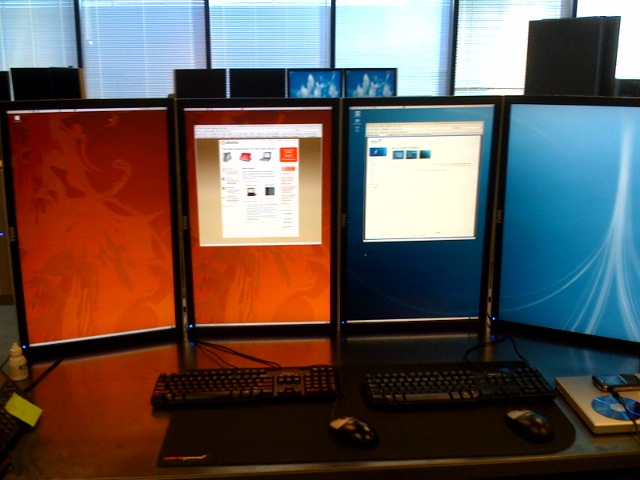
Granted, I'm typing this comment from the beast[1] in this picture (4x dell 30" monitors) with the NVS510 video card under the hood, but really it works amazingly well. I don't honestly see any benefit to moving towards Windows or Mac OS X. OS X has homebrew where I can get some of the much nicer GNU utilities, but the stock BSD userspace I find lacking. I use several of the gnu-ish features like sed -i, grep -r, etc, etc. Perhaps it is because I've worked on Linux for > 10 years, I just find it totally second nature. That being said, I bought my wife a MPB as it is shiney and unix under the hood.
Just use what you're comfortable with. I won't even interview at a place that won't let me run a Linux desktop (seriously).
Once I tweak it to my preferences, I never have to think about it again. My configuration is portable to different versions, different distributions, and even different *NIXes to a large degree. Once in place, the system stays out of my way and I can focus on the task at hand. I used to keep an Arch Linux box around to keep up on the latest versions of things, but I got tired of the constant updating and breakage.
I also use Macs, relying heavily on homebrew (MacPorts before that), but the experience isn't as seamless as it is on Linux. OS X is a great consumer OS, though, so that's what I set my family up with.
I can't get anything done on Windows. I feel like I spend more time maintaining it than using it. The updates are disruptive and kill performance, the endless notifications are annoying and often meaningless, and the interface is byzantine. I haven't tried Windows 8, but I'm curious about it since I love my Windows phone.
Since I'm very keyboard-centric, I doubt that Mac or Windows will change in a direction that interests me. I've been thinking about trying out a ChromeBook because of the instant-on capability. If I don't like it, I'll just wipe it and install Linux (which is another reason I love Linux: I can easily repurpose old or odd hardware).
I love it because it allows me to get the most out of my machine. I've been using xfce and like it everywhere. Most of my work is on Linux machines of one flavor or another (mostly RHEL and a few Ubuntu) so it makes sense.
If I absolutely must do something with Windows, I have a vm that I crank up; then I can edit MS Word, PowerPoint, do my taxes, or update my GPS (Win only updater). I'm trying to convince folks at work to move to Google Docs with some success.
I won't switch to anything else any time soon; Linux does everything I need!
I may switch from Fedora... the continual update process is starting to feel like a treadmill... sometimes the version updates break a lot of things. I may switch to Debian to have a stable platform that doesn't go crazy with updates like Fedora; I've been playing with it on a vm and it seems fine.
I have a Chromebook in the kitchen for web browsing, checking email, etc. and it's surprisingly useful. I couldn't live with it day to day, but I've started to carry it while on the road more often; it's very small, light, and the battery lasts forever.
I love it. It's flexible, it's powerful, it's configurable. I use it for programming in Linux (just a little) so having bleeding edge it's welcomed. I do not play much, but for the little games I play it's excellent if not wine is all I need.
Also I use Debian A lot. But not as my principal OS. I usually install it in PCs set some servers if needed and then ssh all the way.
Also I have some VMs, sometimes for experimenting (freebsd, some Linux distributions).
2)For the advantages of Linux: Probably the distribution software, but FREE SOFTWARE, that's the principal reason. If I could have installed all the libraries, have a posix system, system drivers, a good compiler and the usual desktop apps and Free Sotware then I'm done (Notice I don't have a problem with a NON FREE(LIBRE) OS if is affordable and comfortable enough)
Unfortunately I have issues in Freebsd with drivers, the distribution system in Mac Os X is meh (of course you have macports and homebrew) but again drivers. Windows has all the applications you want but it's unfriendly in the distribution software and no Posix. Then 8.1, I could install 7 but at this moment I don't have a reason.
3)So for the last part, no Linux it's the way to go.
The main advantage I have is that I work in an environment where there are thousands of Linux servers. By running something like linux in my day to day life I have learned a lot of my skills which I use in troubleshooting the production hosts.
I also am a big fan of the linux way of development where there are lots of small tools and everything has its specific role. I feel that in Windows this approach to development doesnt exist. I really do not like powershell but this may be due to me being a linux fanboy and not understanding the powershell way of doing things. Which leads me to the point of flexibility of user interface, shell and many different applications to do the same thing. Its a blessing and a curse.
The fact that with Arch I can have the latest packages at my finger tips shortly after their release is fantastic, but can also be a detriment. I have had many times with bad graphics drivers, kernel panics (havent had one for a while) and recently I had a broken golang install.
With regards to moving to a different OS, my biggest pain point is Xmonad. I want to keep Xmonad (or i3) but I cannot do that in either OSX or Windows. If OSX didnt feel so restrictive (brew helps but i shouldn't have to feel like I'm sidestepping the OSX way of working) I would definitely consider it. OSX is a really good tool and can be a great system for developers but it needs to be heavily modified for my use case. With regards to Windows, I dont find it performant enough. Needs too much RAM, too much disk (Windows SXS is the bane of my existence) and just generally has the most obscure undefined behavior. Every time I have booted my Windows partition I have had trouble (granted maybe lack of use is a player) with rebooting from windows updates and the like.
Rather than post a wall of text about the advantages I get, I'll link to a talk on the subject I recently did: http://lsh.io/plugtalk
The two big problems I find with non-Linux OSes are 1. lack of a good POSIX-style userspace or sufficient OS features to install one; and 2. welded-on, monolithic GUI layers - MacOS and Android are both nonstarters for me because they force me to use their very inflexible, very badly designed window managers (among other issues, but that's the one that's really unfixable due to the fundamental design on both OSes).
I've worked at Apple, and I love Mac OSX, but the expense of owning a Macbook far exceeds any additional returns I would get by using one professionally.
I use my macbook for iOS coding next to it when needed.
There are a lot of reasons, but high among them are the ability to dive into the code when I'm curious about what's going on under the hood, a solid tiling window manager well integrated with my shell, and habits and familiarity built up over almost two decades now of using primarily Linux.
There's doubtless things other OSes could do to be more my speed; honestly the Windows 8 UI, while ugly, fit my work flow slightly better than previous incarnations. No one targeting "mainstream" seems to want me, though - even the Linux distros are barely usable in the default installs.
I don't know if there are any major advantages besides of course everything being open source. Regarding that, if you don't know how to/don't want to hack the apps you use I don't see a lot of value besides from a philosophical point of view.
There are small things that I personally like better, but it also depends a lot on the distro.
Other OSes are much easier to use in practice, since most things one wants to use are build for the Win/Mac ecosystems, and things seem to just work without much work on your part, which isn't always true with Linux.
Windows, OSX and others can do little IMHO for Linux lovers, unless they release their software open source.
Linux is a programmer's paradise and you can basically whatever you wanna do with the system. IMHO the most serious lack is a set of good looking office programs and some lack of interoperability when you needed. On the other hand you get to have much more flexibility than any other OS out there.
Windows to me seems like a mobile OS. It's so restricted and the possibilities are so limited that's scary (DOS vs Bash/Zsh/any-shell + gnutools... comparison doesn't stand, no way).
There are so many advantages ove Windows that it is not even close. Mac OSX is almost usable, but the machines are too expensive. I sometimes have used a Mac, but my most recent is a G4 and I don't use it because it does not get security updates. With Windows, I'll say a few things. I don't like software that is designed to be unreliable, as Windows is. It is clumsy to use and makes me feel dirty even using it.
I try other OSes a good bit. PCBSD is pretty nice. I used Syllable a fair amount. Transparently provable security and a decent desktop would draw me to try a new OS.
For work and play I run unix-type apps, that target Linux systems, so I've always found it better to be running on something close to what you deploy on. Sure you could use VMs, but its still not the same, you don't learn as much about Linux that way.
Over the years I've moved away from Linux laptops and now use a Mac laptop. Mainly to make my life simpler - who knows, maybe Linux on the laptop is better now? But 99% of my time working is on the desktop, and sometimes its nice to have access Mac apps.
It's free, and works on virtually any machine, has a built in package manager, and the command line interface (eg: bash) lends itself to automation / script writing. Virtual desktops are also ingrained in how I interact with a computer, and Windows doesn't have a good alternative.
I've been using Linux pretty much exclusively for close to ten years - the biggest thing for me has been compatibility, but that has gotten a lot better over the years. I have a Macbook for work, and I've been pretty happy with the interface, but the keyboard is subpar, and there is no trackpoint.
PROs: unity is wonderful for keyboard shortcuts; opening a terminal and running some commands couldn't be faster or more natural; Inkscape runs like a dream (unusable on Mac); I think the Unity UI couldn't be nicer-- Mac feels like I've got handcuffs on, and Windows gives me headaches. And it being free? I can't imagine it any other way now.
CONS: working with third-party externals (syncing to iPods is frustrating to all hell).
After having perfectly good documents/programs/hardware getting obsoleted by Microsoft, Apple and other private entities through the years. I switched to OSS, Took years to get proficient again but I have a lot less worry that one day X is just not going to work anymore.
If you can get some adequately advanced one that exists only as firmware that will be static for the rest of my life, that would be a compelling reason for me and a lot of other developers to switch - or at least adopt as a serious platform for development.
b) Advantages I see using Linux on the desktop: I got fed up with the Windows UI when I switched to Linux couple of years ago, and I kept it because of the power of the command line and the possibility to change the Desktop Manager - I got to try Mac OS at work but couldn't stand it. Also it's really convenient to have on my desktop the same OS as my servers.
c) I would go back to Windows if I had to do something with Microsoft Excel - I find Open Office and LibreOffice to be quite limited compared to what Microsoft offers.
I like Fedora because my work runs RHEL on its VMs and it is easy to have the two set up similarly. I like the package manager and the overall configuration of packages. The workflow is good and I love the power of a proper CLI.
Windows: For games (there's just not enough for Linux yet despite Valve's push), Visual Studio, Office (Libre/OpenOffice just doesn't quite work as well IMHO) and the Adobe suite.
It doesn't matter whether it's for digital signage, phones, servers, desktops, or neat projects with the raspberry pi.
They don't all use the same software, same package manager, or same init system, but i can still jump in and play around pretty quickly.
I don't really think there is much that Windows or Mac OS X could do to make me change to something else.
I had a brief stint using a MacBook and found it painful; the keyboard was wrong, installing packages was clunky, and it just didn't work for me well.
I've no interest in paying for an operating system, so it is unlikely I could be lured over to running Microsoft Windows, or Mac OS XX.
I have a Windows VM just in case for doing 0.1% stuff that I have to do. (Converting PSD files, doing stuff with Vocaloid, etc.) In some way, this separation of Windows in VM works better for my use.
For other things, it works great for most of the part; only gripe I can think of is that Chrome's omnibar input is painfully laggy...
Other than that, it's quite a productive system to work with.
I Love it, I maintain a few linux ( CentOS ) servers aswell as write alot of node/php/python/ember code that runs on those servers.
Advantages
a) flexibility and lightweight nature
b) very similar OS to the servers i maintain
c) memory usage ( laptop )
d) i prefer the package managers.
whilst i could perform the majority of my tasks on a mac... i dislike the
a) UI
b) package manager
c) defaults given ( keyboard shortcuts aswell as scrolling ones )
d) lack of flexibility
(note: i havn't really had a good play on a mac so all my listed disadvantageous would most likely be easy to resolve )
I'd like to know more about your setup.
I don't think the FLOSS tools are uniformly great, but the situation isn't hopeless, and is certainly much better than it was when I started trying to record under Linux.
2) My entire career is based on Linux. I run Linux on my desktop so I can run all kinds of virtualisation, play with new kernel features, experiment etc. I enjoy the freedoms and control I can exert over my OS.
3) No. I'll move away from Linux when hell freezes over. I'm actually typing this on a Mac, but it's not mine, so that's how I sleep at night ;)
1991-1995 Bell and Netware Unix SVR4
1995-2001 Sun Solaris
2001-2014 Linux (various distros), currently Linux Mint 17
FreeBSD, Macs OS X, Windows, and Linux distros are all in use at our office, in that order from most to least common.
The biggest issue I have is occasional difficulties with Flash. I'd prefer that be resolved by Flash going away, rather than by FreeBSD flash support getting better.
1. Smaller memory footprint (laptop memory is expensive)
2. Better package management than Windows & iOS
3. I use my laptop almost exclusively for development and I develop for *nix platforms
There is just one reason for Windows on the desktop:
1. Skyrim
b) Love the package manager and user repository(AUR). Also the configurability to make it exactly how I want it. No bloatware that comes with the initial install. Great community and wiki.
c) As others have said, I sometimes find limitation with Libre and Open Office when compared to MS Office.
b) I get things done faster. Every bit of it was built according to my own personal habits and is therefore a really fluid experience as opposed to interacting with a machine on someone else's terms. Its probably pretty difficult for anyone else to use though.
c) Not really.
The advantage is freedom
Other OS's could become free as in freedom, but I still prefer Debian's interface.
I keep a windows VM for any windows specific things that don't run great on wine, but most things work perfect on linux.
I like the level of customization it gives you, plus I ( this may be subjective) find it way more stable then Arch. I love the Portage package manager, and the low memory footprint (besides compiling).
1) good community support towards development (rails,php,python, java)
2)Linux Terminal is one great gift for me
3)Hardly crash ...
Runtime between boots is at least a week (heavy use of Flash eats at resources).
Much of my time is in the browser, the rest is in VIM.
Easy to use and can run on old computers. Lot of packages are available and can you the same job as other windows softwares.
I use it both for programming (node/python/go) and entertainment.