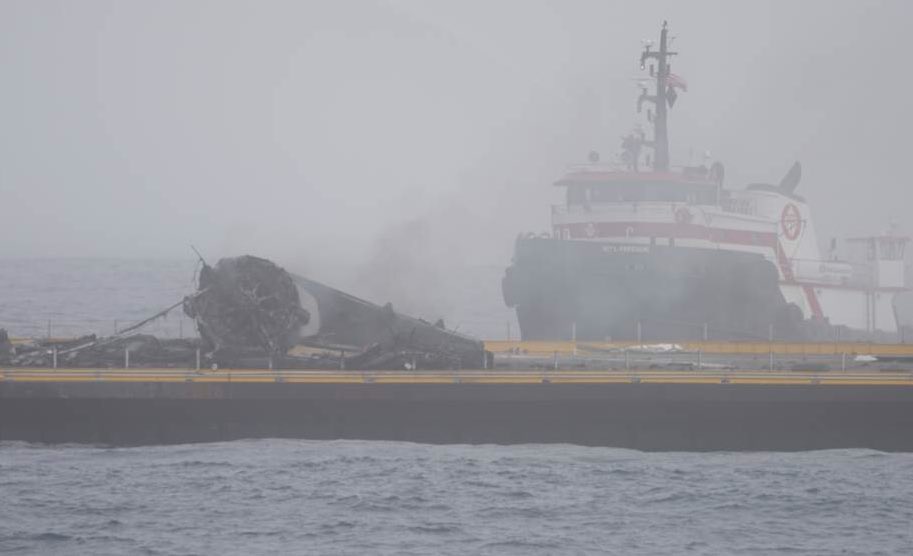
So IMHO, the fact that the rocket exploded is not the most pertinent fact about this experiment. The main piece of news is that SpaceX is exceedingly likely to be able to recover rocket boosters intact from sea, even in non-perfect weather conditions.
In any case, I agree that this was very close. I've also spent a reasonable amount of time on "big water" and was specifically watching the attitude of the landing deck with respect to the horizon. I didn't see much movement of the barge (but that doesn't mean there wasn't some instantaneous movement that together with the force of landing exceeded the leg's load rating).
The other thing that's struck me is that the SSTO advocates could end up becoming irrelevant. Who's going to argue we need SSTO at all if we can recover and reuse all the stages anyway? Multiple stages will remain dramatically more efficient (Yes - I know we don't get space planes with two hour flight times from New York to Tokyo quite as easily).
Finally ... I just have to say "I LOVE THIS". I remember as a child watching the Apollo missions and, as an engineer, I haven't been this excited about a project for a long time. Isn't this exactly the type of thing we can rally humanity around? Who's going to argue that it's not a great accomplishment?
Musk said the "root cause may have been ice buildup due to condensation from heavy fog at liftoff."
http://www.surfline.com/forecasters/blog/12_foot1.gif
(source: http://www.surfline.com/surf-science/wave-heights---forecast...)
And there's the issue: it only takes a tiny bit of imperfect to ruin a landing.
I do think that SpaceX is going to get to the point where they are recovering enough of their rockets to make it pay off. But there will probably always be a significant chance that some little thing will go wrong. Don't be fooled later by "we've landed 5 in a row" about that.
But for the tiny bit of imperfect: the same could have been said for the space shuttle, and that had people in it. And its fragility was a fundamental to its design (it rode exposed on the fuel tank with its critically important heat-absorbing tiles). And the shuttle still had a decent success rate!
I would argue that these failures are less fundamental to the design of the rocket. And the difference is that if, in the future, you have that 1/100 failure on landing, it's only a loss from a cost perspective, not a human one.
Now jet flight across the oceans in often horrendous conditions is 99.999% safe (ish).
The same happened with airplanes. Just something so simple as breaking sound barrier control inversion meant hundreds of pilots dying until someone figured it out..
Thanks to automation and telemetry, SpaceX is learning fast without killing anyone. In the past it was hard to analyze what went wrong when the pilot did not survive.
This is a pretty unfair characterization. It actually made the landing for most purposes, then a specific failure occurred - a leg failed to lock and it fell over. And yes, when a rocket falls over it will often explode.
Succeeded to land. Failed to stand.Why? Why would a small hit make it explode, when the stress of going from orbit does not?
Essentially the right parts just popped like a balloon. Falling on your side involves much different loads than being propelled into orbit. There's little value to designing a rocket to withstand such a fall.
http://www.wired.com/2012/10/ff-elon-musk-qa/all/
The reason they're cavalier about landing videos is that there's not much you can really take from them that would be useful to building your own version of this system. It sounds like much of their "secret sauce" is in manufacturing techniques, materials, and internal design.
https://en.wikipedia.org/wiki/List_of_private_spaceflight_co...
This is way better than back in July, when the booster blew up because of a strut failure. That was a major quality control failure.
In all seriousness though, this was by and large a successful landing, not to mention that they successfully put their payload into orbit without a hitch. The number of things that have to go right to even get that rocket to touch down on the barge is mind boggling. Truly impressive, and bodes well for the future of SpaceX.
Elon's twitter comment about the ice is interesting because it adds some interesting twists. If the stage is icing up as it descends it would change the mass calculation, however it does not seem to shed ice when it lands in the video. He suggested that ice at launch may have interfered with leg locking, which would mean that ice survived travelling supersonically through the atmosphere. But hard to figure how that could be.
Then a wire net between the posts.
When it tips over, it can just fall into the wire net.... they could even have motors to unwind a little while it leans over on them to allow "soft catching" the rocket. Foam over the wires would help here.
Actually... why not skip the barge & the dramatic landing and just catch it with a big underwater net? I suppose getting the rocket wet with salt water is not good? (the inside is covered with liquid spill indicators which void the warranty?)
1) As you say, salt water is bad. Do never go in salt water if you want metallic, electronic things to keep working.
2) The rocket can't withstand much, if any, load in longitudinal bending mode. It'll buckle like a toilet paper cardboard tube. This almost certainly includes under its own weight, if you were to 'catch' it at the top of the rocket and hold it on an angle. To design against that, you'd be adding way too much weight to the structure to make it worthwhile.
Also, we don't have giant posts and nets waiting for us on Mars.
But SpaceX seem to be exceptionally good at control systems, fast and precise automated planning. Maybe they will just skip the level of passive rocket catcher structures and intend to move directly to a three-axis actuated landing table? A system like that that could take responsibility for a tiny little amount of deceleration (think extra suspension) and a fair bit of balancing completely outside of the mass budget of the rocket.
How about a massive electromagnet underneath?
Sea water is also highly corrosive to many materials.
You can also have spearguns firing cords from the top of the rocket to the ground after landing, to hold it.
A working vertical landing mode that can also be used on Mars, Moon and other objects in the solar system is one of the major mission at SpaceX. Shipping a giant vat of non-corrosive/conductive liquid to another planet does not appear viable.
    ... the first stage of Falcon 9 v1.1 is
    capable of holding 119,100 Kilograms of
    Rocket Propellant 1 and 276,600 kg of
    Liquid Oxygen.
So even if it's 99.9% empty, it still can have 120 kgs of rocket fuel. That'll go with a bang.
And it's unlikely to land with only 0.1% of its fuel left - that margin is too small to be attempting a soft landing, so I'd expect it to be a lot more. Then compare with just 5 gallons (probably US gallons, about 19 liters, close to 17 or 19 kgs) of ordinary gasoline:
https://youtu.be/NCWunnJXdm0?t=180
https://youtu.be/Zl12dXYcUTo?t=32
Then compare to this dinky little explosion.
Doesn't take that much to make an impressive bang.
But empty the can, leaving behind just the fumes and the oxygen, and you have yourself a bomb.
My understanding is that the rocket here is a similar problem. It's a giant tube of explosive material. I wouldn't want to tap it with a hammer. And they've got it falling to earth at supersonic speeds, then calmly setting itself down on a barge at sea in 3m waves.
Seriously, I'm not being facetious. We make aeronautical hardware safe by flying the crap out of it. That means lots of flights. Lots of accidents. The more you fly it, the more problems you have, the safer it is.
Congrats guys. Every time gets closer and closer. A few more and you'll have this thing nailed. That's good for all of us.
One second, you're chilling out at -207 C with your bros and some kerosenes, maybe even stopping off in near space--then, out of nowhere your containment vessel is compromised and you're evicted.. expected to just phase change and mix with all those common atmospherics.
I think I'd react the same way.
I suspect there is also a termination system that deliberately detonates so as to control the mode of failure (i.e.: combust the dangerous stuff before it has an opportunity to mix with the other stuff and make things worse)
Any type of lateral forces will irreversibly damage the rocket. As an illustration, extreme care is taken when the rocket needs to be transported on its side. Some rockets, not the Falcon 9, can't even be transported on their side without being pressurized.
So pretty much anything other than a perfect soft touch landing would leave the rocket unable to fly again. Anything touching the 3/16" thick skin of the Falcon 9, would cause the very least extensive refurbishment at the least, but more likely irreversibly damage the frame of the 15 stories tall 1st stage. So this rules out every alternative that has been suggested in this thread.
2) Flotation devices attached to the booster = extra payload. It would be the canvas/dinghys AND compressed gas canisters for inflating them. This is arguably (a lot?) more weight than just landing struts + fins. Any extra payload on a rocket represents a massive cost and means less stuff you can haul for paying customers.
Actually parachuting and fishing the stage from the sea was their first idea, but they never recovered a single stage that way, and moved to active controlled recovery, which is much much much better in my opinion.
Yes, but how much extra fuel does the rocket have to carry to land? That's a ton of extra payload as well.
Further, the ocean platform it was landing on was built to sustain heavy seas and stay relatively flat. Recovering a rocket bobbing in the waves could be much harder than this. Also a challenge: quenching a very hot engine in cold ocean water.
No, this platform-landing is probably one of the simplest, safest ways to recover/reuse a stage.
Of course, you could just try to land it vertically on the water on some cushion and have more cushions deploy to make it tip over horizontally and float (all the time staying above the surface of the ocean). Such a solution isn't as compatible with recovery on dry land. If you want to do e.g. space tourism missions and land on dry land, the vertical landing seems better.
No they haven't. SpaceX started doing that in 2013 before the barge landings. I don't think anyone had ever even tried to land(sea?) a liquid fuel booster before that.
You may be thinking of the STS solid boosters, but solid boosters are really a different game. They can be built sturdy enough to hit the ocean at 60mph, but they couldn't possibly be simply refueled and reflown.
Landing in the ocean is only done for certain types of missions, where its not possible to carry enough fuel to turn the first stand around a fly it all the way back to the launch site. Instead, they can carry just enough fuel to land wherever they are finished boosting the 2nd stage, to put it simply.
I'd imagine that the barge landings introduce a lot of uncertainty and complicating factors that are impossible to completely nullify. High waves and (comparatively) strong open-ocean winds seem (to me at least) to make consistently successful lands much harder.
Nobody else does this. I have absolutely no idea what you could possibly be referring to. SpaceX lands on land preferably when it is an option.
> I don't understand why they won't keep landing them on the ground ... It's not like there's not enough space on Earth
As a general rule, you not understanding the reason for something does not mean there is not a good reason. For reference, see the Dunning-Kruger effect. Furthermore, I honestly do not understand how you could even contemplate "SpaceX does not think there is enough space on land" as a serious argument and treat its dismissal as legitimate support for your beliefs. This is some of the most egregiously lazy reasoning I have ever seen on the internet.
SpaceX launches rockets in the direction of water so that an accident won't threaten property or people on land. To return to land after staging the first stage of the Falcon 9 must perform a burn—the "boost back"—to point its lateral velocity back to land; this is the first of three burns required for landing and the most expensive in fuel by a considerable margin. If the first stage is travelling too quickly (greater than approximately 1.6 km/s lateral velocity) it does not physically have enough fuel to return to the launch site and perform the landing. In this case, a far more mild burn can put the booster on a re-entry trajectory and it can land on an autonomous barge in the ocean. As the rocket trajectory is chosen to put the ground path well away from land, the choice is between either returning to the launch site or landing in the ocean. If a return to the launch site is prohibited by the rocket's capabilites and physics then an ocean landing is the only option.
In the case of Jason-3 a barge landing was the only option as SpaceX does not yet have permission to use their landing facility at Vandenberg Air Force Base. In the future, the central core of the Falcon Heavy will almost certainly have to land in the ocean due to its velocity at separation.
No one else lands first stages. SpaceX is the first to do it.
I don't think big, over-engineered solutions really look necessary with the amount of progress they're making. Plus, there aren't any cushioned walls on Mars, which is SpaceX's eventual goal - use this sort of tech to touch down there.
Quick deploy cushions or other "Oops" enhancements might feature into the final version of the barge, but for now I think they're still trying to maximize the landing success rate. Better not to split engineering resources when the most important problem can still benefit from optimization.
(The Dragon cargo capsule has windows, despite cargo not needing to be able to look outside into space -- the windows are there because the capsule is designed to eventually carry humans some day.)
Big world out there...surely some suitable location can be found that is less wobbly for a start.
They put the barge downrange so less fuel will be needed to turn around and land, enabling first stage landings on beyond-low-earth-orbit launches.
Also, didn't this portion of the rocket land before the satellite was deployed?
ie. maybe the rocket descends several feet INTO the dock into a hole which then locks around the body of the rocket?
     ||
     ||
   ==||==  dock (which opens wide for decent and then closes)
     ||
^^It might be possible, but we're talking about a rocket descending from hypersonic spaceflight; the accuracy is always going to be +/- a few metres. And the rocket would still have to have some kind of "hardpoints" that were strong enough to absorb the landing impact (you don't want to land smack on the delicate engine nozzles). A (relatively) big flat landing field and legs on the rocket itself seem like the smart approach (and Musk wants whatever technology they use to be usable for landing on Mars too).
I mean what if the legs were damaged during launch somehow, how exactly would it get back down safely other than just dropping it in the ocean completely?
You also need to land completely vertically, and it looks like the stage comes in at an angle on its suicide burn.
They'll fix the landing leg problem somehow.
Forgot about the mars aspect.
b) The headline makes this sound like a miserable failure - still beats "fell into the ocean never to be found again", as all other current first stages do.
Musk posted an early statement blaming icing due to bad weather conditions. https://www.instagram.com/p/BAqirNbwEc0/
...and of course press is overly sensationalistic. nothing new there to report.
b) true :)
Current first stages do exactly what they are supposed to do extremely well.
The landing failed, but it's part of a test program, failures are supposed to happen.
They got paid ~$90 million for this flight, and the customer is happy because they got exactly what they paid for.
edit to add some facts since this seems to be getting downvoted pretty quickly: Stage 1 landed and exploded at around T+10min, the satellite was deployed at T+56min. This was just two minutes after it was delivered on its final orbit. Both of those could be considered "delivered to space", neither of which happened before the failed landing.