Meanwhile - none of my friends in the "real world" (outside the HN bubble) seem to be affected by this at all. I have a client that's a Cloudflare customer and they got an email saying they just weren't affected. And I haven't seen any huge leaks or items in the press about some terrible hack or theft that has brought someone or a corporate "down".
Should we always take news like this with a grain of salt? When can we tell when an attack like this is a fundamental undermining of the entire internet infrastructure, an attack that will cripple a few major companies, or just an issue that revealed some data but was mostly just overblown? Would love to hear some opinions!
Some people's accounts will be compromised, and nobody will know if it's been due to fishing, insecure passwords, or an information leak such as the Cloudflare bug, or an undisclosed or undiscovered breach somewhere.
The more responsible Cloudflare customers have invalidated existing sessions; that's much less hassle than forcing a password reset, and since session tokens are transmitted in every request, a leaked token is much more likely than a leaked password.
"Not measurable over the background noise" is a pretty workable definition of "no fallout".
Lacking tools to measure an effect doesn't mean it has no effect.
Criminals are taking advantage of opportunities like this every day, still no one cares too much about it (HN bubble & friends excluded).
Things like this may have a strong impact or not in the press/popularity circus, but in this particular case it seems they promptly monitored the situation (thanks to their competent staff).
What most surprises me is that their highly competent staff is thoughtlessly violating one of the security principles in sw : SECURITY BY ISOLATION .
No one (no matter how able you are) can write absolutely bug-free algorithms : even when dealing with formal verified software you can still attack the assumptions.
Security by correctness is a laudable effort, but computing customers data with a single process is not sane. I'm aware they're doing this for performance reasons, but a well implemented isolation layer would have prevented this (even while dealing with a bug like that).
Their architecture is vulnerable.
I don't think this is really true, but I'm open to hearing your thoughts on this. There was a bug in their HTML parser which caused unrelated memory to be dumped to the process. Their SSL termination servers were isolated elsewhere which is why SSL keys weren't dumped into public caches.
Where would you like them to draw the isolation boundary? Per function? Per rule? Per service? From what I understand, these processes were a part of a single service, but not every request was using each type of rule.
Even if they'd only had customers using their html parser isolated on separate servers, other customers would have been affected even if their HTML was perfectly valid according to the parser.
That's roughly what we do, though we run an hosted version of an open source webapp, not a CDN. It's more expensive resource-wise (particularly RAM), but it has meant that we were immune to 90%+ of the security bugs discovered in the platform.
Suppose you're a "bad actor", knowing this is a shared service, wouldn't you look for 0 days in it ? A carefully crafted exploit has the potential to leak specific content from unaware customers again.
The attack surface is nginx (http://nginx.org/en/security_advisories.html) plus each component of each loaded module ...
It would be saner to apply isolation to each element of the cartesian product between customers and services.
The performance (and cost) impact can be mitigated by scheduling resources over a pool of disposable virtual machines (obviously in xen and with iommu protection), but I bet they can develop even better solutions.
So, as perlgeek says, we'll probably never know specifically what the impact was.
The stuff that got cached was just the persistent vulnerability, there's no way to know how many people noticed the issue taking place in the direct requests they were making.
I have no idea what Google employees have access to. I've always wondered whether they can hand-code their own MapReduce syntax over Google's actual Web index (I could find SO MANY THINGS if that were possible!). I wouldn't be surprised if the cache data <-> index were accessible to everyone who's been around for >6 months, so they can tinker with it.
But I guess the only reason I'm able to type this is that I haven't signed The Large Book Of NDAs (I presume it's large).
Second NDA: If it's not published on a Google domain, you have to make as abstract as it gets
- http://www.goldsborough.me/google/internship/2016/11/18/01-5... - has some interesting tidbits; for example, I would not mind a visit to the Google Store :)
- https://www.reddit.com/r/Amd/comments/5x4hxu/we_are_amd_crea... - The last paragraph in this recent AMD AMA was a real "OH I get it now" eyeopener for me about NDAs and not announcing stuff AOT; tangentially related
Indexes, and yes, in a few ways. Some even have nice frontends. You actually have access to one of those.
I know I've wondered a lot about this subject for a few years, but I can't remember anything at this exact moment (just got home from being out). If you feel like poking me (contact info in profile) from some sort of anonymous email, that would be awesome, I could get back to you.
By the nature of the bug, the likelihood of any particular individual having any meaningful exploitable information exposed to somebody in a position to exploit it is astronomically low. So most ordinary people are ignoring it, and justifiably so.
If you're responsible for security for a site that sends traffic through CloudFare, then it's a very big deal for you. You'd better be quick on the trigger to see and react to this stuff, and you'll have to mass-reset sessions at the very least, and possibly reconsider whether you really want to be terminating SSL at CloudFare. Exactly because, while not much has probably been exposed, you will never be able to be sure what was exposed to anyone from random hackers to the whole world, via search engine caches. So a broad reaction is justified.
And of course people who like tech but aren't actually responsible for any sites being served through CloudFare tend to react the most. Even though it's not a big deal if you're already doing all of the standard security precautions, like different passwords everywhere and 2-factor authentication on anything important.
So even if the sky didn't fall that's no reason to pretend this wasn't a big deal.
End of what? It will just give rise to slightly more secure, improved services (maybe be the same providers, maybe by competitors, but definitely financed and implemented by the same people).
> And I haven't seen any huge leaks or items in the press about some terrible hack or theft that has brought someone or a corporate "down".
Look at the Sony/PSN breach; there has been zero accountability, and it has not hurt the PS4 launch at all. Consumers just don't give a shit.
The bigger thing was the grandiose scale, the impact on administrators in having to rotate a significant number of credentials, and the hit to CloudFlare's reputation. A bug where you randomly dump random data without regard to its sensitivity or origin (i.e., data from completely unrelated sites could've been included in the dump), and have no way to tell what actually leaked, is the worst kind of privacy bug there is, precisely because it's impossible to triage. No one can ever know everything that actually got out.
CloudFlare is now a major piece of internet infrastructure. It's impossible to know that anything sent through a CloudFlare server between Sept 2016 and Feb 2017 wasn't accidentally publicly leaked, and worse, non-trivial quantities of this data were being accidentally saved permanently in search indexes. Surely some bad actors have saved such results in their own private indexes as well.
When CloudFlare says "your site was probably unaffected", they're making a guess, because they have no way to actually tell. They're just assuming that based on the volume of requests your CloudFlare endpoint receives and the volume of requests made to endpoints that exhibited this bug, content from your site probably didn't get out. But there's no way to know.
If we take that seriously, it requires us to consider everything that went through a CloudFlare server as potentially publicized and preserved in the public record (including usually-transparent unique identifiers like session cookies/tokens). We then have to assume that an adversary obtained any and all such data, and respond as best as we can to preclude the possibility of that adversary exploiting the leaked secrets to harm our and/or our company's interests.
Of course, the flip side of the sheer scale of this, and the fact that the bug was relatively rare and that there was no way to control what content it dumped, is that it's very unlikely any of your data specifically actually got leaked.
If you and/or your company are OK with crossing your fingers and hoping this won't affect you, there is probably a 99.something-something-something% chance you'd be right. Most people have responded by resetting tokens/passwords for anything that uses CloudFlare, since that's relatively low-impact and most people were probably overdue for a credential recycle anyway, and have left it at that.
This does clearly illustrate that the internet has a few de-facto junction points, which would be very high-value for an attacker. That's worth keeping in mind.
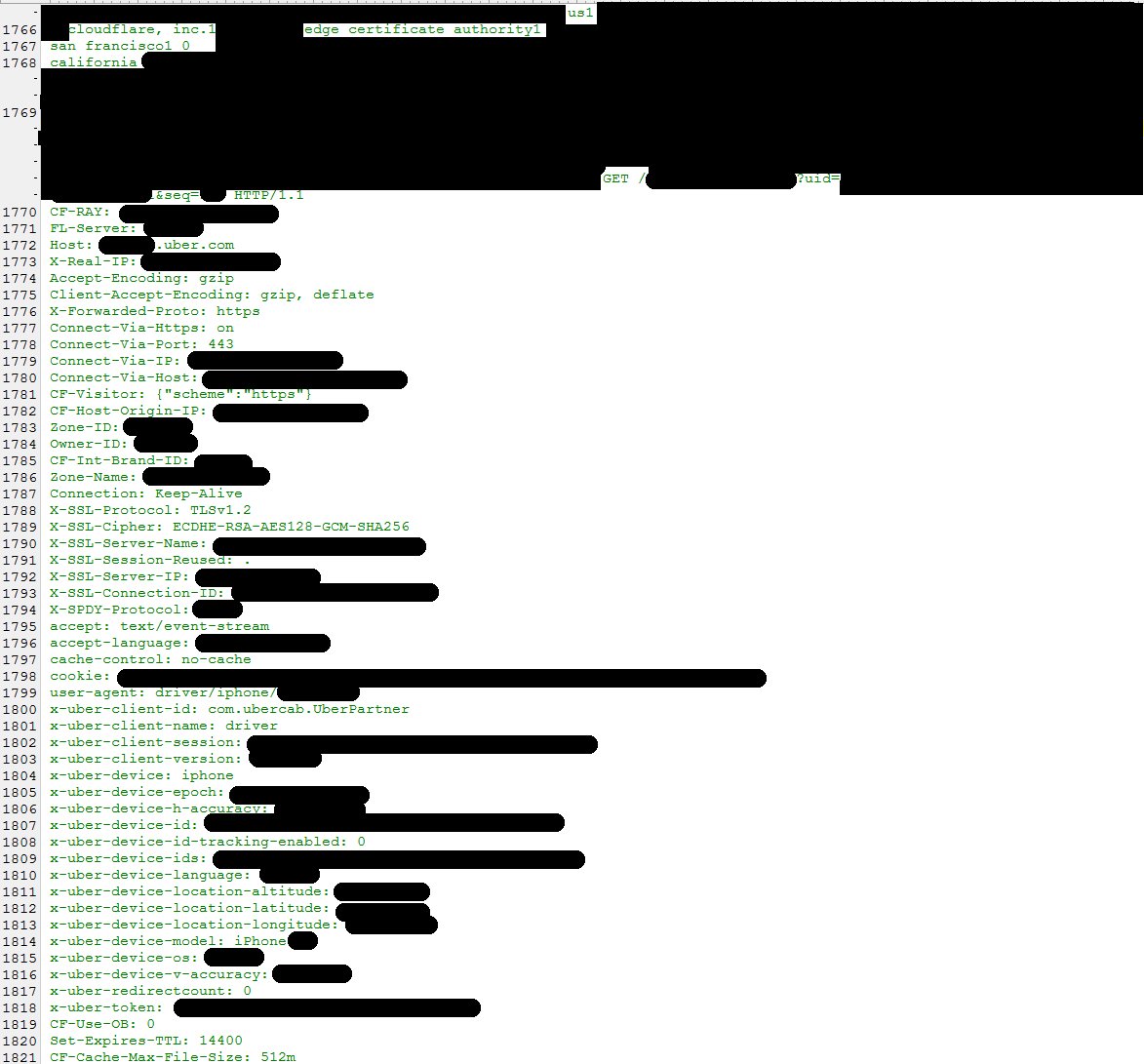
Uber: http://securityaffairs.co/wordpress/wp-content/uploads/2017/...
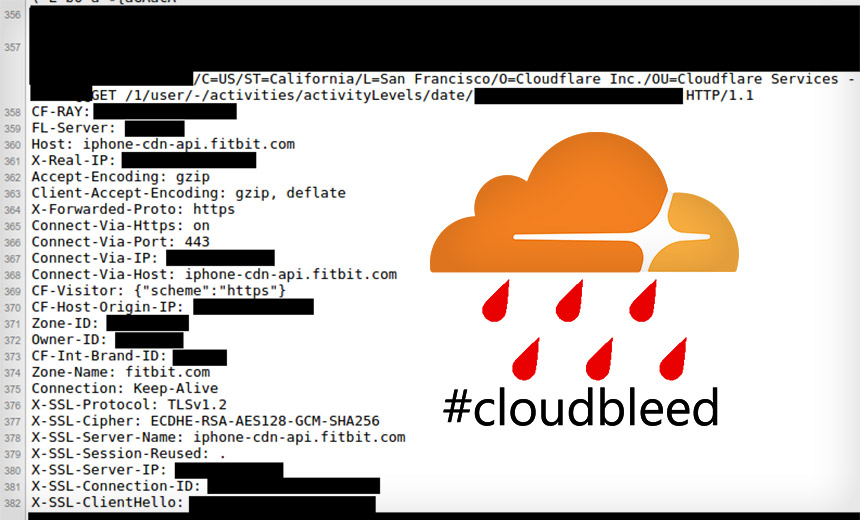
Fitbit: http://cdn.iphoneincanada.ca/wp-content/uploads/2017/02/clou...
OkCupid: https://trtpost-wpengine.netdna-ssl.com/files/2017/02/cloudb...
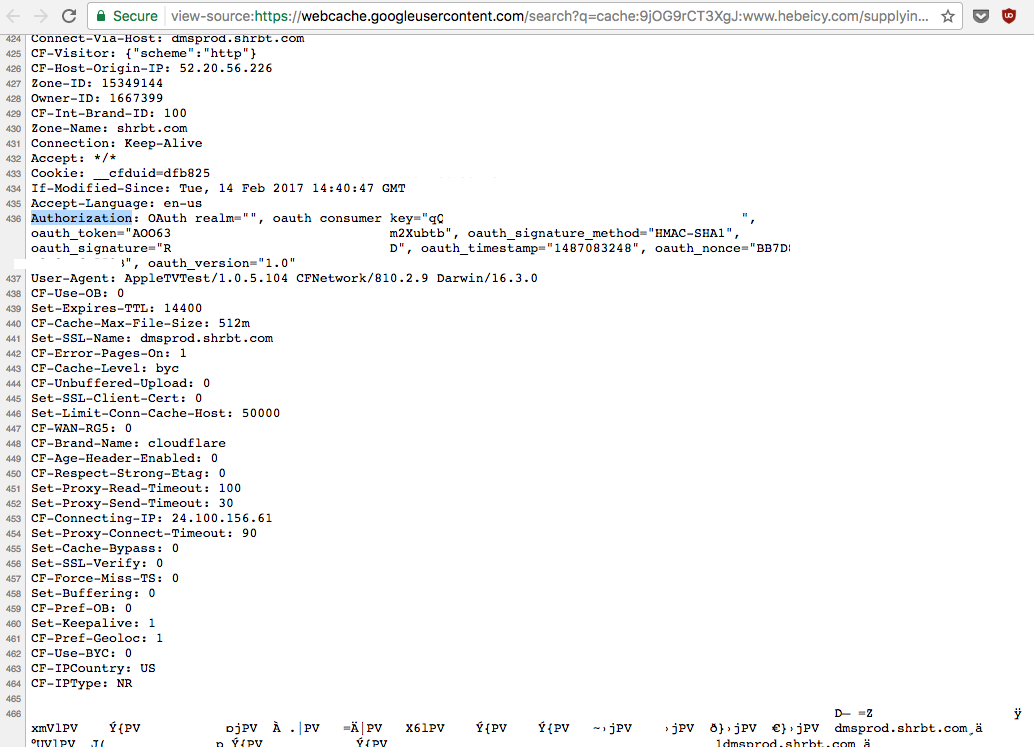
Oauth data: https://pbs.twimg.com/media/C5ZCRtMVMAEs0ca.png
Or were you asking about some consolidated treasure trove?
The real risk, to me, is that someone noticed this before Tavis did. They could have created a site with the right parameters and then scraped it for weeks. Cloudflare only had logs for 10 days of the multi-month exposure window, so they have no idea if someone did this or not.
Realistically, this will probably only be exploited by intelligence agencies who have the means of collecting all the data and motivation to do so, and maybe not even them (because they have better ways too). If they do exploit it, the nature of intelligence agencies, of course, means that you typically won't notice any direct impact.
The reason why this caused such a big panic is that while the likelihood of your password being compromised is small, it could have hit anything, and by conventional wisdom, any password/key that _may_ have been exposed, even if the likelihood is small, needs to be considered compromised. Hence, "OMG everything is compromised".
Another reason was probably that it was a really scary wake-up call demonstrating the risks of centralized services. Cloudflare is a Single Point of Failure for a lot of security, but that is easy to push aside until you see it failing.
Realistically (and I'm going to get a lot of flak for saying this) the correct way to handle it is to rotate extremely high-value credentials (think Bitcoin exchangs, administrative access to major services, ...), reset sessions if you're hosting your website on Cloudflare (since session tokens are much more likely to leak than passwords, and the cost of forcing users to re-auth is small especially if your sessions expire regularly anyways), and then call it a day.
In particular, keep in mind that for high-value services, you're hopefully already using 2FA, so even if an attacker did get your password through this, they probably don't have your 2FA token (although Kraken, a Bitcoin exchange, pointed out to their customers that they should re-setup 2FA if originally set up during the vulnerable timeframe, since the key used to derive the 2FA could be compromised).
People's passwords, identities, and bank and credit card details will have been leaked. Identity theft and other fraud will happen as a result of this. But we have systems in place for dealing with it, and ultimately life will go on. I've had fraudulent charges on my bank account; it was a serious inconvenience at the time, but it wasn't life-changingly bad.
Yet since $AAPL released the new MacBook Pro (Oct 27th '16), their stock is up 24%, with a breakout record Q1. Let's not forget that the entire market has been in an epic bull run since Trump took office, so perhaps that is a factor.
Source ($AAPL vs Dow Jones and S&P since Oct 27th): https://www.google.com/finance?chdnp=0&chdd=0&chds=1&chdv=0&...
Don't believe what you see on HN all the time. People here are incredibly intelligent for the most part, but there is frankly lots of disconnect from reality. In my opinion lots of conspiracy theorists, purest, and some social justice warriors pushing agendas.
My opinion... But I think we can bundle GitLab, CloudFlare, and Uber into categories of will be just fine.
I doubt anyone who wrote those blog posts or comments on HN believes that this product would cause Apple to go belly up. Apple is literally one of the biggest companies in the world by any measure. Having a mediocre product is not going to tank Apple immediately. Being more and more complacent on their part will cause that.
To see Apple's future just look at what happened to Microsoft in the early 2000s. They got complacent, but they still had that sweet, sweet, Office money right?!
Not liking the latest Apple product, and then showing their stock price as proof those people are "disconnected from reality" seems a bit of an overreach...
Nothing bad will happen to Cloudflare (I'm not sure if something "bad" should even happen...?) because no one knows what a Cloudflare is, and even if people's accounts start getting hacked, how can anyone conclusively determine that it was through this Cloudflare bug?
http://www.theverge.com/2017/2/1/14468090/apple-q4-2016-earn...
Otherwise it would have been a down quarter, no?
I have now transferred every single one of my domains away from namecheap
I also installed the following extension, and now watch what I put into cloudflare pages: https://chrome.google.com/webstore/detail/claire/fgbpcgddpmj...
Even if your friends know 100% that they can't possibly have been negatively affected by tons of private information being dumped all over the internet, I'm not sure how such anecdotal evidence is any more instructive than a HN "bubble".
Even if nobody at all ended up negatively affected in any serious way, I don't see why people shouldn't remark on the potential effects of such a fiasco when it happens. Was anyone really predicting "the end"?
Yes.
Except this fear is part of our income source like the TSA, except they are more like 100% IT is a bit less.