I don't think I'll ever fully wrap my head around the kind of numbers that implies, that when light is at approximately sea level it is accelerating at 9.8m/s^2 toward the core of the earth and the only reason it doesn't all get dragged out of the air and to the ground is that it moves too fast to notice.
(... and then 10,000,000 ns for your brain to process it...)
Thought experiment: which will curve spacetime more, a 1kg box of gas at 1K or the same box after the gas inside is raised to 293K?
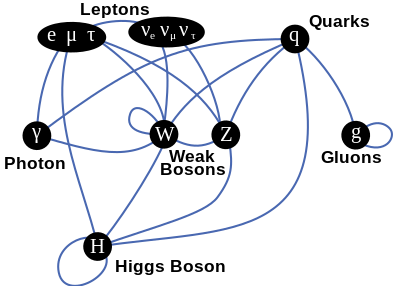
Photons, for instance, cannot interact directly with each other via the electromagnetic field. Gluons do self-interact via the strong interaction. But both photons and gluons interact with all types of particles via gravity (although sometimes this interaction is so small that we would never be able to measure it).
If so it resolves the mysterious central relationship this field has for all the others.
What?
> because photons have rest energy (=> kinetic energy) that can be viewed as mass in special relativity > [...] > impact the gravitational field despite having no inertial mass (=> rest mass)!
Speaking of "mass" in context of relativity is always a bit tricky. The term "inertial mass" for example is really saying something about how an object behaves under the influence of a force (F = ma), not how it behaves relativistically (that would be "relativistic mass", E = mc2).
Can anyone with with real knowledge of gravity comment on whether these two intuitions are correct?
Having said that, your intuition that photons should have gravitational influence makes sense, since according to special relativity, mass and energy are equivalent. Since total energy (mass + energy) is conserved, the gravitational influence of the photon should equal that of the electron-positron pair (assuming they are all located at the same position). I think the article is agreeing with this point of view.
But on further thought, I wouldn't be surprised if some changes in the internals of the box could produce gravitational waves, so maybe my intuition for this is wrong. Although if I further clarify that the box isn't supposed to be emitting energy (which will obviously reduce its gravitational influence as it loses energy), then maybe the intuition is correct after all...
"the conventional electromagnetic fields, and the photons that constitute them, impact the gravitational field despite having no inertial mass!"
Does that mean the build up of the photon sphere around a black hole would have a significant impact on space time?
The article explores the idea that pure kinetic energy in form of photons indeed might have at least gravity-like properties.
My presumption is that atoms are somehow made of really high energy EM fields so that they appear to be massive. Consequently, atoms having mass or photons having inertia are responsible for gravitation, and that could mean that EM fields are the cause of gravity entirely. The problem with that presumption is that perhaps there is no way to check.
Edit: ok so really there is only theoretical evidence of an electroweak field at the beginning (electromagnetic field and weak field are not independent at high energy) and everyone is currently hard at work trying to 1) figure out the “Grand Unified Theory” that will putatively integrate the strong force with the electroweak force, and 2) figure out how to rethink either gravity/spacetime in a quantum context to integrate it with the quantum GUT, or unquantize the GUT (not likely) so it can be combined with spacetime...