As a full-time firefox user, I commonly find that sites have bugs, and when I boot it up in Chrome just to check my hunch, they don't manifest. It's pretty easy to figure out what happened: The developer wrote his code, tested it on chrome alone, and then called it a day. No one booted it up in another browser and even smoke-tested to see if basic use-cases work as intended.
If developers are genuinely concerned with browser diversity and not handing the Web over to Google and whatever they deem to be the next IE6, it starts with having a test plan for other browsers. Testing on only one platform is tantamount to having official support for one platform because you only guarantee your product to work on that platform in so many words. Officially supporting one platform is pressuring your users into a vendor-lock.
They - even the tech savvy ones - can't even begin to make vendor choices when the products they use accidentally lock them out left and right.
I'd say it starts with dialing back the "new feature/change fetish" that a lot of web developers have. Yes, I know some things simply can't be done without a JS webapp, but not all and probably not even a majority, so if HTML and CSS will do the job fine, then so be it; and even if it needs to use JS, it likely doesn't need to be latest-browser-only JS either.
The constant "X is bad, use Y; no, Y is bad, use Z; no, Z is bad, use..." churn and that "push the web forward" trendchasing seems to be so entrenched in "modern" (there's another buzzword) web dev culture that I wonder if Google/Chrome is responsible for cultivating and propagating it, because it's not quite as endemic in other areas of software and also helps Chrome keep its monopoly, since it keeps the target moving and beckons at others to "catch up".
I think web developers need to adopt a more "do what you can with what you have"/demoscene-ish (for lack of a better term) attitude and not the silly "I could do it with just X, but I'll use Y because it's newer/better-but-I-can't-explain-why-and-everyone-else-is" that really just assists Google's monopoly. In other words: Writing a webapp that could work over 20 years of browsers may not be as hard as it sounds (I've done it --- and I'm not even a web developer --- which might be the reason why...), and you will definitely help browser diversity that way.
Sticking to HTML and CSS won't necessarily get rid of this - new stuff is being added to CSS all the time, in particular. And browser support is just as patchy.
I wonder whether this phenomenon is driven by HTML, CSS, and JavaScript being such lacklustre tools for building applications?
Many things that are completely reasonable to deal with in any “native” stack (animations, local storage, offline access, hardware access, accessibility just to name a few), while usually possible with a web stack, are often unnecessarily difficult or awkward.
Things are improving fairly rapidly because of the insistence that everything should be web based these days, and I could totally see that driving people to the bleeding edge.
I mean hell, I do it myself. I’m a web developer, and when reading about shiny new features I’m often eager to start using them ASAP — especially when it would replace a bunch of kludgy JavaScript I’d been relying on previously.
Most web pages will not need any JavaScripts, although some might need it. And in some other cases, optional JavaScript might help, such as to auto-fill or validate a form, in which case the form will still work with JavaScript disabled. (Also note that, for example, Lynx does not implement JavaScript.)
For some of that, my idea of a <widget> element might help a bit. It would improve performance, allow better user customizations, allow enabling some functions that would previously require JavaScript even though JavaScript is disabled, and is compatible even with browsers that do not implement <widget>.
CSS is also overused, although even if you use it, you should try to also allow working without CSS in cases where such a thing makes sense (which it often does, although not always). (CSS styles often just make stuff worse in my opinion anyways; that is why I put in my own CSS codes for stuff.)
I think, the end user need to have enough ropes to hang yourself and also a few more just in case. The entire control of the interface should be controlled by the end user.
Also, these web pages and HTTP(S) are rather overused anyways. There are other protocols, such as Gopher and Telnet and SSH and NNTP and IRC, which are better for some things (and worse for some things, too, I suppose). (But multiple protocols and multiple interfaces can be offered if wanted, anyways, I suppose.)
But modern frontend stack - with the whole pile of transpilers, uglifiers, and what not - is almost unusable with Firefox, because source maps don't work with Webpack.
https://github.com/webpack/webpack/issues/1194
This put me in a position where I had to choose between switching to Chrome for development or not using Webpack that comes nicely integrated into the web framework of my choice.
I went with ditching Webpack, but it's hard.
https://stackoverflow.com/questions/55669725/require-module-...
Developers will not use Firefox if FF dev tools are inferior to Chrome.
Some comments from devs:
> Can we please fix this? I don't want to choose Chrome as the browser only coz of this issue.
Mozzila took notice of the issue after 4 years...
Also a full-time Firefox user. This is fascinating because I quite literally cannot remember a website for which I had to switch browser so it would start working.
What kind of websites are these? Have you noticed any pattern about them? Perhaps it's a certain type of site that I usually avoid.
With Safari or Chrome, I can select the dropdown (by clicking it or navigating there using the keyboard) and then enter the letter or number on the keyboard.
With Firefox, I have to click on the dropdown, scroll down looking for the right letter/number and then select it with the mouse. It takes at least 10 times as long as with other browsers. So I'm not using Firefox for that site.
Of all the interactive sites I use regularly about 10% have some sort of bug when visited with Firefox. And this is getting worse at an alarming rate.
I think many mainstream sites not created by actual tech companies have simply stopped testing with Firefox.
(I don't use ad blockers, just browser default settings)
In all that time, I don't think I've ever seen a Firefox-specific bug or layout issue.
I saw them on IE all the time (obviously), sometimes in Edge, rarely in Chrome, and never in Firefox.
The other issue is that it does not use Windows ca store for certificates. When company uses internal certificate authority for internal websites this requires users to manually update the browser cert store. Chrome and Edge will use windows ca store on windows. My it dept will not automate this but will manage the windows ca store.
I do see quite a few sites that apparently never have been tested with ublock or privacy badger, but they break on all browsers where those are enabled.
And then I have to redo all the ordering process on Chromium.
It for long failed on Visa 3D secure (so not website dependant) until I found why with Badger blocking it.
But often when the payment system is included in the website it fails (and that’s really annoying)
Every damn time.
I also have a big issue with their handling of webm/webp. There was one single guy at Mozilla killing that for years - may still be - despite heavy demand for support.
Both were really disheartening because it showed that Mozilla had lost its fight and had become so complacent that it didn’t even feel the need to match its competitors much less try to lead.
On the flip side Chrome has now become so comfortable with their position that their users are more of an annoyance, which lets them do very unpopular things like pinching off all of the ad blockers. This is where Mozilla could make a comeback because I think a lot of people (myself included) would take another look at Firefox if that is what it took to keep ublock and ghostery functioning.
I've had bugs where the site doesn't work in Firefox but works in Chrome, but as far as I can tell, those were always caused by the aggressive privacy settings I use in Firefox (whereas the Chrome profile is mostly default).
I'm not particularly concerned with the article's complaint about onboarding. The problem is that Firefox is simply slightly worse (less polished, often slower) in many, many aspects.
On Desktop, Firefox is quite usable, even if it is a bit less polished than Chrome.
On Mobile, it's another story. The only thing saving it is the fact that Chrome doesn't let you install extensions, so you have the choice between an ad-filled web on a browser that runs well, with the ads slowing you down (with Chrome), and a clean web in a slow browser with an unpolished UX and infuriating bugs that don't get fixed (with Firefox). So far, I'd say the two experiences are comparably annoying.
You can report sites broken in Firefox (or other browsers) at https://webcompat.com/. Mozilla web developers will debug the broken site and either file a Firefox bug report or try to reach out to the site developer.
Mozilla even has a convenient Firefox extension to make reporting broken sites quick and easy:
https://addons.mozilla.org/en-US/firefox/addon/webcompatcom-...
I don't know if meeting online counts: I'm bothered by Mozilla having a partnership with Google. I'm bothered by the fact that Mozilla maintains an official Facebook container but the Google equivalent is left to the community, I can't help but think that the reason why there isn't an official Google container by Mozilla is that Mozilla and Google have a commercial partnership which apparently provides most of Mozilla's income (as per link provided in the article).
They do already a great job with documentation, but they could and should improve on the dev-tools.
Chrome dev tools are now in a state, that I only use them for developing and debugging. Built in code editor with autocomplete. And I can debug ... and change code while debugging. And it works great (mostly).
Firefox dev tools on the other hand barely work for me to do some debugging and it is no joy. So no wonder more and more developers skip it alltogether, given the low market share of firefox.
This is a game of reducing friction incrementally, not big ticket bothered by it
Web developers can help by using and endorsing Firefox in their coding tutorials/videos/screenshots.
And guess what? Sites that appear to have bugs in FireFox, when I switch the user agent, suddenly render just fine.
Example: Before FB rolled out the FB Live feature to everyone, it was "Chrome only" until I figured out that a simple UA switch made it work.
No, I won't trust you to say "It doesn't work in FireFox" because one of the biggest companies on this planet said the same thing and it was an outright LIE. If you're actually coding to real standards, and not the crap Google dictates, your shit will work right down to Lynx (because you'll also be following best practice for the disabled.)
Good job demonstrating that you don't really know how to make a web page.
I don't. I don't understand how Mozilla has over a thousand employees and over 500 million dollars in annual revenue. With that kind of money, Firefox should be absolutely dominating the browser space. They shouldn't be making Firefox worse with advertising in order to subsidize their flailing around trying to find traction in mobile or VR.
It actually reminds me of Wikipedia, especially with the donation links littered throughout the experience. They're both growing out of control, spending mountains of cash in order to justify spending previous mountains of cash on ventures that nobody asked for or wanted. The whole point of Mozilla is supposed to be Firefox and Thunderbird.
Mostly agree.
> The whole point of Mozilla is supposed to be Firefox and Thunderbird.
I can understand your view. With that said, I am quite happy they funded Rust and also gave a grant to the Godot project to develop their webassembly interface.
I agree, but it seems problematic they aren't monetizing that. They're making money doing the things users don't really like while not making a dime of good things like fostering a legitimate free and open web.
https://www.mozilla.org/en-US/mission/
Firefox, Thunderbird, and other projects are a means to that end.
firefox (different spins) and thunderbird appears to be about it at this point. I'm glad for the work they do but I also find the entire size of the operation staggering.
And the whole point of Google is search? I think it makes sense that Mozilla would expand into more than just Firefox and Thunderbird. They’re a software foundation so limit themselves to a browser or mail client? I like the fact that they’ve becomes champions of privacy and internet safety.
Agreed though. What they’re doing is technically hard but you would expect Mozilla to do more.
Which failed but somehow found a new lease in life in 3rd world countries now. https://en.wikipedia.org/wiki/KaiOS
>they’ve becomes champions of privacy and internet safety //
Two years or so ago I'd have agreed.
Mozilla dropped Thunderbird years ago. It is now an independent project, financed through independent donations.
What's Chrome's budget?
Usually public corporations are shaped in order to maximize profit and market share. But Mozilla doesn't have to report to someone else, so no one forces them to spend money economically, especially as the Corporation is being controlled by the Foundation who hasn't primarily economics in mind, either.
Additionally, Mozilla has grown exponentially between 2007 and 2014 not only due to a superior product but also because IE was bad, and the web grew exponentially and thus browser usage grew exponentially, too.
Mozilla has inherited a large userbase, and they are in an extremely comfortable position where they can be lazy and do not experience any immediate consequences. Employees earn a lot at Mozilla. Mozilla's own post-mortem of the extension-outage has also hinted at a systemic mismangagement inside what is nowadays a pretty complex entanglement of different groups working on similar stuff while not communicating efficiently.
Mozilla has a leadership problem.
Their business-relationship is not with the users, but the search engines who want to monetize the user base, and due to the exclusive deal with Yahoo for 2015-2019, losing 80 million monthly users within 2 years did not translate to a loss in revenue, revenue actually continued to increase despite user loss. So why care?
I suspect the CEO just resigned because he knows that 2020+ will be extremely difficult for Mozilla, as the Yahoo deal is running out, and for the first time ever mozilla will have to spend more money than they recieve. Lack of money will also be the only real motivation for Mozilla to change fundamentally.
EDIT: It was 136 billion in 2018: https://www.statista.com/statistics/266206/googles-annual-gl...
And even if it was, Mozilla shouldn't try to chase that revenue. It should generate only enough revenue to sustain and futher develop web technologies which allow people to stay free on the web.
The figure is pretty much correct. To put things in perspective, though, only a fraction of those thousand people work on the actual browser. And, of that fraction, an even tinier number work on the rendering engine.
The Chrome team, on the other hand, has pretty much the same number of people of the entire Mozilla (or MoCo, to be specific) but almost all of them work on the browser/rendering.
> How does an average user get started with Firefox?
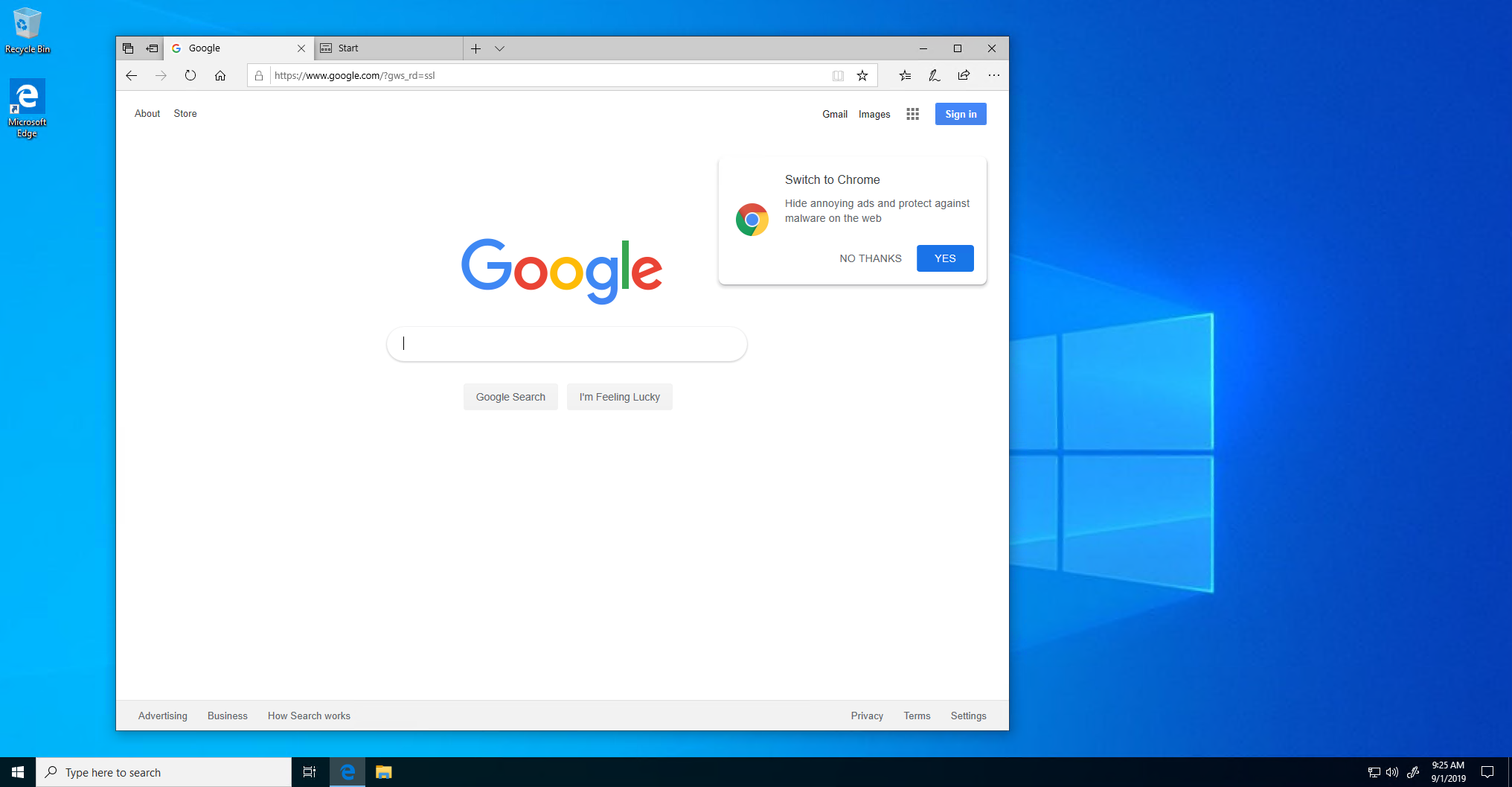
This misses the elephant in the room : the main reason Chrome is eating other browsers is that Google is putting its advertising might behind it. You know that little "want a better browser" pop-up displayed on Google's search engine? That's an absolute killer for other browsers.
stating that the only reason chrome is ahead is because advertising is disingenuous: firefox only started catching up with them only in the last three-four years performance wise and the gap it's still there.
I might be wrong, but with WebRender, isn't scrolling now done asynchronously so it doesn't stutter while things are loading? I certainly haven't experienced any scroll stutter since I turned it on.
I actually do not know what you're talking about. Been using Firefox for the last few years and haven't seen this pop-up once.
https://i.judge.sh/any/Diamond/WindowsSandbox_hE75Eaor7Z.png
I'm not so sure about that. First of all, most "normal" people I know don't actually know what a browser is ("open your browser" - "my what?" - "... open the internet" - "ohh, okay!") nor which one they are using. I've never had anyone ask for help in switching browsers - unless something is seriously wrong with the one they have, they don't see the alternatives, and most users aren't adventurous, they don't want to mess with their computers "just to take a look".
A month later I get a call from him asking about why he is unable to find gmail and facebook. What happened is that my grandpa ended up with google chrome on his machine, which obviously did not have the pinned sites on the front page.
Here's the real kicker - He does not know the difference between about "firefox" and "chrome" and browsers, nor he did not install any other app that bundled google chrome with it. He did not go around adventuring with his browsers.
He was literally baited by google into installing chrome in a completely sneaky and underhanded way. How? Through the front page ads.
Ironically, whenever I've complained about those irritating first-run experiences (not necessarily for Firefox, but for other software), the response has always been "that's for the non-technical users". Remember that these users are accustomed to/desensitised to being bombarded with adverts and such, so perhaps it's not as irritating to them as it is for us. Ideally, I think the first-run experience for a browser should be to open a blank page with the address bar focused and ready for you to type a URL into; but maybe average users are so used to that bombardment of attention and mollycoddling that it would look "broken" to them.
I'm not sure if those users care much about privacy either, which seems to leave the only other reasons to use Firefox being more control/customisation (which is itself slowly disappearing...) and "not controlled by an advertising company", the latter a not-so-compelling argument for the non-technical user.
Firefox is in an unfortunate position, especially as it tries to become more Chrome-like; I don't think that's going to make it gain more users at all, and on the other hand only serves to anger its already-small userbase and threaten to drive them away.
My ideal browser is one that doesn't require any installation, is a single tiny executable that starts instantly (to a blank page, as mentioned above), and is both fast and low on memory usage. I wonder if that "instantness" or ease of using it for the first time might appeal to non-technical users.
There's nowhere better; Firefox may not be optimum, but if you don't want rebranded Google crap, you have basically no choice.
Maybe there's Safari, Epiphany, Konqueror: but only one of these is serious and it requires you to be willing to buy a Mac - which is clearly an easier choice than Google for an anti-Googling estranged Firefox user - but still not a likely choice if the reason you're leaving Firefox is they took away your options.
Epiphany took away all its options years ago, and now it's main purpose is to be replaced with Firefox.
I've barely used Konqi, but it doesn't seem like it's any more viable than Epiphany. It looks like it fell out of a 1990s office suite.
(Web browsers can be as light on memory as they want, but since they're not programs but rather runtimes for a specific programming language, they're always going to put a huge demand on your memory. Unless you change the JS programming model, they will be your biggest app.)
As it tried to become more Chrome like I can't help but feel they shot themselves in the foot for no gain. Several of the friends/relatives I once successfully moved to FF, way back when, ended up back on chrome for variations on "because it's the same now". Yet anyone criticising Australis and UI changes at the time was instantly drowned out.
Me, I still resent the long ago burying of the Phoenix 0.2 idea of being lean, fast and light, and everything not core to being a browser should be in an addon. e.g. Pocket, WebRTC, Sync.
Many of us also reflexively avoid most "cloud" features, because we like control over our data. However, these features are quite convenient. Many people want them, and they would switch to other browsers that offer them aggressively if they weren't sufficiently discoverable.
Sync would be a prime example for this.
The rest is history: Phoenix.exe literally became Firefox, and now the cycle repeats again.
Start Firefox and fans are blaring in seconds, hundreds of reports, years of waiting and no solution... Maybe making it usable in one of the most common devices for devs would be a start, I've got a full building of coworkers here waiting for a fix to try to come back.
Simply idling Firefox on my Mac would use almost the same amount of battery as actively browsing Safari. I love Firefox on my home Linux desktop, but that's as far as my love goes at the moment.
Power usage still lags behind Safari, but at least it doesn't give me the spinning beachball for 30 seconds on every other new tab after 3 hours of browsing with tons of tabs.
Many of us use retina MacBooks, and none of us can honestly recommend it since we can't use it ourselves.
I understand from the bug report that it's not a trivial solution, but then again the new JS engine wasn't trivial either. Mozilla is going to have to step it up and realize that its own version of advertising is making power users want to evangelize.
Get info on the Firefox app and then check ”Open in Low Resolution” on the get info panel, then restart the app.
You can pick up more energy savings by telling Firefox to stop using transparent pixels.
Go to about:config, and set gfx.compositor.glcontext.opaque to true.
Firefox has just been overloading the GPU by painting the entire window over and over and sending the output to the window compositor where it is slowed down even more by scaling and dealing with transparency.
The earliest changes in this process have finally made it into beta and there are already substantial improvements in power usage/heat generated by an overworked GPU even before all the changes in progress have been enabled.
Are you involved in the fix? If so, do you have a rough ETA for the remaining changes?
If the user thinks and feels "This is just like Chrome" on the surface, that's actually good, people hate changing habits (especially if they wouldn't understand why).
Most of the time, we're asking our non-technical relatives and friends to make the change for us technical users, to simply reduce the market share Chrome has, so that Google can't forcefully (and silently) change the web to their suiting.
Sitting each step of the browsing process into things like "They open it. Whoa! That’s a lot of stuff in my face." and then giving a much thriftier summary of the Chrome process doesn't automatically show that Chrome is simpler to get started with
Even if Firefox was superior in every way, Google has more leverage, and will always be able to shift the goalposts to stay ahead of their competition. And they will also be able to get the vast majority of users who don't know what Chrome is and just want to go on Facebook.
But what exactly does beating Google at their own game even accomplish? An ego boost for Mozilla? Focus on making a better browser!
Imagine if it were 2005, and Mozilla was like: Firebird needs to beat IE6! Only by out Microsofting Microsoft can we "win".
We need to abandon the features that make us unique and attractive to the smartest people, and focus on Windows support. We need to have better support for Microsoft's proprietary plugin architecture!
Better Windows Media Player DRM integration!
Javascript should be able to eject the cd tray!
Has anyone considered that Chrome actually has a lot of problems, and maybe Firefox should be the antidote to those problems? Containers are actually the first innovative anti-Chrome thing Firefox has done in a long time.
Firefox initially had success because of their integrated popup blocker and empowering the user to actually control what plugins were added to their browser. Awhile later, rogue plugins and browser bars were becoming an epidemic, and Firefox was there, diligently refined, and ready for IE users.
And Firefox will probably still continue to lose users, but so what?? I think if they seriously focus on being anti-chrome, they will in the long term win users back. (not that number of users should be a goal itself)
So, Mozilla should shut off the damn analytics, fire the UX and marketing people, and then roll up their sleeves and make something cool. Success will follow if they do a good job.
It also has a mode which automatically redirects to non-AMP version of site automatically.
Also the browser itself tends to be a version or two behind which isn't particularly comforting either.
- It still doesn't remember my credit card details, and is generally worse at filling out forms.
- On mobile, I regularly experience that the cookie jar gets broken somehow and all my logins are broken which will work again by closing the browser down and starting it again.
The only think keeping me on Fx is a sense of ethics, the same reason I don't eat meat even though I love it.
https://blog.mozilla.org/firefox/online-shopping-autofill-cr...
However, the feature is still not available, probably because of nagging security worries. Apparently it can be enabled in a nightly build if you edit a config: option:
(Slightly off topic) Personally, I don't get this. I wouldn't store my credit card, even encrypted, on any device if I could manage not to. It seems way too convenient for me that my personal+sensitive info is just a click away from being put into a form. I get that it's stored securely but it still doesn't sit right.
So do I. At least I still use Firefox as my secondary browser.
My own main recriminations:
- The download manager is awful. I sometimes download several times a file because I didn't see it started. And I could describe half a dozen bugs with it. For example, under some conditions, the size of a download is replaced by the sum of the previously downloaded files (4GB/4.1GB instead of 0/100MB + 4GB old files).
- about:config is broken. When I open the settings for power users in Chromium, each option has a short description. With Firefox, the documentation is not linked to the setting, it's in a wiki or blog posts.
- I need an extension to confirm on quit. I sometimes press Ctrl-q when I intended Ctrl-w. The config browser.showQuitWarning and browser.warnOnQuit have no effect. I had to read FF's source code to understand it was intentional: the code had evolved (IMHO, in a bad way), the doc had not.
- Local extensions are removed when FF stops. I heard that this is not the case with "developer FF", but I don't want to drop the OS packaging of ESR FF. And that feature is already in Chromium based browsers. I don't even know what devFF is, though I've heard it's based on a FF beta branch.
These are mostly not problems for the main target of FF. My parents main problem were that an update once replaced their custom starting page (tailor made) with the default one (recently visited sites + ads). They also had a few UI hard times, but these were either fixed by FF (adding a link to the starting page was impossible without reading a doc) or my parents got used to them.
That's odd; I'm running stable Firefox, and the second option in my Preferences is "Warn you when quitting the browser" - and it does what it says, for me, without an extension.
I think BitWarden does.
BitWarden is also open source and allows you to use your own backend if you want.
Although I prefer Firefox in general, I was surprised to see how much better Chrome's performance was when doing development on a super-low-spec "travel laptop".
1. People don't install their own browser, unless they're on a new computer and want the browser they've always used — people are conservative when making technological choices and when they switch browsers, it's often because they get a friend to install it for them, or they buy a new computer, or install some app that tricks them into also installing a new browser.
How do you think Chrome became so popular anyway?
2. The Pocket integration has been good; there was always the issue that it's a third party proprietary service, however AFAIK it has been bought by Mozilla and I personally like it a lot — I do wish to see its source code soon, AFAIK it's not open source yet, but it's much more polished than open source alternatives (e.g. wallabag).
3. I've never had issues with Firefox's fonts. Maybe on Linux you have, but font problems on Linux are to be expected.
4. Google has the best search engine, especially for local searches. People want Google, they'll switch to Google anyway — and Mozilla might as well get a piece of the action.
Saying this as a DuckDuckGo user ... I would never advise my non-technical friends to use anything else but Google. Mozilla tried switching to Yahoo/Yandex/etc and failed. I'm pretty sure that they know what they are doing and random bloggers on the Internet with opinions don't.
Also let's be frank — Google is a big target. When you switch targeted advertising off, when you switch your app history off in your Google profile, I'm pretty sure that Google does indeed turn those off. Otherwise they risk huge fines, especially now post GDPR. I trust smaller companies less than I trust Google. I trust technology more of course, I trust open source, I trust encryption, but when we are talking of companies, I'd rather have a big target, than a smaller one.
Again, saying this as a DDG user — switching off Google for DuckDuckGo due to privacy issues is a stupid thing to do ;-) And it's not the same thing as with a Chrome to Firefox switch, because privacy claims for this one can be verified, instead of being something that's basically non-falsifiable for consumers.
Not really. On Linux for a decade, fonts have been fine. It's just some distros perhaps don't ship with the best defaults.
Chromium, on the other hand, has never fully obeyed the default font settings. Even messing with the flags there are plenty of times the font hinting would be different on certain sites than what I've set it too (e.g. grayscale instead of RGB). Never got into troubleshooting it too much though, since I don't use it as my default.
Reading through his findings in detail and others responses - and what is read in this article I do not find much issue in the aggregate: bringing attention to nitpicks through bugtrackers, an organisation has the opportunity to make a concerted housekeeping effort to streamline the onboarding again. It is customary for websites and software to accumulate cruft over time from different internal teams with different goals. So it is best to turn to the bugtrackers, gently raising awareness with descriptive and good issue tickets.
[1]: https://twitter.com/jonathansampson/status/11658588961766604...
I don't agree with this part. Though the bigger point is that not using Google as a default engine is very user hostile - as everyone is using Google. Of course this isn't ideal from a privacy perspective. But setting it to something else will only frustrate most common users. When I think Microsoft Edge I think Bing - and I don't like Bing.
It's beyond ridiculous that Google's biggest rival Microsoft has a service called Skype (that competes with Google's Hangouts) and Skype Web only works on Chrome.
Seriously ? This is a massive fail for the Firefox devrel team if you can't get Microsoft on your side. Same case exists with many products.
This is pretty much the only reason I switch back to Chrome. It's far too inconvenient not to.
In Firefox mobile it's worse – complex (but sometimes simple) animations stutter. I have tested it using some other 4 or 5 popular ones available, including Chrome – they all produced smooth results. So, Firefox is below average in terms of animation performance. I hope they improve it.
At least on Google's part, that's likely intentional, switching is sending them a signal that being an abusive bully works.
I would love a Quantumbook (or whatever) to be a thing. It would make for a nice change especially if they build a Linux Distro that is very secure much like ChromeOS is (rogue Chrome plugins aside).
Who has them? are they somehow useful?
From their FAQ: https://support.google.com/chromebook/answer/3438631?hl=en
But I will say - I’ve been using Firefox as my daily driver for about 2 years, and I have to say I’m very happy... though I still use Chrome for the dev tools (but planning to switch to Edge as soon as their production release for macOS is out).
Safari might be my next stop for a daily driver browser. I hear Apple’s doing an incredible job with power management and security.
- workspaces. This allows updating live code (JS, CSS, and languages that compile to them) without refreshing. Also allows editing and saving source files in place from DevTools, including CSS changes in the element inspector. It effectively turns DevTools into its own IDE. You can open, edit, and save any file from the workspace, regardless of whether it’s been requested/loaded by the web app.
- breakpoints on much more than just a particular line of JS. Set JS breakpoints on particular DOM and page events (including pre-navigation), XHR/fetch requests with a matching URL, and other exotic things. Find out where in the code a particular action is originating.
- hover info during debugging: lots of extended info available, like which JS file this function is defined in, or direct access to variables in the lexical scope(s) of a function
- stack traces that span async invocation boundaries, even fetch/XHR call to response
I’m sure there are others, but those are the big ones for me.
I switched to it last year. Best decision I made when it comes to browsers. It's super-fast, light and doesn't drain the battery.
"You want to be using Firefox for the foreseeable future" is plenty. If they're technical tell them FF plus Ublock Origin. If not, install FF plus Ublock Origin for them.
https://www.ghacks.net/wp-content/uploads/2013/07/firefox-do...
And maybe even some not so recent standards. Chrome has an extremely novel feature:
I can use my media keys...
...to control the playback of my media.
Why didn't anyone think of that before? :)
...or Firefox simply has some performance problems.
Touching the DOM in Firefox is a terrible bottleneck, for example
In the statement listed, at most ~28% came from Google ad Yahoo paid them $375 million that year. I realize things have since changed, but they aren't as hopelessly tied to Google as people make them out to be.
Firefox blocks trackers by default now.
I agreed that chrome won me because it was at extreme lean points.
- binary setup to download was 600kB, a smart trick - UI .. was naked and to the point, yet it did show some stuff if you needed it (the tiny status bar that would pop right or left depending on context)
Personally, Firefox only issue is UI lag. Chrome is still ahead and it matters. But not for the average (non millenial) user.
Most people today, sadly, are on internet because they have to[0]. Taxes, utilities.. every service is now on internet, and these people are mostly urged to be able to be able to interact with these in the simplest manners.
The browser is just one more hurdle between them and these.
[0] remember when internet used to be a fun distraction or a gateway to learning ?..
We are all frogs in boiling water, so to speak. Consider if the you of 2005 would have used Chrome (or Firefox!) knowing about things like WebRTC leaks or "extension signing" walled gardens or binary blobs with microphone access or injection of executable to promote TV shows.
Firefox just has to provide the strengths of Safari on Windows and that would be good enough.
Pro tip for Mozilla stop focusing on Linux users.
Mozilla could capitalize on its reputation and offer cloud storage and partner with duck duck.
My main complaint about fresh Firefox installations is that it takes a lot of time to fine tune everything. Every single time I have spend hours changing settings in about:config, from disabling telemetry, Pocket, changing networking/DNS settings, pipelining etc. Vanilla installation is just not well optimized.
And a lot of it is barely documented and there's no easy way to set/test it. Took me quite a while to go through the different things for scrollwheel scrolling until I had found a style regarding speed, distance, acceleration etc that I feel good using.
They are in the process of converting their code to use Core Animation instead of OpenGL to draw to the screen, which will help tremendously with the power consumption issue, so help is on the way.
As a temporary workaround until all those changes land, you can have Firefox opt out of using scaled windows on a retina Mac by getting info on the Firefox app and then checking ”Open in Low Resolution” on the get info panel.
Transparency in Firefox can be turned off by going to about:config, and setting gfx.compositor.glcontext.opaque to true.
I refused to touch for over 15 years because it was incredibly slow each time I tried. Now that I'm trying to get out of Google's sphere of influence, I'm kind of forced back into it (Safari just doesn't feel right to me). Speed seems much better than it used to be and I can't really tell any difference between it and Chrome. Memory usage is an absolute disaster though. There are times where I only have 4 tabs of HN open and Firefox will be consuming over 9 GB of memory.
Right now I'm sitting at 3.6 GB used for just a couple tabs of programming documentation. Madness.
Can you please file a bug at https://bugzilla.mozilla.org and include an about:memory dump? You'll probably need to report what addons you have too.
Also, Firefox sends analytics/telemetry to Google - https://twitter.com/jonathansampson/status/11658588961766604...
Very strange decision for competing products, don't you?
I've heard that firefox is not very secure.
Other than that, I've switched back to firefox a looooong time ago.
I hope they consider Startpage if so. That might be an easier switch for non-technical users if they explain it's still Google under the hood, but without the privacy concerns.
Open Chrome and everything is fine. I get TFA said some devs don't write/test for anything but Chrome... but you _have_ to keep Chrome around for some things.
So much for an open web. ¯\_(ツ)_/¯
You don't though!
I agree; YouTube (and most everything else) is WAY faster on Chrome than on Firefox. But, on Firefox, I can block JS and soundly defeat YouTube ads. Trading that for whatever interval of page load time would feel gross to me.
https://addons.mozilla.org/en-CA/firefox/addon/yet-another-s...
(im the author. and its open source of course!)
I have barely contributed to any open source projects except for a few minor bug fixes.
It's fast, it's developer tools are good, after a few customisations I was very happy.
After that small adjustment I'm right at home. I'm using Developer Edition.
The things I would like:
- default to private mode
- store bookmarks with choice of container - really weakens the feature when I can't e.g. bookmark two different gmail accounts
- built-in vertical tabs - extensions just can't achieve perfect UX e.g. can't tear out tabs to move to different windows, poor use of space due to side-panel header, keyboard shortcuts etc.
- Firefox IOS - lots of rough edges e.g. like always trying to autocomplete my urls to the worst possible sites that I never willingly visit e.g. outbrain, guice, oath etc. and no way to remove them
- better debugger and dev tools - still not a patch on chrome dev tools sadly
- become the better choice for Electron style apps (smaller, faster, easier)
- become the better choice for headless testing
If you want to always default to Private Mode, then set that in the Options.
https://www.howtogeek.com/137466/how-to-always-start-any-bro...
Call it a conspiracy or whatever you like, but I hope all the money Firefox leaders are getting from Google is not just to help them kill firefox for the benefit of Google.
They could also take advantage of the flash deprecation in chrome to steal some disgruntled users from chrome. Yeah its a competition
There is an open bug with extension pop-ups, so it helps if you don't use them: https://bugzilla.mozilla.org/show_bug.cgi?id=1560770
I use DuckDuckGo instead Google in Firefox. I'm a happy user. I will switch to Safari as soon as I get a new iPhone and ditch my Xiaomi phone to gain more level of privacy.
The only reason I (and many I know) use Firefox mobile is because it can run uBlock Origin.
It is uncertain if the new mobile Firefox will support uBlock Origin so even there I might stop using it.
Which is sad since I'm all for diversity.
This is not currently happening, but a) it wouldn't be super out-of-character for what Google has become b) it's likely a necessary condition for non-technical users to start caring about Google's threats to privacy.
The browser does use your browsing history to decide which articles to show you, but they claim that information does not leave your device. The browser downloads the full list of articles onto your device and filters them there.
I originally went to Firefox because of Vimperator. There simply hasn't been a compelling reason for me to switch away.
Firefox relies on Google for revenue. Edge doesn't.
* Multiple profiles simultaneously, one for normal browsing, another for authenticated sites I care about, etc.
* Lots of windows and tabs. My main FF usually had around ~20 windows (spread across a huge virtual desktop) and ~300 tabs.
* The amazing Session Manager addon, which would, when FF imploded, let me restart FF, choose which session to restore, and then do so, perfectly, even restoring windows to their correct positions in sections of the virtual screen several feet to the sides of my monitors.
Like I said, Firefox worked flawlessly for this, while Chrome was a flaming disaster.
The decline in Firefox since has been like this:
1) Session Manager loses the ability to restore off-screen positions.
2) So I switched to using more topic-oriented FF profiles, so that if topic X on virtual screen (2, 3) dies, I can just go restart it on the right virtual screen, without having to move a dozen windows there. Annoying as hell, but not fatal.
3) Firefox has the Great Addon Debacle - where many addons abruptly stop working, including Session Manager.
4) The firefox team recognizes that something like SM is required, but the result has far less time put into it, is buggy, forgets which URL went into some of the tabs, can only restore the last session (so if you restart twice without restoring, rank stupidity follows to restore the session you wanted), and so on.
5) At some point, Firefox starts consuming a LOT more process slots (by default), greatly increasing its ability to consume far, far more CPU time
6) This doesn't affect me a lot at first, since I've long saved process cycles - and power - by suspending all Firefox processes when my screen locks. It's worked perfectly since about a year after JavaScript become a thing (but...)
7) I discover that some aspect of FF, the new, sad, session management, and contention between all the FF content procs now means that when FF awakens after its nap when I unlock the screen, they now want to dump some 2 MB/s of data into my hard drive. After a night of suspension, since FF doesn't realize it was asleep, it apparently walks through every time point where it would have saved and does it all at once. My home and work computers (both of which are pretty meaty) are completely useless for up to 20 minutes after unlocking the screen, as FF hammers the disk drive continuously, often made even worse by FF's ongoing tendency to balloon up to 10 to 20 GiB in each content process.
Obviously I've taken steps to find variables relating to how often it checkpoints, and reduced the frequency. I've cut the number of content proc process it runs, but the fundamental issue is:
For power users with lots of profile and windows/tabs, Firefox used to be The Answer.
Chrome is horrible in the same situations Firefox used to excel in.
I don't want Firefox to become Chrome. Chrome is garbage for us. A browser only suitable for a handful of tabs (i.e. < 100 or so), which will then eat your CPU cores (depending on JS content)
The only thing I wanted was for Firefox to be able to tell me WHICH TAB IS EATING CPU TIME SO I CAN KILL THAT TAB.
Still doesn't do it.
Sigh.
(Arcana: I miss NeWS and "psps" / "pskill" which did address this kind of problem)
about:performance may help you.
The interesting part is that the body text appears to have a 5.71 contrast ratio, which meets the WCAG 2.1 Level AA criterion [1] but not Level AAA. I wonder if folks pursuing dark themes are making sure to give enough consideration to contrast.
Oddly enough, this is actually one of the reasons I prefer Chrome Dev Tools. They've been adding a lot of accessibility-focused features [2][3], and as it relates to my question, it seems much easier get some of these essential details from Chrome Dev Tools than Firefox.
[1] https://www.w3.org/TR/WCAG21/#contrast-minimum
[2] https://developers.google.com/web/tools/chrome-devtools/acce...
[3] https://developers.google.com/web/updates/2019/01/devtools#i...
Previously, when reading longer pieces, I'd go into dev tools and quickly kill the side bar, set a max width etc, but it's so convenient with reader mode.
Material Design would have higher contrast than this.
Put a paid Firefox app in Mac, iOS and Windows app stores. Make it clean from integrations and pre-configured for privacy, like no 3rd party cookies, uBlock Origin installed and so on. I'd buy.
Chrome--among other things that make it clearly superior to any other browser--gets updated in the background and without stopping your work.