According to JPL[2] at least one scientific instrument will continue functioning until about 2025, and the crafts will remain in range of the Deep Space Network until 2036.
[1] https://en.wikipedia.org/wiki/Radioisotope_thermoelectric_ge...
[2] https://voyager.jpl.nasa.gov/frequently-asked-questions/
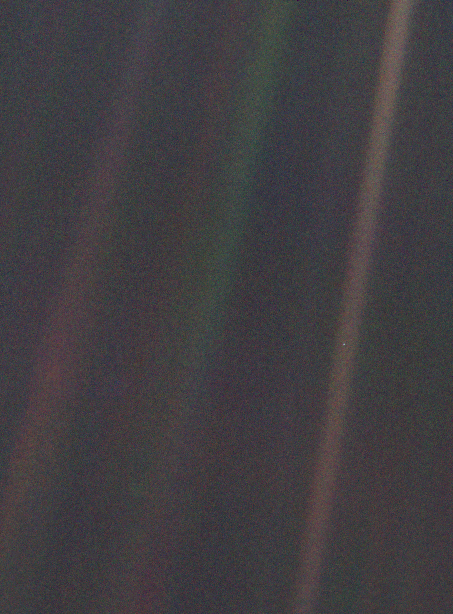
Consider that light emitted from the Sun will decay with the square of the distance – as it is irradiated in all directions. To Voyager, the Sun looks like an ordinary star – although one much brighter than the others. Not much energy can be harvested there.
Until recently, photovoltaics were useless as far away as Jupiter. Given the tech advancements, we can now use them there (and have). Farther than that and you are bumping into practical limits.
This blew my mind. Do you have a reference that talks more on this topic?
>(...) Intensity is inversely proportional to the square of the distance from the source of that physical quantity.
Shit gets dimmer at the square of the distance. So if at a distance of 1 a thing has a brightness of one, at a distance of 2 it has a brightness of 1/(2^2), or 1/4. At a distance of 8, you are looking at a brightness of 1/(8^2) or 1/64th.
Voyager 2 is ~122 AU distant. So the sun's apparent brightness would be 1/(122^2), or 1/14884, or 0.00067 % as bright as the sun as perceived at the earth-sun distance (ignoring the atmosphere of course).
EDIT: Ooops, sorry - this is Earth and not Sun :-(.
https://www.iflscience.com/space/sun-looks-like-every-planet...