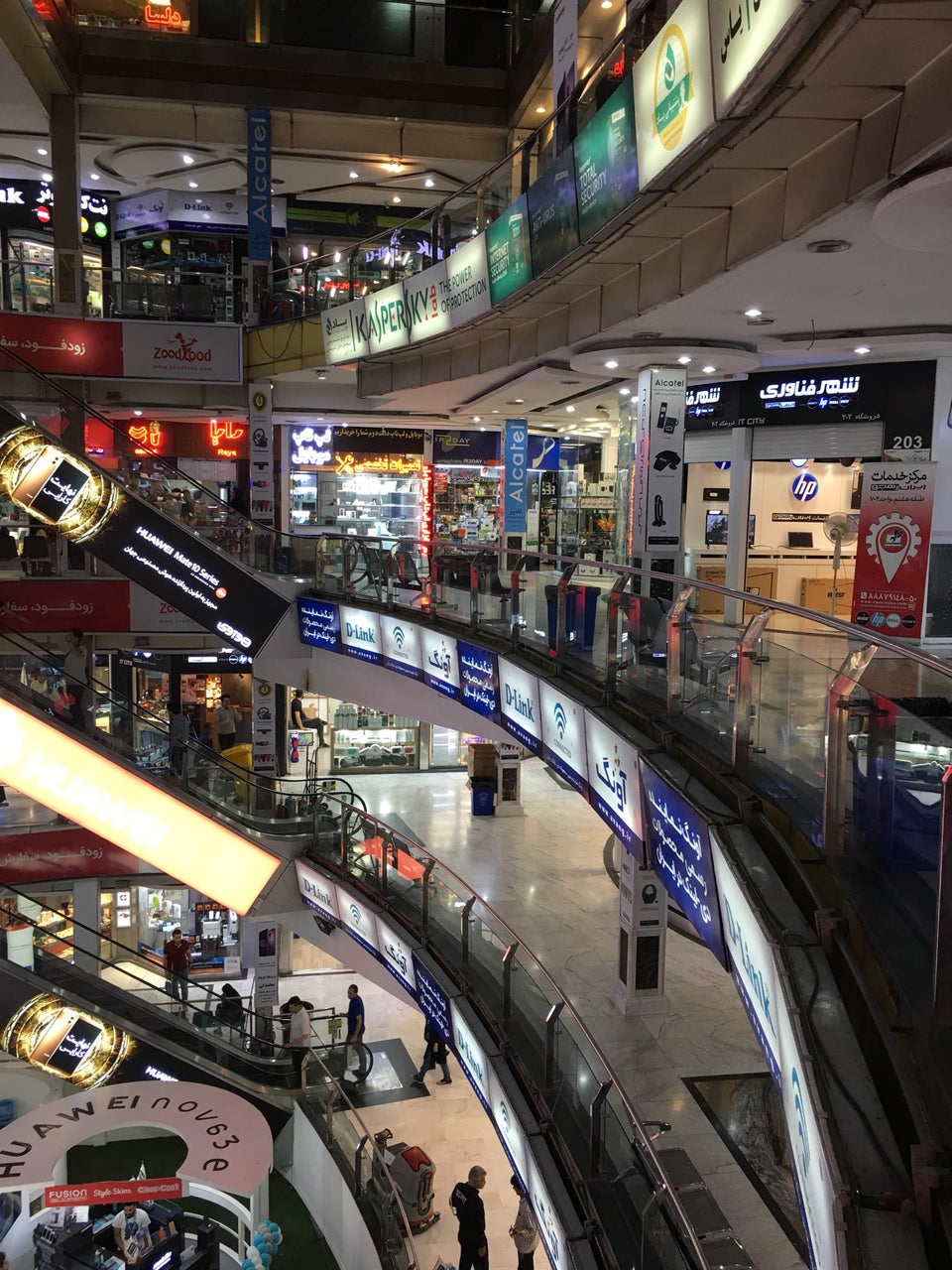
That said - 2017 was, in retrospect, a pretty easy time to visit Iran, and I wouldn't risk it now given the events of the last few months. But I very much hope to be able to go back.
I can confirm what several others here are saying - Tehran is a cosmopolitan, fascinating city, and Iranians are wonderful, on the whole. Some of the biggest surprises for me were
1) the religious and cultural pluralism on display - I saw Zoroastrian temples, synagogues, and plenty of churches (with the prominent exception of Bahá'i, who are forced to live in the shadows). Not to mention that the vast majority of Iranians I talked to about religion were on the atheist-agnostic spectrum, although they participate in religious holidays and customs in much the same way that my lapsed Catholic family did when I was growing up.
2) How much Iranians like American culture, and how connected they are to it by friends and family who live in the US. I knew this from before, of course, but it was surreal to be, say, talking to an older couple in a tiny provincial village and end up discussing their favorite taquerias in Orange County (that really happened to me). Or the kids in a mall who insisted on taking a bunch of selfies with me when they found out I was from the US.
Anyway, I found the whole trip to be extraordinary and came away from it convinced that, on the level of culture and society if not our current governments, Americans and Iranians are natural allies. I hope for a future where that can happen.
The irony here is that if you weren't American, this trip would have cost you visa-free access to America.
How did you manage that? I thought that it was required for American citizens to have a tour guide with them at all times. Did you get some sort of non-tourist visa that allowed that to happen?
Do they still operate or are they remnants of pre-revolutionary times? I don't see how they can operate in a state whose publicly stated goal is to "wipe Israel from the face of the Earth".
My cousin in Tehran introduced me to games like Counterstrike, Grim Fandango, and Battlefield, which got me into PC gaming, which got me into open source game scripting. We spent a few summers in Tehran, and there was this electronics bazaar called Paytakht[1] that I'd always beg my mom to take me to. They had everything from motherboards and CPUs to cracked versions of Photoshop to iPhone screen repairs.
Cosmopolitan Iranians are stuck in a strange situation: a majority resent the current regime for a litany of reasons (repressing religious minorities in Iran, regressive attitudes toward women, corruption, economic stagnation and inflation, the list goes on) - but they also resent the US and UK governments for denying them a chance at being a secular democracy[2]. They don't want to be the next Iraq, or the next Libya, or the next Afghanistan, either.
OTOH, because of this conflict between the people and their government, many Iranians see a country's actions as not representative of the sentiments of its people. This (plus Iran's hospitality culture) is why, despite the political tensions, Americans generally get treated very well in Iran. It's also likely why most people the author of this article interacted with treat him with an air of "I'm sorry, it's not personal." When it comes to Islamic fundamentalism in Tehran, only a vocal minority's hearts are really in it.
[1] Still exists! https://fastly.4sqi.net/img/general/width960/38765094_bQrfJd...
[2] If you want to understand US/Iran relations at all, you need to know about the 1953 coup and its after-effects: https://en.wikipedia.org/wiki/1953_Iranian_coup_d%27%C3%A9ta...
As a US passport holder with no relation to Iran or Israel, it was easy enough to visit, although you are under the watch of your state-sanctioned minder the entire time as the author eluded to. Going through immigration on arrival, I was detained for about an hour while they presumably were examining my documents, but every encounter I had with police was fairly cordial if not a bit unprofessional.
Once inside, it is indeed a vibrant place. Tehran has a booming nightlife, and outside the gaze of the religious police people were living quite freely (especially in the Armenian or jewish communities). It seems they go to great lengths to do everything as privately as possible, as to not attract the attention of the morality police, allowing them to save face. Young people were quite adamantly secular, and apologetic for their theocratic government. You definitely get the impression that citizens feel the government doesn't represent them at all.
I'm not sure I plan on returning, but I'd certainly encourage curious people to visit as there is a lot worth seeing.
US gov contributed to destabilizing the country because they wanted to keep a tight grip on oil.
This is how Iran looked in the 50s, before the coup: https://duckduckgo.com/?q=iran+in+the+50s&atb=v164-1&iax=ima...
His video about Iran is heartwarming.
Cities in the south and northwest are more pleasurable.
Take places like Shiraz, Tabriz (to name a few common examples) for example. They are something to behold! And in the north, squished between the Caspian Sea and the Alborz mountains, you will even find temperate rain forests.
Plenty of Iranians live in the US or western countries.
So maybe I should've said that I wish more Iranians could come to our country safely and easily.
The recent pushback against the regime in the days following the recent soleimani killing should have led to more support from the public in the US. Sadly, since doing so would 'align' them with Trump's anti-regime rhetoric, many people who so eagerly donned green avatars on Twitter many years ago decided to stay silent and ignore it. I don't think people in the US think of the regime and public as the same entity, but I do think that the US's public support of Iran's counter-regime forces will be fickle as long as Trump supports those forces.
Without fail, every single person that has been to Iran rates it their number one country, and the one they most want to go back to. The people are so friendly, the culture so rich, the landscape and architecture so stunning.
I absolutely can not wait to go.
[0] theroadchoseme.com/expedition-overview
[1] theroadchoseme.com/africa-expedition-overview
I also think it's important to distinguish between the government and the people. It can be easy to see them as one and the same, but that would be a mistake.
Peter Santenello opened my eyes to Iran. I couldn't believe how pro-America so many Iranians are; the culture seems so rich, and the people so pleasant.
I highly, highly, highly recommend you check out Peter's vlog series in Iran (https://www.youtube.com/user/santenello?app=desktop).
To a degree they are one and the same though. The government still requires the consent of the governed.
Only heard similar opinions, which really makes me want to visit. Three female friends of mine went together and they loved it even though there is this omnipresence of the religious police, reminding them to cover up.
The stories they told me of how friendly people are and the things that go on behind closed doors makes it sound like a fascinating place.
"House parties"? That happens to be something I hear about a lot from young Iranians that come to the US for school. My understanding is "house parties" are essentially the only time young men/women can socialize together. I also understand sometimes even alcohol will appear at house parties which again I understand to be at least taboo if not outright illegal generally.
I would like to go too. Unfortunately, I also travel frequently to the US and visiting Iran would make further trip to the US potentially problematic.
And I'm from Germany...
I don't think I would not get a visa at an embassy.
I absolutely loved it - it's a large and often beautiful country, of which I only scratched the surface. The people were without exception polite and friendly, and the food was simply amazing.
Friends that have been on expeditions there kayaking and trekking have been shot at and robbed, but but the pictures do look pretty. I did a self supported kayaking trip to the far east of turkey near Erzurum which is pretty near the border and I assume it would be pretty similar. Very friendly people, great food and scenery.
https://apnews.com/c5348f244a6b484fa3678f39a12e3ceb
I remember seeing a clip of an Iranian leader saying every journalist is a spy and if they aren't they should be because they "don't get paid enough". Gives you insight into their thinking, or what happens when you give the hyper-paranoid intelligence agency people way too much power (which the west isn't immune too).
If you're looking for ethical integrity, you should probably stop turning to spy shows for it. They are loud, dumb, and tend to be sickeningly nationalistic.
And the commissioners whole schtick is principled, conservative law-and-order...
our politicians do the same thing.
Madam Secretary [0] was propaganda for Hillary Clinton
Diary of a Future President [1] is propaganda for Michelle Obama
[0] https://en.wikipedia.org/wiki/Madam_Secretary_(TV_series) [1] https://en.wikipedia.org/wiki/Diary_of_a_Future_President
I look forward to seeing some evidence that Diary of a Future President is a cynical piece of propaganda designed to aid the fortunes of Michelle Obama, in order to restore a bit of my faith in humanity.
Do you really think russia is killing "journalists" because they are journalists or because they are spies or worse? Do you think the Saudi's killed kashoggi because he was just a "journalist" or because he was something else? Every major news/media organization in the world ( west, east, south , north ) are tied to the state. Whether you talk about the NYTimes or BBC or Xinhua or RT or Al Jazeera or [fill in the blank], they are all state organizations.
Of course this doesn't mean all journalists are spies. Most are just mindless grunts working for a paycheck like everyone else. But the journalists who are sent to iran, china, russia, etc are more likely than not tied to the state in one way or another.
It's also why these organizations are so dysfunctional. All of these machinations stand in direct contrast to the principles of effective management. Transparency, alignment of incentives, pooling of resources, cross-training expertise, and clear communication are all impossible to achieve in that kind of environment.
The difference between Tony Soprano and Jeff Bezos is that if you stab Tony Soprano in the back, you have a pretty good shot at becoming Tony Soprano. Same story holds true for authoritarian regimes. In democracies, the mandate to rule comes from popular approval. Simply conspiring to depose the ruler is not a viable path to power. Yet in Iran, China or Russia there's nothing to stop this besides fear and paranoia in the regime.
In a healthy org, it'd be nuts to have two divisions working at cross-purposes against each other. Yet in mafias, we see this kind of behavior all the time. For example, Hitler was notorious for giving different generals contradictory orders. Clearly it has some adaptive utility within that context.
As a detainee/possible hostage, he's in the category of a guest who is not free to leave, and not a prisoner who has been convicted of a crime.
It's very important in Persian culture to treat guests well, better than your own family members if possible.
What he describes, being put in a decent hotel, having his expenses covered, and being free to explore the city in a sort of mandatory extended vacation, is characteristic of Persian culture. I'm pretty sure he is aware of the protocol and thus was never too concerned for himself.
Or, perhaps, he knows his own feelings better than random commentators on the Internet?
The data also seems to suggest that antisemitism is more prevalent in Iran than in a lot of other countries: https://mpra.ub.uni-muenchen.de/90093/1/MPRA_paper_90093.pdf
A final analysis then shows the extent of Antisemitism in different countries of the world, ranked by denominational groups, and based on the World Values Survey data. While in our 28 countries with complete data Protestants in Uruguay, Canada, and Argentina and Roman Catholic regular Sunday Mass Church attenders in Argentina, Canada and the United States are the major denominational communities with the lowest global rates of Antisemitism, Muslims in India, Iran and Iraq are the most antisemitic religious groupings of the world.
Briefly, the anger felt by Iranians is due to their support for their fellow Muslims, the Palestinians, and their extreme mistreatment at the hands of the Israeli government. Note this support even though Iranians are Shia and Palestinians are Sunni.
To answer b.) both Israel and Saudi Arabia view Iran and an enemy due to a regional power struggle, where Iran stands in opposition to both. The promotion of Iran as Public Enemy #1 in the ME says more about maximalist Zionist power projection, and Natanyahu's lust for power than anything else. For example, Iran was abiding by the JCPOA, as verified by IAEA inspectors, while Natanyahu was inciting action against Iran, as rapproachment was not in his interests. The canard here is that Natanyahu was claiming Iran was trying to make nuclear weapons and that was unacceptable, despite the fact that Israel already has a well-known but never publicly acknowledged nuclear arsenal, and are famously not a part of the Treaty on the Non-Proliferation of Nuclear Weapons. Even with nuclear weapons it is ridiculous to think that the Iranians do not understand the concept of Mutually Assured Destruction vis a vis Israel.
Yes, we see how angry they are when the extreme mistreatment of Syrian Sunnis or Chinese Uighur. Ah, wait, they even take part in the former. They do a fine job of making it appear the real issue is religious.
"For example, Iran was abiding by the JCPOA, as verified by IAEA inspectors,"
JCPOA and UNSC 2231 included far more than IAEA inspections, and Iran was NOT abiding by the other issues (ballistic missiles, heavy water, keeping a spare set of nuclear tubes for Arak, etc.).
People mostly repeat IAEA because they are unaware of the other issues, or that the deal had time limits on most inspection issues. Some are aware but prefer to elide it.
"The canard here is that Natanyahu was claiming Iran was trying to make nuclear weapons and that was unacceptable, despite the fact that Israel already has a well-known but never publicly acknowledged nuclear arsenal"
Israel isn't threatening to destroy Iran, it's the other way around.
"Even with nuclear weapons it is ridiculous to think that the Iranians do not understand the concept of Mutually Assured Destruction vis a vis Israel."
Some Iranian don't[0]. If you want to entrust the safety of the world to that, well...
[0] https://www.memri.org/reports/former-iranian-president-rafsa...