At the risk of potentially misunderstanding what you meant, there's a yawning chasm between "freedom to die from COVID-19 because public health orders are affronts to liberty" and "extra-judicially kidnapped by one's own government."
I'd much rather live in Sweden or Germany, where people have sufficient trust in their government and a massive social safety net to catch employees who have to be out of work for health reasons--ANY health reasons, but COVID specifically in this instance--and we're able to trust that our fellow residents will act reasonably without forcing others back to work, than in America where the least-powerful and least-well-off of us have the cover of unemployment payments ripped away because some flag-wrapped know-betters demand Golden Corral reopen for buffet service after getting a haircut.
I'm a bit hesitant to compare to either of them because I can't read the local news. That being said, didn't Sweden go with a lockdown-lite policy?
The Sweedes do have the freedom to die from COVID-19 because public health orders are affronts to their liberty.
EDIT And the lockdowns are threatening something like 265 million people experiencing famine [0]. "flag-wrapped know-betters demand Golden Corral reopen for buffet service" is trivialising a serious thing here; the economy isn't a nice-to-have. It is the major generator of all the prosperity that exists in the world. It is too complicated for me to understand causes and effects, but if it doesn't start back up again ASAP the hurt will get worse.
[0] https://www.theguardian.com/global-development/2020/apr/21/c...
Locally, I see city and county governments taking a tack of making slightly differing decisions regarding what to open and keep closed. For example, my city is keeping parks and playgrounds closed; the county is doing the opposite? Why? each other's data shows the historical use trends and such data plays a large part in making reasonable, responsible descisions.
BTW, I'm in Georgia (US state); while the national media makes it out like we're backwoods country idiots, our local governments are very effective in making reasonable choices. Plus the vast marjority of folks are wearing masks and self-distancing. Most people aren't stupid. They only want the freedom to start their lives back up, plus not depend on the state and national governments for their very survival.
I don't think demand will immediately return to 100%, but I think quite a few people are itching to get out and spend money and enjoy life. Maybe not in some areas, but most of the country is probably ready to go.
Not to mention that they've been heavily criticized for mishandling the lockdown.
Sweden never closed down, and Germany is in the midst of reopening. As to the safety net—there is no evidence that safety net has made a difference. (I’m part, I suspect, because the Us already has a comprehensive safety net for the elderly population that is mainly affected by COVID-19). The death rate in the US, per 100,000 people, is well below that of Sweden. It’s also far lower than the death rate in countries with well developed safety nets like France and Italy.
I strongly suspect that people in Germany/Sweden, etc., have more trust in their government because the people themselves are simply less far apart. To pick a controversial but illustrative example: in Germany the outside limit on abortions is 12 weeks—shorter than in any US state. (Excepting a few “heartbeat law” states where the laws have not yet taken effect.) But within that period, abortions are generally available. No such compromise is possible in America. The right is currently focused on ending abortion entirely, while the left is trying to extend abortions into the third trimester (which are pretty much unprecedented in Europe). Or take taxes. Many in the right want to dismantle the existing tax system. But on the left, they treat lowering corporate taxes to the same level as Sweden or Germany (and France and Canada, etc.) not merely as bad policy, but as an affront to morality and decency.
The same is true for COVID-19. In every European country, there is a grown up debate about balancing health and safety with the need to reopen the economy. The American left, meanwhile, has condemned even the idea of such balancing as racist, classist, colonialism, what have you. The left greeted travel bans—which countries from Germany to New Zealand to Denmark have imposed to great effect—as manifest racism and xenophobia. They’re not talking about reopening, as Europe is already doing, but sheltering in place through the rest of 2020. The right, meanwhile, is shouting “give me liberty or give me death.” There is no trust because everybody is crazy, and everybody hates each other, and we should give up being one country and disband the union already.
You seem to forget that in France & Germany, people go to the Netherlands or Spain for abortions after 12 weeks. It’s not a « compromise », it’s just a 1970s law that hasn’t been changed because conservative groups are annoying.
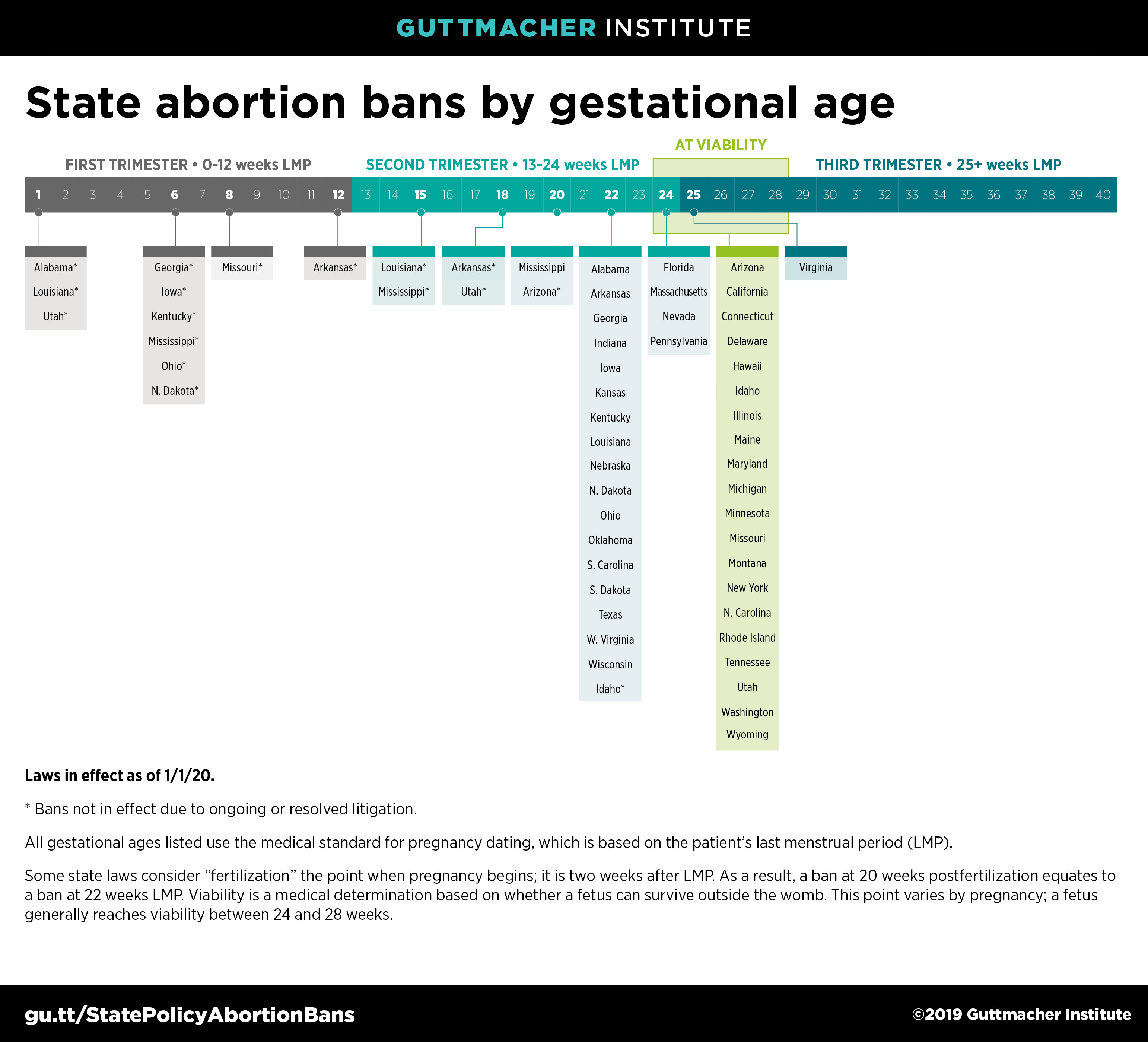
For the European audience: the shortest abortion period that is currently in effect in the US is Mississippi’s at 20 weeks: https://www.guttmacher.org/sites/default/files/922-3.jpg. Shorter ones have been proposed but have been stayed pending litigation. Most of the deep south is close to the Netherlands line at 22 weeks. Most of the blue states limit up to viability, which can be up to 28 weeks. 7 states have no limit whatsoever. (Note that I’m not taking a position in what’s right; I’m just describing how various countries have addressed a divisive issue.)
As to “conservative groups” being annoying—that makes it sound like something the majority agrees with but they just haven’t gotten around to updating the law. In fact, the dominant party in both France and Germany has opposed lengthening the current periods. The woman Angela Merkel hand-picked to be her successor as leader of the CDU is against abortion entirely, like many in the CDU. Merkel has maintained the status quo precisely as a compromise between her party and the more liberal parties in Germany.
That seems like a mighty big next step and one that many of "not-so-friendly" countries would want the US to take.
So... in the UK we have the Daily Briefings about covid. Each time I listen to it I hear politicians (they take it in turns) to come out and give us a fucking performance, projecting their voice, projecting (they think) 'calm' and 'competent' and 'in charge of it all' while they spew words for 15 or 20 minutes which could have been given in 5 at the most.
Then it's time for questions from journalists. Which get answered if convenient or if inconvenient they'll answer a question that wasn't asked, all the fucking while spinning to make themselves look like they've not made a series of serious mistakes.
And each time I hear it my confidence in their competence drops further.
And they've no idea why. They don't seem to understand respect is earned.
The only reason politicians are deferring to experts is they've realised experts are actually useful whereas before they didn't like them (something about the time for experts is over, something like that, can anyone recall?)
Conversely you haven't touched on the fact that the buggers are constantly spinning, deferring blame for not getting enough PPE, plain deceit about the number of tests done etc.
The UK has not done well. That was avoidable. If you defend that, you let the responsible ones off the hook and they will do it again.
The politicians aren't deferring to experts with evidence. They are setting up the experts to be the fallguys for their political missteps.
"We were just following the science" is their excuse when held to account for poorly executed political actions.
I recommend talking to some people instead of parroting the pictures you see in the news.
In addition, for the most part, folks in the US want to return to work. The vast majority find pride and comfort in work, even if they bitch about. They know eventually the payouts will come back out of their pocket.
The mixed signals from the CDC and governmental agencies add to the confusion (everything is fine/stay inside until a vaccine is available, don't wear masks/cover up you face once you step outside, etc.) only add to the feeling the government really dosn't have a clue.
I can go to a superstore which is deemed essential because it sells groceries and buy all sorts of items that specialty stores aren't able to sell me because they're closed. any member of the public can enter these superstores with no screening whatsoever. The small business owners would screen customers much more effectively than a large store would.
It's almost like we've taken steps that are arbitrary in nature and aren't actually scientifically valid because we don't have enough data on this virus and how it actually spreads. these arbitrary measures are then doubled down upon by the local governments in the name of preserving their authority and looking good to the press.
what really bugs me is the level of certainty that people seem to have about this. I'm coming from a position of uncertainty. Anyone being honest right now is doing the same.
Look at your comment: you are absolutely certain that a dubious at best chance of economic survival for small businesses is being traded against a certain chance of a public health crisis. I don't think you're being honest with yourself with a level of certainty like that. You're just like the rest of us flying blind, but you are just positive that you are right and that businesses should be closed to support your preconceived notions.
It's real easy to do that when you have a job that allows you to work remotely. It's not costing you anything just let those Walmart shopping losers go out and deal with the unemployment system. In the meantime a percentage of all of our tax dollars goes to paying off interest on the national debt and that percentage is going to have to increase as a result of this.
I'm not a moron or a science denier. I'm fine with taking on debt to the degree necessary to maximize public health. But there are multiple dimensions to public health not just this virus. My brother's business is in jeopardy and it was growing fast before this pandemic hit. Now I'm deeply concerned that he's going to fall back to an addiction that he beat 10 years ago. That's a tiny story that represents something that's going to happen in this country when young people who would otherwise be unaffected by the virus or going to suffer economic calamity.
By the way my brother always voted Democratic. Due to the false partisan positioning of opening versus reopening pushed by the media, he is now never going to vote Democrat again and plans to vote for Trump in November. He voted for Clinton last time think about that.
In the meantime people on keyboards who were going to vote for Biden anyway are now pushing policies that are going to hand this election to Trump. Maybe the elderly will carry Biden since many appear to be switching their votes. But when they're dead in a few years the young people who have lost their businesses will still be voting. It's not going to go well.
- Slowed the spread of the virus, so it won't overwhelm the capacity of a nation's healthcare system
- Build up testing and tracing capacity to track future spread.
In the US, the SIP orders are an overwhelming success on the first point, and cases are slowly starting to drop off.
On the second point, the US is still far, far behind on testing. For a nation the size of the US, there needs to be something on the order of 2 million tests per day, compared to the the current capacity of roughly 300,000. I cannot overstate how important this testing failure is; without it, businesses will be closed for longer, more jobs will be lost permanently, and the citizens get frustrated that they're stuck at home without any income.
If there was adequate testing capacity, businesses could reopen with precautions, and the government could sustainably offer benefits to those testing positive so they can afford to stay home and not spread the virus any further. If there isn't adequate testing capacity, even with precautions, future waves are more likely, and any of those waves can overwhelm the healthcare system.
The entire rust belt became a cesspool of opiate and heroin addicts and no one cared when companies moved manufacturing offshore. No one cared that healthcare is tied to jobs.
I've talked to a lot of people who said yea I need to work, but I don't WANT to work, I have to. And that is not a failure of the lockdown. it is a failure of this very nation to take care of its own so that the rich can get richer.
Is this really necessary? It's a very inaccurate, and hurtful thing to say.
The cognitive dissonance comes about because it's not very American to expect or ask for help. Even though we're mainly in this position because the government itself mismanaged economic policy for decades, resulting in us being collectively overleveraged.
There seems to be a myth going around that Europe is handling this better than the US and the statistics don't really support that claim. If you have to bash Golden Corral to make your claim, you're probably a bit biased against Americans.
That being said, none of these countries are handling this well, it's just annoying to see the double standard.
Or not, depending on country.
https://ourworldindata.org/grapher/total-daily-covid-deaths-...
https://ourworldindata.org/grapher/total-daily-covid-deaths-...
https://ourworldindata.org/grapher/total-daily-covid-deaths-...
Norway and Sweden are in other measures very similar countries. We lie right next to each other, we have quite similar political environment etc. Our societies are in general quite similar. We had a very different response to the corona virus though.
I'm completely aware that there are different countries in Europe that have different strategies for containing this thing. But so do the states in the US.
[1] https://91-divoc.com/pages/covid-visualization/?chart=states...
Infections are inherently locally clustered. There seem to be all sorts of factors affecting spread, and there's no clear picture of what they are. Eastern Europe isn't very heavily affected and nobody seems to know why. Belgium is a disaster; why?
The UK made a number of big mistakes; the first cases were appearing at the end of February, but the Cheltenham Festival still went ahead in mid-March putting 250,000 people close to each other. We're now relaxing the lockdown and putting people back on packed public transport despite still having thousands of new cases per day.
In a month's time, the best handling countries will be almost entirely out of lockdown with weekly COVID deaths below 10. The worst handling countries will still have lockdown and weekly deaths in the hundreds. It looks like that will include the UK and New York state.
Sweden is handling it, not great but not terrible and so is the US and many other countries.
On top of that there is a lot that we don't understand, for example why do many Mediterranean countries has low death rate even though the sick count is not low ?
Wisconsin (pop 5.8 mil, 10.6k cases, 418 deaths). Sweden (pop 10.2 mil, 27.9k cases, 3460 deaths).
Do you mind showing your work? What do the statistics say about Europe vs. US? I see you mentioned Sweden and Germany but Europe has many more countries than those two.
Sort by deaths/1M. You’ll see the US doing better than UK, France, Belgium, Spain, Italy, etc.
And in absolute terms, there’s still more cases and deaths in Europe as a whole (I find it funny that when it comes to GDP, we like to think of Europe as “United States of Europe”, but when talking about corona deaths, not so much).
But the same lies about "the US is doing worse" are told here in Europe as well. Just need to look to the stats, do the sum, and suddenly the US and EU are about the same.
Oh well, modern journalism is about clicks, not facts, unfortunately.
https://www.startribune.com/even-during-the-pandemic-in-swed...
It is a shame that we (Americans) stand for this - the right for a parent to under-educate or mis-educate their children. If one allows for homeschool, there should be robust oversight, which in most states, there isn't.
I bumped into a few of them at a community college after I got out of the military. The USMC indoc'd me hard with the groupthink, and that took a while to get past, but I could at least do high school Trig and had basic history. I remember one girl who didn't believe the Holy Roman Empire existed and despite her extensively Christian background, didn't know a damn thing about the Crusades.